The History of Analog-Digital (Ana-Digi) Watches
An ana-digi watch puts real hands and a small LCD on the same dial. The idea grew out of the quartz and liquid-crystal boom of the 1970s, and it never went away. Casio is still releasing new analog-digital G-Shock models in November 2026, according to early reports, and Breitling and Omega both kept the format alive in their pilot and space watches.
This guide covers the terminology, how the format works, the competing claims about who was first, the 1980s peak, the professional branch, and G-Shock's long ana-digi run. It also makes one clear point about this month's news: the new G-Shock 2500 series is analog only, so it is not an ana-digi watch.
I label every claim in words. Documented means a maker, museum or official page says it. Reported means several secondary sources agree but We found no maker confirmation. Uncertain means sources conflict or the claim comes from a seller. All prices are in US dollars.
At a glance
| Detail | Summary |
|---|---|
| Format | Quartz watch with analog hands and an LCD in one module |
| Earliest candidates | Omega Chrono-Quartz (1976, reported), Citizen Digi-Ana (1978, documented for Japan), Seiko H127 (1979, reported) |
| Peak | The 1980s, led by Citizen and Seiko, with Casio close behind |
| Professional landmarks | Breitling Aerospace (1985), Citizen Aqualand (1985), Omega Speedmaster X-33 (1998) |
| G-Shock milestones | AW-500 (1989), GA-100 and GA-110 (2010), GA-2100 (2019) |
| Not ana-digi | G-Shock GMC-2500 and GAC-2500 (October 2026): analog only |
What ana-digi means and how the format works
Ana-digi is short for analog-digital. The watch has real hands that turn on a dial, plus one or more LCD windows for numbers or text. Spellings vary: ana-digi, anadigi, analog-digital, analogue-digital. Casio's current US site uses "analog-digital" and notes the "ana-digi" nickname. Citizen used both word orders in its own names: Digi-Ana in 1978 and Ana-Digi Temp a few years later, where Temp stands for temperature.
"Ani-Digi" turns up in some write-ups, but We could not trace it to an official Casio product name, so treat it as an informal spelling (uncertain). We also found no official Seiko name for its H-series hybrids. A fair test is simple: if the hands are physical and the LCD is separate, it counts. An LCD that only draws pretend hands does not, and neither does an analog watch with a small date window.
The mechanism is one quartz crystal vibrating 32,768 times per second, divided down to one pulse a second. A stepper motor turns the hands through a small gear train. A microchip counts the pulses and drives the LCD segments, the calendar, and extra functions such as alarm, world time and chronograph. The module must keep hands and display in step, and some modules re-set the hands after a shock or battery change. The hard parts are power draw and fitting everything in without hands blocking the screen.
Who was first? The competing claims
There is no single answer. Here are the contenders, with evidence labels.
Omega Chrono-Quartz "Albatros" (1976). Analog hands for time, LCD for the chronograph, caliber 1611, launched around the Montreal Olympics. Prototypes existed in 1975 and Wikipedia gives a run of about 15,000. Auction houses and dealers call it the first hybrid or ana-digi chronograph, though some listings date it 1977. Evidence: reported, with seller language. Heuer Manhattan GMT (1977). One wiki calls it the first chronograph with an added analogue indication. Evidence: uncertain, single source. Heuer's own Chronosplit of 1975 was fully digital.
Citizen Digi-Ana (1978). Citizen's own design site calls it the first domestically produced combination watch in Japan, and Citizen's history page reportedly cites more than one million sold. Fratello and Ocarat go further and say "world's first". Evidence: documented for Japan, uncertain for the world. Seiko H127 (1979). Collector forums and dealers call it Seiko's first digital-analog model, produced to 1982. Seiko's own archive pages We found did not confirm it. Evidence: reported.
Citizen Ana-Digi Temp. Fratello says 1980. Two Broke Watch Snobs says 1981, with development spending in 1980. Other sources say 1982. Evidence: dates conflict, so I use "around 1980 to 1982".
My reading: if "first" means hands plus LCD in a quartz watch, the Omega predates Citizen by two years, but it was a limited chronograph. Citizen's 1978 model was the mass-market start. Both can be true.
The 1980s peak: Citizen, Seiko and Casio
The Ana-Digi Temp shows why the format took off. It used Citizen caliber 8980 (reported) and offered dual time with an analog hand for the second zone, a digital readout, a calendar, alarm, stopwatch and a thermometer. The thermometer came with a caveat: reviewers note it only reads accurately off the wrist. Citizen leaned hard on function count.
Seiko built a wide H-series of ana-digi chronograph and alarm watches. The best known is the H558 of 1982, sold as a 150 m diver and nicknamed "Arnie" after the actor who wore it on screen (dating and nickname reported by dealers and enthusiast sites). Seiko's 2019 solar reissue, the SNJ025, reportedly retailed for about $520. For the wider story of why this electronics race happened, see our Seiko quartz revolution guide and the Zenith quartz crisis piece.
Casio's early hybrids are harder to pin down. Collector lists place models such as the AA-81 and AX-250 around 1980, and the AA-81 is described as using analogue-style hands drawn on the LCD, so it may not meet the physical-hands test (uncertain). Casio's first real-hands G-Shock came later, in 1989. Timex's 1980s sports hit, the Ironman of 1986, was digital only. We found no verified Timex ana-digi milestone from this decade, so I leave it out. You can read more on our Timex page.
Swiss pilot watches: Breitling Aerospace and Emergency
The Breitling Aerospace arrived in 1985 as a quartz pilot's chronograph with two LCD windows and two hands. The photo below shows a later titanium Aerospace Avantage with a blue dial, an LCD window above 6 o'clock, one below 12 o'clock, and a rotating bezel. The first reference was 80360 and the dial read Navitimer, since it began inside that range. It used a Breitling B56 quartz movement based on the ETA 988.332, and Ocarat adds that the crown alone controls every function. Fratello says the B56 era ran to 1995.
The line kept evolving, and in 2024 Breitling released the Aerospace B70 Orbiter. See our Breitling Aerospace history for the full run.
In 1995 Breitling added the Emergency, a watch with a built-in 121.5 MHz distress beacon. Wikipedia lists its display as hybrid analogue and digital. Around 40,000 were reportedly sold between 1995 and 2010, and the later Emergency II added a 406 MHz frequency. Heuer took a different road. Its Chronosplit of 1975 was digital, and TAG Heuer's archive says its own digital movements soon became uncompetitive, pointing to a combined analog and digital module also used by Breitling (reported). Browse vintage Heuer for that era, and the main Breitling hub.

Space and tool watches: Omega X-33, Citizen Aqualand, Casio Pro Trek
The Omega Speedmaster X-33 is the best-known ana-digi space watch. The photo shows an early titanium X-33 on a wrist, with luminous hands, a large grey LCD field and a rotating bezel with pushers on both sides. Omega sent prototypes to NASA in 1995, and the production reference 3290.50 was released on March 25, 1998 (reported). The second generation is the one NASA reportedly kept using. The 2014 Skywalker, built on requests from ESA astronaut Jean-Francois Clervoy, was reportedly never NASA-qualified. Sources disagree on whether it is still made. See the Speedmaster hub for the main line.
Citizen's Promaster Aqualand of 1985, reference C0023, put hands on the dial and an LCD at the top that switched to depth underwater, down to 80 m, with dive logging and alarms (Monochrome). Sources split on the original reference and exact year, and Citizen's "Promaster" name became a catch-all for its tool watches in 1989 (reported). A 40th anniversary edition limited to 5,800 pieces was priced at $595.
Casio's Pro Trek began in 1995 with the DPX-500 and its triple sensor. Casio's own timelines name both the PRG-50 and the PRG-60 as the first analog-movement Pro Trek in 2003, so We would not rely on either (uncertain). We could not verify a Casio Edifice ana-digi milestone, so it is left out.

G-Shock's analog-digital era: from AW-500 to GA-100
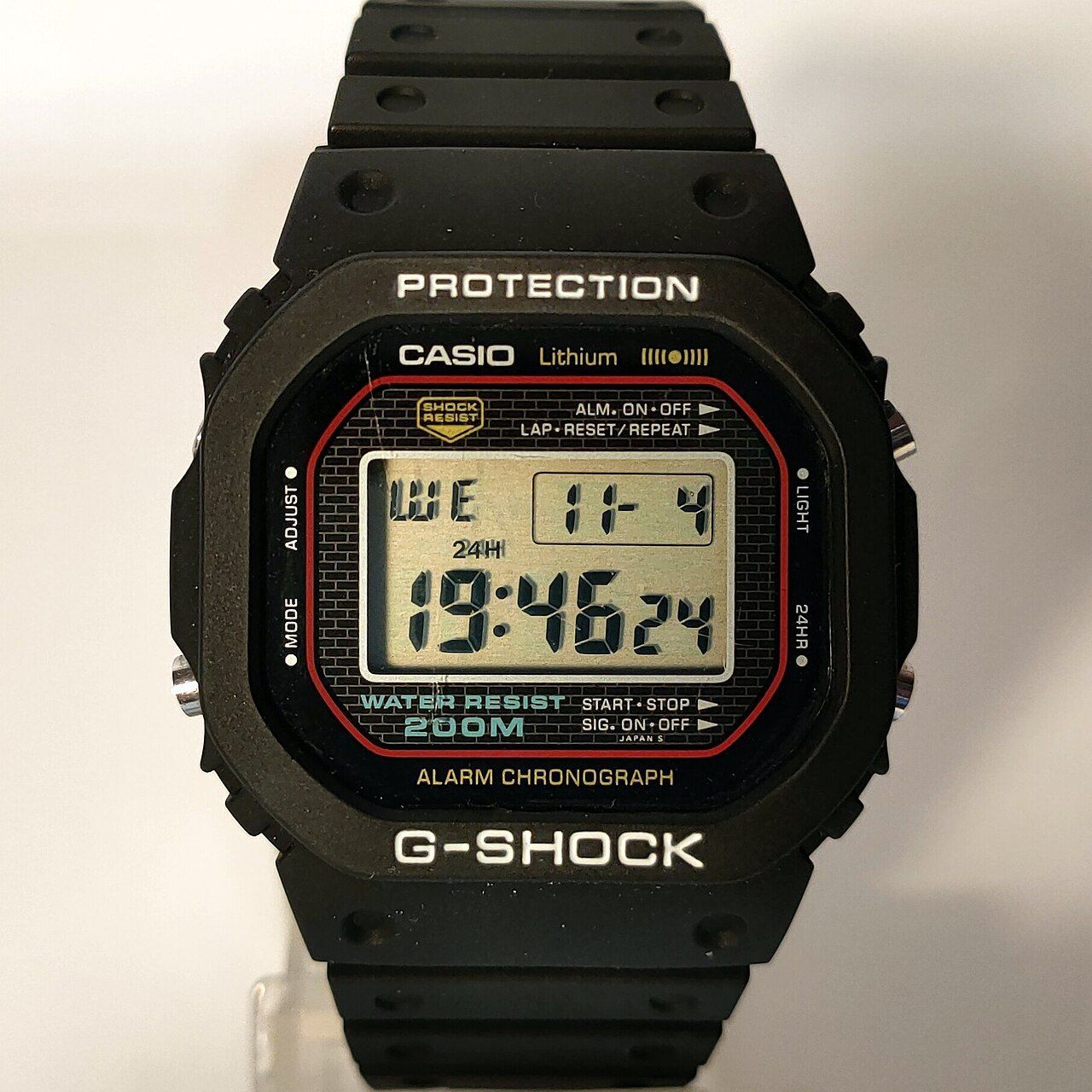
The first G-Shock, the 1983 DW-5000C, was digital only. Casio's own G-Shock site and G-Central both describe the AW-500 of 1989 as the first analog-digital G-Shock (documented). One timeline gives 1985, which conflicts with Casio's page, so I use 1989. The AW-500 has dual time, an alarm, a stopwatch and 200 m water resistance. G-Central says the original series was not released in the US. Casio revived it in 2020 as the resin AW-500E and the metal AWM-500.
The step that made ana-digi a G-Shock staple came in 2010. The GA-110 launched in March 2010 as a bigger analog-digital model, and the GA-100 shown here dates to the same year. The photo shows a black GA-100 with red accents, analog hands over three round sub-dials, two LCD windows and "G-Shock Protection" lettering on the bezel. Casio's own ranking, quoted by G-Central, placed the GA-110 as its best seller by 2019 and the GA-100 second (reported). Read the G-Shock history for the original digital line and the 5600 series.

GA-2100, CasiOak and the new GM-S2110 starry-sky models
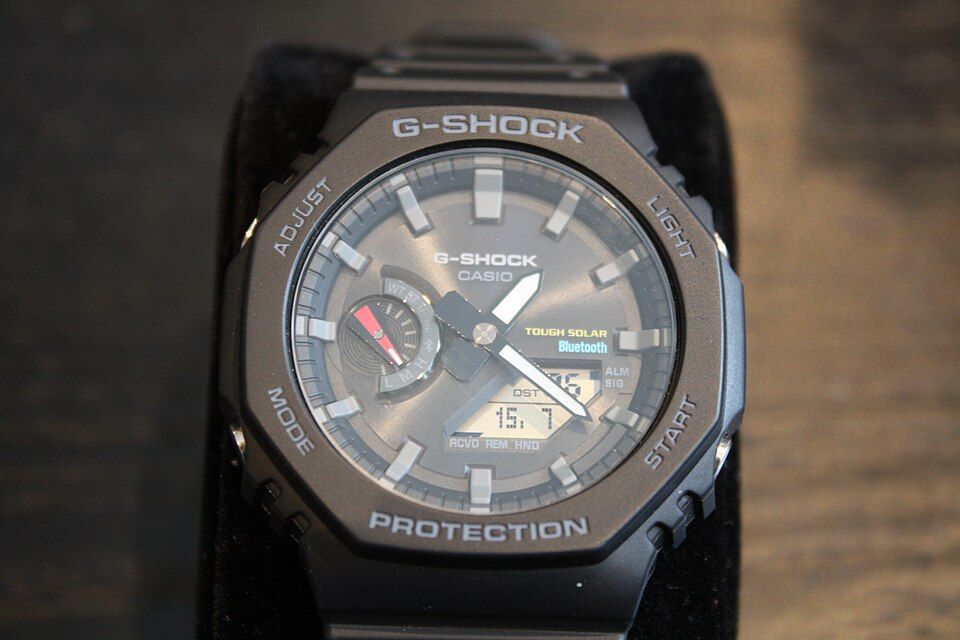
The GA-2100 arrived in 2019 as a slim octagonal analog-digital G-Shock. Its octagonal bezel earned the nickname CasiOak, after the Audemars Piguet Royal Oak. Sources describe it as an instant hit, and G-Central lists the 2100 series as one of four main standard G-Shock families alongside the 5600, 6900 and 110. The photo shows the metal-bezel GM-2100 relative, with a silver octagonal bezel, black dial, white-lit hands and a small LCD window at lower left. Our GA-2100 history covers the full story.
This month's ana-digi news is the GM-S2110 family. ARY News reported on November 3, 2026 that Casio had introduced the starry-sky GM-S2110NS-1A and GM-S2110NS-8A, with a textured diamond-pattern dial, an octagonal steel bezel, 48 cities of time settings, a timer, a stopwatch and several alarms, with 200 m water resistance. It said availability had reached Europe and Japan, with no US release announced. We could not confirm the NS references on Casio's own site, so this is a single-source report. An earlier 2025 starry-sky pair used the SH suffix, so check the reference before buying.

The G-Shock 2500 series is analog only, not ana-digi
Casio announced the GMC-2500 and GAC-2500 on October 22, 2026. Casio says they bring the functional beauty of the 1983 original, the DW-5000C, into a fully analog design. That phrase matters. Casio calls them fully analog and mentions no LCD. The three-cell Multi-Mission Date window at 3 o'clock shows the date, stopwatch minutes and settings, and a small seconds hand at 9 o'clock can stop to save power. We found no source describing that window as an LCD, so I class the series as analog, not analog-digital.
G-Central reports nine models: four resin GAC-2500, three steel-covered GMC-2500, and two GMC-2500D on steel bracelets. G-Central's hands-on notes the nickname CasioNaut, and reported US prices run from $145 for the GAC to $350 for the GMC-2500D. Release timing varies by report: Casio's page gives no on-sale date, and some outlets say Japan sales begin in November. Our news report on the 2500 series and MRG-D5000 has the details.
The contrast is useful. Casio now sells the same octagonal design language two ways: ana-digi in the 2100 and GM-S2110 families, and pure analog in the 2500 series.
Timeline: key ana-digi watches
Dates are as given by the sources above. Where sources conflict, the table says so.
| Year | Watch | Maker | Why it matters |
|---|---|---|---|
| 1973 | 6-digit LCD watch | Seiko | Digital only, but its LCD became the base for later hybrids (documented) |
| 1976 | Chrono-Quartz Albatros | Omega | Hands plus LCD chronograph, caliber 1611, early hybrid claim (reported) |
| 1977 | Manhattan GMT | Heuer | Claimed first chronograph with added analogue indication (uncertain) |
| 1978 | Digi-Ana | Citizen | First domestically produced combination watch in Japan (documented) |
| 1979 | H127 | Seiko | Seiko's early digital-analog model (reported) |
| c. 1980 to 1982 | Ana-Digi Temp | Citizen | Two analog time displays, thermometer; dates conflict |
| 1982 | H558 "Arnie" | Seiko | 150 m ana-digi diver (reported) |
| 1985 | Aerospace | Breitling | Swiss quartz pilot watch with two LCD windows (documented) |
| 1985 | Promaster Aqualand C0023 | Citizen | Hands plus LCD depth gauge (reported) |
| 1989 | AW-500 | Casio G-Shock | First analog-digital G-Shock (documented) |
| 1995 | Emergency | Breitling | 121.5 MHz distress beacon in a hybrid-display watch (reported) |
| 1998 | Speedmaster X-33 | Omega | Space-flight ana-digi, released March 25 (reported) |
| 2010 | GA-100 and GA-110 | Casio G-Shock | Large ana-digi G-Shocks; GA-110 a best seller by 2019 (reported) |
| 2019 | GA-2100 | Casio G-Shock | Slim octagonal CasiOak ana-digi (reported) |
| 2026 | GM-S2110NS | Casio G-Shock | Starry-sky ana-digi models (single-source report) |
| 2026 | GMC-2500 and GAC-2500 | Casio G-Shock | Analog only, not ana-digi (documented) |
Why ana-digi persists, and where it sits against smartwatches
Three practical reasons keep ana-digi alive. Hands are still the fastest way to read the time at a glance. A small LCD adds precise numbers, such as a second time zone, a stopwatch or a depth reading, without crowding the dial. And the hybrid look is distinct from both a plain analog watch and a plain digital one.
Against a smartwatch, the trade is simple. An ana-digi watch gives you a fixed set of tools and no app store. In return the G-Central spec page for the AW-500 lists a CR2016 battery rated at about seven years, and the GM-S2110 reports include 200 m water resistance. Most smartwatches need regular charging. That is my view of the market, not a lab test.
Tissot's 1999 T-Touch used touch zones on the crystal and added a weather forecast, compass and thermometer (Ocarat). Whether the format is thriving or niche depends on the source. Ocarat calls it a niche outside its 1980s heyday, while Casio's steady stream of new ana-digi G-Shocks suggests the format is healthy at the affordable end.
A collector's guide: what to look for
Identify the real model. Many late-century chronographs from Longines, TAG Heuer, Certina, Tissot and others share the ETA 251.265 movement, so the dial alone may not tell you the maker (Ocarat). Match the module number, case back and reference, and treat any "first ever" in a listing as marketing until you can verify it. The Omega Chrono-Quartz, for example, appears dated both 1976 and 1977.
Check the LCD and hands. Look for a clear, even display with every segment working, no dark patches and no fading. Confirm the hands line up with the digital time and can be reset. Replacement modules for 40-year-old watches can be hard to find.
Treat water resistance as unproven. Ocarat advises checking the battery and water resistance, especially on vintage dive models like the Seiko H558 and Citizen Aqualand. Old gaskets age even when the watch looks perfect. Ask for a pressure test before you swim in one.
Consider a reissue. If you want something to wear daily, reissues exist. The Seiko SNJ025 came in 2019 at a reported price of about $520, Casio revived the AW-500 in 2020, and Citizen's Aqualand 40th anniversary edition was priced at $595. For vintage, pay for condition and documentation, not for a "first" claim.
Sources
- Fratello, ana-digi explainer: fratellowatches.com
- Ocarat, Ana-Digi Watches: ocarat.com
- Citizen design site, Digi-Ana 1978: citizenwatch-global.com
- Two Broke Watch Snobs, Ana-Digi Temp: twobrokewatchsnobs.com
- Seiko Museum, 1973 LCD watch: museum.seiko.co.jp
- Seiko H127 collector thread: thewatchsite.com
- Wikipedia, Omega Chrono-Quartz: wikipedia.org
- TAG Heuer, digital era: tagheuer.com; Grail Watch wiki: grail-watch.com
- Wikipedia, Breitling Aerospace: wikipedia.org
- Wikipedia, Breitling Emergency: wikipedia.org
- Fratello, Speedmaster X-33: fratellowatches.com
- Monochrome, Aqualand: monochrome-watches.com; WatchTime, Aqualand 40th: watchtime.com
- G-Central, AW-500: g-central.com; Casio, AW-500: gshock.casio.com
- G-Central, GA-110: g-central.com; GA-2100: g-central.com
- Casio, Pro Trek history: casio.com
- ARY News, GM-S2110NS (November 3, 2026): arynews.tv
- Casio, GMC-2500 and GAC-2500 release (October 22, 2026): casio.com
- Casio US, analog-digital watches: casio.com
- Images: Wikimedia Commons (AKS.9955, Chris Gaunt, Pittigrilli, ArildV), licences in captions.
Frequently Asked Questions
What is an ana-digi watch?
An ana-digi watch combines physical hands on a dial with one or more LCD windows in the same quartz module. The hands show the time at a glance, while the LCD adds numbers for functions such as a second time zone, alarm, chronograph or thermometer.
What was the first analog-digital watch?
Sources conflict. Omega's 1976 Chrono-Quartz is reported as an early hybrid, Citizen's 1978 Digi-Ana is documented as Japan's first combination watch, and Seiko's H127 is reported as 1979. Calling any one of them the world's first depends on how you define the term.
What does Ana-Digi Temp mean?
It is the name of a Citizen hybrid watch from around 1980 to 1982, with Temp standing for temperature. It combined analog hands with LCD readouts, a calendar, alarm, stopwatch and a thermometer. The temperature reading is only accurate off the wrist, and sources disagree on the launch year.
When did G-Shock first become analog-digital?
Casio's own G-Shock site and G-Central describe the AW-500 of 1989 as the first analog-digital G-Shock, six years after the digital original in 1983. The GA-110 and GA-100 followed in 2010 and made the format a G-Shock staple, and the GA-2100 CasiOak arrived in 2019.
Is the G-Shock 2500 series ana-digi?
No. Casio describes the GMC-2500 and GAC-2500 as fully analog watches, and its announcement mentions no LCD. They have a three-cell Multi-Mission Date window at 3 o'clock, but We found no source calling it an LCD. The ana-digi G-Shocks in the current range are the 2100 and GM-S2110 families.
How does an ana-digi watch work?
A quartz crystal sends regular pulses to a microchip. The chip drives a stepper motor that moves the hands, and it also runs the LCD segments and extra functions. Because both displays share one timekeeping source, they stay in step.
Are vintage ana-digi watches worth collecting?
They can be, if you value condition and documentation over "first" claims. Check the LCD for fading, confirm the hands sync with the display, and treat water resistance as unproven on old gaskets. Modern reissues, such as the Seiko SNJ025 or Casio AW-500E, are an easier way to wear the look daily.
Is the Breitling Aerospace still made?
Breitling has produced the Aerospace in some form for decades, starting with the 1985 original. Recent releases include the 2022 Red Arrows edition and the 2024 B70 Orbiter. Check Breitling's current catalog for what is on sale today, since sources describe several generations and the lineup changes.
Related Reading