
Breitling Aerospace: SuperQuartz Multifunctional Instrument Since 1985

Zach Charles • July 19, 2026

Share this article

Breitling Aerospace: The Serious Case for Quartz

There is an argument, rarely made and more rarely accepted among watch enthusiasts, that the most serious instrument in the Breitling catalogue is not the B01-equipped Navitimer, not the COSC-certified Chronomat, and not the rattrapante Duograph. It is a quartz watch. A titanium-cased, analogue-and-digital, thermocompensated-oscillator professional instrument that has been the choice of working pilots and aerospace professionals since 1985, and that sits apart from every other Breitling in both philosophy and function.

The Aerospace was born from a genuine recognition of what professional aviation demands — and from the willingness to follow that recognition wherever it led, even if the destination was a quartz movement. Understanding the Aerospace means understanding why, for certain classes of professional user, the question "mechanical or quartz?" has a clear and unambiguous answer.


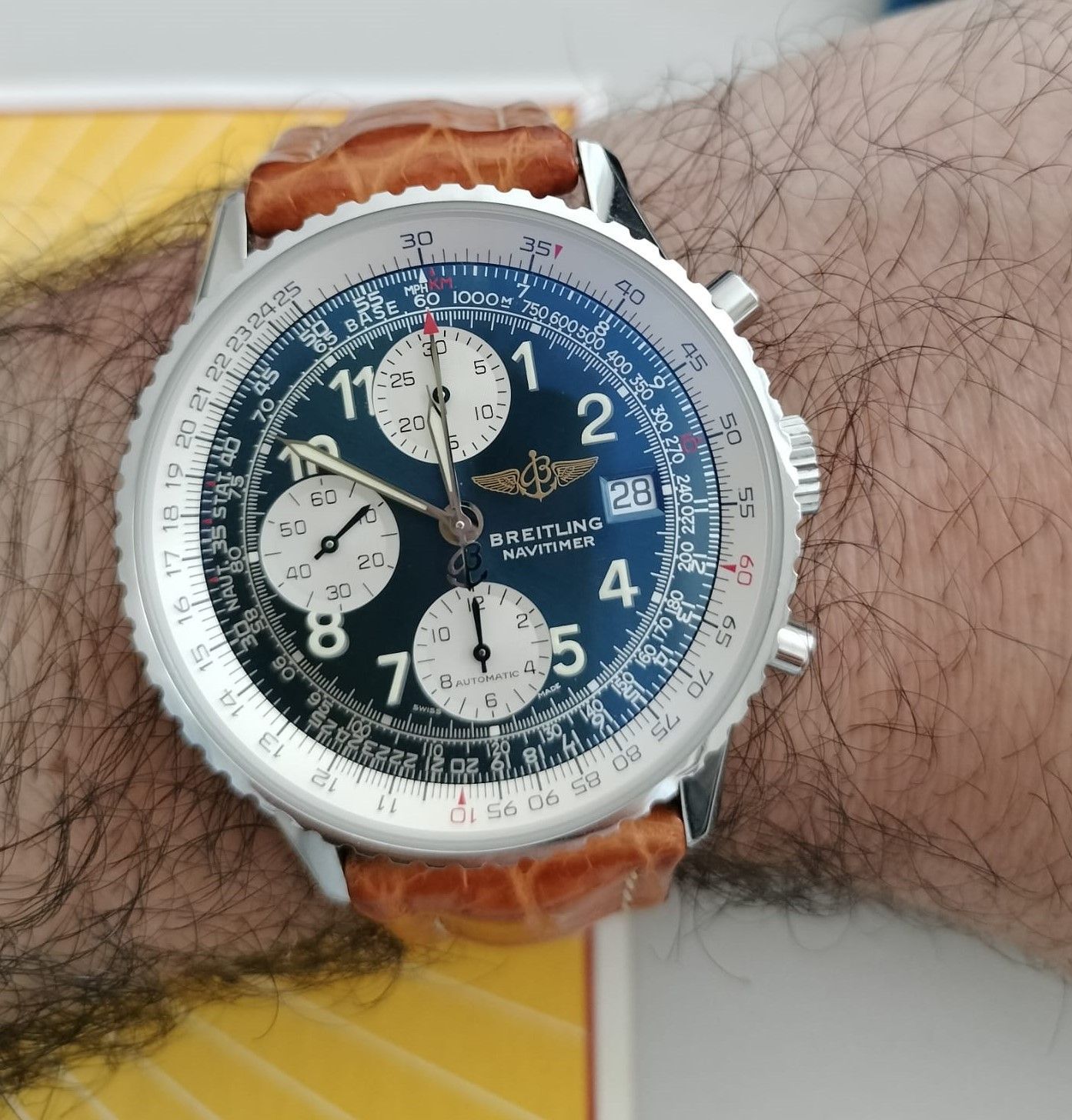
Breitling Old Navitimer ref. A13322 — early 2000s
A Breitling Old Navitimer ref. A13322 from the early 2000s — the circular slide rule bezel, a defining Navitimer feature since 1952, allows pilots to perform airspeed, fuel consumption, and distance calculations without a separate computer.
Photo: EMore98 — CC BY-SA 4.0 — Wikimedia Commons
1985 — A Different Kind of Professional Instrument

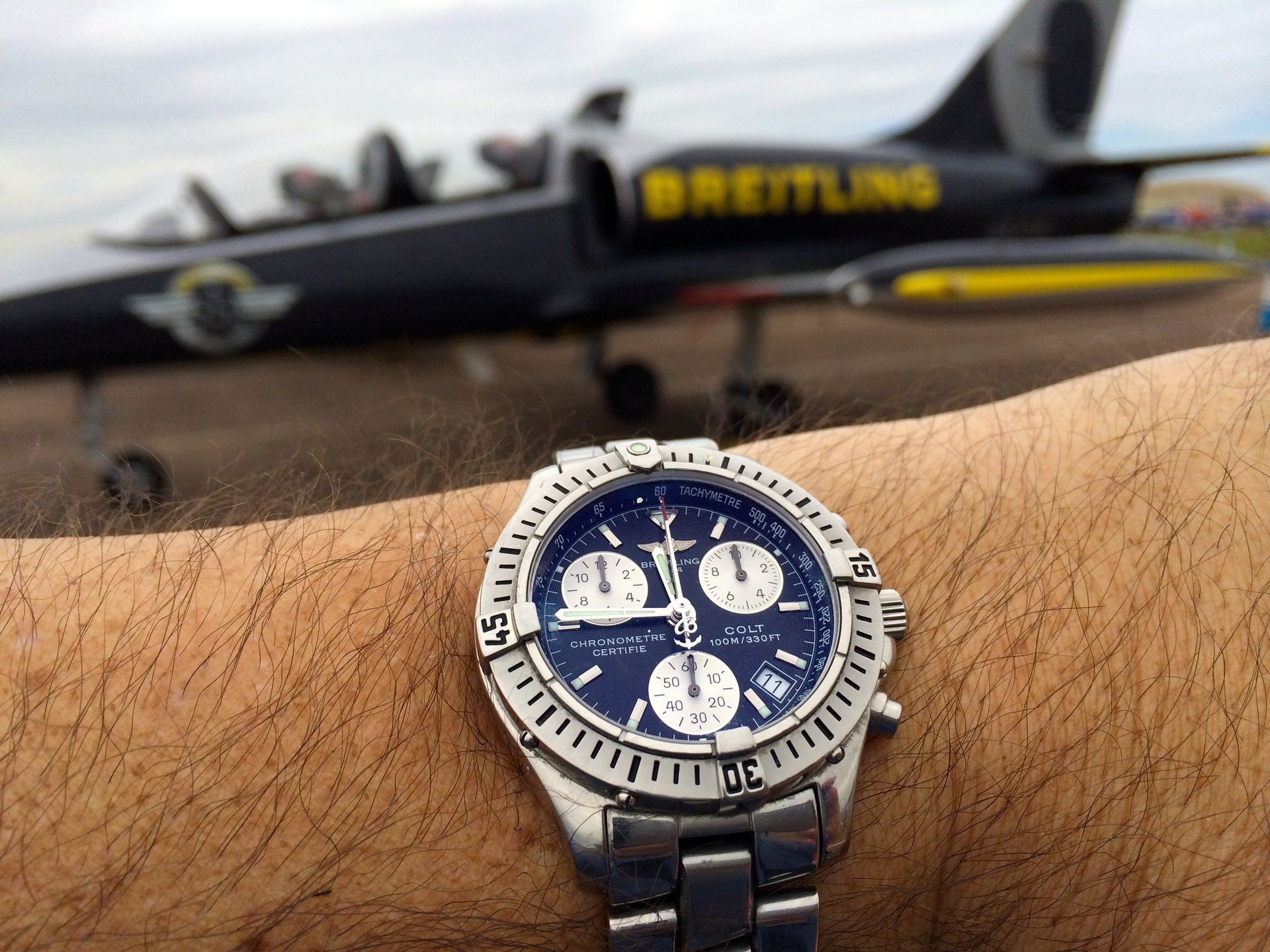
Breitling Colt — sport three-hand watch
A Breitling Colt — Breitling’s entry-level sport three-hand watch with a unidirectional rotating bezel and 300m water resistance. The Colt name references military aviation and anchors Breitling’s affordable professional range below the Superocean and Avenger.
Photo: Phil Guest — CC BY-SA 2.0 — Wikimedia Commons

The year 1985 placed the Aerospace in immediate and instructive contrast with its brand stablemate. Just one year earlier, Breitling had launched the revived Chronomat — the watch that would rescue the brand, reclaim its aviation-instrument identity, and become the flagship mechanical chronograph of the modern era. The Chronomat was assertive, robust, unmistakably mechanical. It made a statement about the enduring value of Swiss mechanical watchmaking precisely when that value needed reaffirming.

The Aerospace made a different statement entirely. Where the Chronomat was mechanical and emphatic, the Aerospace was electronic and precise. Where the Chronomat's dial was organised around the traditional chronograph architecture, the Aerospace combined an analogue display for primary timekeeping with a digital window for secondary functions. Where the Chronomat's case was steel, the Aerospace's was titanium — lighter, slimmer, subtly different in colour and finish, and critically important for professional applications where non-magnetic materials are a genuine requirement rather than a marketing claim.

The movement — Breitling's Calibre 55, later superseded by updated variants — was what Breitling calls SuperQuartz: a thermocompensated quartz oscillator delivering accuracy approximately ten times better than a standard quartz movement. Accessible functions through the digital display included a second time zone, chronograph, countdown timer, and alarm. The case measured 43mm, worn lightly due to titanium's reduced mass. The overall impression was of an instrument made to be used, hard, by people with no tolerance for inaccuracy or complication.


SuperQuartz — Why Temperature Matters to a Crystal

Breitling Old Navitimer ref. A13322 — early 2000s
A Breitling Old Navitimer ref. A13322 from the early 2000s — the circular slide rule bezel, a defining Navitimer feature since 1952, allows pilots to perform airspeed, fuel consumption, and distance calculations without a separate computer.
Photo: EMore98 — CC BY-SA 4.0 — Wikimedia Commons

A standard quartz oscillator works by applying a controlled electrical signal to a quartz crystal, which vibrates at a precise frequency — typically 32,768 vibrations per second in wristwatch applications. In theory, the constancy of the crystal's resonant frequency makes quartz movements far more accurate than mechanical oscillators. In practice, quartz crystals are not perfectly immune to environmental influence: temperature affects the resonant frequency, and as temperature rises and falls, the frequency shifts and so does the apparent rate of the movement.

For a standard quartz watch worn through a cold morning commute and an air-conditioned office — a temperature span of perhaps 20°C — accumulated error from these temperature-induced frequency shifts can amount to 15–30 seconds per month. Still substantially better than most mechanical movements, but not negligible for professional aviation applications.

Thermocompensation addresses this directly. The movement incorporates a temperature sensor that continuously monitors ambient temperature. A compensation algorithm calculates the frequency error introduced by the current temperature and applies a correction to the oscillator's output. The result is a movement that maintains its rated accuracy regardless of temperature excursions across normal wearing environments.

Breitling's SuperQuartz implementation achieves accuracy of approximately ±15 seconds per year. Allow that figure to settle: fifteen seconds per year. The COSC standard for mechanical chronographs permits -4/+6 seconds per day — the Aerospace, in a year, may err by less than the Navitimer's B01 might err in three days. For professional aviation — where time accuracy is directly relevant to navigation, communication, and coordination — this is not a trivial difference. It is a decisive one.

Breitling recognised the achievement was genuine enough to warrant third-party validation and submitted the calibre to COSC for certification. The COSC-certified SuperQuartz in the Aerospace is therefore among the most independently validated timing instruments ever placed in a wristwatch.


The Professional User — Who Actually Wears an Aerospace

Breitling Aeromarine Shark ref. A13051 — mid-1990s
A Breitling Aeromarine Shark ref. A13051 from the mid-1990s — a 200m water-resistant diver’s chronograph from the Aeromarine line, predecessor to the Superocean and Avenger Seawolf. The orange accents and ceramic bezel insert mark it as a professional dive tool.
Photo: EMore98 — CC BY-SA 4.0 — Wikimedia Commons
Military pilots, and in particular fast-jet and helicopter pilots, operate in electromagnetic environments that place unusual demands on personal equipment. Avionics systems generate significant magnetic fields. Some mechanical watch movements — those using steel components in the balance wheel and lever — can be affected by these fields. A titanium-cased watch with a quartz movement has no such vulnerability. The case is inherently non-magnetic; the movement has no susceptible ferromagnetic components. The Aerospace is simply more reliable in the cockpit environment than most mechanical peers.

Commercial airline crew face a related consideration: some commercial aviation regulatory frameworks have historically imposed restrictions on timepieces permitted in cockpits, motivated by concerns about magnetic interference. A SuperQuartz instrument with documented and validated accuracy is easier to clear through such regulatory review than a mechanical chronograph, however fine.

Beyond aviation professionals, the Aerospace appeals to expeditionary scientists, military personnel in electromagnetically complex environments, engineers, and the substantial category of buyers who simply want the most accurate wristwatch available and are indifferent to the romantic appeal of mechanical oscillators.


Case, Display, and the Dual-Register Dial

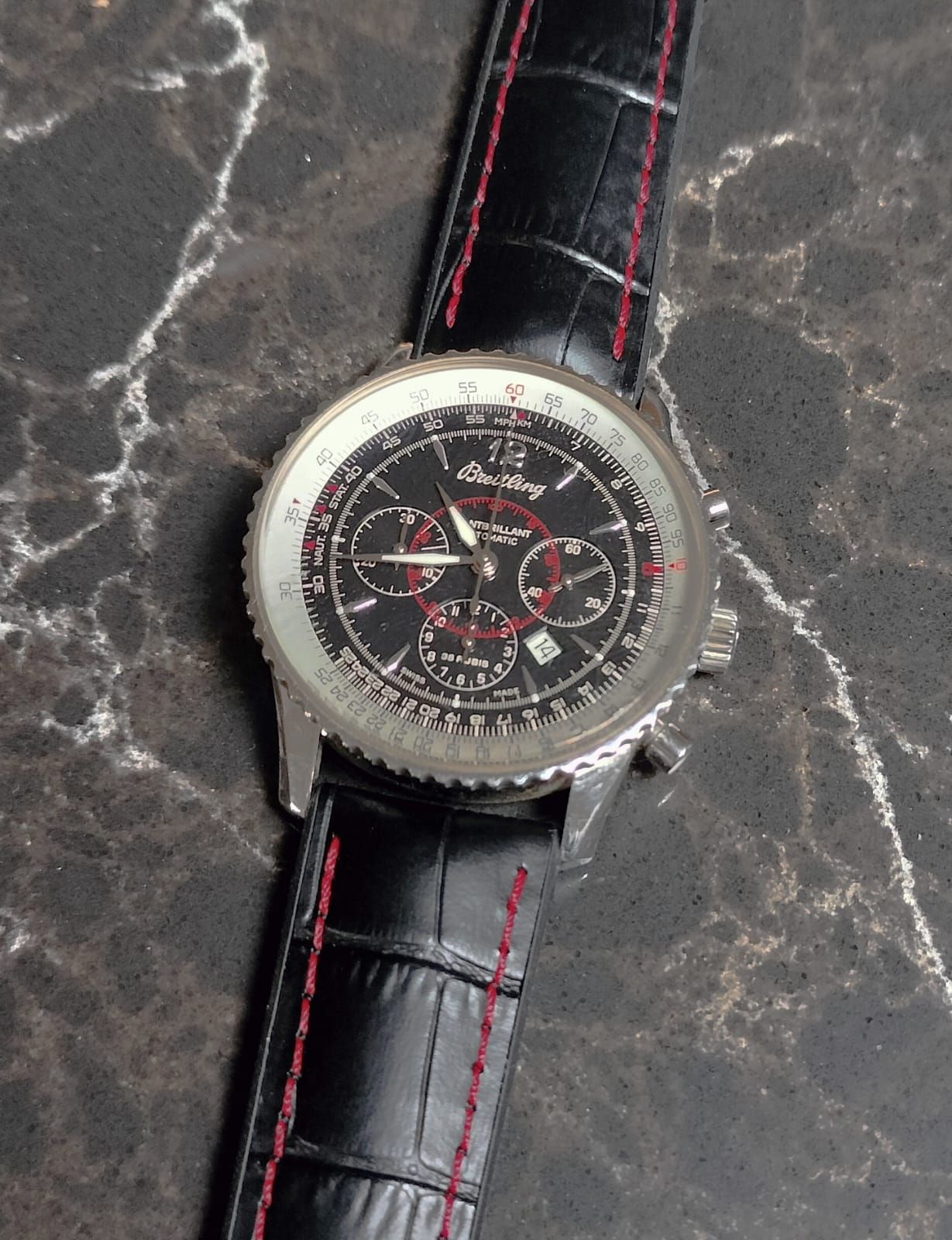
Breitling Montbrilliant — mid-2000s
A Breitling Montbrilliant from the mid-2000s — a 38mm round-case chronograph with circular slide rule, representing the more elegant end of the Breitling catalogue. The Montbrilliant references Breitling’s address at Rue Montbrilliant in Geneva and the original 1915 chronograph push-piece design.
Photo: Clyde94 — CC BY-SA 4.0 — Wikimedia Commons

The Aerospace's visual identity is organised around its dual-register display — a feature that sets it apart from virtually every other watch in Breitling's catalogue.

The main analogue display occupies the full dial face conventionally: central hands indicating hours and minutes, a seconds hand completing the primary timekeeping display. Below the twelve o'clock position, a rectangular digital window provides access to secondary functions: second time zone, chronograph elapsed time, countdown timer readings, alarm settings. Navigation through these functions is accomplished via the crown and pushers.

The result is a dial immediately legible for its primary function — reading the time — while providing access to professional-grade additional capabilities without cluttering the analogue display. The ergonomics are not those of casual user interaction: the Aerospace rewards familiarity and practice. Airline crew who wear the watch daily develop fluent facility with its operations. The watch was not designed to be immediately intuitive to any random wearer. It was designed to be perfectly reliable in the hands of a trained professional.

The 43mm titanium case provides approximately 40% weight reduction compared to an equivalent steel construction — genuinely significant over a twelve-hour duty cycle. The matte finish typical of titanium gives the Aerospace a working-instrument appearance quite distinct from the polished and brushed finishing combinations on steel chronographs.


Four Decades of Evolution

Breitling Colt — sport three-hand watch
A Breitling Colt — Breitling’s entry-level sport three-hand watch with a unidirectional rotating bezel and 300m water resistance. The Colt name references military aviation and anchors Breitling’s affordable professional range below the Superocean and Avenger.
Photo: Phil Guest — CC BY-SA 2.0 — Wikimedia Commons
Original references (1985–c. 2004) : The essential template — titanium case, dual analogue/digital display, SuperQuartz movement, professional function set. Movement architecture reflects mid-1980s integrated circuit technology: entirely capable, representing an earlier generation of electronic miniaturisation. Now among the most sought-after by collectors.

Aerospace Evolution (c. 2004) : Updated case and dial that refreshed the watch's appearance for changing aesthetic expectations. Fundamental architecture unchanged.

Aerospace Avenger : Extended the concept into the Avenger sub-family's design language — a larger 45mm case, more pronounced lugs and bezel, aimed at buyers who wanted the Aerospace's functional intelligence in a more aggressive presentation.

Aerospace EVO Night Mission : Black ceramic coating on the case with a black dial — obvious appeal for military users for whom reflectivity is a practical concern. The black case and dial combination makes the digital display particularly legible by contrast.

Current Aerospace Evo (43mm titanium) : Maintains the essential proposition of the 1985 original with decades of refinement in movement accuracy, case finishing, and dial legibility. Available in multiple dial configurations — blue, black, grey — and priced approximately $3,000–$5,000 depending on configuration.


The Paradox That Is Not a Paradox

The Aerospace presents what appears to be a contradiction: a quartz watch from a brand whose identity is built on mechanical chronographs and Swiss horological heritage. The resolution lies in what Breitling has always actually been, beneath the romantic surface: a maker of professional instruments.

The Navitimer was not created to celebrate mechanical complexity. It was created because aeronautical navigators needed to compute flight plans on their wrists, and a mechanical watch with a circular slide rule was the most effective available solution to that problem in 1952. The Aerospace exists because, in 1985, professional aviation demanded time accuracy, electromagnetic reliability, and multi-function utility that could not be delivered by any mechanical movement at any price. SuperQuartz was not a compromise. It was the correct answer to the actual question.

By applying for and receiving COSC certification for the SuperQuartz calibre, Breitling made this argument explicitly: not that quartz is better than mechanical, but that the relevant standard of excellence for a professional instrument is accuracy and reliability — and that on those terms, the Aerospace exceeds what any mechanical watch can offer.


Collector Appeal

Within the Breitling collector community, the Aerospace occupies a genuinely unusual position. It is not sought after for the reasons that drive most Breitling collecting: vintage Navitimers prized for reference evolution, early Chronomat references valued for their connection to the brand's revival. The Aerospace is sought after precisely because it is different from all of these things.

Vintage examples from 1985 to 2000 have accumulated a dedicated following: the slim titanium case that was genuinely unusual in mainstream professional watches at the time, the dual analogue/digital display unlike any other Breitling, the professional heritage that is documented rather than mythologised. The movement's quartz nature — often a handicap in collector valuation — is here integral to the watch's identity and purpose. A well-preserved early Aerospace is a genuinely interesting object: purposeful, historically significant, technically serious, and visually distinctive in a way that owes nothing to nostalgia for mechanical watchmaking.


Frequently Asked Questions

Is the Aerospace accurate? What does SuperQuartz mean?
SuperQuartz refers to Breitling's thermocompensated quartz movement — a calibre with a temperature sensor and compensation circuit that corrects the crystal oscillator's frequency for temperature-induced variation. The result is accuracy of approximately ±15 seconds per year, compared to the -4/+6 seconds per day permitted by COSC for mechanical chronographs. The SuperQuartz movements are themselves COSC-certified to standards appropriate for electronic oscillators.

Is the Aerospace a mechanical watch?
No. The Aerospace uses a thermocompensated quartz calibre — no mainspring, no balance wheel, no escapement. This is not a design compromise but a deliberate choice made to meet the accuracy and electromagnetic reliability requirements of professional aviation.

Why would a pilot prefer quartz to mechanical?
Three decisive advantages for professional aviation: first, accuracy — SuperQuartz is approximately 10x more accurate than a mechanical movement; second, electromagnetic reliability — quartz movements are not susceptible to magnetic field interference from avionics in the way that mechanical movements with ferromagnetic components can be; third, multi-function utility — the digital display provides second time zone, chronograph, countdown, and alarm in a single instrument without the complexity of an equivalent multi-complication mechanical movement.

Are vintage Aerospace references collectible?
Increasingly so. Early references from 1985 through the late 1990s have a dedicated following among collectors who value their titanium cases (unusual for the period), the analogue/digital dual-register display unlike any other Breitling, and documented professional heritage. Collectors who appreciate the Aerospace's departure from mechanical orthodoxy have recognised it as a genuinely interesting object.


Related Articles

Recent Posts

By Zach Charles • October 10, 2026
Hamilton's American Classic Cushion Mechanical revives its 1926 Art Deco cushion watches, seen in Oppenheimer, in 30mm and 34mm with the new hand-wound…
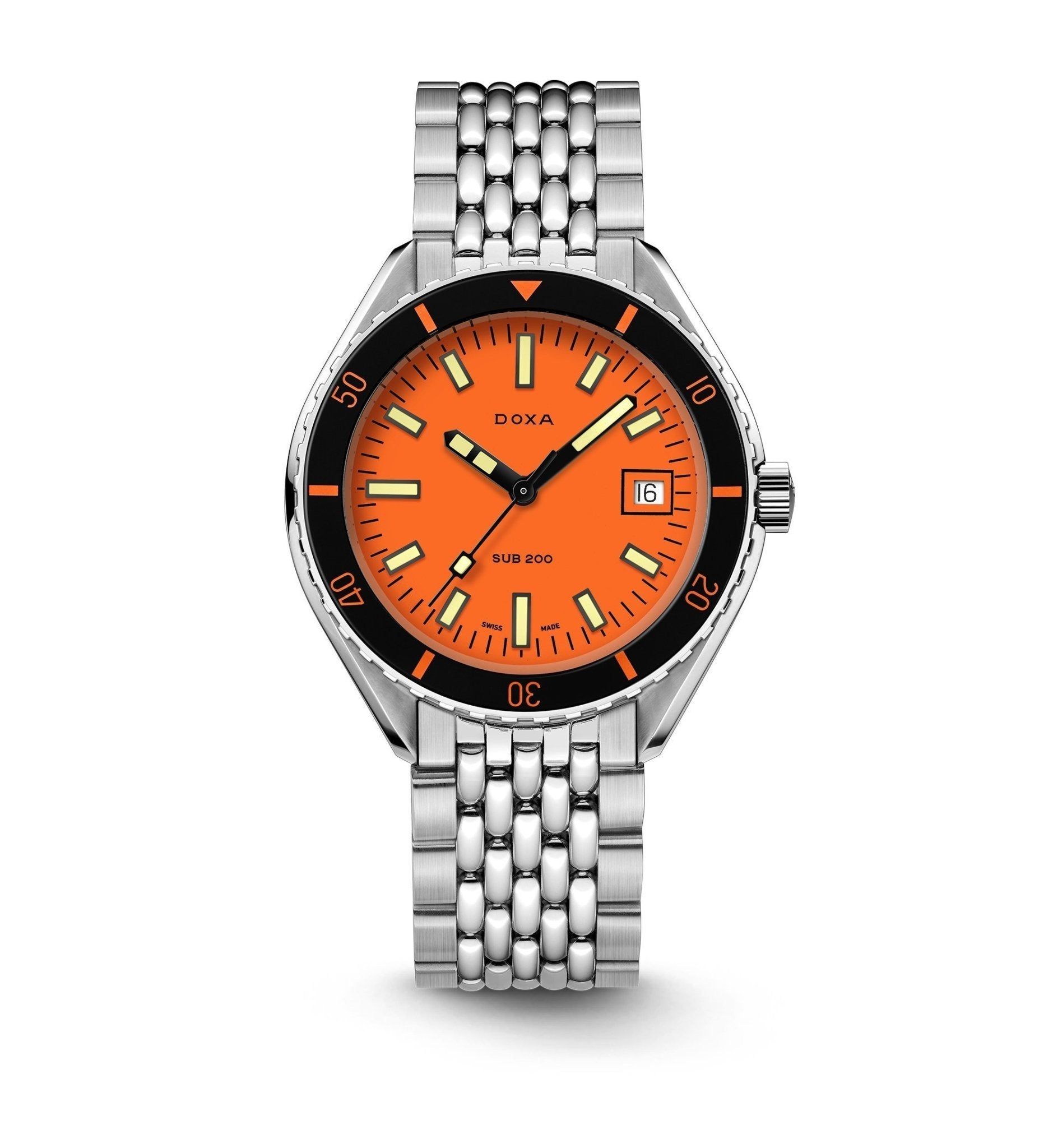
Doxa SUB 200: The Accessible Everyday Diver
By Zach Charles • October 10, 2026
Complete guide to the Doxa SUB 200 — 42mm, 200m, four colorways, Sellita SW200-1. The accessible entry to the Doxa SUB family with the full…

By Zach Charles • October 10, 2026
The Breitling Top Time B01 Aston Martin DB5 pairs a cushion-shaped 41mm case, a wooden inner ring and the in-house Caliber 01 across three limited…
By Zach Charles • October 10, 2026
TAG Heuer developed the Mikrograph (2011, 1/100th second), Mikrotimer Flying 1000 (2011, 1/1000th second), and Mikrogirder (2012, 1/2000th second).
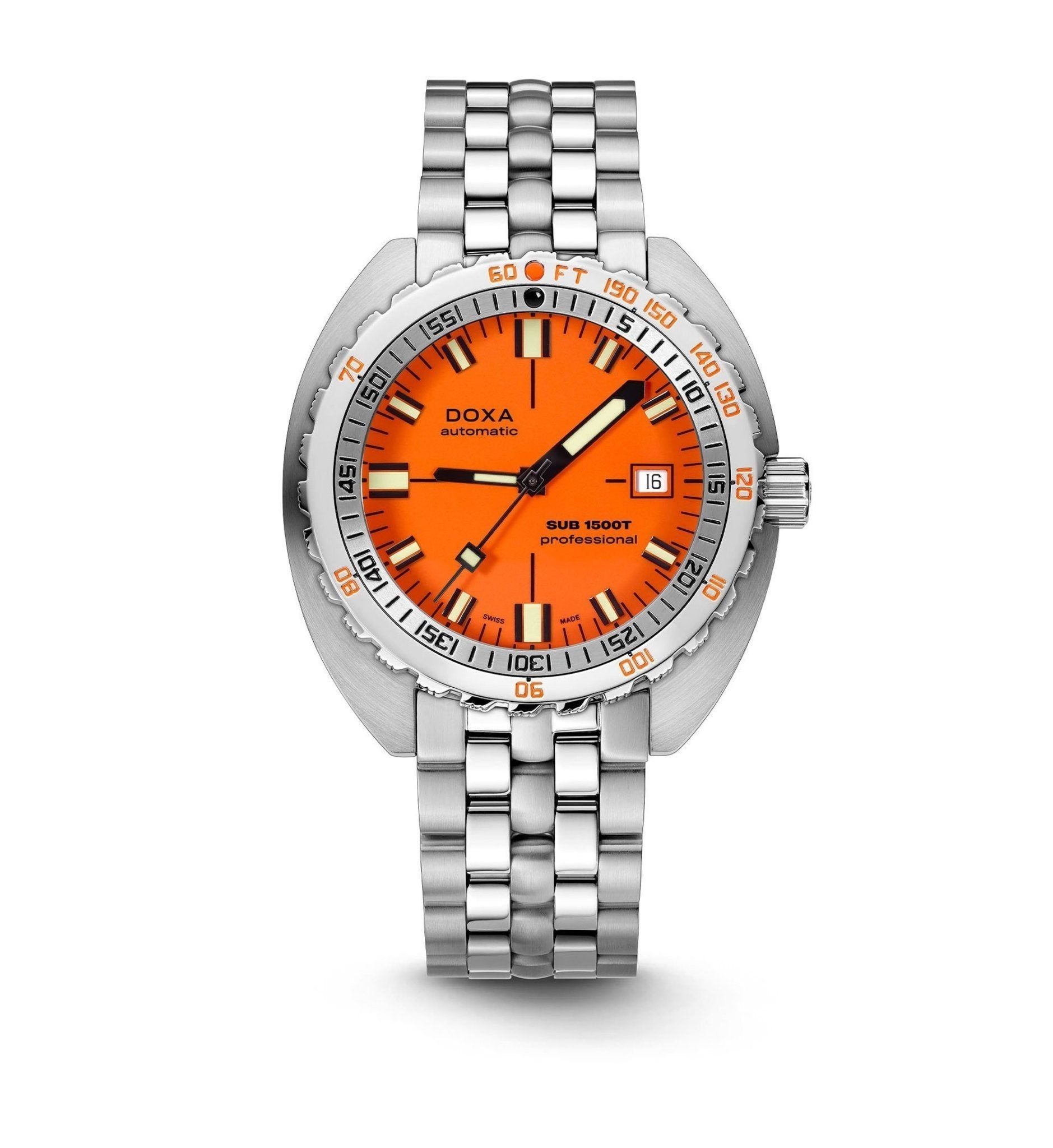
Doxa SUB 1500T: The 1,500-Metre Depth-Rating Flagship
By Zach Charles • October 10, 2026
Complete guide to the Doxa SUB 1500T — 45mm, 1,500m depth rating, helium escape valve, ETA 2892-2 movement, USD 2,690.
Audemars Piguet Royal Oak 'Jumbo' ref. 15202 with blue tapisserie dial and integrated steel bracelet
By Zach Charles • October 10, 2026
The Audemars Piguet × Swatch Royal Pop is a $400 bioceramic pocket watch in 8 colourways, powered by a new hand-wound SISTEM51 with 90+ hour power…

Time on the Move logo
By Zach Charles • October 10, 2026
Zach Charles is the editor of Time on the Move, an independent watch reference covering brand and model histories, buying guides and release news…
Omega Speedmaster Professional 'Moonwatch' chronograph, front view on steel bracelet
By Zach Charles • October 9, 2026
Find the best watches at every price point from $500 to $15,000 — new and pre-owned. Covers every budget tier with specific reference picks, brand…
By Zach Charles • October 9, 2026
The latest watch news: new releases, Watches and Wonders coverage, discontinuations, industry analysis, and market trends. Currently 1 article.

Seiko's New Panda Chronograph Is Literally a Panda: The Power Design Project HHK001 and HHK002
By Zach Charles • October 8, 2026
Seiko's Power Design Project panda chronograph (HHK001, HHK002) turns the panda dial into an actual panda face, with ear pushers, a 'Sasameter' and a 3D…
Show More