Patek Philippe: Founded 1839, the Stern Family, and the Patek Philippe Seal
Patek Philippe: The Last Independent Geneva Manufacture
By Zach Charles, Editor, Time on the Move
The claim that Patek Philippe makes about itself — "the last independent Geneva manufacture in family hands" — is precise in every word. Independent: not owned by a group. Geneva: not the Jura, not Schaffhausen, not the Vallée de Joux, but Geneva proper and its suburbs. Family: the same bloodline of owners across five generations, from the Sterns' 1932 acquisition to Thierry Stern's current presidency. Manufacture: in-house design, production, and assembly, with the engineering capability to prove it.
In an industry where independence has been progressively absorbed — by LVMH, Richemont, Swatch Group, and smaller holding companies — Patek Philippe's position is genuinely unusual. It is not independently owned because no one has tried to acquire it. It is independently owned because the Stern family has declined to sell, across conditions that motivated other Swiss manufacturers to accept acquisition.
The result is a brand with no peer in its combination of depth, continuity, and manufacturing capability.
Photo: Mourad Ben Abdallah (Moumou82) — CC BY-SA 3.0 — Wikimedia Commons
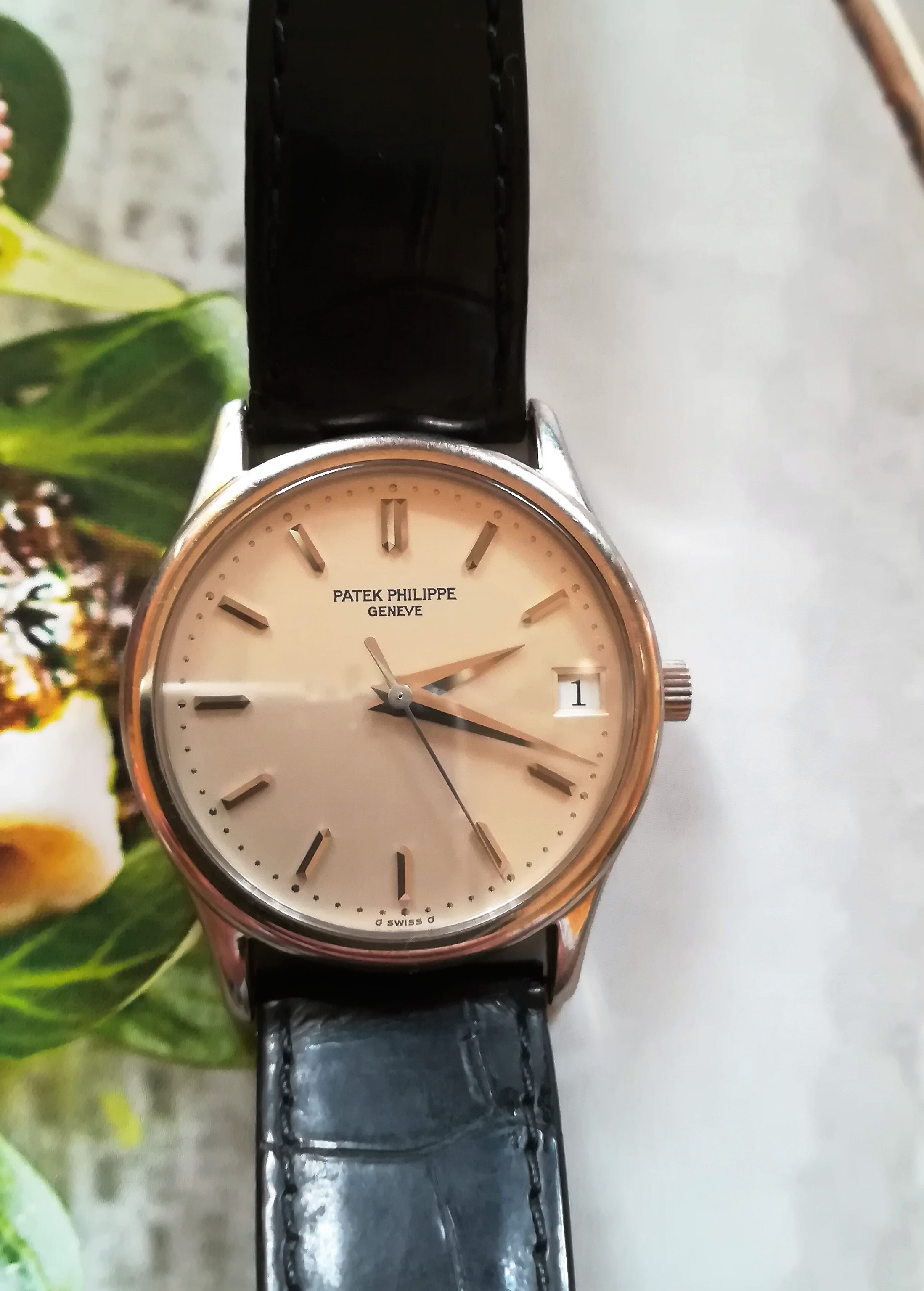
Founding — Three Phases, One Brand
Photo: Clyde94 — CC BY-SA 4.0 — Wikimedia Commons
The founding of Patek Philippe is a story in three phases, and the distinction between them matters for accuracy.
Phase 1: Patek, Czapek & Cie (1 May 1839)
Antoni Patek — Antoine Norbert de Patek — was a Polish-born watchmaker who had fled to Geneva following the November Uprising of 1830. He partnered with Franciszek Czapek, a Czech-born watchmaker, to form Patek, Czapek & Cie
on 1 May 1839. The partnership produced watches of competent quality but was dissolved on 18 April 1845, reportedly due to irreconcilable personal and business disagreements.
Phase 2: Patek & Cie (15 May 1845)
Adrien Philippe, a French watchmaker who had invented the stem-wind and crown-set mechanism — the keyless winding system that replaced the watch key in common use — joined Patek following the Czapek dissolution. The new company, Patek & Cie
, was formally constituted on 15 May 1845.
Phase 3: Patek, Philippe & Cie (1 January 1851)
The company's name was formally changed to Patek, Philippe & Cie
on 1 January 1851, six years after Philippe joined. The comma between "Patek" and "Philippe" — a typographical detail rarely noticed — remained in the legal company name for 158 years. It was only removed in 2009.
The 1839 date is the conventional founding year, and Patek Philippe uses it. The company that bears the Philippe name, and the watchmaking philosophy that defines it, did not fully exist until the 1845 partnership and the 1851 name. Both dates are defensible depending on the question being asked.
Stern Family Acquisition — 1932
Photo: Franck Schneider — CC BY-SA 3.0 — Wikimedia Commons
The Great Depression created the conditions for one of watchmaking's most consequential ownership changes. In 1932, Charles and Jean Stern — owners of Cadrans Stern Frères , a Geneva dial manufacturer that had been supplying Patek Philippe for decades — acquired a controlling interest in the watchmaking company.
The correct year is 1932 , not 1934. The 1934 date that appears in some sources refers to a subsequent event: the introduction of the in-house Calibre 12"'120, developed under watchmaker Jean Pfister whom the Sterns had installed to lead manufacturing. The acquisition and the in-house calibre development were related but distinct events separated by two years.
Stern succession:
- Charles and Jean Stern
(from 1932): acquired the company; established manufacturing foundation
- Henri Stern
(from 1935): joined as commercial director; became chairman from 1958; expanded the American market; moved manufacturing to Plan-les-Ouates
- Philippe Stern
(from 1993): president; assembled the Museum collection; initiated the Patek Philippe Seal
- Thierry Stern
(from 2009): current president; discontinued the reference 5711 Nautilus; oversaw the PP6 facility
The Patek Philippe Seal
Photo: Kamal Aboul-Hosn — CC BY 2.0 — Wikimedia Commons
In spring 2009, Patek Philippe replaced the Geneva Seal — the cantonal certification it had long carried — with its own, more demanding standard: the Patek Philippe Seal.
The distinction is specific:
The Geneva Seal covered only the movement, tested in uncased condition, against 12 finishing criteria. It did not address the case, bracelet, dial, or the movement's performance once installed in a watch.
The Patek Philippe Seal
applies to the entire finished watch. Key requirements:
- Rate accuracy (finished, cased watch): maximum -3/+2 seconds per day — a standard applied to the complete watch, not a bare movement
- Movement finishing: chamfered and mirror-polished edges; Geneva-striped visible surfaces; circular-grained inner sides
- Precious stones: Top Wesselton grade, flawless, excellently cut
- Case and bracelet: polished and brushed surfaces meeting Patek's internal standards
Patek administers the Seal itself rather than through a cantonal authority — a design that critics note removes the third-party validation the Geneva Seal provided. The counter-argument: the Seal's standards exceed what any third-party auditor has historically required, and Patek's commercial reputation is the enforcement mechanism.
The Generations Campaign — "You Never Actually Own a Patek Philippe"
The most quoted line in luxury watch marketing was introduced in autumn 1996 . The first print advertisements ran in October 1996 , created by the London agency Leagas Delaney . The exact official wording is: "You never actually own a Patek Philippe. You merely look after it for the next generation."
The word "actually" distinguishes this from variants often quoted online ("truly," "really"). The earlier campaign line was "Begin your own tradition." The Generations campaign replaced it.
The tagline's power is philosophical rather than commercial: it repositions the purchase as stewardship rather than consumption, and the watch as an heirloom rather than a product. For a brand whose watches regularly sell at prices that make them genuinely rare in the context of most people's financial lives, the tagline worked by making the price irrelevant to the brand's self-definition.
Manufacturing — Plan-les-Ouates and the PP6 Building
Photo: Kamal Aboul-Hosn — CC BY 2.0 — Wikimedia Commons
Patek Philippe's manufacture moved from central Geneva to Plan-les-Ouates , a suburban commune south of the city, in 1996 — the same year as the Generations campaign's launch.
The PP6 building , Patek's most ambitious manufacturing facility, opened in early 2020 : 133,650 square metres across ten floors (four subterranean). The building houses the full manufacturing stack: case and bracelet production, movement components, dial finishing, assembly, quality control, and the Advanced Research department that has developed silicon escapement components and the Spiromax silicon balance spring.
Vertical integration expanded significantly between 2001 and 2010 as Patek absorbed its former suppliers: Calame & Cie (cases), Poli-Art SA (polishing), SHG (gem-setting), and Cadrans Flückiger (dials) were consolidated at workshops in Le Crêt-du-Locle.
Patek Philippe Museum
Photo: Patekphilipe1897 — CC BY-SA 4.0 — Wikimedia Commons
The Museum opened to the public in November 2001 in a restored Art Deco building in central Geneva that Patek had purchased in 1975 to house watchcase and bracelet production. When that production moved to Plan-les-Ouates in 1996, the building was renovated and expanded (one additional floor); restoration completed approximately 1999.
The collection comprises approximately 2,500 objects : portable timekeepers back to circa 1500, automatons, miniature enamel portraits, and the brand's own horological creations from 1839 to the present. The Antique Collection and the Patek Philippe Collection occupy separate wings. The museum library is one of the world's largest horological archives.
Philippe Stern , the third-generation family president who preceded Thierry Stern, assembled the collection over decades. The Museum was his project as much as any watch.
The Collections
Patek Philippe's production is organised into collections, each with a distinct design vocabulary and functional purpose:
Calatrava: The round dress watch line, tracing to reference 96 in 1932. The expression of Bauhaus principles in watchmaking — form follows function, no ornamentation beyond what the design requires.
Nautilus: The integrated-bracelet steel sports watch designed by Gérald Genta in 1976. The most commercially discussed watch in Patek's current catalogue.
Aquanaut: The sportier, more accessible counterpart to the Nautilus, introduced in 1997 with a composite "Tropical" strap and rounded octagonal case.
Grand Complications: The summit of the manufacture's technical capability — Calibre 89, Sky Moon Tourbillon, Grandmaster Chime.
Perpetual Calendar: Patek's longest-running complications line, tracing to the 1941 reference 1526.
Annual Calendar: Patek's 1996 patent — the first commercially produced annual calendar mechanism for a wristwatch.
Chronograph: From the historically significant references 1518 and 2499 to the modern Calibre CH 29-535 PS.
Golden Ellipse: The oval dress watch based on the Golden Section proportion, introduced in 1968.
Twenty~4: Patek's first collection conceived as a complete women's line, introduced in 1999.
Latest News
- Watch Price Increases 2026: Rolex Up 7%, AP Raises 7.5%, Tudor 5.6% — Then Patek Cuts — January 2, 2026
- Patek Philippe Nautilus Turns 50: Four Limited Editions, the Return of 38mm, and a Desk Clock — April 15, 2026
- Watches and Wonders 2026: Every Major Announcement, Discontinuation, and Trend — May 1, 2026
- Phillips New York Watch Auction XIV: A $13.9M F.P. Journe and a $75.8M U.S. Record — June 21, 2026
- Patek Philippe's Milan Grand Exhibition 2026: The 5978P Instantaneous Perpetual Calendar Chronograph and Six More Italian Limited Editions — October 3, 2026
Frequently Asked Questions
When was Patek Philippe founded?
The watchmaking enterprise that became Patek Philippe was first established on 1 May 1839 by Antoni Patek and Franciszek Czapek. After the Czapek partnership dissolved in 1845, Adrien Philippe joined to form Patek & Cie
on 15 May 1845. The name Patek, Philippe & Cie
was adopted on 1 January 1851. Patek Philippe uses 1839 as its official founding year.
Who owns Patek Philippe?
The Stern family, who acquired the company in 1932. Thierry Stern has been President since 2009. The brand is not owned by any watch group — it is private and independent.
What is the Patek Philippe Seal?
Patek Philippe's own quality certification, introduced in spring 2009 to replace the Geneva Seal. The Patek Philippe Seal applies to the entire finished watch (movement, case, bracelet, dial) and requires a rate accuracy of -3/+2 seconds per day on the complete cased watch. It is self-administered.
What does "You never actually own a Patek Philippe" mean?
It is the tagline of Patek's Generations advertising campaign, which launched in autumn 1996 (first print ads October 1996, agency Leagas Delaney). The full text: "You never actually own a Patek Philippe. You merely look after it for the next generation." It positions the watch as a heirloom — an asset of permanent rather than personal value.
Where is Patek Philippe made?
In Plan-les-Ouates, a suburb south of Geneva, Switzerland. Patek moved its manufacturing there from central Geneva in 1996. The PP6 facility, which opened in 2020, is the primary manufacturing building.
Related Articles
- Nautilus: Gérald Genta's Steel Sports Watch for Patek Philippe
- Calatrava: Patek Philippe's Bauhaus Dress Watch Since 1932
- Patek Philippe Grand Complications: Calibre 89 and the Grandmaster Chime
- Patek Philippe Perpetual Calendar: A History of the Complication
- Audemars Piguet: The Founding-Family Watch Manufacturer Since 1875