Phillips New York Watch Auction XIV: A $13.9M F.P. Journe and a $75.8M U.S. Record
June 21, 2026 • Time on the Move
Phillips' New York Watch Auction XIV closed on June 14, 2026 as the highest-grossing watch sale ever held on American soil — $75.8 million across 156 lots with a 100% sell-through rate. The night was defined by a single F.P. Journe Résonance that hammered for nearly $14 million and rewrote the record book for independent watchmaking.
Held over two days at 432 Park Avenue in association with Bacs & Russo, the sale more than doubled its pre-sale high estimate and extended Phillips New York's streak to five consecutive years of completely sold-out live watch auctions. But the headline number was almost a footnote next to the watch that drove it: a single F.P. Journe that hammered for nearly $14 million and rewrote the record book for independent watchmaking.
A $13.9M F.P. Journe rewrites the record book
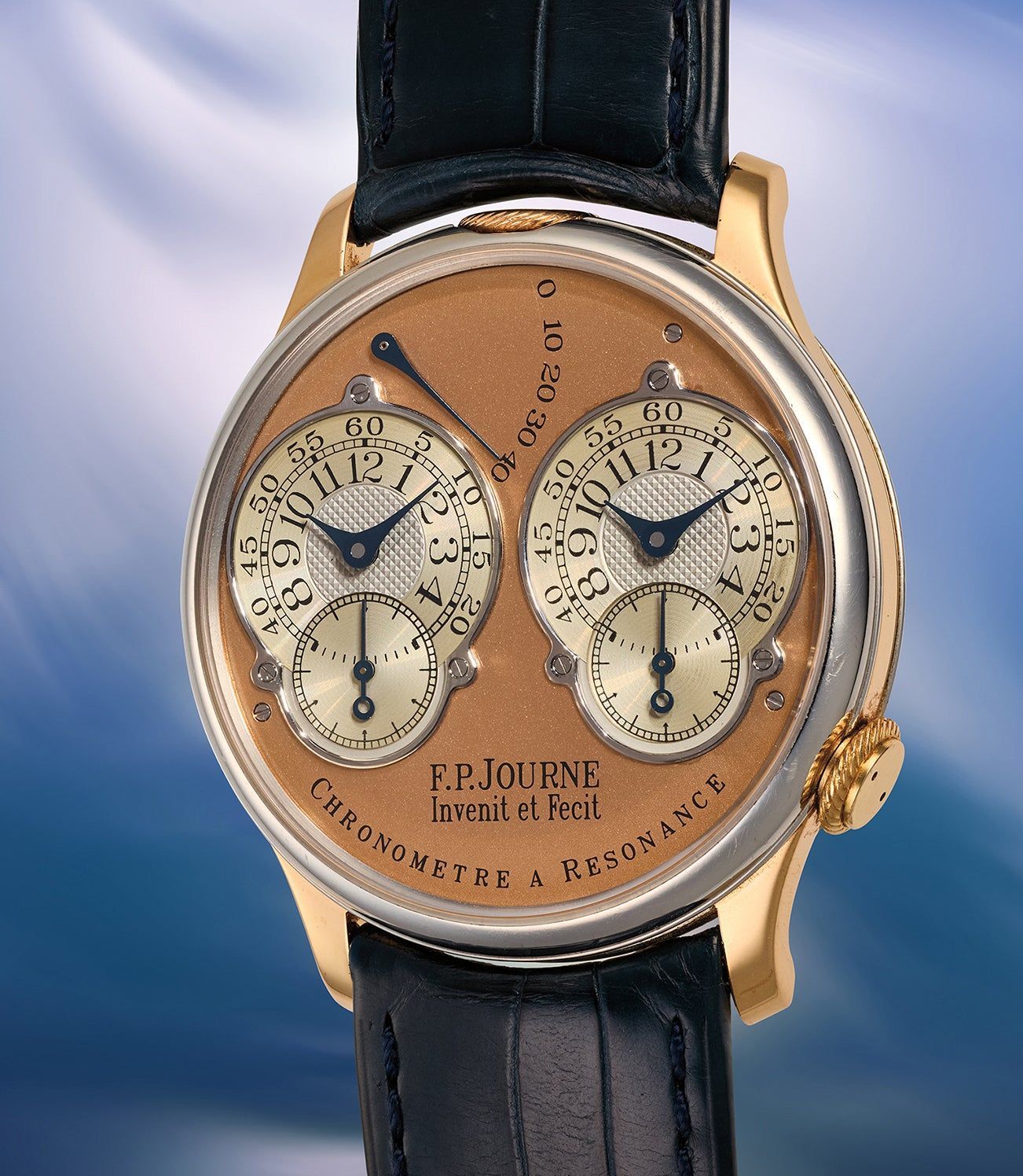
Lot 10: the F.P. Journe Chronomètre à Résonance "Souscription, No. 007," circa 2000, with its salmon-pink gold dial, twin off-center sub-dials, and the power-reserve indicator at top center. The case combines platinum and 18k pink gold. Credit: Phillips.
The night belonged to Lot 10 , an F.P. Journe Chronomètre à Résonance "Souscription, No. 007," which sold for $13,922,000 after a bidding war that ran close to nine minutes against a pre-sale estimate of merely "in excess of $1,000,000." The result set three records simultaneously: the most expensive watch ever sold by F.P. Journe, the highest price ever paid at auction for a watch by any independent watchmaker, and the highest price for any 21st-century wristwatch sold commercially.
The watch itself explains much of the fervor. Number 7 of the original 20-piece subscription series François-Paul Journe sold around 1999–2000 to fund his fledgling brand, it pairs a platinum and 18k pink gold case, 38mm in diameter, with the manually wound Calibre 1499 and its 36 jewels. The Résonance is no ordinary dual-time piece: it houses two independent balance wheels positioned to influence one another through acoustic resonance, each settling the other into a more stable rhythm — a phenomenon first observed in pendulum clocks by Christiaan Huygens in the 17th century and rarely tamed in a wristwatch. These earliest "souscription" examples, hand-signed and pre-dating Journe's move to in-house gold movements, are the most coveted objects the brand has ever produced.
Independent watchmaking takes over the top 10
The Journe Résonance was not an outlier so much as the apex of a trend that defined the entire sale. Whereas a decade ago independents barely registered at this level, here F.P. Journe alone accounted for half of the top 10 lots; in total, 17 Journe watches changed hands for roughly $29.2 million in a single session. Lot 85 , a Tourbillon Souverain Anniversaire "Hong Kong" numbered 1 of 5, reached $4,355,000 , while a Tourbillon Anniversaire Historique "T30" (Lot 79) and an Octa Chronographe "Swiss FineTiming" (Lot 83) each made $2,032,000 .
Soon after the Journe lots cleared, two other independents posted fresh brand records of their own. A Kari Voutilainen Masterpiece Chronograph II, numbered 1 of 10, sold for $1,841,500 , and a Roger Smith Series 3 "Unique Piece" — from the Isle of Man workshop that carries forward George Daniels' method of single-handed watchmaking — brought $1,219,200 . For a category that a decade ago lived at the margins of the auction world, the message was unambiguous: because supply is so constrained, the names that command seven and eight figures are increasingly the ones with the smallest production numbers, whereas the large heritage houses must lean on rarity and provenance to compete.
The heritage heavyweights: Clapton's Patek and a JPS Daytona
Vintage Patek Philippe and Rolex still anchored the sale, even if they no longer topped it. The most striking result came from Lot 88 , the Patek Philippe Ref. 5004G-020 once owned by Eric Clapton, CBE.
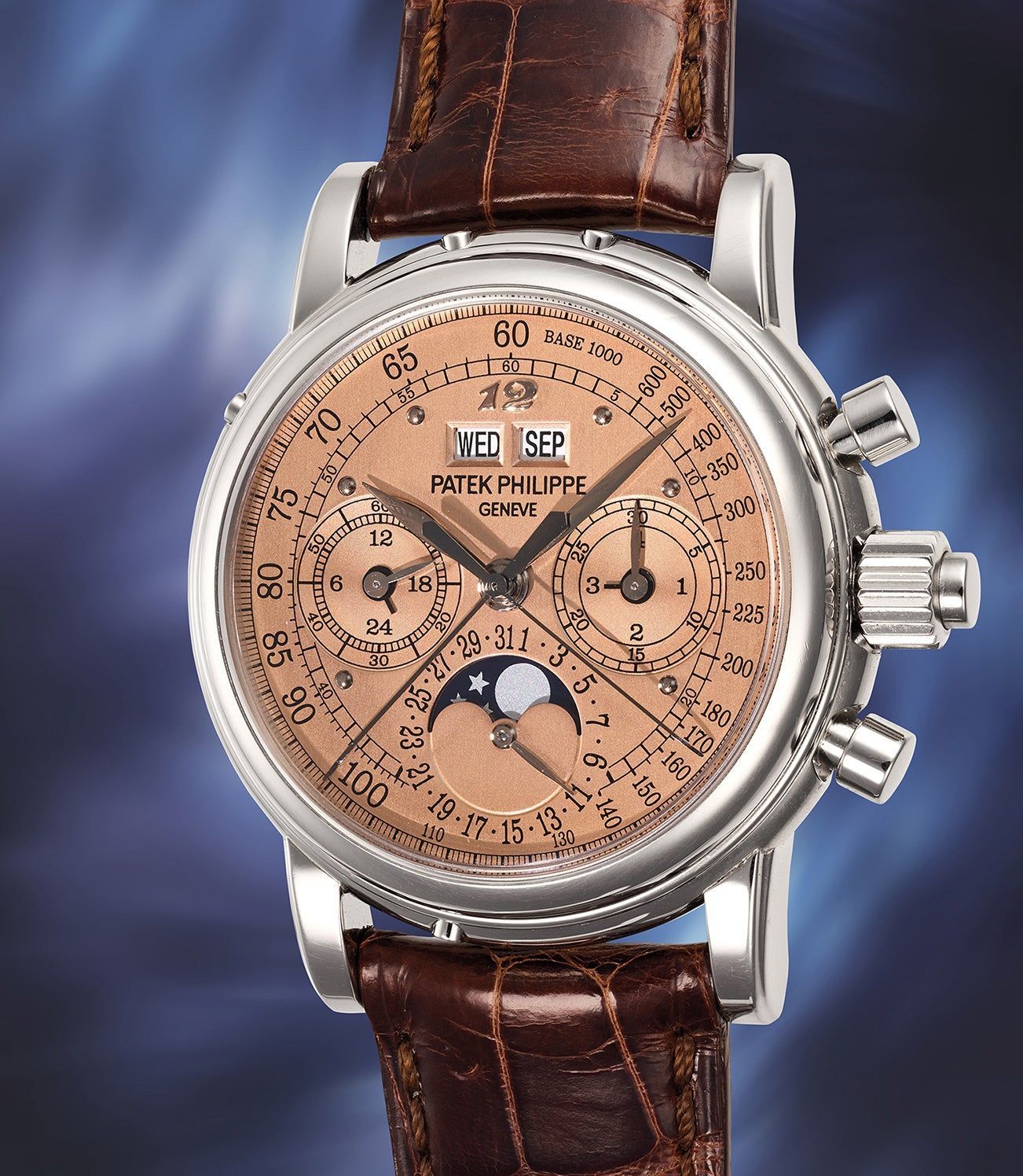
Lot 88: Eric Clapton's Patek Philippe Ref. 5004G-020, a white gold perpetual calendar split-seconds chronograph with a warm salmon dial, day/month apertures flanking 12 o'clock, and the rattrapante pusher set into the crown. Credit: Phillips.
Described in the catalog as "possibly unique," this 2008 white gold perpetual calendar split-seconds chronograph carried provenance from one of the most famous watch collectors in popular music. The split-seconds complication, or rattrapante , uses a second chronograph hand stacked beneath the first so a timer can record two simultaneous events — think of timing two laps that start together but finish apart — and because combining it with a self-adjusting perpetual calendar demands so much hand-finishing, the 5004 series ranks among the most complex watches Patek has ever serially produced. Estimated at $700,000–$1,400,000, it sold for $5,202,000 — a record for the reference. A 1948 Patek Philippe Ref. 1518 (Lot 101), in 18k pink gold and one of only roughly 58 believed to survive, followed at just under $3,992,000 , a reminder that the first serially produced perpetual calendar chronograph remains a cornerstone of any serious collection.
Rolex's standard-bearer was Lot 31 , a circa-1969 Cosmograph Daytona Ref. 6241 known as the "John Player Special."
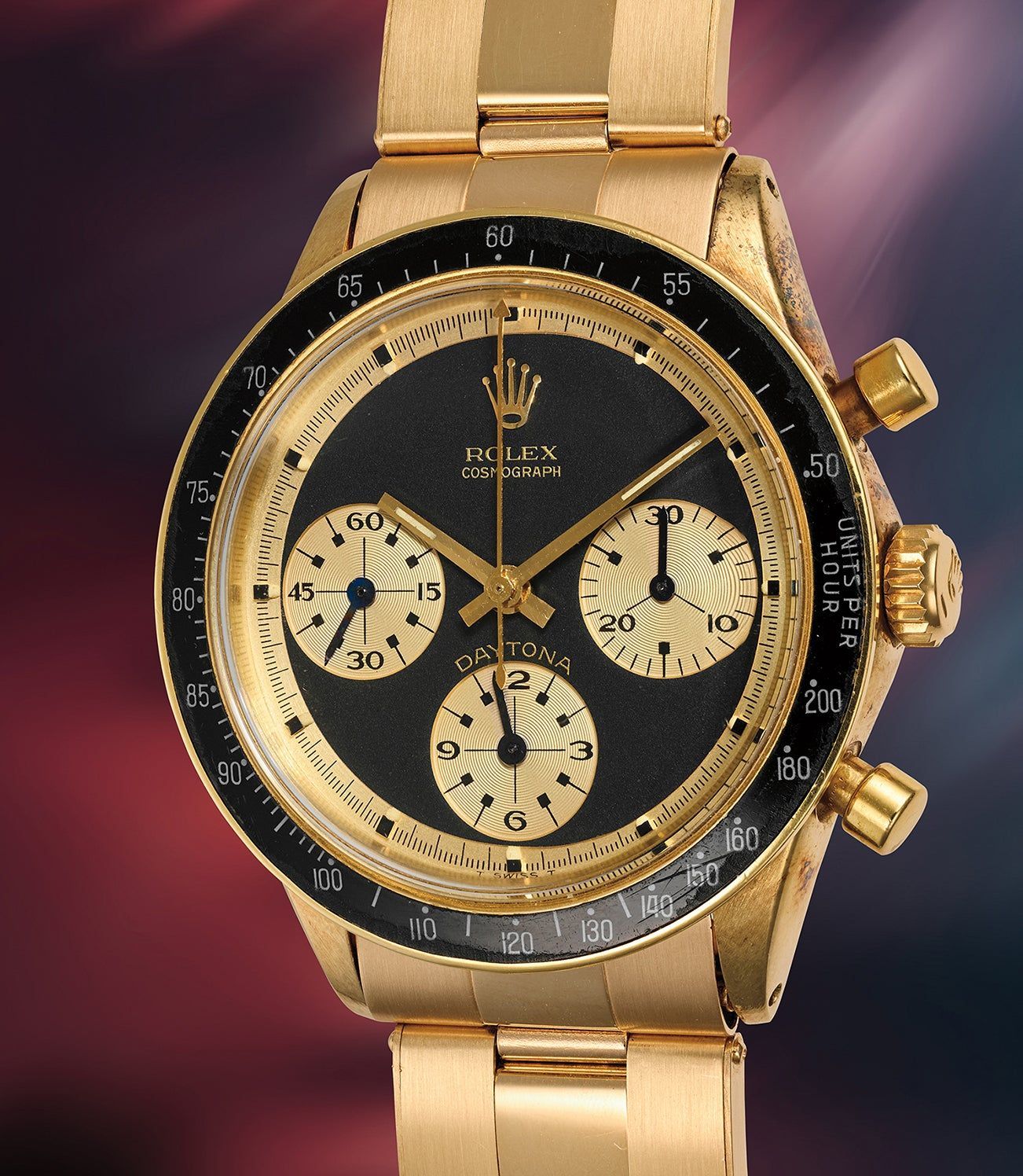
Lot 31: the "John Player Special" Daytona, a 14k yellow gold Ref. 6241 whose black-and-gold Paul Newman exotic dial echoes the livery of the famed Lotus Formula 1 cars. Credit: Phillips.
Named for the black-and-gold color scheme it shares with the iconic Lotus F1 racing livery, the 14k yellow gold chronograph with its art-deco Paul Newman exotic dial sailed past a $700,000–$1,400,000 estimate to realize $1,803,400 .
What the Phillips New York Watch Auction result means for the market
Three figures tell the story of where collecting is headed. First, the $75.8 million total shattered the $43.5 million record Phillips itself set in New York just six months earlier, in December 2025 — a near-doubling in half a year. Second, 16 timepieces crossed the $1 million threshold in a single sale. Third, and most telling for the industry, because the season produced an unprecedented hat-trick — three watches sold above $10 million in Geneva, Hong Kong, and now New York within a single calendar season — the Phillips New York Watch Auction result reads less as an isolated spike than as confirmation of a structural shift.
The throughline is the institutionalization of independent watchmaking. A result like the Résonance's $13.9 million would once have been unthinkable for a maker without a centuries-old name; consequently, now that it sits at the very top of the market — ahead of the vintage Pateks and Rolexes that historically defined the ceiling — collectors are recalibrating what a "blue-chip" watch even means. For collectors, it raises a practical question — whether contemporary independents represent durable value or a speculative peak — that the next few sales will begin to answer. For the brands still making these watches by hand in small numbers, it confirms that scarcity, provenance, and intellectual ambition now price comparably to heritage alone.
Meanwhile, on the retail side: notable June 2026 releases
Away from the auction room, two of the more talked-about new releases of the early summer landed in the same window — both answering long-standing enthusiast wish lists.
Tudor Black Bay Chrono 39 "Bumblebee"
Tudor finally gave its chronograph fans the smaller case they had been asking for. The Tudor Black Bay Chrono 39 (reference M79310N-0001), nicknamed the "Bumblebee" for its vivid yellow dial and contrasting black sub-counters, shrinks the case to 39mm and slims it to just 13.1mm thick. Whereas the original Black Bay Chrono wore large at 41mm and over 14mm thick, this version finally sits flush under a shirt cuff. The stainless steel case keeps the family's beveled lugs, signed crown, and Snowflake hands, paired with a fixed steel bezel carrying a black anodized aluminum tachymeter insert and a domed date at 6 o'clock. Inside is the COSC-certified Manufacture Calibre MT5813, a column-wheel automatic chronograph built on the Breitling B01 architecture, running at 4Hz with a roughly 70-hour power reserve and 200m of water resistance. It is priced at $6,725 (€6,200 / CHF 5,500).
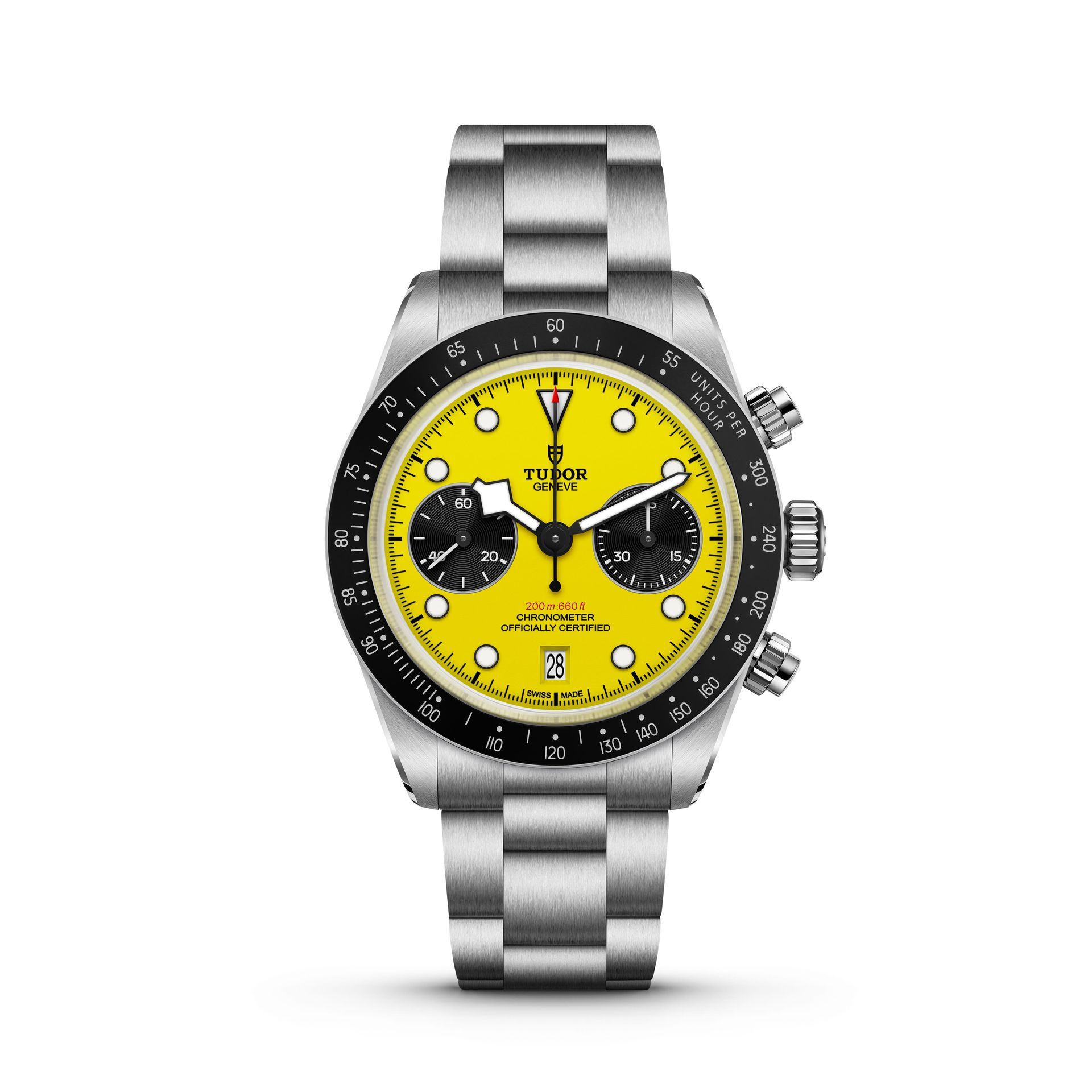
The Black Bay Chrono 39 "Bumblebee": a bright yellow dial with two black sub-counters and a domed date at 6 o'clock, white Snowflake hour hand, and a fixed steel bezel carrying a black anodized aluminum tachymeter scale. © Tudor Watch — official press image.
Omega Seamaster Diver 300M "007 First Light"
Omega did something it had never done before with the Bond Seamaster: the Omega Seamaster Diver 300M Chronograph "007 First Light" (reference 210.32.44.51.01.002) is the first chronograph version of Bond's dive watch, launched alongside the 007 First Light video game from IO Interactive and Amazon MGM Studios. The 44mm stainless steel case (17.2mm thick, 52.8mm lug-to-lug) wears a polished black ceramic bezel with a white enamel diving scale and matching black ceramic pushers. The laser-engraved wave-pattern dial carries a date at 6 o'clock, "Seamaster" picked out in red, and a PVD bronze-gold ring around the 3 o'clock sub-dial echoed by a gold central chronograph seconds hand. The column-wheel Calibre 9900 is METAS Master Chronometer certified, with a 60-hour power reserve, while sapphire crystals front and back and 300m of water resistance preserve the watch's genuine dive credentials. Delivered on a striped NATO strap engraved "007" and "First Light," it is priced at $9,400 and is not a limited edition.
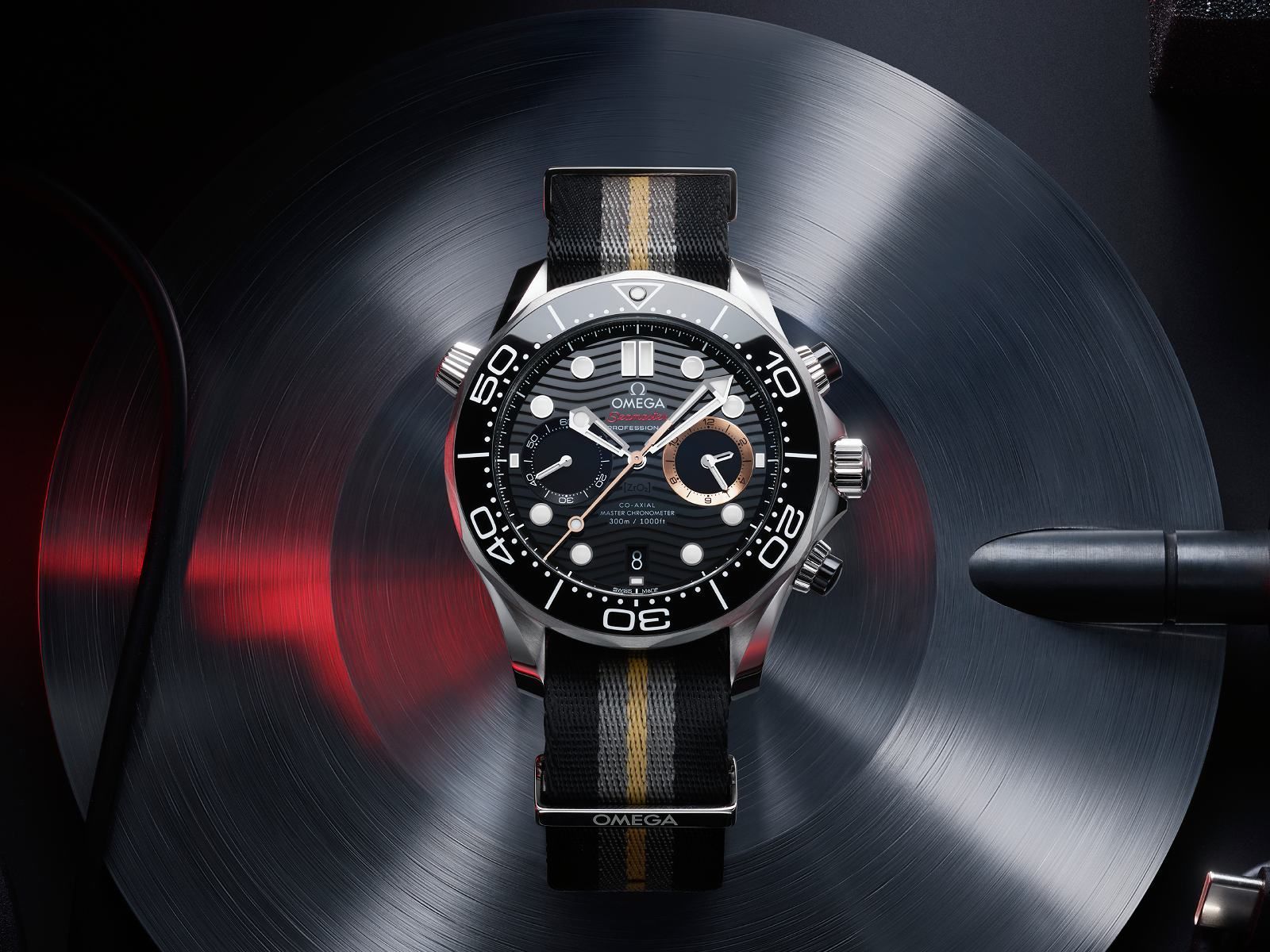
The Seamaster Diver 300M Chronograph "007 First Light": a polished black ceramic bezel with a white enamel diving scale frames the laser-engraved wave dial, with "Seamaster" picked out in red, a date at 6 o'clock, and a PVD bronze-gold ring around the 3 o'clock sub-dial echoed by the gold central chronograph seconds hand. © Omega SA — official press image.
People also ask
Sources: Phillips (phillips.com, lot data and images), Robb Report, ArtNews, Hypebeast, Monochrome Watches, Time and Tide, Men's Journal. Auction figures and lot details as reported June 13–17, 2026.