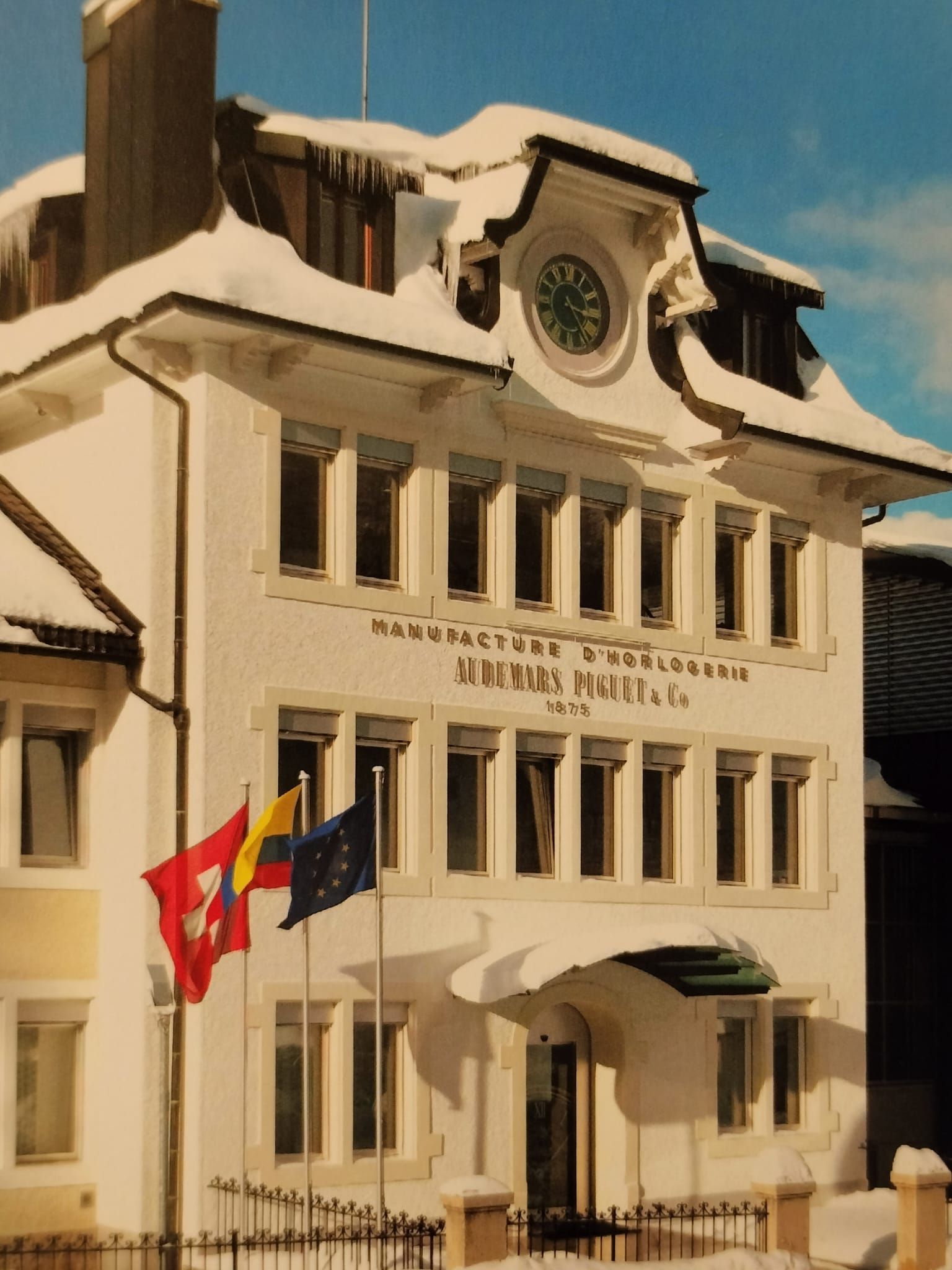
Audemars Piguet: The Founding-Family Watch Manufacturer Since 1875
By Zach Charles, Editor, Time on the Move
On 17 December 1875, two men in their mid-twenties signed a founding partnership deed in Le Brassus, a village in the Vallée de Joux, the watchmaking heartland of the Canton of Vaud. Jules-Louis Audemars and Edward-Auguste Piguet had known each other as children. They had been working separately in the valley's watch trade and found in each other a complementary division of labour: Audemars for technical production and movement work, Piguet for commerce and client relationships. The document they signed that December was not merely a business founding. It was the beginning of a family stewardship that remains unbroken a hundred and fifty years later.
Audemars Piguet is the only major prestige Swiss watch manufacture that has remained in continuous ownership of its founding families since the day it was established. This claim requires precision: it is not merely independent ownership — Patek Philippe is independently owned, but by the Stern family, who acquired it in 1932, not the founding Patek or Philippe families. Audemars Piguet's claim is specific and remarkable: direct descendant family governance from 1875 to the present. Jasmine Audemars, great-granddaughter of Jules-Louis, served as Chairwoman of the Board from 1992 until 2023. Olivier Audemars continues on the board.
That continuity has shaped everything about the company — its patience with complications that take years to develop, its willingness to absorb financial pressure rather than sell, and the particular pride that makes the Vallée de Joux context feel like more than geography.
Photo: EMore98 — CC BY-SA 4.0 — Wikimedia Commons
Le Brassus and the Vallée de Joux
Photo: OpaleHorse — CC BY-SA 4.0 — Wikimedia Commons
Le Brassus is at approximately 1,000 metres above sea level in a valley between the Swiss Jura mountains. In winter it is snowbound; in the eighteenth and nineteenth centuries, when the valley's farmers could not work the land, they made watch parts. The cold, damp conditions were considered ideal for precision hand work: low humidity keeps metal dimensions stable, and the enforced indoor winter months created a skilled labour pool unlike anything elsewhere in Switzerland.
The Vallée de Joux became home to the most technically ambitious watchmaking in Switzerland — not the production-scale manufacture of the Jura cantons, but the complications specialists. Grande sonneries, perpetual calendars, minute repeaters: these were Vallée de Joux territory. The region produced the movements that the Geneva and Neuchâtel ateliers assembled into finished watches. Audemars and Piguet set up within this tradition.
The founding building dates to 1868 and still stands. Today it anchors the Musée Atelier Audemars Piguet — a glass spiral structure designed by Bjarke Ingels Group, opened in 2020, where functioning artisan ateliers are visible to visitors through transparent walls.
The Complications Era (1875–1940)
Photo: EMore98 — CC BY-SA 4.0 — Wikimedia Commons
The company's first decades were spent producing extraordinarily complicated ebauches — movements, not finished watches — for sale to other houses. Tiffany & Co. was an early client. The division of labour in Swiss watchmaking at the time was clear: specialist movement makers in the Vallée de Joux supplied the raw mechanical intelligence; commercial houses in Geneva, La Chaux-de-Fonds, or Neuchâtel assembled, cased, dialed, and sold the finished product.
Audemars Piguet became the valley's premier complications atelier within its first decade. Minute repeaters, chronographs, perpetual calendars — the firm mastered each and combined them. The accumulation reached its peak in 1899 with what remains one of the most celebrated pocket watch complications in history.
The 1899 Grande Complication pocket watch combined seven complications: grand and small strike, minute repeater, alarm, perpetual calendar, deadbeat seconds, and a split-seconds chronograph with jumping seconds. Twenty-one separate functions. 1,168 components. Four years to restore when AP undertook the project in the late twentieth century. Displayed at the Paris World Exhibition of 1900, where it won recognition. It precipitated the construction of a purpose-built factory in 1907.
The first half of the twentieth century saw AP begin to produce finished watches rather than only movements. The first wristwatch minute repeater — a benchmark complication — was produced by AP in 1892 on commission from Louis Brandt, founder of Omega, who assembled it into the finished watch. AP holds legitimate claim to the mechanism; Omega to the finished watch.
The Quartz Crisis and the Royal Oak Rescue
Photo: Peripitus — CC BY 3.0 — Wikimedia Commons
The 1970s hit Swiss watchmaking with the force of an industrial crisis. Japanese manufacturers — Seiko in particular — flooded global markets with accurate, inexpensive quartz movements. The commercial case for mechanical watchmaking collapsed in entry and mid-tier price points. The Swiss industry contracted dramatically. Dozens of manufactures closed or were absorbed.
Audemars Piguet entered this period with quality and heritage but limited commercial mass. The company was not large enough to have reserves against a sustained market downturn. By AP's own account, the brand came close to bankruptcy in this period.
The watch that changed this trajectory — the Royal Oak — was not designed to save the brand. It was designed to meet a specific brief from the Italian market: a luxury steel sports watch at a price that defied conventional wisdom about what steel watches could command. Gérald Genta drew it overnight in late 1970 or early 1971. It launched at the 1972 Basel Watch Fair. Dealers initially struggled to sell it.
The Royal Oak's eventual commercial success did not arrive immediately — it built across the decade as the logic of a luxury sports watch in steel became first comprehensible, then desirable, then the category-defining standard by which all subsequent luxury sports watches would be evaluated. The Rolex Submariner, the Patek Philippe Nautilus (also a Genta design, 1976), and eventually every luxury tool watch concept owes its commercial viability to what the Royal Oak proved was possible.
AP credits the Royal Oak with rescuing the company from bankruptcy through the late 1970s and early 1980s. Whether that is precise or retrospective, the Royal Oak's centrality to the company's survival is not in dispute.
The 1986 Tourbillon Milestone
Photo: EMore98 — CC BY-SA 4.0 — Wikimedia Commons
In 1986, Audemars Piguet introduced the first self-winding tourbillon wristwatch — Calibre 2870. All prior tourbillon wristwatches required manual winding. The tourbillon mechanism, developed by Abraham-Louis Breguet in 1801, rotates the escapement continuously to average out positional rate errors. Its application in a wristwatch was already mechanically extraordinary; integrating an automatic winding rotor into the same movement without adding thickness beyond practicality was a genuine engineering achievement.
Calibre 2870 reasserted AP's complications credentials at a moment when the Swiss industry was rebuilding its identity around mechanical prestige rather than quartz practicality. The year 1986 is often cited by horologists as the period when the Swiss luxury watch recovery began to find its footing, and AP's tourbillon contribution was part of the argument that mechanical watchmaking had irreplaceable technical depth.
The Offshore and Commercial Acceleration
The Royal Oak Offshore, launched in 1993, was the catalyst for AP's transformation from a respected niche manufacture into a globally recognised luxury brand. Designer Emmanuel Gueit's 42mm sports chronograph — commissioned by Stephen Urquhart, rejected internally as "crazy," denounced by Genta as "killing" his Royal Oak — became AP's commercial accelerant through the 1990s and 2000s.
Under CEO François-Henry Bennahmias (2012–2023), AP's revenue grew to approximately CHF 2 billion annually — roughly quadrupled over his tenure. Waitlists for Royal Oak references extended across years. Secondary market premiums became legendary. The brand's positioning shifted from respected watchmaker to cultural status object, with partnerships spanning Formula 1, basketball, and music.
The Code 11.59 and the Second Pillar Question
In January 2019, AP unveiled the Code 11.59 — a new collection intended as the brand's second major product line alongside the Royal Oak. Bennahmias described it as "the biggest launch since the Royal Oak in 1972." Online reception was immediate and hostile: collectors found the design derivative and the positioning arrogant.
The Code 11.59 story is more complicated than its 2019 reception suggests. Technically, it contained genuine innovations — a biconvex double-curved sapphire crystal, AP's first in-house vertical-clutch column-wheel chronograph movement, and the extraordinary Universelle RD#4 ultra-complication. The design objections were real but not universal; the watch improved in collector estimation over the following years.
The Code 11.59 episode illuminates a structural challenge that Audemars Piguet shares with few brands: when a single product line (the Royal Oak) defines a brand so completely that any departure from it reads as either tribute or violation, how does the company develop a second pillar? The answer remains open.
The Manufacture in Le Brassus
Audemars Piguet produces movements, cases, dials, and bracelets in-house. The main production facility — the Manufacture des Forges — opened in 2008 in Le Brassus, housing several hundred watchmakers. Some of the most complicated movements are produced at a separate facility in Le Locle.
The tapisserie dials — the guilloché pattern that identifies every Royal Oak — are produced using traditional rose engines, one dial at a time. The Petite Tapisserie of the Jumbo references takes the longest; the machine must be hand-operated with care for each of the hundreds of tiny squares. It is, in a brand whose identity is built on mechanical precision, the most human part of the process.
The Collections
Photo: Clyde94 — CC BY-SA 4.0 — Wikimedia Commons
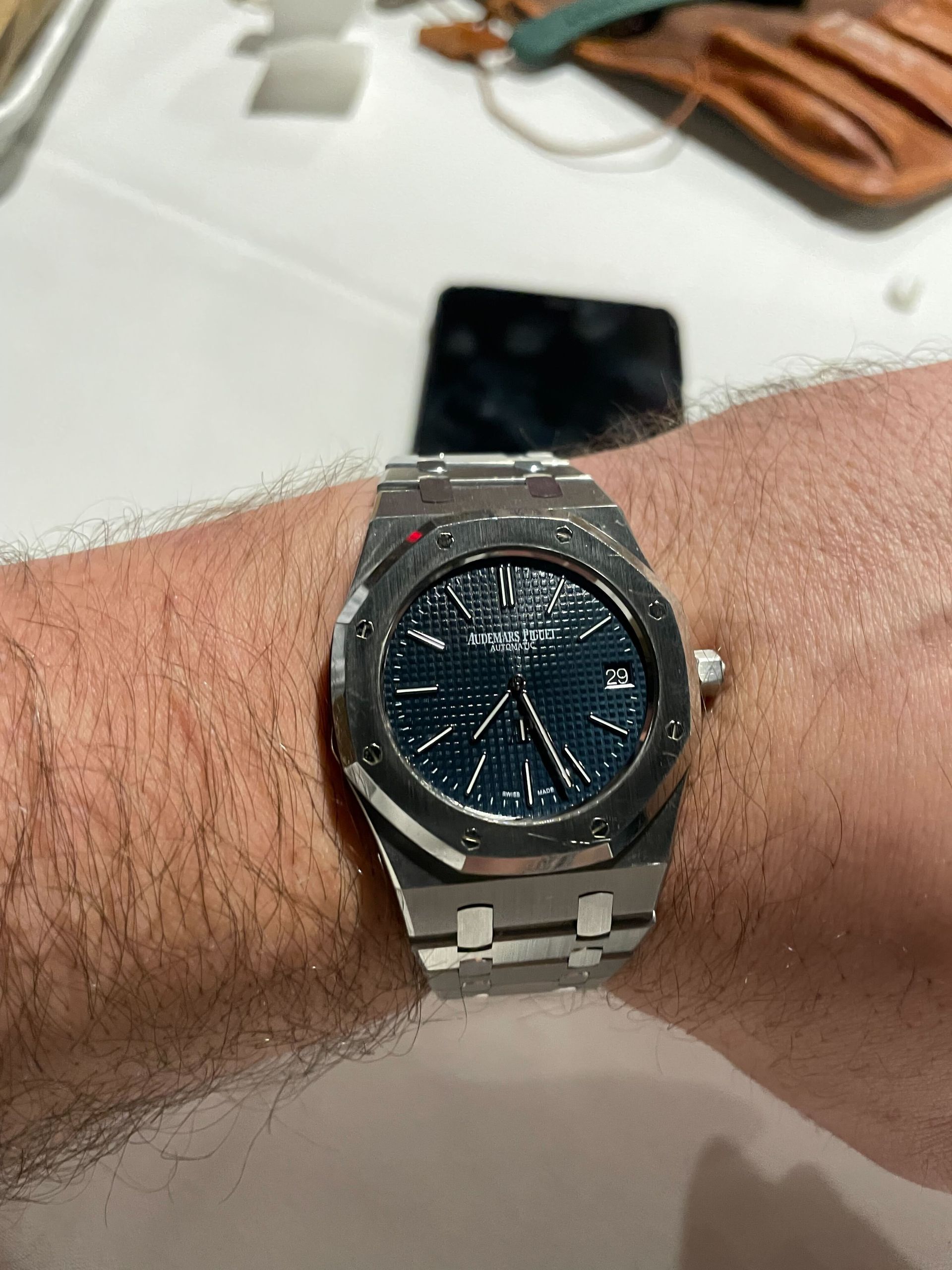
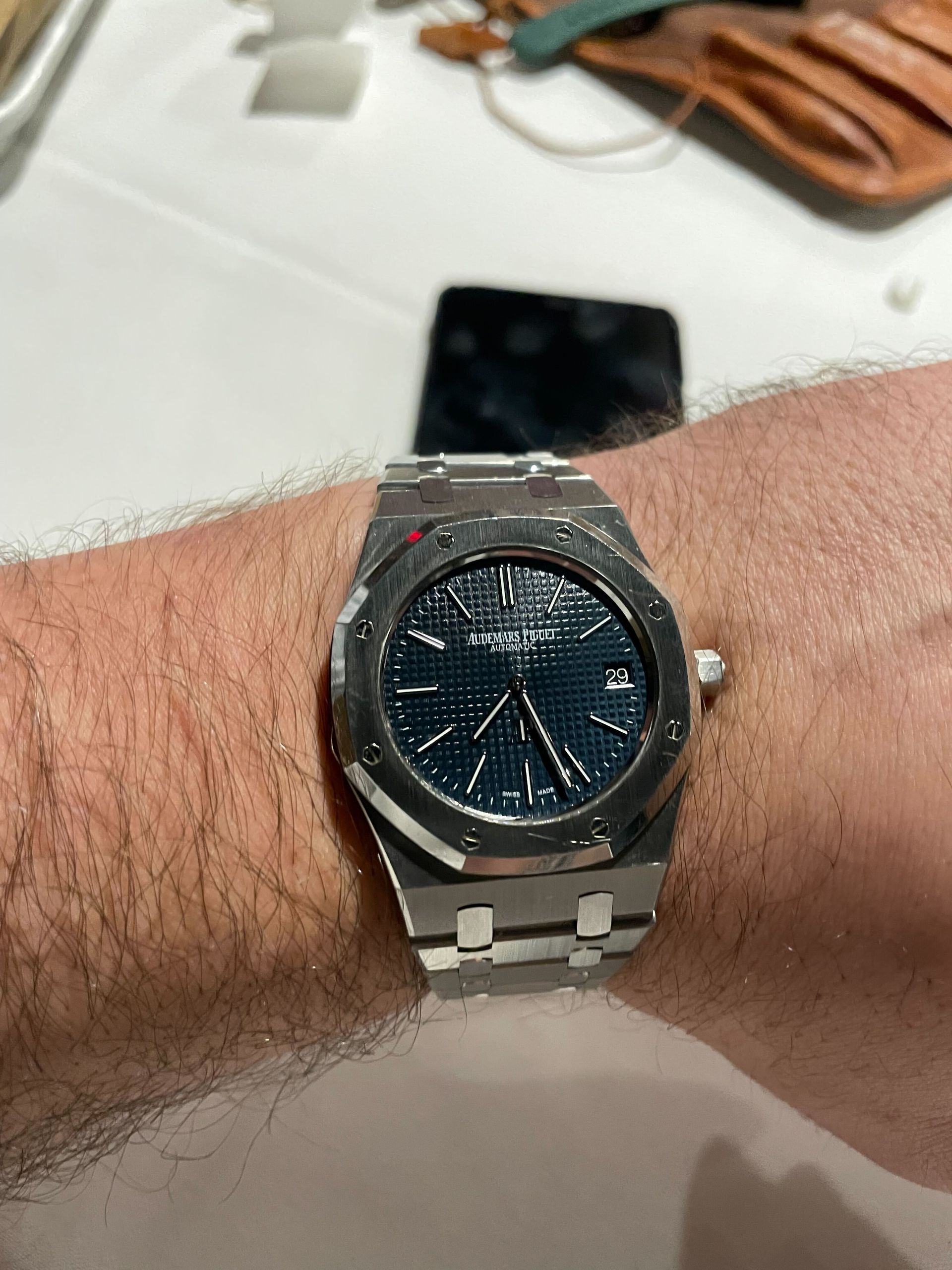
Royal Oak — The collection that rescued the brand and defined a category. Octagonal bezel, eight hexagonal white-gold screws, tapisserie dial, integrated bracelet. The design that Genta drew overnight in late 1970/early 1971 and that launched in April 1972.
Royal Oak Jumbo — The 39mm ultra-thin direct lineage: 5402 → 14802 → 15002 → 15202 → 16202. The Calibre 2121 / 7121 no-running-seconds design that most directly continues the original.
Royal Oak Offshore — Emmanuel Gueit's 42mm sports chronograph from 1993. The watch that expanded the brand's commercial reach.
Royal Oak Perpetual Calendar — AP's complications heritage in the Royal Oak case. Some of the most technically ambitious watches the brand produces.
Royal Oak Concept — The research and development showcase. Avant-garde materials, skeletonized architecture, ultra-high complications.
Code 11.59 — The 2019 collection. Controversial on arrival; technically serious; improving in reception.
Millenary — The elliptical-cased collection introduced in 1995. Off-center dials, exposed movement architecture, AP's creative alternative to the Royal Oak's sports register.
Jules Audemars — The classical dress watch collection, named for the co-founder. Where AP's grandest complications appear in traditional form.
Grand Complications — The heritage of minute repeaters, grande sonneries, and combined complications that established the company's foundational reputation.
Latest News
Frequently Asked Questions
Is Audemars Piguet still family-owned?
Yes. AP is the only major prestige Swiss watch manufacture to remain in continuous founding-family ownership since its establishment in 1875. No conglomerate acquisition has occurred. The Audemars and Piguet families retain control through a board structure; Olivier Audemars continues as Vice Chairman. This distinguishes AP from Patek Philippe (owned by the Stern family since 1932, not the founding family) and from every other major Swiss prestige brand.
Where are AP watches made?
Le Brassus, in the Vallée de Joux, Switzerland — the same location where the company was founded in 1875. The main modern production facility (Manufacture des Forges, opened 2008) is in Le Brassus. Some complicated movements are produced at a Le Locle facility. All movements, cases, and dials are produced in-house.
What makes the Royal Oak historically significant?
The Royal Oak (1972) was the first luxury sports watch to be made in stainless steel and priced above gold dress watches from competing manufacturers. Before it, steel watches were considered entry-level; gold was the luxury material. The Royal Oak's 5402ST launched at approximately CHF 3,300 — more expensive than a gold Patek Philippe dress watch of the era. It proved that steel could be a luxury material when combined with exceptional finishing, design, and manufacturing quality.
Who is Gérald Genta?
Gérald Genta (1931–2011) was the most consequential watch designer of the twentieth century. He designed the Audemars Piguet Royal Oak (1971), the Patek Philippe Nautilus (1976), and numerous other landmark watches. The Royal Oak is considered by many — including Genta himself — as his masterwork. He later designed his own brand of complicated watches.
Why is the Royal Oak so expensive relative to competitors?
Several factors: AP produces entirely in-house at relatively low volume. The tapisserie dials are rose-engine guilloché produced one at a time. The case finishing requires more hours per watch than most competitors. The Royal Oak's integrated bracelet alone — 154 hand-finished components with alternating brushed and polished surfaces — is among the most labour-intensive bracelet constructions in Swiss watchmaking. Demand substantially exceeds production capacity.