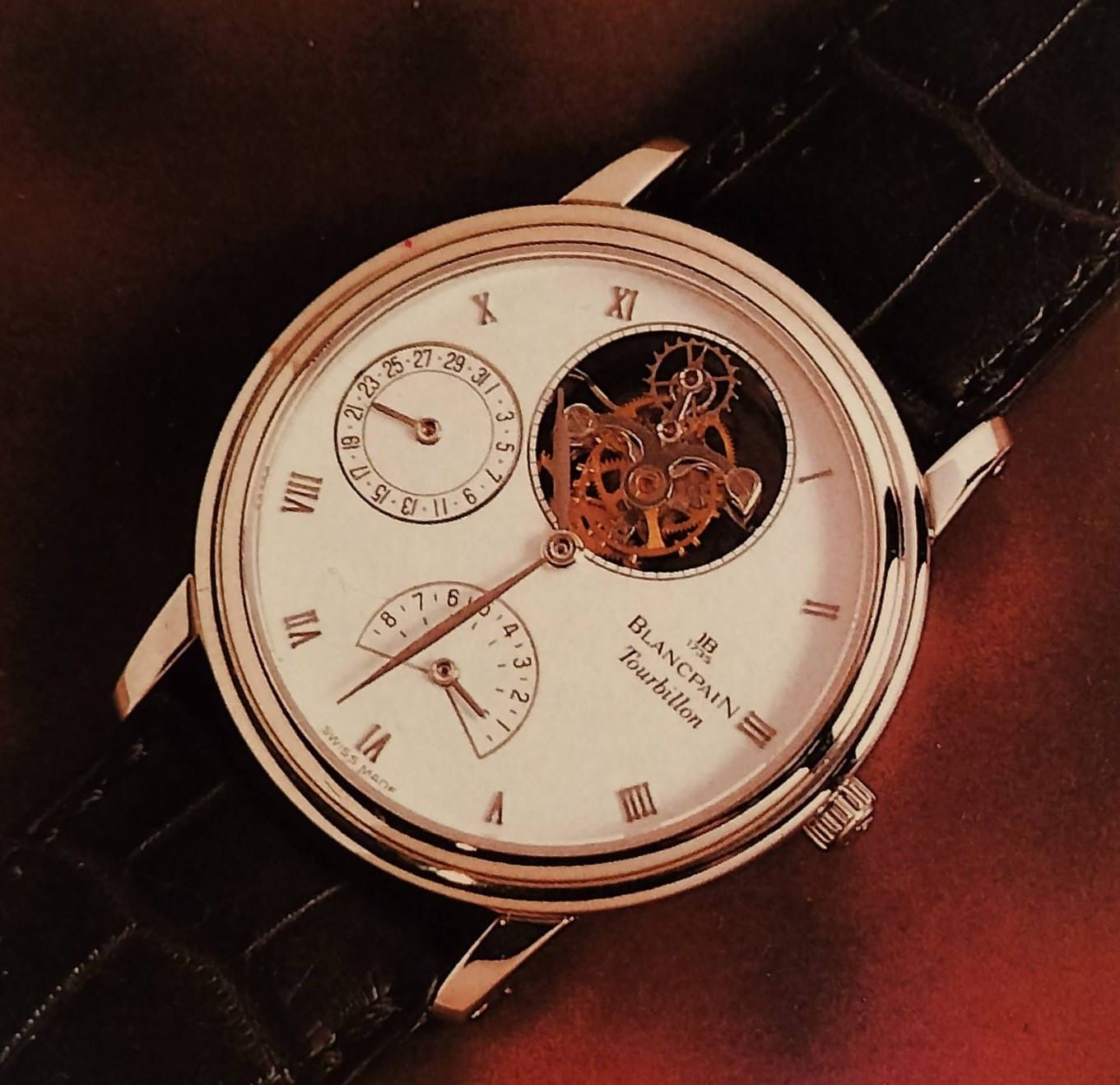
Blancpain Le Brassus: Ultra-Grand Complications from the Vallée de Joux
Blancpain Le Brassus: Grand Complications from the Vallée de Joux
Le Brassus is the village in the Vallée de Joux where Blancpain's Le Sentier manufacture is located, and it gives its name to the brand's most complex collection. Where the Villeret collection addresses dress watch elegance with moderate complications, Le Brassus is where Blancpain demonstrates its technical limits: carousels, tourbillons, minute repeaters, and watches that combine all three simultaneously. These are among the most mechanically complex wristwatches produced by any manufacturer.
Le Brassus and the Vallée de Joux
Photo: EMore98 — CC BY-SA 4.0 — Wikimedia Commons
The Vallée de Joux — the Valley of Joux — is a high valley in the Vaud Jura, at approximately 1,000 metres altitude, isolated from the lowlands by winter snowfall for months each year. This isolation shaped watchmaking: without agriculture viable year-round, the valley's population turned to craft industry, and the precision of watchmaking — which requires delicate hands in still rooms — suited the long winters.
By the eighteenth century, the Vallée de Joux was producing the most sophisticated movements in Switzerland. The valley's manufacturers — Audemars Piguet (Le Brassus), Jaeger-LeCoultre (Le Sentier), Blancpain (Le Sentier) — remain there today. The concentration of complication expertise in this small area is unmatched anywhere in the world.
Blancpain's manufacture is in Le Sentier , adjacent to Le Brassus. The collection name honours the valley's watchmaking tradition and the neighbour that shares Blancpain's altitude and culture.
The Carousel — An Alternative to the Tourbillon
Photo: EMore98 — CC BY-SA 4.0 — Wikimedia Commons
The carousel (carrousel) is an alternative to the tourbillon, invented by Danish watchmaker Bahne Bonniksen in 1892 — nearly a century after Breguet's tourbillon patent. Like the tourbillon, the carousel rotates the escapement within a rotating cage to average out gravity errors across multiple orientations. The technical difference:
- In a tourbillon : the escape wheel, pallet fork, and balance wheel all rotate together in a cage driven by the gear train
- In a carousel : the escape wheel is driven from outside the rotating cage, allowing a different mechanical arrangement and (historically) simpler construction
The practical accuracy difference between tourbillon and carousel in a wristwatch (which moves constantly, self-averaging gravity errors) is nil. The value of the carousel is its mechanical distinction and rarity — few manufacturers produce it, and Blancpain's carousel is one of a tiny number in production.
Carrousel Répétition Minutes — Three Grand Complications in One
Photo: EMore98 — CC BY-SA 4.0 — Wikimedia Commons
The Carrousel Répétition Minutes is Blancpain's most celebrated complication watch. It combines three traditionally separate grande complications:
- Carousel — rotating escapement cage
- Minute repeater — mechanical chiming mechanism that strikes the hours, quarter-hours, and minutes on demand when a slide is activated
- Perpetual calendar — automatic accounting for months of different lengths, no correction required until 2100
Combining all three in a wristwatch requires movement architecture of exceptional complexity. The minute repeater alone (with its gongs, hammers, all-or-nothing piece, and rack-and-snail mechanism) occupies significant movement volume. Adding the carousel and the perpetual calendar programming system while keeping the case at a wearable size is an engineering challenge of the highest order.
The result: approximately 500 components in a movement of approximately 6mm height, in a case of 41.8mm diameter. The minute repeater strikes on two cathedral gongs — the acoustic quality of which requires precise tensioning and positioning, as a poorly tuned repeater produces a flat or tinny sound regardless of mechanical correctness.
Eight Day Tourbillon
Photo: EMore98 — CC BY-SA 4.0 — Wikimedia Commons
The Eight Day Tourbillon (Calibre 25 Calibre Huit Jours) extends the standard two-day power reserve of most tourbillon movements to eight days — achieved through a series of four mainspring barrels in series, providing four times the standard energy storage.
An eight-day reserve in a tourbillon wristwatch is extremely unusual. The tourbillon cage itself consumes significant energy (rotating once per minute against the friction of its pivot bearings and the drag of the balance wheel at full amplitude); maintaining sufficient amplitude for accurate regulation over eight days requires a large and carefully engineered energy reserve.
The eight-day tourbillon is offered in the Villeret design language — round case, stepped profile, guilloché dial — rather than the sport-inflected L-Evolution case.
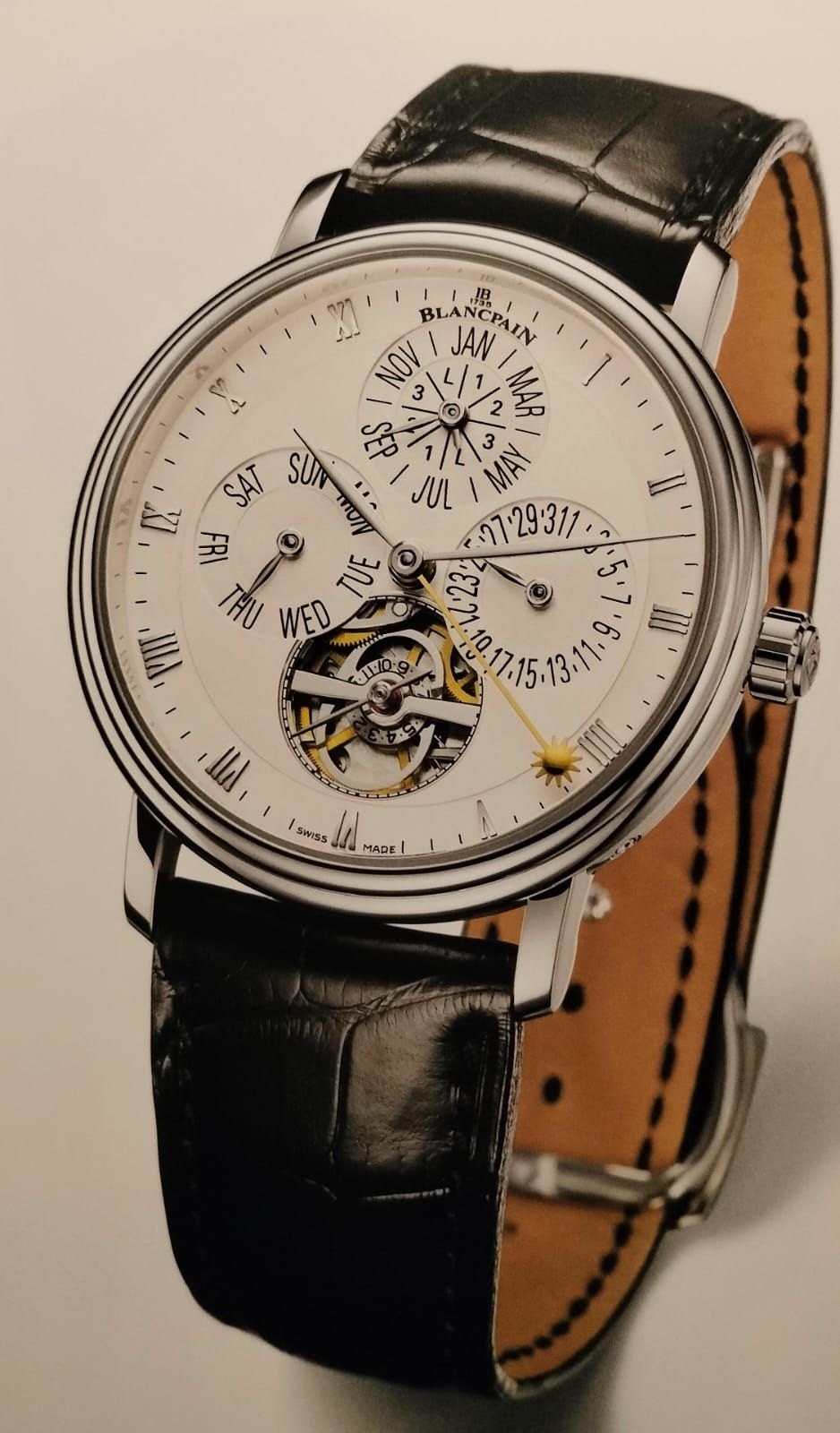
Le Brassus Perpetual Calendar Chronograph
Photo: EMore98 — CC BY-SA 4.0 — Wikimedia Commons
Combining a perpetual calendar with a flyback chronograph is one of the most mechanically complex complication combinations in wristwatch form. The challenge is that both systems use the same mechanical infrastructure (the gear train, motion works, and date correctors) and must be designed so that the chronograph's instantaneous energy demands do not disrupt the perpetual calendar's programming.
Blancpain's solution: a column-wheel chronograph mechanism with a vertical clutch (reducing the jolt of chronograph engagement) and a perpetual calendar cam system engineered to absorb the momentary load of chronograph operation without advancing date displays incorrectly.
The flyback function (in which the chronograph seconds hand returns to zero and immediately restarts on a single push, rather than the three-push stop-reset-restart sequence) adds a fourth complexity to the movement.
The Eight Days of Production
Photo: EMore98 — CC BY-SA 4.0 — Wikimedia Commons
Blancpain does not publish production numbers for Le Brassus watches, but industry estimates suggest that the most complex references (Carrousel Répétition Minutes, Eight Day Tourbillon, Perpetual Calendar Chronograph) are produced in quantities of dozens per year rather than hundreds. Each movement requires weeks of assembly by a single watchmaker — the établisseur tradition in which one person assembles and regulates the entire movement.
The Le Brassus collection represents Blancpain's philosophical commitment to mechanical watchmaking at the limit of what is achievable in a wristwatch: not because the complications serve practical timekeeping functions (a quartz clock on a phone does everything better) but because the mechanical achievement itself is the purpose.