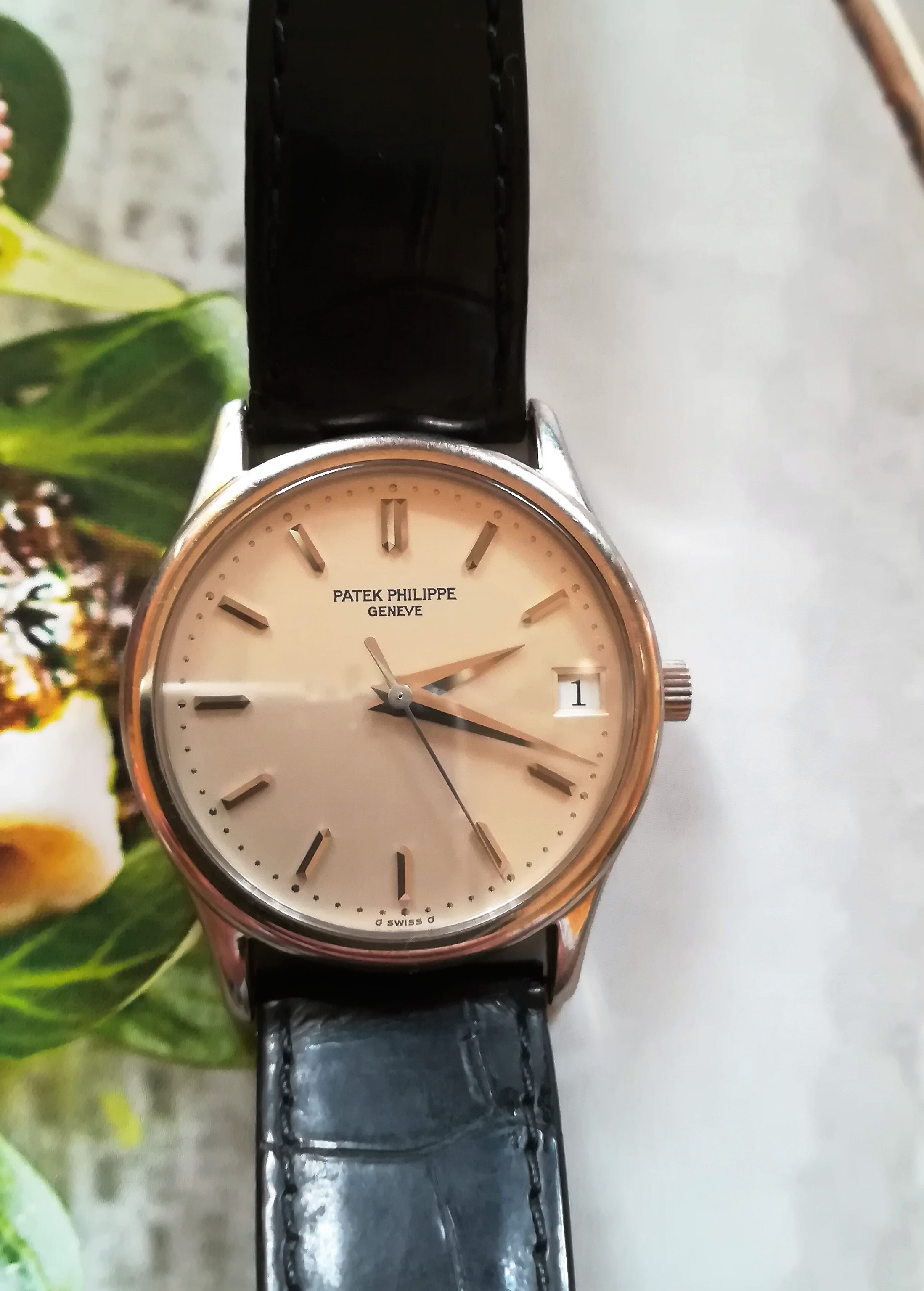
Patek Philippe Golden Ellipse: The Golden Section Applied, 1968
Patek Philippe Golden Ellipse: The Watch Built on the Golden Ratio
The Golden Section — the proportion 1:1.6181, expressed mathematically as φ (phi) — appears in the growth patterns of shells, the proportions of the human body, and the classical architecture of ancient Greece. It is the ratio that the human eye finds most naturally harmonious, according to the tradition that has associated it with beauty since Euclid described the "extreme and mean ratio" in the Elements around 300 BC.
Patek Philippe applied it to a watch case in 1968. The result is the Golden Ellipse — an oval case whose long and short axes are in the ratio 1:1.618. Everything else about the watch is secondary to that decision. The case is the argument.
Photo: Clyde94 — CC BY-SA 4.0 — Wikimedia Commons
Origins — 1968, and the Correct First Reference
Photo: Kamal Aboul-Hosn — CC BY 2.0 — Wikimedia Commons
Nearly every casual source identifies the reference 3738 as the original 1968 Golden Ellipse. This is incorrect by a decade. The reference 3738 was introduced in 1978 . The original Golden Ellipse references, introduced in 1968 , were 3546 and 3548 .
This error is persistent enough to be worth noting directly. The 3738, which ran from approximately 1978 to 2009, is the most widely encountered vintage Golden Ellipse reference and the one that appears most frequently in publications and auction catalogs from the 1980s and 1990s. Its familiarity has led to the chronological error being reproduced as fact. The 3546 and 3548 are the originals.
The correct reference timeline:
- 1968–1976
: Refs. 3546 and 3548 — inaugural models
- 1970–1979
: Ref. 3589 — ultra-thin variant
- 1971–early 1980s
: Ref. 3605 — the larger "Jumbo Ellipse"
- 1978–2009
: Ref. 3738 — longest-running vintage reference; four production series; Calibre 240 across most of its run
- From approximately 2008
: Ref. 5738 — current production
Design — The Golden Section Applied
Photo: Mourad Ben Abdallah (Moumou82) — CC BY-SA 3.0 — Wikimedia Commons
The Golden Section has been associated with ideal proportion since classical antiquity. The ratio φ = 1.6180339... is irrational — it cannot be expressed as a simple fraction — and it appears throughout natural growth patterns, architecture, and art. The Parthenon's façade, Leonardo's Vitruvian Man, and Le Corbusier's Modulor all engage with it.
Applying it to a watch case requires fixing the ratio between the case's long and short axes. A circle has a ratio of 1:1. A very elongated oval approaches 1:∞. The Golden Ellipse's ratio — approximately 1:1.618 — occupies the specific position in that range that the mathematical tradition identifies as most naturally harmonious to the human eye.
The designer: Patek Philippe's in-house stylist Jean-Daniel Rubeli is generally credited with the Golden Ellipse design. An alternative account holds that the inspiration came from the company's director Georges Delessert , who was struck by the shape of an American highway interchange viewed from an airplane — the smooth curves of the interchange's ramps forming an ellipse that read as organically proportioned from altitude. Both accounts circulate; the Rubeli credit is the more commonly cited in Patek's own materials.
The 1968 context: Henri Stern, Patek's president, wanted a watch that was immediately recognisable as Patek from across a room, unisex in its appeal, and distinctive in a market where most watches were either round or rectangular. The Golden Ellipse's form answered all three requirements: the oval case was unlike anything else in Patek's catalogue or the broader Swiss market, and the Golden Section proportion gave it a mathematical legitimacy that distinguished the design choice from arbitrary styling.
Reference 3738 — The Defining Vintage Reference
Photo: Franck Schneider — CC BY-SA 3.0 — Wikimedia Commons
The reference 3738 , despite not being the original, is the Golden Ellipse that defined the collection across its longest production period (1978–2009) and the reference through which most collectors first encounter vintage Golden Ellipse examples.
Four production series
across the 3738's thirty-one-year run:
- Movements evolved: Calibre 240 appeared across most of the run, with earlier pieces using the 240 31 and 240 111 designations as the movement was refined
- Dial variations: yellow gold, white gold, and platinum; various dial colours and finishes; some enamel examples
- Case proportions were maintained consistently across the production run, making different series distinguishable primarily through dial and movement details
The 3738 in yellow gold with a blue-grey dial is the canonical expression most associated with the Golden Ellipse's character: a flat, slim oval in warm metal with a dial colour that reads as sophisticated without being conventional.
Reference 5738 — Current Production
Photo: Kamal Aboul-Hosn — CC BY 2.0 — Wikimedia Commons
The reference 5738 has been in production since approximately 2008 , carrying the Golden Ellipse into its contemporary form. The design language is directly continuous with the 3738; the proportions are unchanged.
Movement: Calibre 240 — ultra-thin automatic with micro-rotor (the rotor oscillates within the movement diameter rather than extending beyond it, enabling the ultra-thin profile). The Cal. 240 is one of the defining movements in Patek's catalogue, found across multiple dress watch references.
Notable current reference: The 5738/51G in white gold with a blue dial is among the most recognized current Golden Ellipse examples. The blue dial against the white gold case occupies the colour relationship that the collection has explored across its history — warm neutrals and cool colour tones that complement rather than compete with the oval case's inherent visual geometry.
The Golden Ellipse in Patek's Catalogue
Photo: Kamal Aboul-Hosn — CC BY 2.0 — Wikimedia Commons
The Golden Ellipse occupies a specific position in Patek's collection hierarchy: it is neither the Calatrava's strict Bauhaus circle nor the Nautilus's octagonal sports watch. It is Patek's ellipse — a form that is neither the conventional round nor the conventional rectangle, and that offers a wrist silhouette unlike any other reference in the catalogue.
For buyers, this translates into a legibility question: the Golden Ellipse reads as Patek from proximity, but not from the distance that the Nautilus's octagonal bezel or the Calatrava's recognizable round form provides. The case shape is the identification, and it rewards attention.
The collection has never been Patek's primary commercial driver — that role belongs to the Calatrava in the dress segment and the Nautilus in sports. The Golden Ellipse persists because it answers a genuine design requirement that nothing else in the catalogue addresses: an oval Patek dress watch in precious metal, at a price point below the complication-heavy references.
Collector Position
Golden Ellipse references trade near or at retail for most current production examples. Vintage 3738 references in original condition, particularly in precious metals other than yellow gold, attract collector interest proportionate to their condition and configuration. Early production 3546 and 3548 references — the genuine 1968 originals — are more rarely encountered and command premiums reflecting their historical precedence.
The collection's secondary market is quiet relative to the Nautilus and Aquanaut — which is to say it operates without the allocation dynamics and speculative premiums that characterize the sports watch segment. A collector who wants a Golden Ellipse can generally find one at fair prices, through authorised channels, without the distortions of scarcity economics.
Frequently Asked Questions
What was the original Golden Ellipse reference?
References 3546 and 3548, introduced in 1968. The reference 3738 — which is frequently cited as the original — was introduced in 1978, a decade later. The 3738 is the most widely encountered vintage Golden Ellipse and the longest-running reference (1978–2009), but precedence belongs to the 3546 and 3548.
What does "Golden Ellipse" mean?
The name refers to the Golden Section (Golden Ratio: 1:1.6181, expressed as φ), the mathematical proportion whose application has been associated with natural harmony and beauty since antiquity. The watch's oval case has long and short axes in this ratio.
Who designed the Golden Ellipse?
Patek Philippe's in-house stylist Jean-Daniel Rubeli is generally credited with the design. An alternative account credits director Georges Delessert, who was inspired by the shape of a highway interchange viewed from an airplane. Both accounts circulate; the Rubeli credit appears in most Patek-adjacent publications.
What movement does the current Golden Ellipse use?
Calibre 240 — Patek's ultra-thin automatic with micro-rotor, enabling the slim oval case profile. The Cal. 240 appears across multiple Patek dress references and is one of the defining movements in the manufacture's current catalogue.
How does the Golden Ellipse trade on the secondary market?
Current production references trade near retail. Vintage 3738 references in original condition attract collector interest; early 3546 and 3548 examples command premiums for their historical significance. The collection's secondary market is quiet relative to the Nautilus and Aquanaut — purchases can generally be made at fair prices without allocation dynamics.
Related Articles
- Patek Philippe: The Last Independent Geneva Manufacture
- Patek Philippe Calatrava: The Bauhaus Dress Watch Since 1932
- Patek Philippe Twenty~4: The Women's Collection Since 1999
- Nautilus: Gérald Genta's Steel Sports Watch for Patek Philippe
- Patek Philippe Perpetual Calendar: History of the Complication