Cartier Roadster: History of the Luxury Sports Watch
Cartier Roadster: History of the Sports Watch
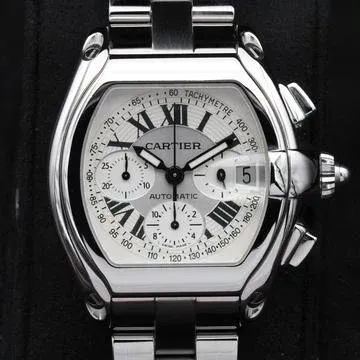
The Cartier Roadster is the house's most explicit engagement with sports watch design — and the only Cartier watch that makes no attempt to be a jewellery watch. Launched in 2002, it arrived during the period when every prestige watch brand was responding to the dominance of the Royal Oak and Nautilus by producing its own integrated-bracelet sports watch. Cartier's version was characterised by a distinctive barrel-shaped case, a Roman numeral dial that preserved the house's typographic signature in a more rugged context, and integrated bracelet links that referenced the watch's automotive inspiration.
The Roadster is not Cartier's most elegant watch nor its most historically significant. What it is — and what makes it genuinely interesting — is Cartier's most honest attempt to build a watch that would be equally at home on a racing driver's wrist as on an executive's. It did not quite succeed in becoming a collector grail during its production run (2002–approximately 2015), but the secondary market has treated it kindly in the years since its discontinuation, and the Roadster XL Chronograph in particular has achieved a collector following that its original retail position would not have predicted.
Photo: EMore98 — CC BY-SA 4.0 — Wikimedia Commons
Design Concept and Origins (2002)
Photo: EMore98 — CC BY-SA 4.0 — Wikimedia Commons
The Roadster's name signals its inspiration directly: the open-topped sports car of the 1950s and 1960s, specifically the era of racing and road cars that represented motoring's most glamorous period. Cartier had dressed racing drivers and motoring enthusiasts since the early twentieth century — the Santos, after all, was made for an aviator who drove a car with as much enthusiasm as he flew aircraft — and the Roadster attempted to formalise this connection.
The case shape — sometimes described as a rounded square or barrel shape — takes a rectangular form and softens every edge to a generous radius, creating a case that is neither the clean rectangle of the Tank nor the circle of the Ballon Bleu, but something in between. The casebands have a noticeable curvature that follows the wrist, making the Roadster surprisingly comfortable despite its substantial dimensions (at 38mm across the case, the standard Roadster was genuinely large for a Cartier of its era). The crown — following Cartier convention — is set with a blue cabochon sapphire.
The dial preserved the Roman numerals and blue sword hands that identify every Cartier watch, but the overall execution was more robust: more prominent numerals, a more emphatic dial layout, a date window at 3 o'clock. In the XL Chronograph variant, the pushers flanking the crown added a functional element that Cartier rarely emphasises.
The Roadster XL Chronograph
Photo: EMore98 — CC BY-SA 4.0 — Wikimedia Commons
The most significant Roadster variant — and the one with the strongest contemporary collector following — is the Roadster XL Chronograph. Launched alongside the base model, the Chronograph offers a larger case (approximately 43mm), column-wheel chronograph movement, and a more complex dial layout with subdial registers at 3 and 9 o'clock.
The Roadster XL Chronograph in stainless steel is the reference that has appreciated most meaningfully on the secondary market since the model was discontinued. At its original retail price of approximately $10,000–$12,000, it was positioned below the Royal Oak Chronograph but above most conventional sports chronographs. Today, well-maintained examples in original condition regularly sell for $8,000–$14,000 on the secondary market — a range that represents neither significant appreciation nor significant depreciation, but the kind of price stability that suggests the market has found the watch's natural level.
The movement in the Roadster XL Chronograph was the Calibre 8510 — a modified ETA Valjoux 7750 with Cartier finishing. This is not a manufacture movement by Cartier's own standards, but the 7750-based calibre is among the most reliable chronograph movements ever made, and the Roadster's examples have aged well.
Roadster S (2007)
Photo: EMore98 — CC BY-SA 4.0 — Wikimedia Commons
The Roadster S — introduced in 2007 — was a more extreme version of the sports watch concept: rubber strap options, black ceramic versions, larger dimensions, a more overtly contemporary aesthetic that aligned it with the design language of the late 2000s luxury sports watch market.
The Roadster S in black ceramic and rubber strap is the variant most clearly dated to its era — it reads unmistakably as a late-2000s luxury sports watch in a way that the original steel Roadster does not. This is not necessarily a criticism: the Roadster S was designed for the 2007 market and it succeeded in reaching buyers who would not have considered a conventional steel Roadster. On the secondary market, Roadster S examples are more abundant and trade at lower prices than the original Roadster references, reflecting both the larger production numbers and the more obviously era-specific design.
Discontinuation and Current Status
Photo: EMore98 — CC BY-SA 4.0 — Wikimedia Commons
The Roadster was discontinued from Cartier's main catalogue by approximately 2015, as the brand consolidated its range around its core identities: the Tank, Santos, Ballon Bleu, and Panthère. The Roadster's discontinuation was not the result of commercial failure — the watch sold in meaningful numbers during its production run — but of a strategic decision to focus Cartier's sports watch ambitions through the Santos de Cartier (relaunched in 2018 as a more versatile sports-adjacent piece) rather than maintaining a dedicated sports watch line.
For buyers today, the Roadster represents an interesting secondary market opportunity. The watch is no longer new or fashionable, which means pre-owned examples are available at prices that significantly undercut original retail. The original steel Roadster in good condition can be found for $2,500–$5,000; the Roadster XL Chronograph for $8,000–$14,000. These are not investment propositions in the Rolex sense, but they offer access to a genuine Cartier mechanical watch at prices well below what comparable current production would cost.
Frequently Asked Questions
Is the Cartier Roadster still made?
The Roadster was discontinued from Cartier's main catalogue by approximately 2015. It is available only on the secondary market. The Santos de Cartier now serves Cartier's sports-adjacent positioning.
What movement does the Roadster use?
The standard Roadster used the ETA 2892-A2 automatic; the Roadster XL Chronograph used the Calibre 8510, a modified Valjoux 7750-based movement. Neither is a Cartier in-house manufacture calibre, but both are reliable and well-supported for service.
Is the Roadster a good buy on the secondary market?
For buyers who want to wear a Cartier mechanical watch at a below-retail price, the Roadster represents good value — particularly the original steel version in good condition. For investment purposes, the watch is not comparable to Rolex sports models; values have remained broadly stable rather than appreciating.