TAG Heuer High-Frequency Innovations: Mikrograph and Beyond
TAG Heuer High-Frequency Innovations
Precision in mechanical timekeeping is constrained by frequency. A standard 28,800 vph watch advances its hands at 4 beats per second — the resolution of its time display is 1/8th of a second. To measure finer intervals mechanically, the chronograph oscillator must beat faster. TAG Heuer's high-frequency programme, developed between 2009 and 2012, pushed this boundary to its theoretical limits — demonstrating that mechanical watchmaking could achieve timing precision previously thought to require electronic instruments.
Photo: Ferengi — CC BY-SA 3.0 — Wikimedia Commons
The Problem of High Frequency
Every mechanical chronograph faces the same constraint: the precision of measurement is limited by the oscillation frequency of the timing element. At 28,800 vph (standard for a quality Swiss chronograph), the oscillator completes 8 beats per second. A chronograph running from the same oscillator can, at best, indicate 1/8th-second resolution.
To measure 1/100th of a second, the chronograph oscillator needs to complete 100 beats per second — 360,000 vph . To measure 1/1000th of a second, it needs 1,000 beats per second — 3,600,000 vph . These are not incremental improvements; they are order-of-magnitude increases in oscillation frequency that introduce entirely different engineering problems.
The power problem : Energy consumption scales with frequency. An oscillator at 100 Hz consumes 25 times more energy than one at 4 Hz. This means a high-frequency chronograph drains its power source dramatically faster — a fundamental constraint on any wristwatch application where mainspring energy is limited.
The stability problem : At extreme frequencies, the balance spring and escapement must operate with greater precision. Any variation in the spring's elasticity, the escape wheel's geometry, or the oil viscosity produces rate errors proportionally larger than at lower frequencies. Materials science constrains what is achievable.
TAG Heuer's solution to the power problem was elegant: separate the high-frequency chronograph oscillator from the low-frequency timekeeping oscillator, giving each its own energy chain. The chronograph runs fast for a limited time; the watch runs normally indefinitely.
Mikrograph — 2011
Photo: Personey — CC BY-SA 4.0 — Wikimedia Commons
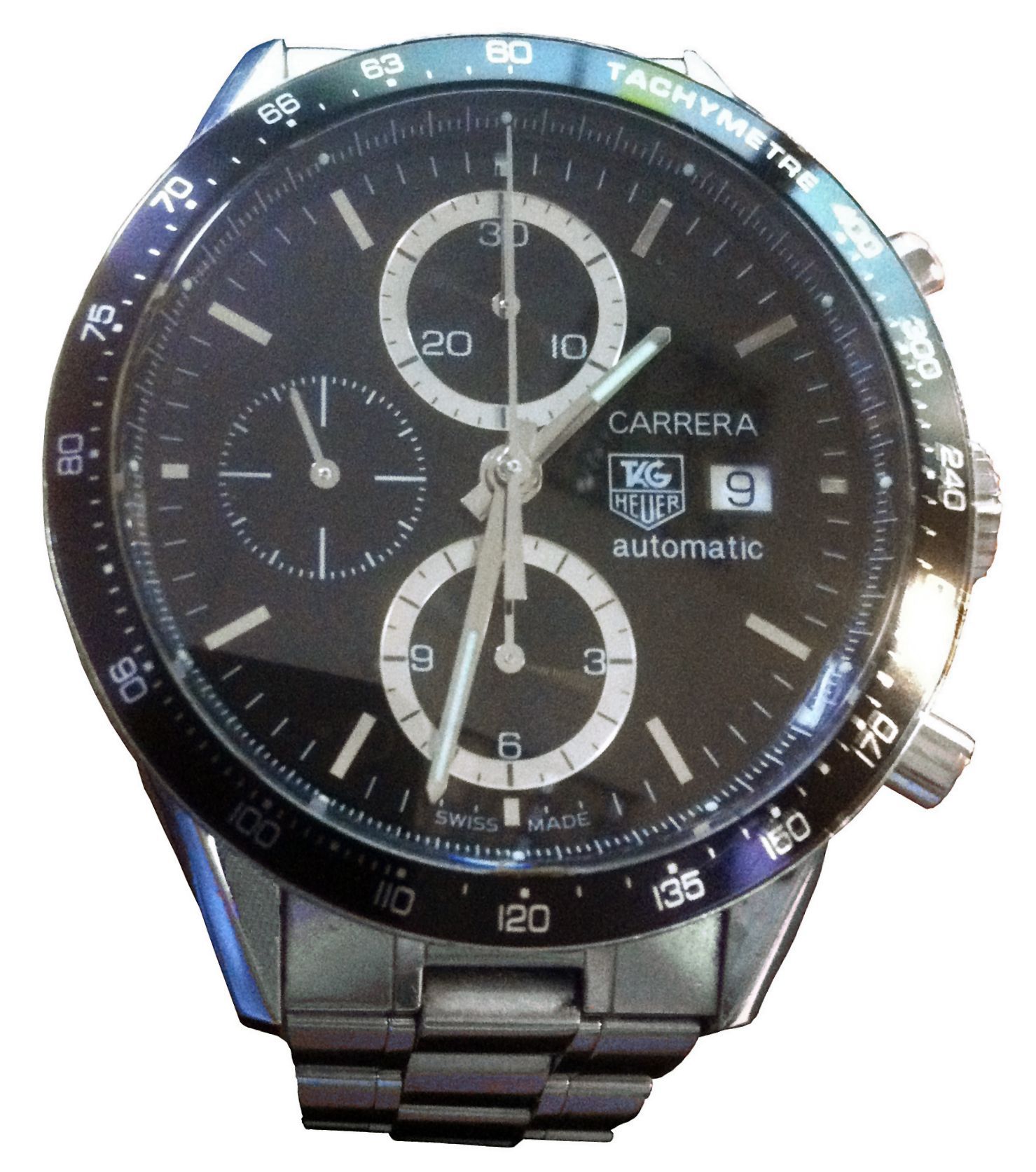
The Mikrograph was introduced at Baselworld 2011. It was the first wristwatch capable of mechanically measuring to 1/100th of a second using a dedicated high-frequency oscillator.
Architecture
The Mikrograph uses a dual-chain architecture — two completely independent kinematic chains sharing the same movement:
- Timekeeping chain : Standard frequency, 28,800 vph — the watch runs normally for 42 hours
- Chronograph chain : High-frequency, 360,000 vph (100 Hz) — activated when the chronograph is started
When the chronograph pusher is pressed, the high-frequency chain engages. The chronograph hand — driven by the 100 Hz oscillator — makes one complete revolution per second, allowing the 1/100th-second graduation on the dial to be read directly.
Power Reserve Trade-Off
The power penalty for the high-frequency chain is dramatic:
- Timekeeping power reserve : 42 hours
- Chronograph power reserve : 90 minutes only
90 minutes is the operational limit before the chronograph chain exhausts its energy allocation. This is not a flaw — it is the honest engineering consequence of running an oscillator at 25 times the energy cost of a standard chronograph. The Mikrograph is designed for precision timing of specific intervals, not for continuous chronograph use.
Production
The Mikrograph was released in a rose gold case limited to 150 pieces , priced at approximately USD 50,000 . It won the Grand Prix d'Horlogerie de Genève (GPHG) Best Sports Watch award in 2011.
Calibre Specifications
| Specification | Value |
|---|---|
| Timekeeping oscillator | 28,800 vph |
| Chronograph oscillator | 360,000 vph (100 Hz) |
| Precision | 1/100th second |
| Power reserve (timekeeping) | 42 hours |
| Power reserve (chronograph) | 90 minutes |
| Case | Rose gold, 45 mm |
| Production | 150 pieces |
Mikrotimer Flying 1000 — 2011
Photo: Pinback66 (photo); Lämpel (retouching) — CC BY-SA 3.0 — Wikimedia Commons
Also introduced at Baselworld 2011, the Mikrotimer Flying 1000 pushed the concept to 1/1000th of a second — ten times finer than the Mikrograph.
Architecture
The Mikrotimer uses the same dual-chain principle, but the chronograph oscillator operates at 1,000 Hz — 3,600,000 vph . At this frequency, the chronograph hand completes one full revolution in 1/10th of a second . Reading 1/1000th-second resolution requires the hand to be stopped at the precise moment of interest and the position read from the scale.
The oscillator design was unlike a conventional balance wheel. TAG Heuer used a special high-frequency mechanism with a perforated aluminium wheel linked to a pallet fork and escape wheel , allowing the system to oscillate at 1,000 Hz in a physically compact form. The system was described by TAG Heuer as the "Launcher-Hub-Brake" mechanism.
Power Reserve Trade-Off
- Timekeeping power reserve : 42 hours
- Chronograph power reserve : 150 seconds (2.5 minutes)
At 1,000 Hz, the chronograph chain exhausts its energy in 2.5 minutes — an honest reflection of the energy cost. The Mikrotimer is an extreme demonstration of achievable mechanical precision, not a practical timing tool for extended events.
Status
The Mikrotimer Flying 1000 was presented as a concept watch and prototype . It won the GPHG Best Sports Watch award in 2011 (alongside the Mikrograph, both receiving recognition). Serial production was not announced.
Mikrogirder — 2012
Photo: Ferengi — CC BY-SA 3.0 — Wikimedia Commons
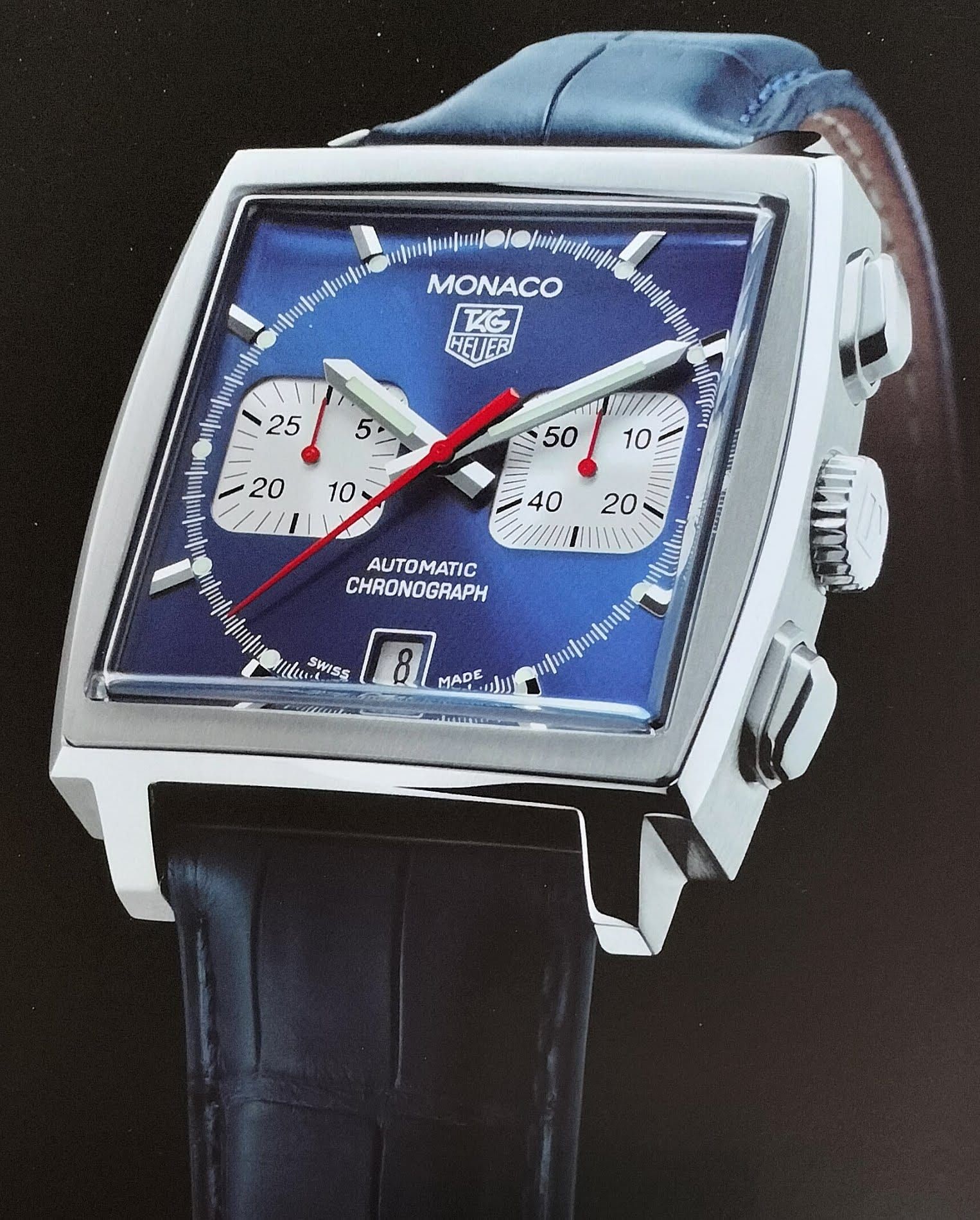
The Mikrogirder , introduced in 2012, approached the high-frequency challenge differently — by replacing the conventional balance spring with an entirely different type of oscillator.
The Carbon Composite Blade Oscillator
Instead of a coiled balance spring (hairspring), the Mikrogirder uses two carbon composite blades arranged in a crossing pattern:
- A coupling blade and an excitatory blade that flex and return, creating oscillation through blade elasticity rather than spring tension
- The crossing geometry eliminates the amplitude loss that conventional balance springs suffer at extreme frequencies
- Carbon composite is non-magnetic, temperature-stable, and does not require lubrication
The blade oscillator operates at a frequency equivalent to 7,200,000 vph — the movement is described as achieving 1/5000th of a second precision, or 5/10,000ths of a second. TAG Heuer described it as 250 times faster than a standard 4 Hz watch .
Technical Specifications
| Specification | Value |
|---|---|
| Oscillator type | Carbon composite blade (linear) |
| Equivalent frequency | ~7,200,000 vph |
| Precision | 5/10,000ths of a second |
| Movement components | 339 parts |
| Jewels | 46 |
| Movement diameter | 35.8 mm |
| Movement height | 7.96 mm |
| Patents (at launch) | 10 pending |
Status
The Mikrogirder was presented as a concept watch . The carbon composite blade oscillator represents a genuinely novel approach to wristwatch oscillation — but the extreme frequency and the associated power constraints mean that a commercially viable implementation remained a demonstration rather than a production specification at the time of its introduction.
Legacy
Photo: EMore98 — CC BY-SA 4.0 — Wikimedia Commons
The Mikrograph, Mikrotimer, and Mikrogirder collectively represent the most technically ambitious chronograph development programme any watch brand undertook in the 2010s. Their legacy is not primarily in production volumes — none achieved significant commercial production — but in demonstrating theoretical limits and developing techniques that influenced subsequent work.
The Nanograph hairspring in the Calibre Heuer 02T tourbillon (2017) is a direct descendant of the Mikrogirder's carbon composite work. The material science developed for the blade oscillator was applied to a hairspring form that could function in a conventional balance wheel architecture — producing a practical commercial product from an extreme research concept.
The Zenith El Primero 21 (Calibre 9004, announced 2017) also uses a dual-oscillator architecture to achieve 1/100th-second mechanical measurement — the same principle as the Mikrograph, independently developed. That two major brands arrived at the dual-oscillator solution independently confirms the engineering logic: for high-frequency chronograph applications, separating the timing and chronograph oscillators is the correct approach.
Frequently Asked Questions
What is the Mikrograph?
A TAG Heuer wristwatch introduced at Baselworld 2011, capable of mechanically measuring to 1/100th of a second. It uses a dual-chain architecture: a standard 28,800 vph timekeeping oscillator and a 360,000 vph (100 Hz) chronograph oscillator. Chronograph power reserve: 90 minutes. 150 pieces in rose gold.
What is the Mikrotimer Flying 1000?
A 2011 concept watch capable of 1/1000th-second measurement using a 1,000 Hz chronograph oscillator. Chronograph power reserve: 150 seconds. Presented as a prototype, not released in series production.
What is the Mikrogirder?
A 2012 concept watch using a carbon composite blade oscillator rather than a conventional balance spring — equivalent to approximately 7,200,000 vph, for 5/10,000ths-second precision. 339 components, 46 jewels.
How does the dual-chain architecture work?
Two independent kinematic chains share the movement: one drives the watch at standard frequency for normal timekeeping; the other drives the chronograph at extreme frequency for precision measurement. The high-frequency chain has a limited power reserve; the timekeeping chain operates normally regardless.
Is the Nanograph hairspring related to the Mikrogirder?
Yes. The carbon composite material science developed for the Mikrogirder's blade oscillator was subsequently applied to produce the Nanograph hairspring used in the Calibre Heuer 02T tourbillon — the same material science in a conventional hairspring form.