Tissot History: From 1853 in Le Locle to the PRX

Tissot is a Swiss watchmaker founded in 1853 in Le Locle by Charles-Félicien Tissot and his son Charles-Émile, and today a brand of the Swatch Group. This history follows it from a family assembly shop that sold pocket watches in Russia to the maker of the PRX, the integrated-bracelet watch that put it back in the conversation in 2021. It covers the people, the technology, the sport and the ownership, and ends with a collecting section. Where sources disagree, we say so. Prices were retrieved on October 25, 2026 and are indicative.
Tissot at a glance
| Detail | Fact |
|---|---|
| Founded | 1853, Le Locle, canton of Neuchâtel, Switzerland (Wikipedia, Lugaro, Worn & Wound) |
| Founders | Charles-Félicien Tissot (casemaker) and his son Charles-Émile Tissot (watchmaker) |
| Headquarters | Le Locle, Switzerland. Tissot says it has made watches there for more than 170 years |
| Owner | The Swatch Group, headquartered in Biel/Bienne. SSIH, formed from Omega and Tissot, was one ancestor of the group |
| Leadership | Sylvain Dolla was named CEO from July 2020 (Moneycab, June 18, 2020); François Thiébaud became chairman of the board |
| Known for | Accessible Swiss watches, the PRX, the Powermatic 80 automatic, the T-Touch, sports timekeeping (NBA, MotoGP, cycling) |
| Flagship collections | PRX, Seastar, Le Locle, Gentleman, Chemin des Tourelles, Visodate, T-Touch |
| Typical new price (US) | Mostly about $425 to $2,450 on the Tissot US pages we read on October 25, 2026 |
Tissot timeline
| Year | Milestone |
|---|---|
| 1853 | Charles-Félicien and Charles-Émile Tissot found the company in Le Locle. |
| 1858 | Charles-Émile goes to Russia and sells savonnette pocket watches across the Russian Empire. |
| 1885 | Charles Tissot, Charles-Émile's son, moves to Moscow to run the branch (Wikipedia, Lugaro). |
| 1907 | Tissot opens a manufacture on the Chemin des Tourelles in Le Locle, still used today per Tissot. |
| 1916 | The “Banana” watch appears; the 1917 events in Russia then end shipments there. |
| 1925 | Partnership agreement with Louis and Gustave Brandt, directors of Omega (Worn & Wound). |
| 1930 | SSIH formed from Omega and Tissot; Tissot releases the Antimagnétique, billed as the first antimagnetic wristwatch. |
| 1951 | Navigator World Timer, called the first automatic world-time wristwatch by Fratello. |
| 1971 | Astrolon (IDEA 2001), described as the first plastic mechanical watch. |
| 1983 | SSIH and ASUAG are combined under Nicolas Hayek, the road to the Swatch Group. |
| 1985 | RockWatch, a stone watch, followed by the Pearl (1987) and Wood (1988) watches. |
| 1998 | The group takes the name The Swatch Group (Wikipedia). |
| 1999 | First T-Touch, a touch-sensitive sapphire crystal watch. |
| 2001 | Tissot becomes Official Timekeeper of MotoGP (Tissot). |
| 2015 | Tissot becomes Official Timekeeper of the NBA (Tissot). |
| 2020 | Sylvain Dolla takes over as Tissot CEO in July. |
| 2021 | The PRX returns: a $375 quartz model in March, a mechanical version later that year. |
| 2026 | PRX Skeleton Damian Lillard Special Edition launches on October 21. |
1853: a family workshop and the road to Moscow
Tissot began as a family workshop. Wikipedia, Lugaro and Worn & Wound agree on the basics. In 1853, in Le Locle in the Neuchâtel Jura, Charles-Félicien Tissot, a casemaker, and his son Charles-Émile, a watchmaker, set up what Lugaro calls the Charles-Félicien Tissot & Son assembly shop. Worn & Wound calls it a comptoir assembling parts and says it delivered between 1,100 and 1,200 watches in its first year. That figure is the article's own and carries no source. Tissot's own history page is thinner: it gives 1853, the town and “more than 170 years,” and names no founders.
Brand lore adds that 1853 produced the first mass-produced pocket watch and the first pocket watch with two time zones. Wikipedia and Worn & Wound both repeat the claim, and Worn & Wound says it found no source for it, so read it as a brand claim, not an established record.
The business grew through Russia. In 1858 Charles-Émile went there and sold savonnette pocket watches across the Empire; Worn & Wound adds that this was reportedly with the Czar's blessing and names no city. Lugaro says the watches sold in the United States from 1853 and in the Russian Empire from 1858. Charles Tissot, Charles-Émile's son, moved to Moscow in 1885 to run the branch his father had set up, according to Wikipedia and Lugaro; Worn & Wound is less precise and says only that he was firmly established in Russia by the late 1880s. Lugaro says the Russian Empire was Tissot's biggest market until 1917, and Worn & Wound records a watch delivered to Czar Nicholas II in 1904.
The revolution ended that trade. The Hour Markers reports that after 1917 shipping to Russia became illegal, which is why one Banana watch returned for service never went back.
Le Locle and the Chemin des Tourelles factory
The town is part of the brand. Tissot says the Chemin des Tourelles in Le Locle is where its factory was established in 1907 and where it still operates, and it named a collection after the street. The Hour Markers also dates the move to a proper manufacture there to 1907, when it says Tissot began making wristwatches for men and women.
Worn & Wound gives the surrounding corporate steps: the firm became Charles-Émile Tissot & Fils in 1865 and Chs. Tissot & Fils SA in 1917. Its ébauche workshops became a manufacture making its own movement blanks in 1918, and a tonneau-cased model called the Porto followed in 1919. Awards at Zurich, Antwerp, Paris and Neuchâtel are listed for 1888, 1890, 1900 and 1907. These come from a single source, so we use them for context only.
The most visible survivor from this era is the Banana, released in 1916 and popular in Russia, according to The Hour Markers. Both it and Worn & Wound say today's Heritage Prince is a homage to it. It is the clearest line from the 1910s to the current range. Le Locle is also a name on the dial today: Tissot's US store describes its Le Locle line as named after the town where the company was founded, and in June 2024 Europa Star quoted Sylvain Dolla calling the classic Le Locle the brand's best-seller that year, ahead of the PRX.

Omega, SSIH and the 1930 Antimagnétique
Tissot's ties to Omega are older than the Swatch Group. Worn & Wound records a 1925 partnership agreement with Louis and Gustave Brandt, directors of Omega, and says Tissot and Omega formed SSIH in 1930 to counter the economic crisis. Wikipedia's Swatch Group entry also dates SSIH to 1930. Wikipedia's Tissot page tells it slightly differently, with an alliance in 1929 and Paul Tissot-Daguette becoming Omega's CEO in 1930.
The same year Tissot released the Antimagnétique, which it called the first antimagnetic wristwatch. Worn & Wound, The Hour Markers and Gear Patrol all date it to 1930, and Wikipedia gives “1929-30.” Gear Patrol, published in 2020, says Tissot appears to have used a palladium alloy in the regulating parts, similar to Vacheron Constantin's approach, and that a Vacheron antimagnetic pocket watch existed 15 years earlier. It also notes that Tissot cited independent Neuchâtel studies but that the resistance claims come from Tissot's own materials and no gauss figure is given.
Fratello adds a useful collecting detail. The earliest dials were small and rectangular, and the author says the logo with the word “Antimagnetique” was used from 1930 to 1959, although Tissot told him the word was registered in 1931 and absent from the earliest dials. One reader comment raises an earlier antimagnetic wristwatch, which we could not verify.
Navigator, Astrolon and a taste for experiments
After the war Tissot built a reputation for odd, ambitious ideas. Fratello dates the Navigator World Timer to 1951 and calls it the first automatic world-time wristwatch. Worn & Wound and The Hour Markers date the Navigator to 1953 and call it the first mass-produced 24-time-zone watch. Those are different claims about the same model line, and all rest on Tissot's own framing, so we do not choose between them. Fratello also says Tissot reissued the Navigator in 2019 as the Heritage 1973 Chronograph.
The boldest experiment was in 1971. Worn & Wound and The Hour Markers describe the Astrolon, also called the IDEA 2001, as the first plastic mechanical watch, and Wikipedia lists the Idea 2001 in 1971 as the first plastic watch without using the Astrolon name. We tried to confirm part counts and the reported commercial reception, but the pages we could fetch did not carry them, so we do not state them.
The 1980s brought material stunts: Wikipedia and Worn & Wound list the RockWatch in 1985, the Pearl in 1987 and the Wood watch in 1988, and Fratello says the RockWatch came in 23, 30 and 33mm with a six-jewel ETA quartz movement. They show a brand willing to use its factory for ideas rather than prestige. Worn & Wound also notes that Tissot began sponsoring racing cars in 1974. Tissot SA took its formal name in 1982, and the next year the group that would become the Swatch Group came together.
T-Touch and Powermatic 80: technology at a price
Two technologies carry the modern Tissot. The first is the T-Touch. Worn & Wound says the first T-Touch was released in 1999, and Wikipedia describes a touch-sensitive sapphire crystal that controlled compass, barometer, altimeter and thermometer functions. It lists the T-Touch Expert Solar and Lady Solar in 2014, each with 25 functions. On October 25, 2026 the T-Touch Connect Solar 47.5mm appeared on Tissot's US pages at $1,250 in titanium and $1,350 with a ceramic bezel, though these came from cached search results and should be checked.
The second is the Powermatic 80. SJX describes the PRX's version as an ETA C07-based automatic, derived from the 2824-2, with a free-sprung balance, a Nivachron hairspring, a 21,600 vph beat and an 80-hour reserve. Time+Tide wrote in 2020 that the Seastar 1000 Powermatic 80, a 43mm 300m diver, was unveiled at Baselworld 2018 and offered more than three days of reserve. We could not fetch a page that confirms the movement's original launch date, so we do not date it here.
Europa Star described Tissot in June 2024 as the largest Swiss watch brand “by any measure.” Silicon hairsprings, as Gear Patrol notes, are now the main route to antimagnetic performance in some Swatch Group watches, a long way from the palladium of 1930.
PRX: from a 1978 quartz watch to the 2021 hit
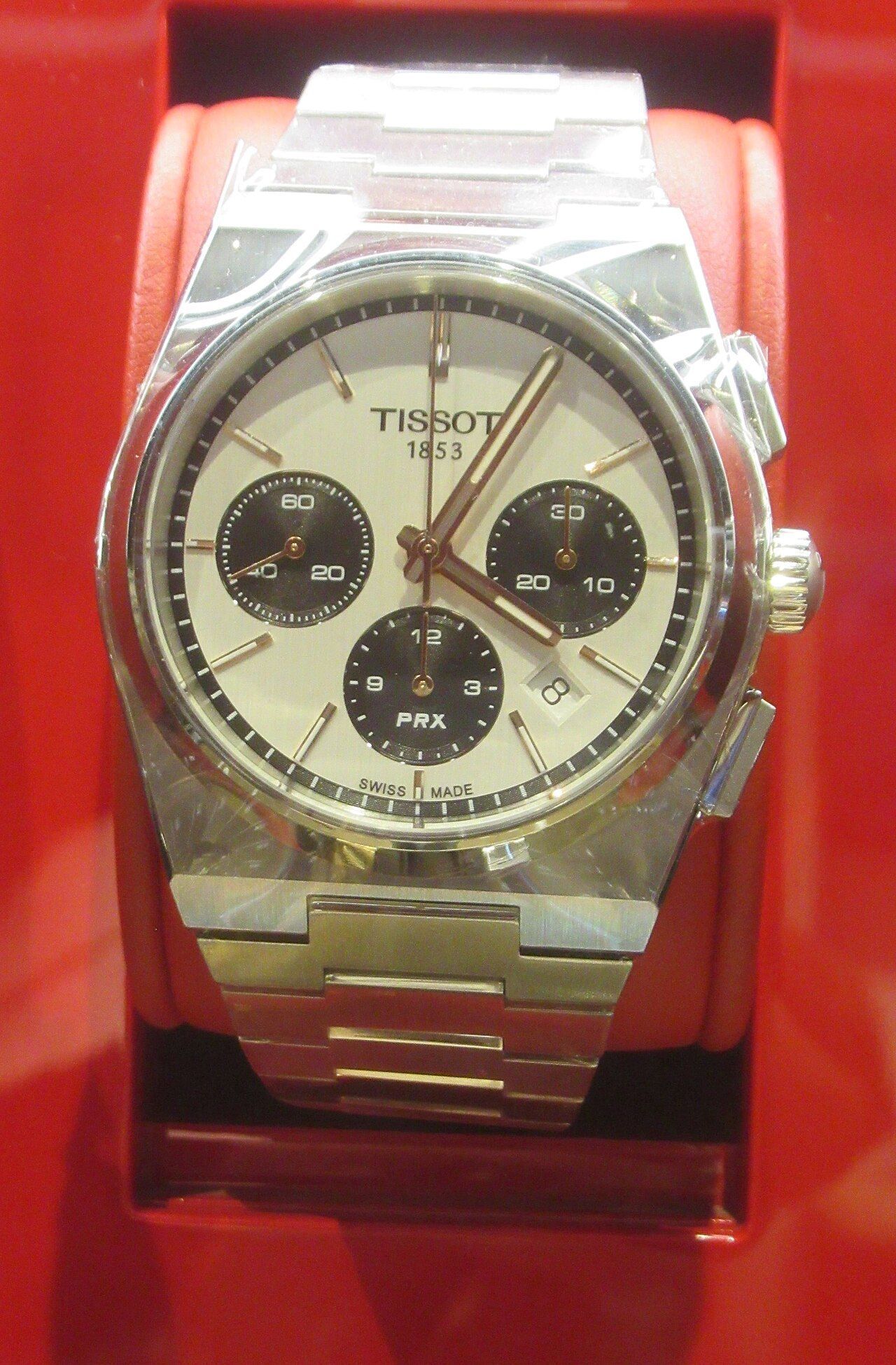
The PRX is Tissot's biggest recent story, and it is mostly a rediscovery. Oracle of Time (September 2022) says the original PRX arrived in 1978 as a quartz watch first unveiled as the Seastar, with 10 atmospheres of water resistance. Watchonista (March 2021) says “PR” stands for Precise and Robust, “X” for 10 atmospheres, and that the name was registered a few years after the 1978 watch. Tissot's US page calls the current collection “a tribute to the original timepiece from 1978.”
Sources disagree on the original's size. Oracle of Time says 35mm. SJX says the original is 40mm, then says its 35mm model returns to the diameter of the 1978 Seastar ref. 40205, which contradicts itself. We therefore give no size for the 1978 watch.
Oracle of Time reports that Sylvain Dolla found an original in the archive in his first week as CEO and quotes him: “We used tomography to be true to the original design.” Watchonista's review, dated March 18, 2021, covers the 40mm PRX 40 205 quartz: 10.40mm thick, ETA F06.115 movement, three dials, $375. It reports the model sold out after an early-March direct sale. The mechanical version was due “later this year.” Oracle of Time quotes Dolla as saying the forecast was badly wrong and production had to be multiplied by 20, and that Tissot now caps new references at 99 a year, down from at least 150. In 2023 SJX reported a 35mm Powermatic 80 at $695 to $750.

Sport, basketball and the Lillard watches
Tissot has long run its marketing through timekeeping. Its sports page lists the dates it gives itself: Official Timekeeper of the Tour de France from 1988 to 1992, a partnership with the UCI from 1995, the International Ice Hockey Federation from 1996, MotoGP from 2001, the FIM Superbike World Championship from 2011 and the NBA from 2015. The NBA relationship also covers the WNBA, though the page gives no start year for the WNBA. Wikipedia adds the Davis Cup in 1957, ski races in 1938, and Formula One sponsorship of Lotus, Renault and Sauber, without dates we could confirm.
Sources conflict on cycling. Tissot's US history page lists the Tour de France among its current timekeeping roles, while its sports page gives 1988 to 1992 only. We cannot say which is current. We also did not find the Olympics on Tissot's sports page, so we make no Olympic claim. For other brands with sporting ties, see Omega and TAG Heuer.
The most recent basketball tie-in is Damian Lillard, an NBA player known as “Dame Time.” Monochrome says the PRX Skeleton Damian Lillard Special Edition, ref. T137.405.17.371.00, is his second collaboration after a 40mm Powermatic 80 PRX with gold PVD accents. It is the first skeletonised PRX, the first hand-wound PRX and, at 44mm, the largest. It launched on October 21, 2026 at CHF 1,735 or EUR 1,895, per Monochrome, and $2,075 per aBlogtoWatch, which does not say whether it is limited. Monochrome gives the power reserve as 46 hours in the text and 43 in the spec sheet, and aBlogtoWatch says Tissot did not specify it. Our news page has the full story.
Swatch Group, volume and Russia today
Tissot belongs to the Swatch Group. Wikipedia's Swatch Group page says SSIH arose in 1930 from Omega and Tissot, that ASUAG was formed in 1931, and that the two were combined in 1983. Nicolas Hayek took the company private in 1985, and the group became Swatch Group Ltd in 1998. Sources disagree on the interim name: Worn & Wound calls the 1983 merger SMH, Wikipedia's Swatch Group page says SMH was adopted in 1986, and Wikipedia's Tissot page says SMH existed from 1983 to 1985. The group's headquarters is in Biel/Bienne; Wikipedia lists Nayla Hayek as chair and Nick Hayek Jr as CEO.
The brand's weight is in volume. In June 2024 Europa Star quoted Dolla setting a target of five million watches a year, “not yet attained,” and reported 11,000 points of sale. Tissot, Swatch and Longines together were said to account for at least half of the 17 million Swiss watches exported in 2023. For 2025, a report on Swatch Group's results said sales were CHF 6.28 billion, operating profit CHF 135 million and net profit CHF 25 million, with Tissot a key driver of the entry-level segment that gained significant share in North America. The Americas were up almost 20% in local currencies. See our pages on 2026 price increases and Swiss exports and the US tariff.
Russia was once the biggest market. On March 3, 2022, Bloomberg reported that Swatch Group put exports to Russia on hold but kept its stores open there to sell Omega, Longines and Tissot. We could not verify the later state of the Russian business, so we say nothing more.
Tissot collections and indicative US prices
| Collection | Years | What it is | Price (US) |
|---|---|---|---|
| PRX | 1978; relaunched 2021 | Integrated-bracelet sports watch in quartz and Powermatic 80 versions, 35 to 44mm | New: $425-$950 quartz and automatic; $2,150 Valjoux chronograph; Lillard Skeleton $2,075 (Tissot US, Oct 25, 2026). Pre-owned: PRX Powermatic 80 40mm $240-$252 (Loupe, Oct 25, 2026) |
| Seastar | Name on 1970s watches; Seastar 1000 Powermatic 80 shown 2018 | Dive and sport watches, quartz and automatic, 36 to 46mm | New: $495-$1,275 (Tissot US, Oct 25, 2026) |
| Le Locle | Current line; launch year not verified | Classic 39.3mm automatics named after the home town | New: $715-$1,050; gold COSC $2,225 (Tissot US, Oct 25, 2026) |
| Gentleman | Current line; launch year not verified | Everyday 38 or 40mm watches, quartz and automatic | New: $495-$1,025; gold-bezel models $2,375-$2,450 (Tissot US, Oct 25, 2026) |
| Chemin des Tourelles | Current line; launch year not verified | Dress watches, 39mm skeleton and 42mm automatic, named after the factory street | New: $875-$1,100 (Tissot US, Oct 25, 2026) |
| Visodate | Current line; origin dates not verified | Dress automatic, 39mm | New: $850-$950 (Tissot US, Oct 25, 2026) |
| T-Touch | 1999 onward | Touch-sensitive sapphire crystal multifunction watches | New: $1,250-$1,350 for Connect Solar 47.5mm (cached Tissot US pages, not re-checked) |
How to collect Tissot: new, pre-owned and vintage
New. We found no waitlist notice on the Tissot US pages we read in October 2026. The 2021 PRX was different: Watchonista reported a sellout, and Oracle of Time quoted Dolla on a forecast miss. That scarcity was a launch effect, not a permanent feature. Because the lineup is large, with 54 PRX listings on the US men's page we read, check the reference number, not just the name. Prices vary by size and material: the 40mm Powermatic 80 PRX was $850 to $950, and the 35mm automatic $795, on October 25, 2026.
Pre-owned. Loupe's PRX Powermatic 80 40mm page, generated October 25, 2026, shows a market range of $240 to $252 across six references, based on Chrono24, eBay and dealer listings with 11 active listings. That is a small sample and far below the $850 list price, so we treat it as a rough floor rather than a rule. Tissot's own prices are the benchmark, and aggregator values for the same model can differ between sources. For the secondary market in general, see our secondary market report.
Vintage. The most interesting vintage Tissots are the Antimagnétique, the Navigator and the Astrolon. Gear Patrol calls Antimagnétique watches collectible and relatively affordable, but gives no prices, and we found no dated sale prices we could verify. Fratello's author says the dating of his example rests on a serial number estimate and that Tissot archive extracts can be requested, so budget for confirming the date. He also notes radium lume on his 1949-ish piece, and that his strap and buckle were not original. Buy vintage from sellers who photograph the movement, accept returns and disclose any service history, and be careful with the lume.
Value notes. Swatch Group's 2025 results call Tissot a driver of its entry-level segment, while Wikipedia says the group classes it as mid-range. Either way, we found no evidence that new Tissots appreciate, so buy for design and a Swiss movement. See our best watches under $1,000 for alternatives.
Myths and mix-ups, corrected
- “Tissot invented the antimagnetic watch.” Tissot calls the 1930 Antimagnétique the first antimagnetic wristwatch. Gear Patrol notes a Vacheron Constantin antimagnetic pocket watch 15 years earlier, and a Fratello reader comment names an earlier antimagnetic wristwatch we could not verify. The wristwatch claim is Tissot's own.
- “The PRX is a 2021 design.” The relaunch is from 2021, but Tissot's US page, Oracle of Time and Watchonista all trace the PRX to 1978. The original was quartz and was first unveiled as the Seastar.
- “The PRX is Tissot's best-seller.” In June 2024 Sylvain Dolla told Europa Star that the classic Le Locle was the brand's best-seller that year, not the PRX. Treat that as one year's statement.
- “Tissot is an independent family firm.” It was founded by the Tissot family in 1853 but is a Swatch Group brand, and SSIH, formed from Omega and Tissot, dates to 1930.
- “The Lillard Skeleton is a limited edition.” The sources we fetched call it a Special Edition and state no production limit. aBlogtoWatch says it is available through authorized dealers.
Sources
Retrieved October 25, 2026: Wikipedia (Tissot; Swatch Group); Tissot US site (history, sports partnerships, collection pages); Worn & Wound; Lugaro; The Hour Markers; Gear Patrol; Fratello; Watchonista; Oracle of Time; SJX; Time+Tide; Europa Star; Moneycab; Monochrome; aBlogtoWatch; Bloomberg via AJOT; Time and Watches (Swatch Group 2025 results); Loupe. Prices are indicative, taken from retailer or aggregator pages on the dates stated, and change often. Swiss-franc and euro prices are in the currency reported and were not converted to US dollars; the Lillard Skeleton US price of $2,075 is the figure reported by aBlogtoWatch and Tissot's US page. GBP launch prices are not used. We could not fetch several primary sources, including the Swatch Group's own annual report, so some facts rest on secondary reports as noted.
Frequently Asked Questions
When was Tissot founded and by whom?
Tissot was founded in 1853 in Le Locle, Switzerland, by Charles-Félicien Tissot and his son Charles-Émile Tissot, according to Wikipedia, Lugaro and Worn & Wound. Tissot's own history page gives the date and place but not the founders.
Who owns Tissot?
Tissot is owned by the Swatch Group. SSIH, formed from Omega and Tissot in 1930, was one predecessor; it was combined with ASUAG in 1983 under Nicolas Hayek, and the group has been called Swatch Group since 1998.
Where is Tissot based?
Le Locle, Switzerland. Tissot says it has made watches there for more than 170 years, and its Chemin des Tourelles factory dates from 1907.
Was the Tissot PRX really made in 1978?
Yes, per Tissot's US page, Oracle of Time and Watchonista: a 1978 quartz watch first unveiled as the Seastar, relaunched in 2021 at $375 for the quartz model. Its original size is disputed between sources.
How much does a Tissot PRX cost?
On Tissot's US site on October 25, 2026, 40mm quartz PRX models were $425 to $450, 40mm automatics $850 to $950, and the 42mm Valjoux chronograph $2,150. Prices change.
Is Tissot a good watch brand?
Europa Star described it in June 2024 as the largest Swiss watch brand “by any measure”, and Swatch Group said in its 2025 results that Tissot gained significant share in North America. Whether it suits you depends on your budget and taste.
What is the Powermatic 80?
An automatic movement based on ETA's 2824-2, with an 80-hour power reserve, a 21,600 vph beat and, in the PRX, a Nivachron hairspring, per SJX in 2023.
Is Tissot the official timekeeper of the NBA?
Tissot's sports page says it has been Official Timekeeper of the NBA since 2015. We found no Olympic timekeeping on that page.
What was the first antimagnetic Tissot?
The Antimagnétique of 1930, which Tissot calls the first antimagnetic wristwatch. Gear Patrol notes an earlier Vacheron Constantin pocket watch, and the claim is Tissot's own.
Does Tissot sell in Russia?
In March 2022 Swatch Group put exports to Russia on hold and kept stores open, per Bloomberg via AJOT. We could not verify the current status.
How much is the PRX Skeleton Damian Lillard?
It launched on October 21, 2026 at CHF 1,735 or EUR 1,895 per Monochrome, and $2,075 per aBlogtoWatch and Tissot's US page.
Related Reading