Omega: The Swiss Watch That Went to the Moon
Omega Watches: A Complete Brand History
By Zach Charles, Editor, Time on the Move
Few names in horology carry the weight of Omega. Over the course of nearly 180 years, this Swiss manufacture has accumulated a record that most brands can only aspire to: official timekeeper of the Olympic Games for over nine decades, the watch brand chosen by NASA to accompany astronauts to the Moon, and the marque that has graced James Bond's wrist in every film since 1995. These are not merely marketing talking points — they are the result of a relentless, documented commitment to precision that stretches back to a modest workshop in La Chaux-de-Fonds in 1848.
What sets Omega apart from its peers in the upper tier of Swiss watchmaking is a particular combination of technical ambition and cultural presence. Where some luxury watch brands rest on heritage and exclusivity, Omega has consistently sought to prove itself under the most demanding real-world conditions — whether that means withstanding the extreme temperature swings of low Earth orbit, surviving the pressures of professional saturation diving, or keeping time to the hundredth of a second at the Olympic finish line. The brand does not merely tell you it makes accurate watches; it submits its movements to third-party testing institutions and publishes the results.
At the same time, Omega occupies a distinctive cultural space. The Seamaster's association with James Bond has given it a cinematic glamour that few mechanical timepieces can match. The Speedmaster's role in the Apollo programme — particularly its use as a manual timer during the Apollo 13 emergency — has embedded it in the history of human space exploration in a way that transcends advertising. Understanding Omega means understanding both sides of this identity: the watchmaker's workshop and the wider world in which its watches have played genuine, sometimes critical, roles.
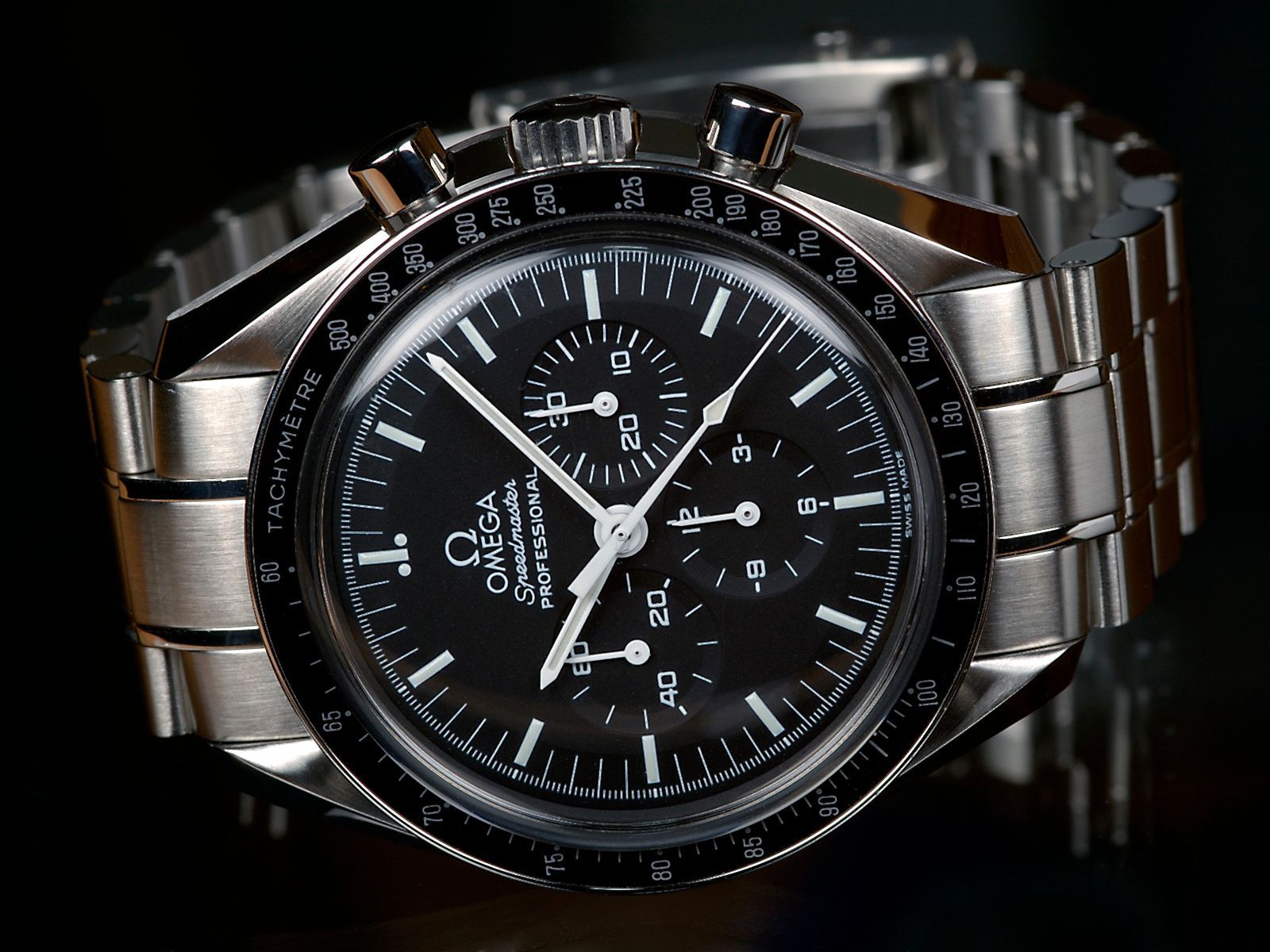
Photo: Superspido~commonswiki — CC BY-SA 3.0 — Wikimedia Commons
Origins: Louis Brandt and the La Chaux-de-Fonds Workshop (1848)
Photo: Clyde94 — CC BY-SA 4.0 — Wikimedia Commons
The story of Omega begins with Louis Brandt, born in 1825 in the Jura region of Switzerland — the heartland of the Swiss watch trade. In 1848, at the age of twenty-three, Brandt established a small workshop in La Chaux-de-Fonds, then as now one of the most important centres of Swiss horology. His operation was not a manufacture in the modern sense; Brandt sourced parts from local suppliers and assembled key-wound pocket watches by hand, selling them to merchants and traders across Europe. What distinguished his work from the outset was an insistence on consistency and finish that was unusual for a small independent assembler.
Brandt built steadily through the 1850s and 1860s, developing commercial relationships in Britain, Scandinavia, and Italy. By the time of his death in 1879, the business was turning out a respectable volume of pocket watches with a reputation for reliability. The direction of the firm then passed to his two sons, Louis-Paul and César Brandt, who recognised that the old La Chaux-de-Fonds model — artisan assembly spread across multiple suppliers — was becoming obsolete in the face of American industrialised watchmaking. In 1880, the brothers made the decisive move to Biel/Bienne, a town better positioned for rail transport and closer to the resources needed for a larger, more vertically integrated operation.
The transition to Biel marked the beginning of a true manufacture. In 1882, Louis-Paul and César introduced the Labrador calibre, the first movement produced entirely within the company rather than assembled from outside parts. With a remarkable output of eight pieces per day — high for the era — the Labrador demonstrated that Swiss watchmaking could compete with the industrial efficiency of its American rivals without sacrificing quality. A decade later, in 1892, the brothers opened the Rebberg factory, a purpose-built production facility that introduced genuine assembly-line methods to Swiss fine watchmaking. Rebberg was not a compromise; it was a statement that precision and volume were not mutually exclusive. The foundation for everything that followed was laid here, in these two practical, forward-thinking decades.
The "Omega" Name — A Calibre Becomes a Brand (1894)
The word "Omega" entered watchmaking history in 1894, when the Brandt enterprise introduced what it called the 19-ligne Omega calibre. The movement was remarkable for its time: designed from the outset around the principle of interchangeable parts, it could be repaired by any trained watchmaker anywhere in the world using standardised components. This was not merely a manufacturing convenience — it was a fundamental philosophical shift. Where luxury watches had traditionally required the skills of the watchmaker who built them to service them, the Omega calibre democratised maintenance and made the watch far more practical for the owner.
The name the company chose for this calibre carried deliberate symbolic weight. Omega (Ω) is the final letter of the Greek alphabet, used in classical and biblical tradition to signify completion, totality, and ultimate achievement. The Brandt brothers were not being modest: they were signalling that this calibre represented the apex of what they believed was achievable in practical watchmaking. The name resonated. Retailers and customers began referring to the watches themselves as Omegas, and the brand identity was born informally before it was formalised.
In 1903, the company made it official, renaming itself "Omega Watch Co." — one of the more unusual moments in commercial history, in which a calibre name became a company name because the market demanded it. The decision reflected not stubbornness but good commercial sense: the Omega name had already acquired market recognition and positive associations. By folding the company identity into the calibre identity, the Brandt heirs locked in a century's worth of brand equity.
Early 20th Century — Record-Breaking Precision
The early twentieth century was the era of the observatory trial — the formal, internationally recognised test of a movement's timekeeping ability under controlled laboratory conditions. Observatory certificates were to watchmakers what Michelin stars would later be to chefs: hard-won, publicly verifiable marks of distinction that carried genuine commercial weight. Omega pursued these trials with singular determination.
The most prestigious test of the era was administered by Kew Observatory in England, whose Class A certificate was the highest grade awarded to any timepiece. In 1914, an Omega pocket watch achieved a Kew Class A certificate — the first time a Swiss watch had ever done so. The result was not an accident or a one-off. It was the outcome of years of incremental refinement in movement design, finishing, and quality control.
When the First World War broke out, Omega supplied watches to Allied military forces, developing rugged, legible field watches designed for the particular demands of trench warfare. In 1932, Omega's role as a precision timekeeper took on a new dimension when the company served as official timekeeper at the Los Angeles Olympic Games. This was the beginning of one of the longest commercial partnerships in sporting history. Omega has served as official Olympic timekeeper at every subsequent Games through Paris 2024 — a span of more than ninety years.
The Holy Trinity of 1957
Photo: Torsten Bolten — Public Domain — Wikimedia Commons
By the mid-1950s, watchmaking was entering what historians of horology now call the tool watch era. Rolex had established the template with the Submariner (1953) and the GMT-Master (1954). Omega's response came in 1957 in the form of three watches launched simultaneously: the Seamaster 300, the Speedmaster, and the Railmaster.
The Seamaster 300 — reference CK 2913 — was designed for divers, offering 200 metres of water resistance with a rotating elapsed-time bezel and highly legible luminous indices. The Speedmaster — reference CK 2915 — was built for motorsport and aviation, featuring a tachymeter scale. The Railmaster addressed the specific hazard of electromagnetic interference faced by railway workers and engineers, with a magnetically shielded movement rated to 1,000 gauss.
What makes 1957 significant is not just the individual watches but the coordinated strategy they represent. Omega was articulating a comprehensive vision of the professional tool watch across three different use cases at once. The Speedmaster would reach the Moon. The Seamaster would define the modern luxury dive watch. The Railmaster would resurface in the twenty-first century as one of the brand's most thoughtfully designed heritage pieces.
Conquest of Space — From NASA to the Moon (1965–1972)
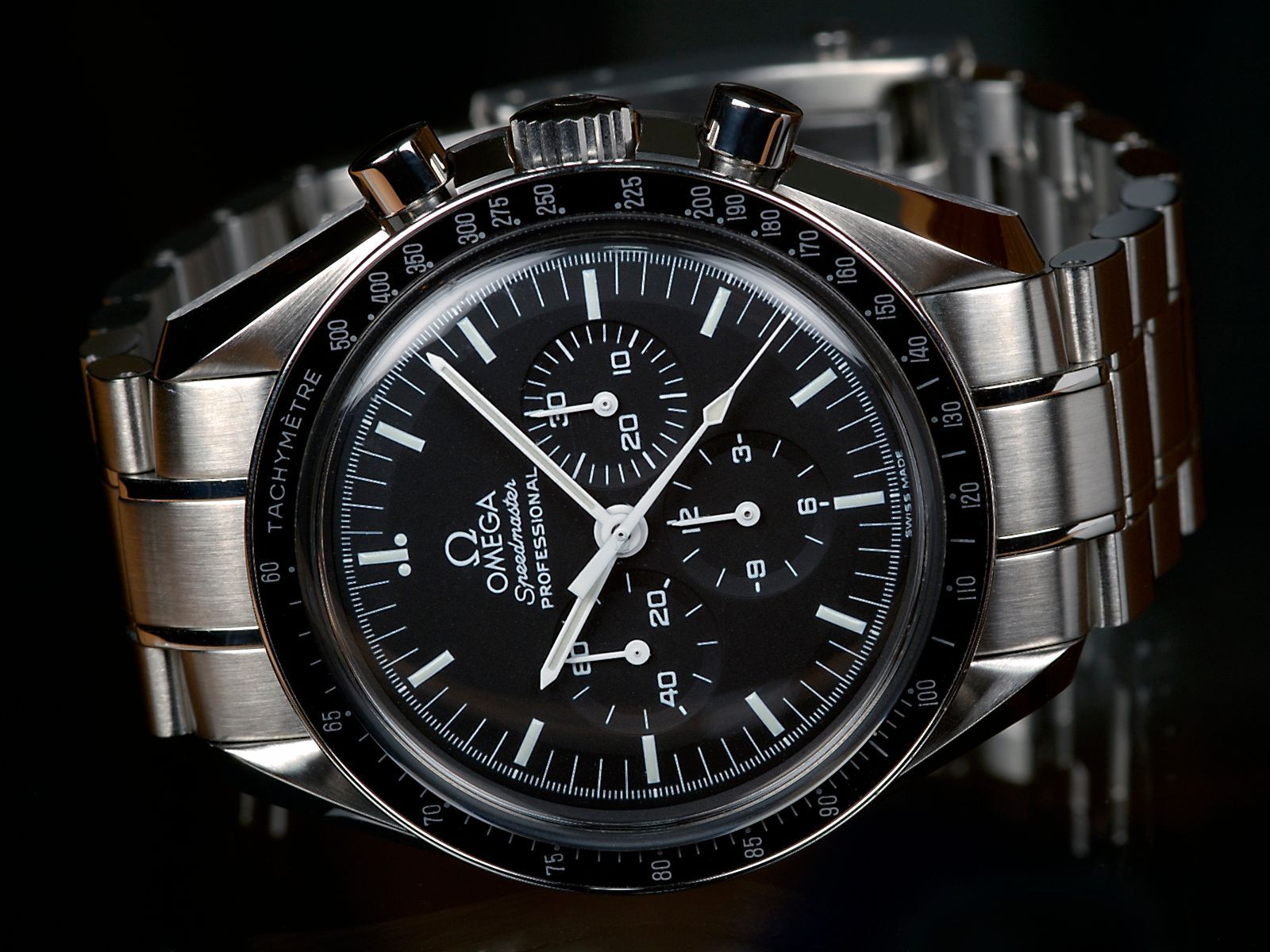
Photo: Superspido~commonswiki — CC BY-SA 3.0 — Wikimedia Commons
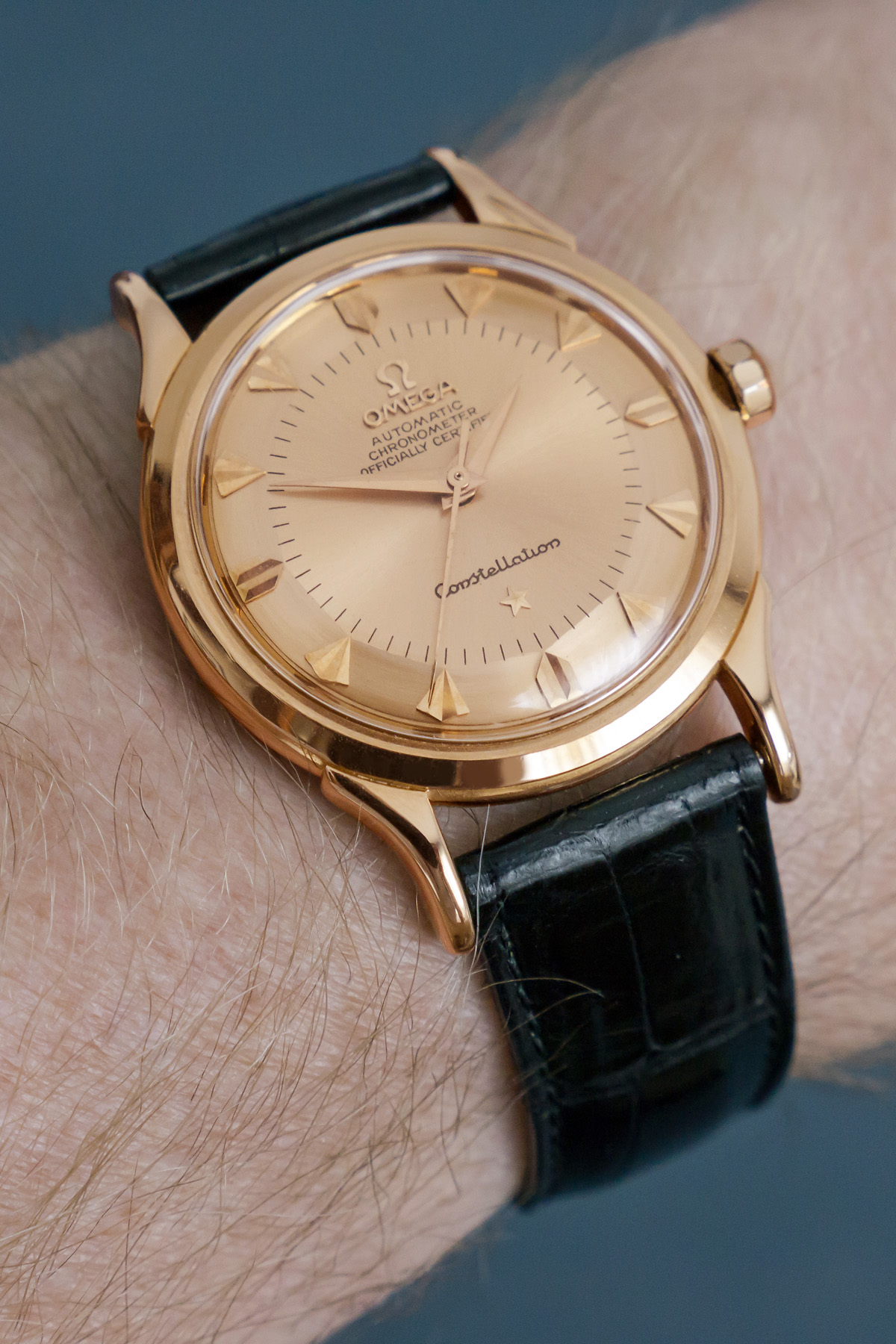
No chapter in Omega's history is more dramatic, or more thoroughly documented, than its relationship with the American space programme. In 1965, NASA was preparing for Project Gemini and required a wristwatch that could serve as a reliable timekeeping instrument in the extreme environment of space.
NASA's procurement process was unusually rigorous. Rather than approaching watch manufacturers for sponsored partnerships, the agency sent buyers to retail stores in Houston and purchased chronographs off the shelf. All were subjected to eleven tests designed to replicate the conditions of spaceflight: temperatures from -18°C to +93°C, high humidity, pure oxygen exposure, 40g acceleration, vibration, and high-intensity acoustic noise. The Speedmaster — reference CK 2998 — was the only watch to survive all eleven tests without failure.
In June 1965, NASA formally certified the Omega Speedmaster as "Flight Qualified for All Manned Space Missions." On 20 July 1969, Neil Armstrong and Buzz Aldrin carried Speedmasters — reference ST 145.012 — to the lunar surface during Apollo 11. Armstrong left his inside the Lunar Module as a backup timer; it was Aldrin's Speedmaster that made the first watched journey to the Moon's surface.
The Speedmaster's most critical moment came during Apollo 13 in April 1970. After an oxygen tank explosion crippled the Service Module, the crew used the Lunar Module as a lifeboat. With all primary systems shut down, they needed to time a precise 14-second engine burn to correct their trajectory for a safe return. Jack Swigert's Speedmaster was the only available instrument. The burn was timed manually, the correction was successful, and all three astronauts returned safely. NASA subsequently issued a formal commendation to Omega for the Speedmaster's role in the rescue.
The James Bond Connection (1995–Present)
Photo: Noop1958 — CC BY-SA 3.0 — Wikimedia Commons
For the first twenty-six years of the James Bond film franchise, the spy's watch was a Rolex. That changed in 1995 with GoldenEye, when Pierce Brosnan's Bond appeared wearing an Omega Seamaster Professional 300M in reference 2541.80 — ending the Rolex association and beginning one of the most commercially significant watch partnerships in cinema history.
Brosnan wore variants of the 300M through Tomorrow Never Dies (1997), The World Is Not Enough (1999), and Die Another Day (2002). When Daniel Craig took the role in Casino Royale (2006), Omega's Bond connection evolved rather than ended. Craig's Bond wore the Planet Ocean (2006–2010), the Aqua Terra, the updated 300M in Skyfall (2012), the vintage-inspired Seamaster 300 in Spectre (2015), and the titanium Seamaster Diver 300M 007 Edition in No Time to Die (2021). The partnership has now lasted thirty years and remains one of the most durable luxury product placements in cinema history.
The Co-Axial Revolution — George Daniels and a New Escapement (1999)
Photo: Lindemann97 — CC BY-SA 4.0 — Wikimedia Commons
George Daniels, widely regarded as the greatest horological craftsman of the twentieth century, invented the co-axial escapement in 1974. His mechanism separated the impulse and locking functions of the escapement onto different planes, dramatically reducing the lateral friction that causes lubricant breakdown in conventional lever escapements. The practical result was a mechanism requiring substantially less frequent servicing — Omega claims eight to ten years between services for co-axial movements, versus three to five for conventional lever escapement watches.
Daniels offered the design to the Swiss watch industry in the 1970s and was largely rebuffed. It was Omega, under Swatch Group leadership in the late 1990s, that finally recognised the potential. Omega licensed the design, engineered it for industrial production, and introduced the first production co-axial movement — Calibre 2500 — in 1999. By 2007, the company had committed to making the co-axial escapement standard across its entire range. George Daniels received due recognition before his death in 2011; the co-axial stands as his most significant practical legacy, now embedded in millions of Omega movements worldwide.
Master Chronometer Certification (2015–Present)
COSC — the Contrôle Officiel Suisse des Chronomètres — has long been the standard certification for Swiss movement accuracy, requiring -4/+6 seconds per day. Omega, having already moved beyond conventional lever escapements, wanted a more demanding standard reflecting real-world conditions, including the magnetic fields generated by smartphones and airport security equipment.
In 2015, Omega partnered with METAS, the Swiss Federal Institute of Metrology, to develop the Master Chronometer certification. Movements are tested over ten days and must achieve -0/+5 seconds per day — tighter than COSC — and must maintain that rate after exposure to a 15,000-gauss magnetic field, far beyond any standard antimagnetic test. The movement underpinning this certification is the Calibre 8800 series, featuring a silicon balance spring and co-axial escapement in magnetically resistant materials. Master Chronometer certification is now offered across the Seamaster, Speedmaster, Constellation, and De Ville lines.
Swatch Group and the Modern Era
In 1931, the predecessor entity SSIH brought Omega and Tissot together under common ownership. By the early 1980s, SSIH was in financial difficulty as Japanese quartz movements threatened to destroy the Swiss mechanical watch industry. Nicolas Hayek, a Swiss businessman of formidable strategic vision, consolidated SSIH and ASUAG in 1983 into what would become the Swatch Group. His strategy: use the high-volume Swatch line to defend entry-level market share while repositioning prestigious brands — Omega, Longines, Breguet, Blancpain — at the top of the market.
Within this structure, Omega became Swatch Group's flagship luxury brand. Today the group encompasses Harry Winston, Jaquet Droz, Rado, and others, but Omega remains the group's largest revenue generator and most publicly recognised brand. Olympic timekeeping has continued through Paris 2024, with Omega providing not just watches but the entire photo-finish and transponder infrastructure that determines competitive results to the hundredth of a second.
Omega Model and Technology Guides
Each Omega collection and key technology has its own in-depth history on Time on the Move:
- Omega Constellation: History of the Observatory Chronometer Watch
- Omega De Ville: History of the Co-Axial Dress Watch
- Omega Railmaster: History of the Anti-Magnetic Watch
- Omega Seamaster: History of the Swiss Dive Watch
- Omega Seamaster Aqua Terra: History of the Versatile Sports Watch
- Omega Seamaster Planet Ocean: History of the Professional Dive Watch
- Omega Speedmaster: History of the Moonwatch
Latest News
- Omega's Milano Cortina 2026 Olympic Editions: Three Watches, One Games, Ninety-Four Years of History — February 6, 2026
- Watches and Wonders 2026: Every Major Announcement, Discontinuation, and Trend — May 1, 2026
- Phillips New York Watch Auction XIV: A $13.9M F.P. Journe and a $75.8M U.S. Record — June 21, 2026
- Omega Speedmaster 38 (2026): Steel Black No-Date Homage Revives the Speedmaster Reduced — September 2, 2026
Frequently Asked Questions
When was Omega founded?
Omega traces its founding to 1848, when Louis Brandt established his watch assembly workshop in La Chaux-de-Fonds, Switzerland. The company was formally renamed Omega Watch Co. in 1903.
What does "Omega" mean?
The name derives from the 19-ligne Omega calibre introduced in 1894. The Greek letter Omega (Ω), the final letter of the alphabet, was chosen to signify the ultimate achievement in watchmaking.
Is Omega better than Rolex?
The two brands occupy comparable positions in the upper tier of Swiss watchmaking. Omega has invested more aggressively in escapement technology — the co-axial mechanism and Master Chronometer certification represent genuine technical advances. Rolex focuses on case and bracelet engineering and supply chain control, and generally commands stronger secondary market values. Neither is objectively superior; they reflect different horological philosophies.
What is a Master Chronometer?
A Master Chronometer is a METAS-certified movement that has passed ten days of testing including exposure to a 15,000-gauss magnetic field and achieved a rate accuracy of -0/+5 seconds per day after that exposure — a more demanding standard than COSC chronometer certification.