IWC Schaffhausen: The American-Founded Swiss Watch Manufacturer
By Zach Charles, Editor, Time on the Move
The International Watch Company was founded by an American. This fact sits at the centre of IWC's identity in ways both obvious and subtle: the full name — International Watch Company, never translated into German or French — was chosen by Florentine Ariosto Jones in 1868 with the confidence of a man who believed he was building something that would sell to the world. That confidence was not misplaced, though the path from Jones's original vision to the manufacturer IWC eventually became required more than a century of revision, near-collapse, and a series of individuals who each understood the company's potential before its moment arrived.
IWC occupies a position in Swiss watchmaking that is genuinely singular: technically serious without the horological antiquarianism of Patek Philippe; historically grounded without the brand mythology of Rolex; mechanically adventurous without the complication-as-art philosophy of A. Lange & Söhne. The collections — Pilot's Watch, Portugieser, Portofino, Ingenieur, Aquatimer, Da Vinci — are each coherent around a specific brief, and the brief in each case is functional before it is aesthetic.
Photo: サフィル — CC BY-SA 4.0 — Wikimedia Commons
Florentine Ariosto Jones and the Rhine (1868)
Photo: Ferengi — CC BY-SA 3.0 — Wikimedia Commons
Schaffhausen was selected for a reason that had nothing to do with watchmaking tradition and everything to do with industrial practicality. The Rhine falls at Schaffhausen — the Rheinfall, the largest waterfall in Europe — provided hydraulic power at a time when electricity was not yet a viable industrial energy source. Jones, a former superintendent at the American Waltham Watch Company who had absorbed the American system of parts-interchangeability, saw Schaffhausen as a location where he could apply American manufacturing methods to Swiss labour and materials.
The proposition was straightforward: use machine tools to produce standardised, interchangeable components at scale, then assemble them with Swiss craft. American watchmaking had developed this approach to address a labour shortage; Jones believed it was simply the correct way to make watches efficiently, and that efficiency would allow competitive pricing in the global market his brand name anticipated.
The strategy was partially successful. Jones produced watches. The factory ran. But the financial architecture was fragile — Jones had borrowed to establish the company, and the revenue curve did not match his projections. By 1875, Jones had lost control. The company passed through a brief, unsuccessful period under American management before a figure arrived who would determine its survival.
The Rauschenbach Era (1880–1978)
Johannes Rauschenbach-Vogel acquired IWC in 1880. This is the moment that secured the company's continuity: the Rauschenbach family — wealthy industrialists from Schaffhausen with interests in machinery and metalworking — provided the financial stability that Jones's entrepreneurial ambition had not. Under the family's ownership, IWC became a serious Swiss manufacturer: consistent, quality-focused, not spectacular but not in danger of dissolution.
The Rauschenbach period lasted across three generations and nearly a century. It is not remembered for horological firsts or dramatic innovations but for institutional solidity. IWC built a reputation during this era for movement quality, precision finishing, and durability — qualities that would prove foundational when the company began to develop the specialist instrument watches of the mid-twentieth century.
The last private owner from the extended family was Hans Ernst Homberger, who had married into the Rauschenbach line. By the 1970s, the economics of Swiss watchmaking were in severe distress. The quartz crisis — the flooding of the market with accurate, inexpensive Japanese electronic movements — was destroying the commercial basis of Swiss mechanical watchmaking. Homberger negotiated the sale of IWC to VDO Adolf Schindling AG, a German automotive instruments manufacturer, in 1978.
Günter Blümlein and the Transformation (1980–2001)
Photo: EMore98 — CC BY-SA 4.0 — Wikimedia Commons
The VDO acquisition brought IWC under the umbrella of what would become Les Manufactures Horlogères — LMH — a group that eventually included Jaeger-LeCoultre and, later, A. Lange & Söhne. The individual who shaped what this meant in practice was Günter Blümlein.
Blümlein arrived at IWC as general manager in 1980. He was an engineer by training and a watch enthusiast by formation — a combination that produced a leader who understood both the mechanical substance of what IWC made and the commercial logic of how it needed to be positioned. His assessment of IWC's situation was clear: the company had quality, heritage, and manufacturing capability that were being significantly undervalued, both commercially and creatively. The solution was to demonstrate what IWC was actually capable of.
The Blümlein era produced a sequence of achievements that defined IWC as a complication-capable manufacture of the first order:
1985 — Da Vinci Perpetual Calendar. Kurt Klaus developed the perpetual calendar module that would bear his name: 81 components, settable by crown alone without tools or pushers, accurate until 2499 (skipping only 2100, which is not a leap year under the Gregorian calendar). The Da Vinci perpetual calendar remains one of the most elegant horological mechanisms of the twentieth century.
1990 — Da Vinci Grande Complication. Expanding on the 1985 foundation, the Grande Complication added a minute repeater and split-seconds chronograph to the perpetual calendar. One watch; three grand complications.
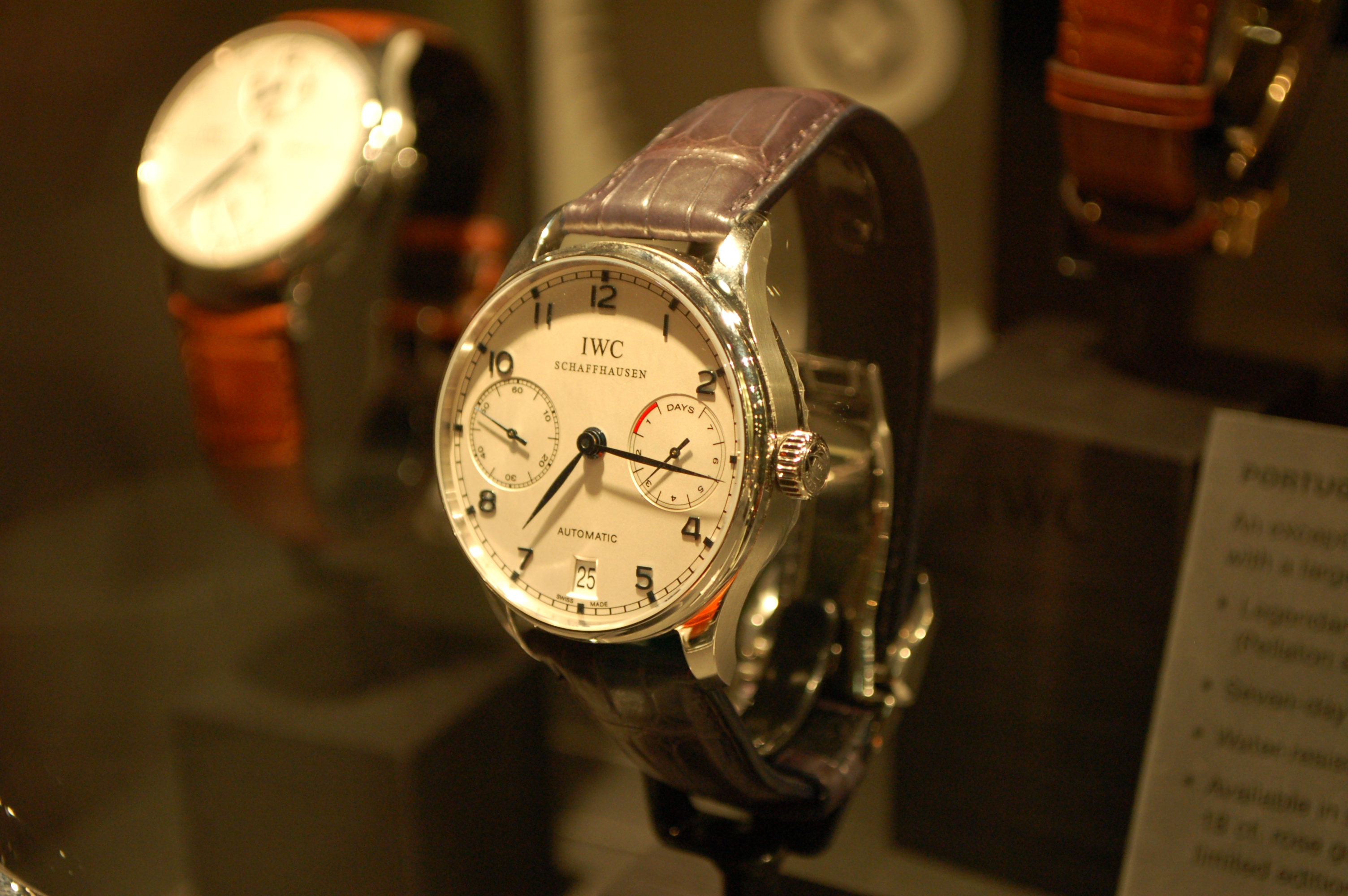
1993 — Portugieser Jubilee. The revival of the Portugieser name — dormant since the 1981 production end of the original references — in a series of 1,750 pieces that reintroduced IWC to the collectors who would drive the brand's modern growth.
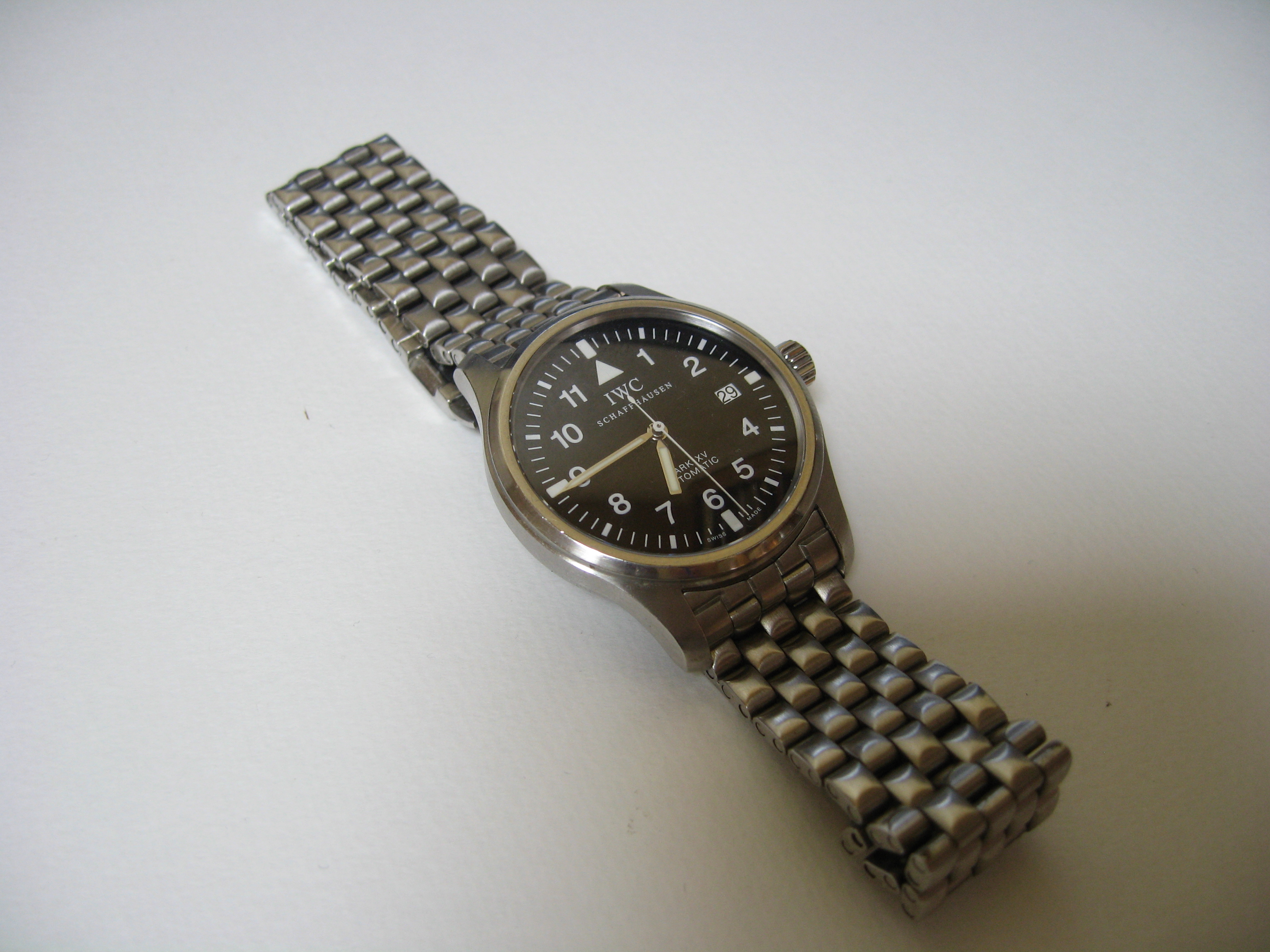
1994 — Mark XII. The relaunch of the Mark series in modern form, with a JLC-base calibre dressed as the IWC Cal. 884 and a 36mm case that respected the proportional language of the military originals.
2002 — Big Pilot IW5002. Blümlein's final major project, completed posthumously. The modern revival of the Big Pilot, with a 46mm case and the Pellaton winding system, established the watch that would become IWC's most recognisable single reference.
Blümlein died on 1 October 2001, aged 58. He had negotiated IWC's acquisition by Richemont in July 2000 — securing the company's future as part of a global luxury group — but did not live to see most of what his final years of work would produce.
Richemont and the Georges Kern Era (2002–2016)
Photo: EMore98 — CC BY-SA 4.0 — Wikimedia Commons
Richemont's acquisition brought resources and distribution that an independent mid-sized manufacture could not have achieved alone. The question was whether the institutional character Blümlein had established would survive absorption into a conglomerate that also included Cartier, Van Cleef & Arpels, and Piaget.
Georges Kern was appointed CEO in 2002. His fourteen-year tenure resolved that question emphatically in the affirmative: IWC under Kern became more commercially successful, more widely distributed, and more clearly positioned than it had been at any previous point in its history. The Pilot's Watch family was expanded and systematised. The Ingenieur was revived. Marketing investments in motorsport and aviation made IWC visible to audiences that Swiss watch marketing had not previously prioritised.
Kern's critics — and there were collectors who found the era's aggressive growth strategy alienating — argued that IWC under Richemont prioritised commercial expansion over the technical seriousness that Blümlein had emphasised. The watches became larger, marketing became louder, and the brand's positioning drifted from engineering heritage toward lifestyle aspiration.
The watch that best illustrated this tension was the Ingenieur SL — the Gérald Genta-designed reference from 1976 that Kern's team revived in forms that divided collector opinion. But the commercial success of the era was undeniable: IWC's revenue and global profile during the Kern years bore no comparison to the company's position in 2002.
Christoph Grainger-Herr and the Manufacture Era (2017–Present)
Photo: EMore98 — CC BY-SA 4.0 — Wikimedia Commons
Christoph Grainger-Herr took over as CEO in April 2017. His tenure has been characterised by a systematic internalisation of movement production — the commitment to in-house calibres that Blümlein had begun but Richemont's group-sourcing approach had partially suspended.
The new manufacture building opened in 2018 for IWC's 150th anniversary — a purpose-built facility that enabled the in-house production rollout:
- 2019 — Spitfire : First Spitfire models with in-house calibres replace JLC-base movements
- 2020 — Portugieser Chronograph : In-house Cal. 69000 column-wheel chronograph replaces the long-serving Val. 7750-base movements
- 2022 — Mark XX : Cal. 32111 — a fully in-house, silicon-component 32000-family movement — debuts in the Mark series, completing the transition the Mark XI had served in the RAF for three decades
The programme represents a genuine strategic investment: IWC is now producing its own movements across the major families rather than sourcing from JLC, ETA, or Sellita. The cost is real; the benefit — manufacturer credibility and supply chain independence — is equally real.
The IWC Approach to Accuracy
Photo: EMore98 — CC BY-SA 4.0 — Wikimedia Commons
One technical aspect of IWC's philosophy deserves direct address, because it is frequently misunderstood: IWC does not submit its movements to COSC for chronometer certification. This is not an oversight and not a concession. It is a deliberate position.
IWC applies its own testing standard: movements must achieve 0 to +7 seconds per day in the cased watch as worn — a stricter upper bound than COSC's +6, and the specification is measured after casing, in actual wearing conditions, rather than on a timing machine. IWC's position is that the relevant accuracy standard is in-use performance, not bench performance, and that its own standard reflects this priority.
Collectors should understand this clearly: an IWC movement without COSC certification is not a movement that failed COSC testing. It is a movement from a manufacturer that considers its own standard more meaningful than COSC's.
The Collections
Pilot's Watch — The broadest and most historically grounded family. The anti-magnetic soft-iron inner case, established in the Mark series for RAF contract work, defines the technical identity. The family spans from the Mark series and Big Pilot to the Spitfire and Top Gun.
Portugieser — The elegant, large-diameter watch born from a 1939 commission for pocket-watch precision in a wristwatch case. Now IWC's dress watch flagship. The first delivery went to a Ukrainian wholesaler in Odessa; the Portugal connection came later.
Portofino — The 1984 dress watch, designed under Hannes Pantli, named after an Italian fishing village. IWC's understated formal reference.
Ingenieur — The anti-magnetic sports watch, from the 1955 original to Gérald Genta's 1976 "Jumbo" redesign. The 2025 Perpetual Calendar revival acknowledges the Genta design explicitly.
Aquatimer — The dive watch, remarkable for introducing an internal rotating bezel under the crystal in 1967. The SafeDive system added in 2009 extended the architecture.
Da Vinci — The complication watch, most famous for Kurt Klaus's 1985 perpetual calendar. The Da Vinci name has been applied to a range of complications across the years.
Frequently Asked Questions
Who founded IWC?
Florentine Ariosto Jones, an American from the Waltham Watch Company, founded IWC in Schaffhausen in 1868. He chose Schaffhausen for its access to Rhine waterpower and applied American parts-interchangeability methods to Swiss manufacture. Jones lost control of the company by 1875; the Rauschenbach family acquired it in 1880.
Why is IWC in Schaffhausen rather than Geneva or the Jura?
Jones selected Schaffhausen specifically for the Rheinfall — the Rhine waterfall — which provided hydraulic power for his factory machinery. Schaffhausen is in German-speaking Switzerland, geographically distant from the traditional watchmaking cantons of Neuchâtel, Geneva, and the Jura. IWC remains the only major Swiss watch manufacturer based there.
Does IWC make its own movements?
Increasingly yes. Following the opening of a new manufacture in 2018, IWC has systematically introduced in-house calibres across its collections: the 32000 family (Pilot's Watch including Mark XX), the 69000 chronograph (Portugieser), and the 52000 Pellaton automatics (Portugieser, Big Pilot). Some references continue to use third-party base movements.
Why doesn't IWC have COSC certification?
IWC deliberately does not submit to COSC, applying instead its own in-cased accuracy standard of 0 to +7 seconds per day — measured after casing in wearing conditions. IWC's position is that in-use accuracy is a more relevant standard than bench certification. The absence of COSC marking on an IWC watch is not a quality deficiency.
Who owns IWC?
IWC has been owned by Richemont — the Swiss luxury conglomerate — since 2000, when Günter Blümlein negotiated the acquisition. Richemont also owns Cartier, Jaeger-LeCoultre, A. Lange & Söhne, Vacheron Constantin, and Panerai, among others.
What is the Pellaton winding system?
The Pellaton system is an automatic winding mechanism developed by IWC's master watchmaker Albert Pellaton in the late 1940s. It uses a pair of pawls engaging a toothed wheel, transferring winding energy in both directions of rotor rotation with high efficiency — particularly valuable in low-movement conditions. The Pellaton system is used in the Big Pilot and Portugieser automatics and is considered one of the most reliable automatic winding architectures in Swiss watchmaking.