IWC Big Pilot: History of the Oversized Aviation Watch
In 1940, the German Luftwaffe needed a watch so large it was barely a watch at all. The Beobachtungsuhren specification — the B-Uhr — called for a minimum 55mm case diameter: a navigation instrument worn on the wrist because the cockpit instrument panels of the era could not accommodate every timing function a bomber crew needed. The watch had to be legible without lifting the wrist to read it. It had to be accurate. It had to be magnetically shielded. It had to be undeniably present.
IWC's response to that brief — the ref. 431, with its Cal. 52T SC and its onion crown and its soft-iron inner case — was not the most elegant object IWC Schaffhausen has ever produced. It was the most purposeful. And when Günter Blümlein, in the final years of his life, decided to revive the concept for the modern market, he understood that the purposefulness was the point.
Photo: Ferengi — CC BY-SA 3.0 — Wikimedia Commons
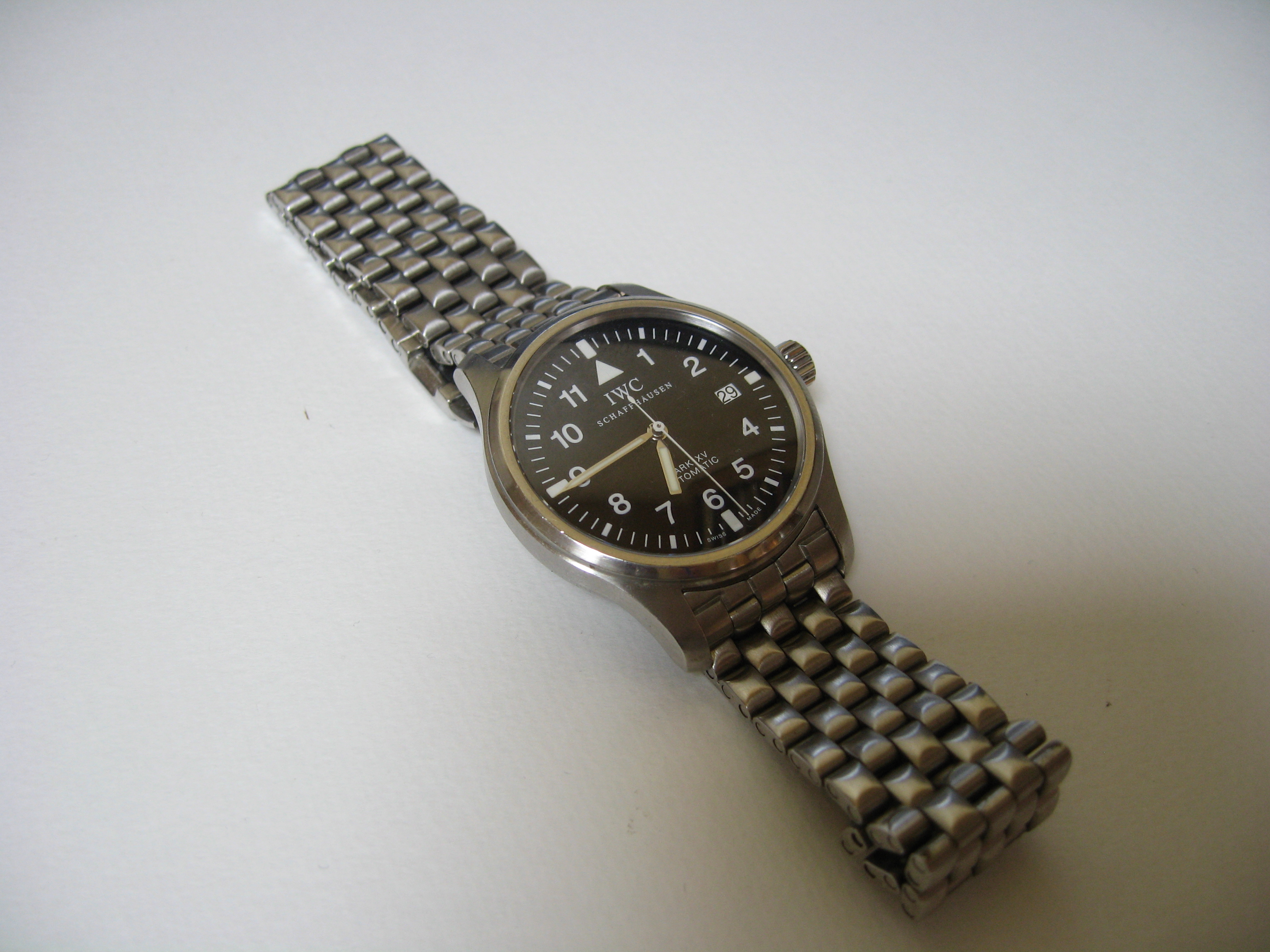
The Original B-Uhr (Ref. 431, 1940)
Photo: Ferengi — CC BY-SA 3.0 — Wikimedia Commons
The Beobachtungsuhren — "observer's watches" — were specified by the Luftwaffe in 1940 as a class of aviation instrument watches. The specification required:
- Case diameter: 55mm minimum
- Dial: Triangle marker at 12 o'clock (for rapid orientation without numerals); applied Arabic numerals
- Crown: Oversized onion-shaped, for manipulation with gloved hands
- Movement: Large-format calibre with a minimum 44-hour power reserve
- Anti-magnetic protection: Soft-iron inner case
- Water resistance: Appropriate for operational conditions
Five manufacturers were contracted: A. Lange & Söhne, Laco, Stowa, Wempe — and IWC. IWC was the only Swiss manufacturer in the programme. The others were all German, and the inclusion of a Swiss firm reflected the Luftwaffe's willingness to source the best available instrument regardless of national origin.
IWC produced the ref. 431 with the Cal. 52T SC — a large-format, hand-wound movement sized to the 55mm case specification. The onion crown, which has become one of the most recognisable design elements in the Pilot's Watch family, was functional before it was iconic: it needed to be operated by aviators wearing heavy leather gloves, and its size reflected that operational requirement directly.
Approximately 1,000 B-Uhr ref. 431 pieces were produced. They survive in varying states of preservation; complete examples in original condition are significant collector objects.
The Gap — The B-Uhr Becomes History
Photo: サフィル — CC BY-SA 4.0 — Wikimedia Commons
After the wartime production, IWC did not continue to offer an oversized pilot's watch through the postwar period. The Mark series continued in 36mm form — practical, wearable, within the size parameters of everyday professional use. The B-Uhr remained in the archive.
This was the correct commercial decision for the period. The extreme case size of the B-Uhr was a functional requirement of wartime aviation instrumentation. As cockpits became more sophisticated and wristwatches became more integrated into daily professional life, the rationale for 55mm diminished. The Mark series was what professional aviators actually wore.
The B-Uhr reference 431 became a collector object rather than a production watch — sought after for its wartime documentation, its connection to the Luftwaffe specification, and the specific character of its 55mm case and oversize crown. Prices for original examples grew steadily as aviation-heritage collecting developed.
Günter Blümlein and the Modern Revival (2002)
Photo: Ferengi — CC BY-SA 3.0 — Wikimedia Commons
Günter Blümlein initiated the modern Big Pilot project as one of his final major contributions to IWC before his death in October 2001. The brief he set was specific: not a reproduction of the B-Uhr ref. 431, but an homage — a modern manufacture watch that carried the B-Uhr's visual and functional vocabulary into a contemporary mechanical package.
The result, launched in 2002 as reference IW5002, made the following choices:
Case: 46mm. Not 55mm. Blümlein and his team recognised that 55mm was a cockpit specification, not a wrist specification. 46mm was the threshold at which the B-Uhr's visual dominance and presence could be maintained while remaining a watch that might actually be worn on a contemporary wrist. It was still enormous by Swiss watchmaking standards of 2002 — the era had not yet fully embraced the 44mm+ casual it would later reach.
Crown: Oversized, screw-down. The onion crown of the B-Uhr was adapted into a substantial crown with a crown-guard architecture — functional in the tradition of the original, but updated for modern water-resistance standards and daily-wear durability.
Movement: Cal. 5011 with Pellaton winding. This was the heart of the specification. The Cal. 5011 used IWC's Pellaton automatic winding system — the pawl-winding mechanism developed by Albert Pellaton in the late 1940s, which transfers winding energy in both directions of rotor rotation with exceptional efficiency. The result: a seven-day power reserve. 168 hours. A watch wound on Monday that would continue running through the following Monday.
Power reserve indicator. The front dial of the IW5002 displays a sector power reserve indicator — a practical instrument feature that invites the wearer to treat the watch as an instrument, monitoring remaining reserve rather than simply trusting habitual daily wear.
Design vocabulary. Triangle at 12, applied Arabic numerals, luminous handset, soft-iron inner case. The continuity with the B-Uhr original is obvious and intentional.
The Pellaton System — Seven Days from Albert Pellaton
Photo: サフィル — CC BY-SA 4.0 — Wikimedia Commons
The Pellaton winding system is worth understanding specifically because it is what makes the Big Pilot's seven-day power reserve possible.
Albert Pellaton was IWC's master watchmaker from the 1940s into the 1960s. His automatic winding system, developed in the late 1940s, addressed a fundamental inefficiency in conventional automatic winding: most rotor-driven winding systems only transferred winding energy in one direction of rotor rotation, losing efficiency every time the rotor reversed.
The Pellaton system uses two pawls that engage a ratchet wheel alternately as the rotor swings in each direction. On every swing — clockwise and counterclockwise — winding energy is transferred to the mainspring barrel. The result is an automatic system that is approximately twice as efficient per unit of rotor movement as a conventional unidirectional system.
The practical consequence for the Big Pilot: a barrel architecture designed for a large power reserve can accumulate energy quickly enough to sustain the seven-day specification. The same system is used in IWC's Portugieser automatics. Collectors who carry the watch irregularly — wearing it on weekends, leaving it in a drawer during the week — will find the seven-day reserve accommodates their wearing pattern without requiring manual winding to compensate.
The Big Pilot Family Today
Photo: Ferengi — CC BY-SA 3.0 — Wikimedia Commons
The original IW5002 has been succeeded across two decades by a range of references that maintain the core specification while adapting for market segments and aesthetic preferences.
IW501001 — The current flagship. 46mm, Cal. 51111 (evolved Pellaton system), 168-hour power reserve, steel case. The reference that most directly continues Blümlein's 2002 vision.
Big Pilot Perpetual Calendar — The complication variant. The Da Vinci's perpetual calendar tradition combined with the Big Pilot architecture. 46mm, Cal. 52850.
Big Pilot Top Gun — Ceramic case (black zirconia), 44mm, for buyers who want the Top Gun military specification in the large-format case.
Big Pilot 43 — A 43mm variant introduced to address buyers who found 46mm impractical. Functionally identical to the 46mm references but with improved wearability under a shirt cuff. Reference IW329301.
The Case for Large
The Big Pilot's 46mm case is its most debated feature — a genuinely polarising specification. Collectors who embrace it argue that the watch's visual authority is inseparable from its size: a 40mm watch with the Big Pilot's dial design would be a pilot's watch. A 46mm watch with that design is a statement. The B-Uhr was not small.
Critics note that 46mm case diameter typically means 14mm or more in height and 55mm or more lug-to-lug — numbers that create genuine difficulties for wrists under 18cm and that make the watch essentially incompatible with formal dress contexts.
IWC's response was the Big Pilot 43: a reference that preserves the design vocabulary at a more wearable scale, at the cost of some visual drama. The 43mm version is the practical choice; the 46mm is the committed one.
Secondary Market and Collector Position
The Big Pilot occupies a specific secondary market position: above the Mark series in price and profile, below the Portugieser in collector prestige, and unique in the IWC lineup as the watch that most visibly references the wartime heritage.
Early IW5002 references from the 2002 launch have appreciated steadily — partly because they are the first-generation modern revival, partly because the Pellaton system's longevity has been proven over two decades of production. Buyers seeking the closest modern equivalent to the original B-Uhr should look at the IW5002 and its immediate successors; the current production references have evolved somewhat in detail.
Prices for current new-old-stock and recent secondary market Big Pilot references in steel typically run $10,000–$15,000 depending on configuration. Limited edition and precious metal references command meaningful premiums. The Top Gun ceramic variants tend to hold value well due to the ceramic case's scratch resistance and the sub-family's focused appeal.
Frequently Asked Questions
What is the Big Pilot based on?
The IWC Big Pilot is based directly on IWC's wartime B-Uhr ref. 431, produced in 1940 for the Luftwaffe to the Beobachtungsuhren specification. The triangle at 12, oversized crown, applied numerals, and soft-iron inner case all derive from that brief. The modern revival was initiated by Günter Blümlein as his final major project before his death in 2001.
How long does the Big Pilot's power reserve last?
The Cal. 51111-equipped Big Pilot references achieve 168 hours — seven days — of power reserve via the Pellaton double-pawl winding system. The Big Pilot 43 with Cal. 82800 achieves 60 hours.
Is 46mm too large?
For many wrists and lifestyle contexts, yes. The 46mm Big Pilot is genuinely large — difficult under a shirt cuff, impractical for formal dress, demanding of a wrist circumference above 18cm for comfortable wear. IWC's 43mm Big Pilot variant addresses this. If 46mm has historically been too large for you, the 43mm is the reference to consider rather than the full-size.
What is the difference between the Big Pilot and the Mark XX?
Both are IWC Pilot's Watches with in-house calibres and soft-iron inner cases. The Big Pilot (46mm, seven-day power reserve, Cal. 51111) is the large-format heritage statement. The Mark XX(40mm, five-day power reserve, Cal. 32111 with silicon components) is the practical daily-wear reference. They share a design vocabulary but serve different purposes and different wrists.
How does the Pellaton system work?
The Pellaton system uses two spring-loaded pawls that engage a toothed ratchet wheel alternately as the rotor swings in each direction. Every swing — clockwise and counterclockwise — transfers winding energy to the mainspring barrel. This makes the system approximately twice as efficient per unit of rotor movement as conventional unidirectional winding, enabling the seven-day power reserve in a wrist-worn automatic.