
IWC Mark Series: Complete History from Mark IX to Mark XX

Zach Charles • July 9, 2026

Share this article

IWC Mark Series: Complete History from Mark IX to Mark XX

The IWC Mark series is the longest continuously evolved military-heritage pilot's watch line in Swiss watchmaking. It begins with a reference that was never officially called "Mark" during its production and ends — so far — with a 2022 watch housing IWC's first fully in-house pilot's watch calibre with silicon components and a five-day power reserve. Between those two points lies every meaningful shift in the relationship between Swiss watchmaking and professional military aviation: wartime contracts, Cold War RAF service, the quartz crisis hiatus, the collector revival, and finally the in-house manufacture rollout.

Covering the series correctly requires confronting some received wisdom that is not quite accurate, understanding the military procurement process that shaped each generation, and recognising why collectors who know the Mark series well regard certain references — the Mark XI especially — with a reverence that goes beyond nostalgia.


IWC Pilot’s Watch Mark XV
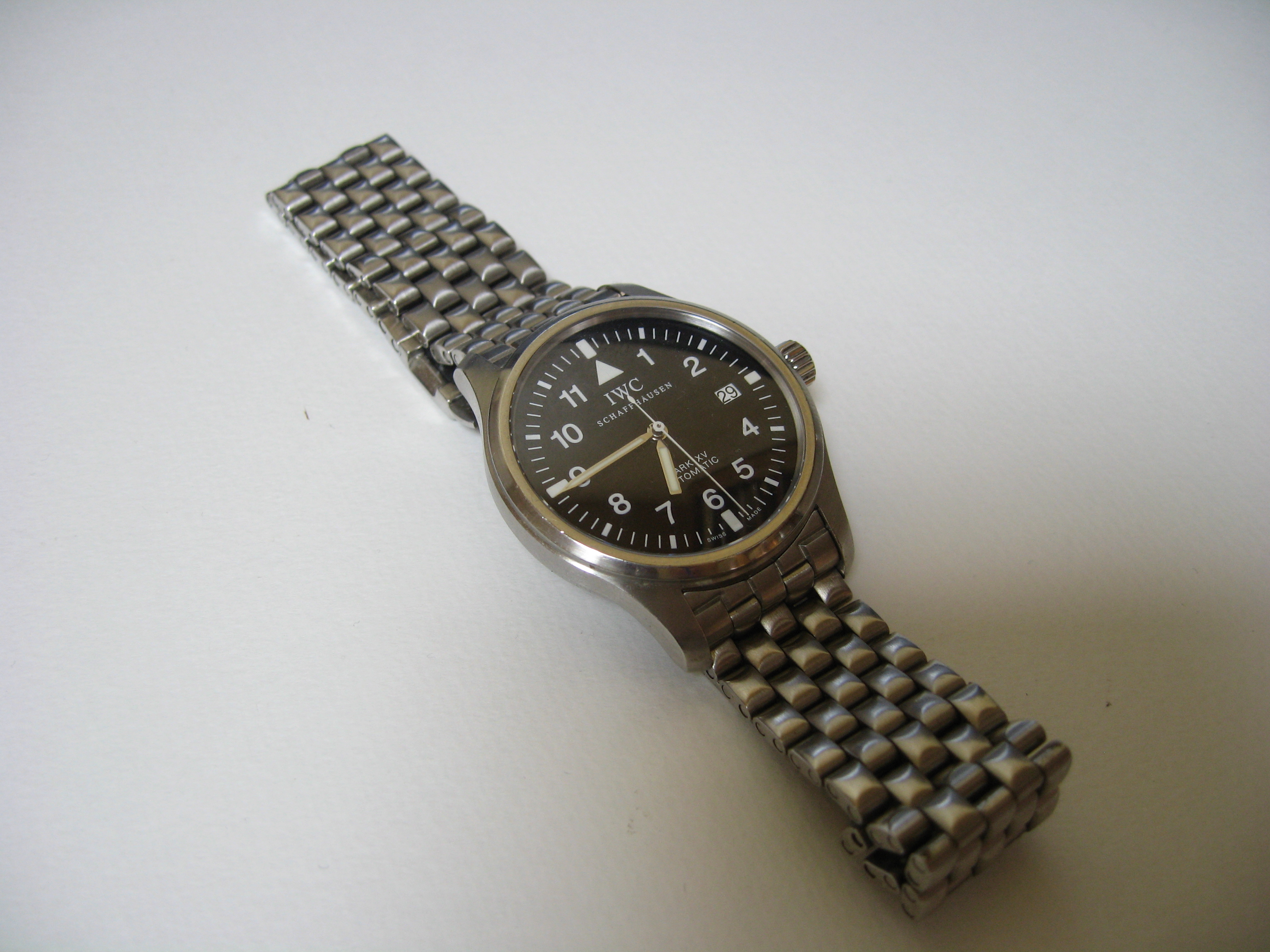
An IWC Pilot’s Watch Mark XV — the 38mm reference housing the Cal. 37524 (ETA 2892-A2 base) that bridged the Mark XII and Mark XVII. The clean tool-watch dial with Arabic numerals, luminous hands, and soft-iron inner case continues the design language established by IWC’s wartime RAF contracts from the 1940s.
Photo: サフィル — CC BY-SA 4.0 — Wikimedia Commons

The Mark IX (Ref. 436) — The Retroactive Beginning

IWC Big Pilot Antoine de Saint-Exupéry limited edition
The IWC Big Pilot Antoine de Saint-Exupéry limited edition — one of 1,900 pieces. The 46mm case, triangle at 12 o’clock, large screw-down crown, and luminous Arabic numerals directly reference the Luftwaffe Beobachtungsuhren specification that IWC fulfilled in 1940 with B-Uhr reference 431.
Photo: Ferengi — CC BY-SA 3.0 — Wikimedia Commons

The reference designated "Mark IX" in collector literature was produced in the late 1940s and early 1950s under IWC reference number 436. It was never officially named "Mark IX" during its production. The retroactive designation — applied by collectors and later by IWC itself in heritage documentation — was assigned to establish historical coherence for the series, working backward from the Mark X to identify its predecessor.

This is not a minor technical point. Buyers who encounter a watch sold as a "Mark IX" are purchasing something whose name was applied after the fact, by the market rather than the manufacturer. The ref. 436 is a legitimate IWC pilot's watch and a genuine historical predecessor, but the "Mark IX" designation should be understood as collector nomenclature rather than original documentation.

Specification: 38mm case, Calibre 83 (manual wind), soft-iron inner case as established in the B-Uhr tradition. The ref. 436 established the format that the military contract watches would refine — clean dial, Arabic numerals, aviator-function legibility.


The Mark X (1944–1948) — The Dirty Dozen

In 1944, the British Ministry of Defence issued a contract for military-specification watches to twelve manufacturers — the "Dirty Dozen," as collectors have called them. The twelve watches shared a common specification: W.W.W. (Watch, Wrist, Waterproof) markings; broad-arrow military ownership marks; a standardised dial format. The manufacturers selected included IWC, Longines, Omega, and nine others.

IWC's Dirty Dozen contribution was the Mark X. It housed Calibre 83, the same movement as the ref. 436, in a case carrying the W.W.W. designation and broad-arrow markings that identify British military-issue watches. The Dirty Dozen watches were functional rather than remarkable — the specification was intentionally standardised — but they represent the formative moment of the Mark series' relationship with institutional military procurement.

The Mark X is collected today primarily for its Dirty Dozen status: the twelve-manufacturer contract is among the most documented and best-understood chapters of mid-century military watch history, and collectors who pursue complete Dirty Dozen sets treat the Mark X as a necessary component. Values for clean examples with legible case and dial markings have risen steadily.


The Mark XI (1948/49–1984) — Thirty-Five Years of RAF Service

IWC Pilot’s Watch Mark XV
An IWC Pilot’s Watch Mark XV — the 38mm reference housing the Cal. 37524 (ETA 2892-A2 base) that bridged the Mark XII and Mark XVII. The clean tool-watch dial with Arabic numerals, luminous hands, and soft-iron inner case continues the design language established by IWC’s wartime RAF contracts from the 1940s.
Photo: サフィル — CC BY-SA 4.0 — Wikimedia Commons

The Mark XI is the anchor of the series. Every serious discussion of the IWC Mark watches — and of military pilot's watches generally — must engage with the Mark XI.

The background: in 1948, the Royal Air Force conducted an evaluation of pilot's watches for standard issue. IWC submitted the reference that would become the Mark XI for institutional testing. The RAF's evaluation lasted forty-four days — a rigorous programme that tested accuracy, anti-magnetic performance, water resistance, and operational durability under conditions that a daily-rate test on a timing machine could not approximate. The Mark XI passed. IWC was awarded the contract.

Technical specification:
- Case: 36mm
- Calibre: 89 (manual wind, 18,000 vph, 36-hour power reserve, Breguet overcoil)
- Power reserve indicator: none — the 36-hour specification was the minimum acceptable; crews wound daily
- Anti-magnetic protection: soft-iron inner case, as established across the family
- RAF reference: 6B/346
- Service period: approximately 1948/49 through 1984 — over thirty years of continuous active service
- Production volume: substantial; supplemented by three civilian limited editions of 500 pieces each at the end of the run

The Cal. 89 is a movement that repays study. At 27.1mm diameter and 4.25mm height, it is sized for a 36mm case. The 18,000 vph beat rate is lower than modern movements and reflects the accuracy expectations of the era — the Mark XI was specified to perform to acceptable accuracy over the full 36-hour power reserve. The Breguet overcoil hairspring is the traditional high-quality regulating device; IWC's patented centre-seconds bridge was a notable design feature.

Dial evolution — Two details collectors track closely:

The triangle at 12 o'clock: early Mark XI dials used a "12" numeral rather than the triangle; the triangle replaced the numeral in later production. Early "12" dials command premium collector interest.

The "7": later production Mark XI dials feature a distinctive hooked "7" rather than the conventional straight-tailed form. This detail is tracked by specialists as a dating indicator.

The Mark XI's thirty-five years of RAF service is the specification's most compelling credential. A watch that a military aviation service continues to issue and use for over three decades — not because it is the only option but because it continues to perform to specification — is a watch that has proven itself in the most demanding possible evaluation context.


The Gap — The Quartz Crisis and the Mark Series' Absence

The Mark XI's RAF contract ran until approximately 1984. When it ended, there was no Mark XII. The series fell silent through the late 1980s and into the early 1990s.

The explanation is structural, not editorial. The quartz crisis of the 1970s had restructured Swiss watchmaking's commercial logic. ETA's rationalisation programme — Ebauche SA concentrating mechanical movement production into efficient platforms, phasing out bespoke calibres — meant that the Cal. 89 that powered the Mark XI was not going to be succeeded by a direct descendant. IWC, in the late 1980s, did not yet have the manufacturing programme that would produce a worthy successor, and the Blümlein era's energy was concentrated on perpetual calendars, grand complications, and the Portugieser revival.

The gap is real, and collectors should understand it: there are no production Mark watches between the Mark XI's end and the Mark XII's 1993 introduction. A "Mark XII" presented as an early 1980s watch is not correct.


The Mark XII (1993–1999) — The Purest Modern Mark

IWC Pilot’s Watch Mark XV
An IWC Pilot’s Watch Mark XV — the 38mm reference housing the Cal. 37524 (ETA 2892-A2 base) that bridged the Mark XII and Mark XVII. The clean tool-watch dial with Arabic numerals, luminous hands, and soft-iron inner case continues the design language established by IWC’s wartime RAF contracts from the 1940s.
Photo: サフィル — CC BY-SA 4.0 — Wikimedia Commons

The Mark XII was the first fruit of Günter Blümlein's project to revive the IWC Pilot's Watch as a serious contemporary proposition. The 1993 launch came the same year as the Portugieser Jubilee revival — part of a deliberate programme to return IWC's heritage collections to production with updated movements and modern manufacturing quality.

Technical specification:
- Case: 36mm (consistent with Mark XI proportions)
- Calibre: IWC Cal. 884 — a JLC Calibre 889/2 base, produced by Jaeger-LeCoultre and badged as IWC
- Power reserve: 38 hours
- Date: first time a date complication appeared in the Mark series — a significant addition, controversial among purists
- Reference: IW325201 (steel) and IW325501 (gold)

The Cal. 884 / JLC 889/2 is a high-quality movement with excellent finishing for its price point and long proven reliability. IWC's use of a JLC base was not unusual — the LMH group shared movement platforms across IWC, JLC, and later A. Lange — and the Cal. 884 is a genuine upgrade in terms of automatic winding efficiency and service requirements compared to the Mark XI's manual-wind Cal. 89.

Collectors describe the Mark XII as the "purest" modern Mark for a specific reason: it is the reference that most faithfully reproduced the Mark XI's aesthetic and functional priorities within the constraints of available movement technology. The 36mm case maintained the proportions of the original. The clean dial — three-hand plus date, Arabic numerals, luminous hands — made no concessions to fashion. The result is a reference that photographs as a straightforward evolution of the Mark XI and wears as one.

Mark XII references on the secondary market remain among the most sought-after of the modern series. Steel examples are frequently offered; gold references are less common and carry a meaningful premium.


The Mark XV (1999–2004) — The First Size Increase

The Mark XV represented IWC's response to the case-size expansion that was reshaping Swiss watchmaking through the late 1990s. Where the Mark XI and Mark XII had been 36mm, the Mark XV expanded to 38mm — modest by later standards but a clear signal that the series would track contemporary wearability expectations rather than maintain historical proportions as an end in themselves.

Technical specification:
- Case: 38mm
- Calibre: IWC Cal. 37524 (ETA 2892-A2 base)
- Power reserve: 42 hours
- Reference: IW325301 (steel)

The ETA 2892-A2 is a reliable, well-regarded movement with decades of proven service across many manufacturers. Its use in the Mark XV was pragmatic: the 2892-A2 is efficient, serviceable, and available. The Cal. 37524 designation reflects IWC's practice of applying its own calibre numbers to ebauche-base movements.

The Mark XV is the transitional reference: it demonstrates IWC beginning to adapt the series for the growing-case environment, while maintaining the visual language established by the Mark XI and XII.


The Mark XVI (2004–2009) — Refined Continuation

The Mark XVI continued the ETA 2892-A2 architecture in an updated case, expanded to 39mm. The reference IW325501 represents the Mark series in its most widely distributed modern commercial incarnation — produced in meaningful numbers, available through IWC's then-expanding retail network, and accessible to buyers who encountered the brand during the Kern era's marketing expansion.

Technical specification:
- Case: 39mm
- Calibre: IWC Cal. 30110 (ETA 2892-A2 base, cannon pinion and hour wheel height variant)
- Power reserve: 42 hours
- Reference: IW325501

The Cal. 30110 differs from the Cal. 30120 (used in later references) in cannon pinion and hour wheel height — a detail relevant to service and parts compatibility but not to performance or aesthetics. Both are ETA 2892-A2 derivatives.


The Mark XVII (2009–2016) — The Late Kern Era Standard

The Mark XVII is the reference most commonly encountered on the secondary market from the mid-production period of the series — widely available, consistently well-received, and serving as the everyday Pilot's Watch for buyers who wanted IWC's quality without the scale of the Big Pilot or the price premium of limited editions.

Technical specification:
- Case: 41mm
- Calibre: IWC Cal. 30110 (ETA 2892-A2)
- Power reserve: 42 hours
- Reference: IW326501

The step from 39mm (Mark XVI) to 41mm (Mark XVII) reflects the full arrival of the 40mm+ era in Swiss watchmaking. The Mark XVII's 41mm case is the size point that a large portion of the contemporary market identified as optimal for a tool watch with clean aesthetics — large enough to be legible, compact enough to clear a shirt cuff.


The Mark XVIII (2016–2022) — The Transition Generation

The Mark XVIII is the most technically complex reference in the series from a collector identification standpoint. Two distinct calibres were used across its production run, reflecting the supply disruption that ETA's withdrawal from third-party movement supply created for all Swiss manufacturers in the mid-2010s.

Technical specification:
- Case: 40mm (slight reduction from Mark XVII's 41mm)
- Calibre: Cal. 30110 (ETA 2892-A2) in early production; Cal. 35111 (Sellita SW300 base) in later production
- Power reserve: 42 hours
- Reference: IW327001 (steel), with "Tribute to Mark XI" ref. IW327007 being a notable limited edition

The movement transition — from ETA to Sellita — is a collector-relevant detail. ETA began restricting supply to non-Swatch-Group customers in the 2010s, forcing many manufacturers to source alternative movement platforms. Sellita's SW300, which the Cal. 35111 is based on, is a genuine alternative to the ETA 2892-A2 in specifications and reliability, but it is not identical. Buyers of Mark XVIII references should verify which calibre their example contains.

The Tribute to Mark XI (IW327007) — This reference, launched in 2016 as part of the Mark XVIII family, reproduced several details of the original Mark XI: the "12" numeral at 12 o'clock rather than a triangle, a specific lume lozenge at 12, and a dial design consciously closer to the RAF original than the contemporary production references. It was very well received by collectors who valued the historical reference without the requirement to find an original Mark XI at vintage prices.


The Mark XX (2022–Present) — The In-House Standard

IWC Pilot’s Watch Mark XV
An IWC Pilot’s Watch Mark XV — the 38mm reference housing the Cal. 37524 (ETA 2892-A2 base) that bridged the Mark XII and Mark XVII. The clean tool-watch dial with Arabic numerals, luminous hands, and soft-iron inner case continues the design language established by IWC’s wartime RAF contracts from the 1940s.
Photo: サフィル — CC BY-SA 4.0 — Wikimedia Commons

The Mark XX represents IWC's full commitment to the in-house manufacture programme that opened with the 2018 factory. The Cal. 32111 is the first fully in-house calibre in the Mark series — developed and produced in Schaffhausen, requiring no ETA or Sellita ebauche.

Technical specification:
- Case: 40mm, 10.8mm thick, 49.2mm lug-to-lug (improved wearability vs. Mark XVIII)
- Calibre: IWC Cal. 32111 (fully in-house, 32000 family)
- Silicon components: escape wheel and pallet fork — significant for magnetic resistance and long-term rate stability
- Power reserve: 120 hours (5 days) — a major increase from the 42-hour ETA-base references
- Water resistance: 100m (increased from 60m)
- First Mark to launch with a bracelet option
- Reference: IW328201 (leather strap); IW328202 (bracelet)

The 120-hour power reserve is the Mark XX's most immediately compelling specification: five days of power reserve from a 40mm watch is a practical benefit with no real cost in terms of case size. A Monday wind keeps the watch running through the weekend. This is not a marketing statistic; it is a genuine convenience that changes daily wear behaviour.

The silicon escape wheel and pallet fork provide magnetic resistance inherent to the movement's construction — silicon is non-ferromagnetic and requires no external shielding in the same way steel components do. Combined with the traditional soft-iron inner case, the Mark XX offers layered anti-magnetic protection.

The bracelet option at launch is notable for the Mark series: previous references were offered on straps only at launch, with bracelets available as accessories. The Mark XX acknowledged that contemporary buyers expect strap and bracelet options as part of the initial offering.


The Series in Perspective

The Mark series is unique in Swiss watchmaking not because it has the most interesting individual references — though the Mark XI qualifies — but because it has continuity. The line from the retroactive Mark IX to the Mark XX spans more than seventy years, involves both military contract watches and commercial production, covers the full range from manual-wind Cal. 83 to in-house silicon-component Cal. 32111, and maintains a consistent design language across all of it.

The triangle at 12, the Arabic numerals, the luminous hands, the soft-iron inner case: these are not arbitrary aesthetic choices that IWC could swap out when fashion demanded. They are the visual vocabulary of a functional brief that has not changed since the 1940s. A pilot's watch needs to be read at a glance, under stress, in low light, in a cockpit where magnetic fields are present. Every Mark series design decision answers to that brief.


Frequently Asked Questions

Was there really a watch called the Mark IX?
Not officially. The reference retroactively called "Mark IX" is IWC ref. 436, produced in the late 1940s and early 1950s. It was never named "Mark IX" during production. The designation was applied by collectors and later adopted in IWC heritage documentation to provide historical continuity for the series. Ref. 436 is a legitimate IWC pilot's watch predecessor — just not one that knew it was the first Mark.

Why is the Mark XI so significant?
Three reasons: duration (thirty-five years of continuous RAF service, 1948/49–1984), the institutional validation of forty-four days of testing before contract award, and the Cal. 89's technical integrity. The Mark XI is not famous because IWC claims it is famous. It is famous because the RAF used it for over three decades, and the RAF's choice of equipment is not sentimental.

Which Mark is the best value on the secondary market?
The Mark XII and Mark XV offer the greatest collector value per pound — clean references with established calibres at prices significantly below new Mark XX retail. The Mark XVIII "Tribute to Mark XI" is increasingly sought-after and may offer less secondary market discount than standard references.

What is the difference between Cal. 30110 and Cal. 35111 in the Mark XVIII?
Both are automatic movements with 42-hour power reserve. The Cal. 30110 is based on the ETA 2892-A2; the Cal. 35111 is based on the Sellita SW300. Both are reliable. The ETA has a longer commercial history; the Sellita has equivalent specifications and equally long service. Neither is preferable on objective grounds, though ETA-base examples may carry a slight secondary market premium due to familiarity.

Does the Mark XX have COSC certification?
No. IWC does not submit to COSC. The Mark XX is tested to IWC's own in-cased standard of 0 to +7 seconds per day. This is not a deficiency — IWC's testing standard is applied after casing in wearing conditions, which is in some respects a more demanding specification than COSC's bench-test protocol.

What does the silicon escape wheel in the Mark XX actually do?
Silicon is non-ferromagnetic, meaning magnetic fields do not affect its rate. The steel escape wheel and pallet fork in a conventional movement can be magnetised — causing erratic rate behaviour — in environments with strong magnetic fields (MRI machines, speaker magnets, electric motors). Silicon components provide inherent magnetic resistance, complementing the soft-iron inner case's external shielding.


Related Articles

Recent Posts

By Zach Charles • October 10, 2026
Hamilton's American Classic Cushion Mechanical revives its 1926 Art Deco cushion watches, seen in Oppenheimer, in 30mm and 34mm with the new hand-wound…
Doxa SUB 200: The Accessible Everyday Diver
By Zach Charles • October 10, 2026
Complete guide to the Doxa SUB 200 — 42mm, 200m, four colorways, Sellita SW200-1. The accessible entry to the Doxa SUB family with the full…

By Zach Charles • October 10, 2026
The Breitling Top Time B01 Aston Martin DB5 pairs a cushion-shaped 41mm case, a wooden inner ring and the in-house Caliber 01 across three limited…
By Zach Charles • October 10, 2026
TAG Heuer developed the Mikrograph (2011, 1/100th second), Mikrotimer Flying 1000 (2011, 1/1000th second), and Mikrogirder (2012, 1/2000th second).
Doxa SUB 1500T: The 1,500-Metre Depth-Rating Flagship
By Zach Charles • October 10, 2026
Complete guide to the Doxa SUB 1500T — 45mm, 1,500m depth rating, helium escape valve, ETA 2892-2 movement, USD 2,690.

Audemars Piguet Royal Oak 'Jumbo' ref. 15202 with blue tapisserie dial and integrated steel bracelet
By Zach Charles • October 10, 2026
The Audemars Piguet × Swatch Royal Pop is a $400 bioceramic pocket watch in 8 colourways, powered by a new hand-wound SISTEM51 with 90+ hour power…

Time on the Move logo
By Zach Charles • October 10, 2026
Zach Charles is the editor of Time on the Move, an independent watch reference covering brand and model histories, buying guides and release news…
Omega Speedmaster Professional 'Moonwatch' chronograph, front view on steel bracelet
By Zach Charles • October 9, 2026
Find the best watches at every price point from $500 to $15,000 — new and pre-owned. Covers every budget tier with specific reference picks, brand…
By Zach Charles • October 9, 2026
The latest watch news: new releases, Watches and Wonders coverage, discontinuations, industry analysis, and market trends. Currently 1 article.

Seiko's New Panda Chronograph Is Literally a Panda: The Power Design Project HHK001 and HHK002
By Zach Charles • October 8, 2026
Seiko's Power Design Project panda chronograph (HHK001, HHK002) turns the panda dial into an actual panda face, with ear pushers, a 'Sasameter' and a 3D…
Show More