Panerai: From Florence Instrument Maker to Italian Icon — Brand History
Panerai: The Florence Manufacture
By Zach Charles, Editor, Time on the Move
Most watch brands begin as watchmakers. Panerai began as something more specific: a precision instrument supplier to a navy at war. The Florence shop that Giovanni Panerai opened in 1860 sold Swiss watches and taught watchmaking, but its defining commercial identity was forged in the supply of compasses, depth gauges, and illuminated sighting instruments to the Regia Marina — the Royal Italian Navy. The watches came later, and they came specifically because combat swimmers needed something that no commercial watchmaker had yet produced.
Photo: Historical photograph — Public Domain — Wikimedia Commons
Founding — Florence, 1860
Photo: Piero7 — Public Domain — Wikimedia Commons
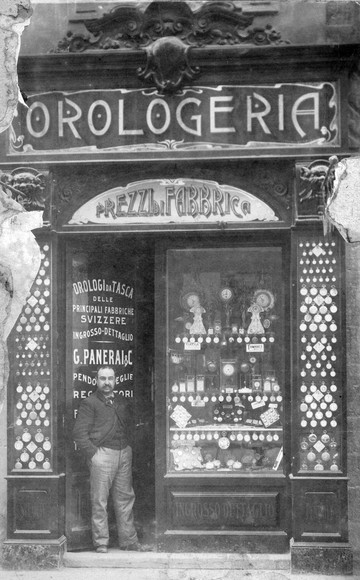
Giovanni Panerai (1825–1897) established his shop at Ponte alle Grazie in Florence in 1860 , naming it "Orologeria Svizzera" (Swiss Watch Shop). It operated simultaneously as a retail outlet for Swiss timepieces and as Florence's first watchmaking school.
The shop's military instrument focus developed under Giovanni's grandson, Guido Panerai (1873–1934), who expanded the business into precision optical and scientific instruments — compasses, depth gauges, and underwater lighting equipment supplied to the Regia Marina. Panerai was not manufacturing movements at this stage; its technical contribution was in instrument design, luminous compounds, and military supply relationships.
In 1915 , Guido Panerai patented illuminated gun sights using a radioluminescent mixture of radium-226 and zinc sulfide enclosed in hermetically sealed vessels. This was not a watch complication — it was a weapons sight. But the compound, which Panerai called Radiomir , would define the dials of the brand's military watches for the following two decades.
Military Instrument Supplier
Photo: Piero7 — Public Domain — Wikimedia Commons
Panerai's formal relationship with the Regia Marina as a precision instrument supplier predates World War I. By the 1930s, the relationship had evolved to include purpose-built dive watches for the navy's underwater assault units.
Between 1935 and 1970
, Panerai delivered approximately 1,600 watches
to the Marina Militare across multiple references:
- ~1,000 Ref. 3646s (the original Radiomir)
- ~500 Ref. 6152/1s (the military Luminor)
- ~24 Ref. 6152s, ~36 Ref. 6154s
- ~60 GPF 2/56 "Egiziano" references (produced for the Egyptian Navy in 1956)
The watches were designed for the Decima Flottiglia MAS — Italy's elite underwater assault unit — whose combat swimmers wore Panerai watches on operations throughout World War II, including the December 1941 Alexandria harbour raid that temporarily neutralised the British Mediterranean fleet. The full military history is covered in the Italian Navy article.
Military supply effectively ended circa 1970 , as the Marina Militare transitioned to other specifications.
The Luminous Compound and the Luminor Trademark
Photo: Piero7 — Public Domain — Wikimedia Commons
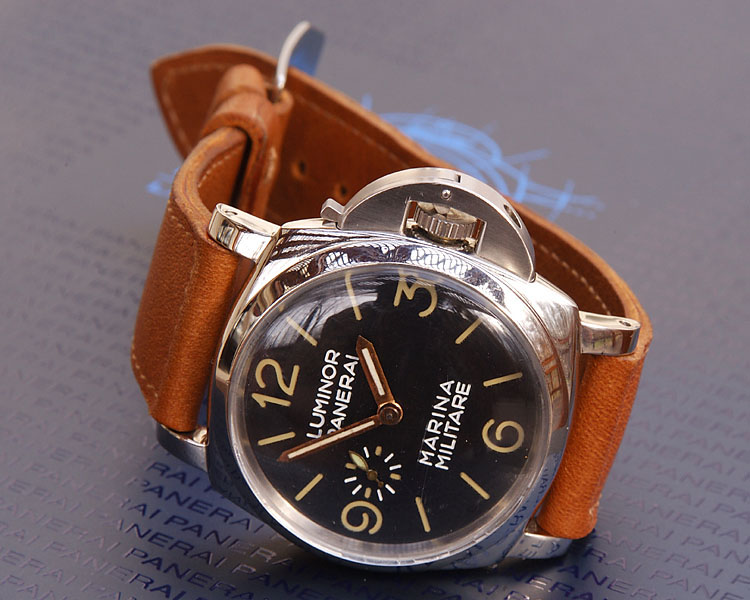
The Radiomir compound — the radioluminescent mixture used on Panerai's military dials — was radium-based, and while it provided exceptional luminosity it was also radioactive. In 1949 , Panerai replaced it with a tritium-based luminous compound and trademarked the new material as "Luminor" on January 11, 1949 . The new compound was far less radioactive and became the basis for both the Luminor movement and the Luminor watch case name.
Separately, Panerai patented the crown-protecting bridge — the lever guard that became the Luminor's defining visual feature — in Italy on November 30, 1955 . The two trademarks (Luminor compound and Luminor crown guard) predated the brand's commercial sales by four decades.
First Commercial Sales — September 1993
Photo: Jay Pulli — Copyrighted Free Use — Wikimedia Commons
For most of its history, Panerai operated exclusively as a military supplier. Watches were not sold commercially. The first public sales occurred in September 1993 with the reference 5218-201/A "Luminor Logo" — a 44mm stainless steel Luminor with a sandwich dial and Unitas 6497-based movement, offered in a limited run.
The brand was virtually unknown outside Italy. Three years later, everything changed.
Sylvester Stallone contacted Panerai in 1995 requesting special watches for his film productions. Two "Slytech" editions were created (5218-205/A Submersible, 95 pieces; 5218-207/A Daylight, 105 pieces). The film "Daylight" (1996) showed Stallone wearing the ref. 5218-201/A — and gave Panerai its first significant international exposure. Arnold Schwarzenegger and other celebrities followed. US demand opened rapidly.
The timing of the Vendôme acquisition — spring 1997 — coincided directly with the surge in celebrity-driven attention that Panerai had not sought and could not have planned for.
Vendôme / Richemont Acquisition — 1997
Photo: Historical photograph — Public Domain — Wikimedia Commons
The Vendôme Luxury Group acquired Officine Panerai Srl in spring 1997 . Vendôme was subsequently consolidated into Richemont Group in 1998–1999, placing Panerai within a portfolio that includes Cartier, IWC, Jaeger-LeCoultre, and Vacheron Constantin.
Panerai made its first appearance at SIHH (Salon International de la Haute Horlogerie) in April 1998 — its debut on the international trade calendar. The historic Florence boutique was renovated in 2001 and remains operational.
The acquisition brought the resources for in-house movement development. A Manufacture facility in Neuchâtel, Switzerland was established in 2002 — the foundation for all in-house calibre work. A significantly expanded Neuchâtel Manufacture opened in early 2014 .
In-House Movement Development
The move to in-house calibres was Panerai's defining technical project of the 2000s–2010s. The first in-house calibre, the P.2002 — named for the year development began — launched in 2005 : a hand-wound 8-day movement with GMT and power reserve indicator.
Subsequent calibres expanded the family: the P.9000 (2009, first in-house automatic), the P.5000 (2014, 8-day manual, simpler architecture), the P.4000 (2014, ultra-slim micro-rotor), and the P.900 (slim automatic, shared ValFleurier architecture). By 2018 , Panerai announced no new models would use ETA/Unitas movements; the transition was substantially complete by the early 2020s.
Current Leadership
Jean-Marc Pontroué served as CEO from April 2018 through early 2025 , overseeing the Submersible collection's independence, expanded sustainability materials (EcoTitanium, eSteel), and the Carbotech and Goldtech material programmes.
Emmanuel Perrin was appointed CEO effective April 1, 2025 , bringing 33 years of Richemont experience spanning Cartier, Van Cleef & Arpels, and Richemont's Specialist Watchmakers Distribution.
Panerai Model and Technology Guides
Each Panerai collection and key technology has its own in-depth history on Time on the Move:
- Panerai Calibres: From Unitas 6497 to the In-House P.2002, P.9000, and P.900
- Panerai and the Italian Navy: Decima MAS, Combat Swimmers, and Military Supply
- Panerai Luminor: Crown Guard Patent, PAM00005, and the Modern Collection
- Panerai Luminor 1950: The Reference Year Case and Its Variants
- Panerai Luminor Due: The Slim Luminor for Everyday Wear — P.4000 and P.900
- Panerai Materials: Carbotech, Fibratech, Goldtech, BMG-Tech, and eSteel
- Panerai Radiomir: The 1936 Prototype to the Modern Collection
- Panerai Submersible: Dive Watch Heritage from the GPF 2/56 to the Modern Line
- Panerai Watches of Destiny: The Pre-Vendôme References and Stallone Connection
Latest News
- Panerai Luminor 42 (2026): PAM01710, PAM01711 & PAM01714 Shrink an Icon — September 23, 2026
Frequently Asked Questions
When was Panerai founded?
1860, by Giovanni Panerai in Florence, Italy. The shop was called "Orologeria Svizzera" (Swiss Watch Shop) and served as a retail outlet and watchmaking school. The company's military instrument supply relationship with the Regia Marina began before World War I.
When did Panerai first sell watches publicly?
September 1993, with the ref. 5218-201/A "Luminor Logo" — a 44mm stainless steel Luminor in a limited run. The brand had supplied watches exclusively to the Italian military prior to this.
Who acquired Panerai and when?
The Vendôme Luxury Group acquired Panerai in spring 1997. Vendôme was subsequently absorbed into Richemont Group in 1998–1999. Panerai has been a Richemont maison since.
What was the Stallone connection?
Sylvester Stallone contacted Panerai in 1995 requesting watches for film productions. Two "Slytech" limited editions were made. His 1996 film "Daylight" gave Panerai its first significant international exposure, directly contributing to the circumstances of the 1997 Richemont acquisition.
Where are Panerai watches manufactured?
Movements are produced at the Neuchâtel Manufacture (established 2002, expanded 2014). The historic Florence shop remains the brand's spiritual home and an operational boutique.