Panerai and the Italian Navy: Decima MAS, Combat Swimmers, and Military Supply
Panerai and the Italian Navy: Military History
On the night of December 18–19, 1941, six Italian frogmen entered Alexandria harbour on three human torpedoes, placed mines under two British battleships and a tanker, and withdrew. The battleships HMS Queen Elizabeth and HMS Valiant — the two largest warships of the British Mediterranean fleet — were out of action for over a year. The Italian Navy had, without surface ships or submarines engaging in direct combat, temporarily eliminated British naval superiority in the eastern Mediterranean.
The frogmen who executed the Alexandria raid wore Panerai watches. This is the context from which every Panerai design specification originates.
Photo: Piero7 — Public Domain — Wikimedia Commons
The Decima Flottiglia MAS
Photo: Jay Pulli — Copyrighted Free Use — Wikimedia Commons
The Decima Flottiglia Mezzi d'Assalto (10th Flotilla of Assault Vessels) — commonly called the Decima MAS — was Italy's elite special operations naval unit in World War II. Commander: Prince Valerio Borghese (the "Black Prince," subsequently one of Italy's most controversial post-war figures).
The Decima MAS operated three types of assault vessels:
- SLC (Siluro a Lenta Corsa)
— "slow-running torpedoes," known as "maiale"
(pigs) — two-man human torpedoes ridden by frogmen in closed-circuit rebreather suits
- MTSM
— explosive motorboats carrying charges to detonate against ship hulls
- Gamma swimmers
— assault swimmers who operated without any vehicle, swimming independently to target ships
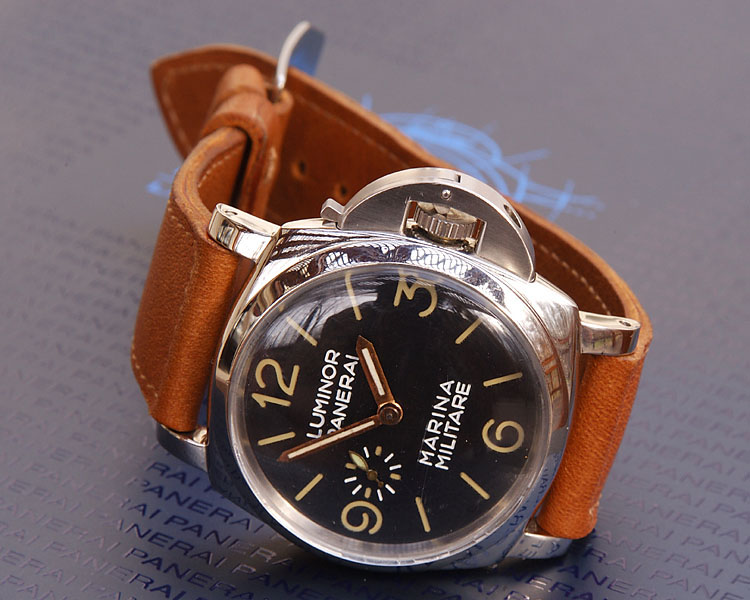
Panerai watches were the standard timekeeping instrument across all three types. The watch requirements drove specifications that remain visible in current production.
The Gamma Swimmers
Photo: Piero7 — Public Domain — Wikimedia Commons
"Uomini Gamma" (Gamma Men) were assault swimmers within the Decima MAS. The name derived from the Pirelli rubber diving suit worn by these swimmers — nicknamed "muta gamma." Unlike the SLC crews who rode human torpedoes to their targets, Gamma swimmers operated entirely under their own power , swimming to enemy ships and attaching limpet mines directly to their hulls.
Standard Gamma ordnance: cimici (bedbugs, 4.5 kg each) or bauletti (small trunks, 12 kg each). The swimmers wore Belloni rubberised closed-circuit rebreather suits — producing no exhaust bubbles, which was essential for avoiding detection.
The Gamma unit conducted multiple successful operations against Gibraltar , including raids in September 1941 and July 1942 that sank or damaged multiple vessels in the harbour.
The Alexandria Raid — December 19, 1941
Photo: Piero7 — Public Domain — Wikimedia Commons
The most operationally significant Decima MAS action was the attack on Alexandria harbour, the main base of the British Eastern Mediterranean Fleet.
Delivery : Italian submarine Scirè (Commander Valerio Borghese) transported three SLC human torpedoes to the target area, launching them approximately 1.5 miles from the harbour entrance.
Execution : Three two-man SLC crews entered the harbour through the boom gate, which was opened momentarily to allow British destroyers to pass. Each crew located a target, placed their charges, and withdrew.
Results
:
- HMS Queen Elizabeth
(British flagship, 32,700 tons): Mine detonated under the keel. Settled on the harbour bottom. Out of action for approximately 14 months.
- HMS Valiant
(battleship, 31,585 tons): Mine detonated under the bow. Settled on the harbour bottom. Out of action for several months.
- Norwegian tanker Sagona
: Sunk by the third SLC crew's mine.
- HMS Jervis
(destroyer): Damaged alongside the Sagona.
All six frogmen were captured but survived. Lieutenant Luigi Durand de la Penne and Petty Officer Emilio Bianchi — who had placed the mine under HMS Valiant — were detained aboard the ship and, when interrogation produced no information, confined below the waterline. Minutes before the detonation, de la Penne informed the ship's captain of the imminent explosion (the ship was already doomed; his disclosure saved crew lives without affecting the outcome). He was later awarded Italy's highest military decoration, the Gold Medal for Military Valour.
The strategic consequence: both British battleships neutralised simultaneously. For over a year, the Royal Navy had no capital ships operational in the eastern Mediterranean. The raid is still studied in naval warfare curricula.
What the Watch Had to Do
Photo: Piero7 — Public Domain — Wikimedia Commons
The combat conditions of the Decima MAS frogmen produced a precise specification for what a military dive watch required. This specification drives the Radiomir and Luminor design in ways that are visible in current production:
1. Luminous dial readable underwater
The frogmen operated in murky harbour conditions and at night. Standard watch luminous treatments of the 1930s were inadequate. Panerai's Radiomir compound — radioluminescent radium and zinc sulfide — provided substantially brighter luminosity than commercial alternatives. The large Arabic numerals and oversize hands maximised legibility at depth.
2. Reliable crown seal
Early military Radiomir watches (Ref. 3646) used the Rolex screw-down crown for water resistance. The problem: frequent winding (necessary for the original Cortébert/Rolex calibre's shorter power reserve) meant repeated threading and unthreading of the crown mechanism. This wore the threads. The lever bridge crown guard, patented in 1955, solved this — the crown is sealed by mechanical compression of the lever, not threading, eliminating thread wear as a failure mode.
3. Large case for large numerals
47mm was not a fashion choice. It was the minimum diameter to accommodate numerals large enough to read through a diving mask, in murky water, at operational depth.
4. Long power reserve (later requirement)
The transition from the Cortébert/Rolex calibre to the Angelus 8-day movement (in the Ref. 6152 era) addressed a practical operational problem: a frogman on an extended mission could not safely wind his watch daily without risking crown thread damage. Eight days of reserve meant the watch could be set before a mission and not touched again until return.
5. Strap compatibility with diving suits
Wire lugs on the original Ref. 3646 were not structural elegance — they were the simplest way to allow an extra-long strap that could pass over a thick rubber diving suit. Contemporary Panerai strap lengths reflect the same requirement.
The Destro Configuration
Photo: Historical photograph — Public Domain — Wikimedia Commons
"Destro" is Italian for "right." A Destro Panerai is designed for wear on the right wrist — with the crown on the left side of the case (approximately 8–9 o'clock position rather than the conventional 3 o'clock).
The origin is operational convention: Italian Navy frogmen carried multiple instruments. Standard practice was a compass or depth gauge on the left wrist and the Panerai watch on the right wrist . A watch worn on the right wrist with a conventional 3 o'clock crown would require awkward wrist rotation to operate. The Destro configuration places the crown in a natural position for right-wrist wear.
The first Destro variants appeared in the Ref. 6152/1 era. Modern Panerai produces Destro references across the Luminor and Radiomir lines — including the Luminor Destro Otto Giorni (PAM01655) — primarily for left-handed wearers and collectors who appreciate the historical reference.
Military Supply — The Numbers
Between 1935 and 1970 , Panerai delivered approximately 1,600 watches to the Marina Militare:
| Reference | Approximate Quantity | Era |
|---|---|---|
| Ref. 2533 | ~35 | Pre-WWII prototypes |
| Ref. 3646 (all types) | ~1,000 | 1938–early 1950s |
| Ref. 6152 | ~24 | ~1950 |
| Ref. 6154 | ~36 | ~1950–1954 |
| Ref. 6152/1 | ~500 | Mid-1950s–1960s |
| GPF 2/56 "Egiziano" | ~60 | 1956 (Egyptian Navy) |
Military supply effectively ended circa 1970 as the Marina Militare transitioned to other specifications and suppliers. The total delivered across 35 years was approximately 1,600 watches — a number that makes every surviving example with verified military provenance historically significant.
Frequently Asked Questions
What is the Decima MAS?
The Decima Flottiglia Mezzi d'Assalto — Italy's elite underwater assault unit in World War II. Operated SLC human torpedoes (maiale), explosive motorboats, and Gamma assault swimmers. Commanded by Prince Valerio Borghese. Wore Panerai watches on operations.
What was the Alexandria raid?
On December 19, 1941, three Decima MAS SLC crews entered Alexandria harbour and placed mines under HMS Queen Elizabeth, HMS Valiant, and a tanker. Both battleships were put out of action for over a year, temporarily neutralising British naval superiority in the eastern Mediterranean. All six frogmen were captured.
Why was the Panerai case 47mm?
Not fashion — function. 47mm was the minimum diameter to accommodate numerals large enough to read through a diving mask in murky water at operational depth. The wire lugs allowed extra-long straps to pass over rubber diving suits.
What is a Destro Panerai?
A watch configured for right-wrist wear, with the crown at the 8–9 o'clock position rather than 3 o'clock. The convention originated from Italian Navy frogmen who wore compasses on the left wrist and Panerai watches on the right — requiring a crown position appropriate for right-wrist operation.
How many watches did Panerai supply to the Italian military?
Approximately 1,600 watches between 1935 and 1970, across the Ref. 3646, 6152, 6154, and 6152/1 references. Military supply ended circa 1970.