Panerai Luminor: Crown Guard Patent, PAM00005, and the Modern Collection
Panerai Luminor: The Crown Guard Collection
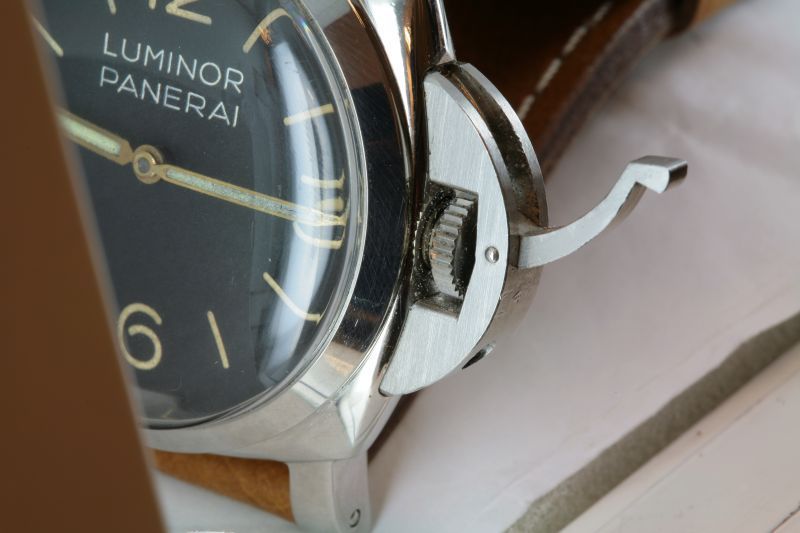
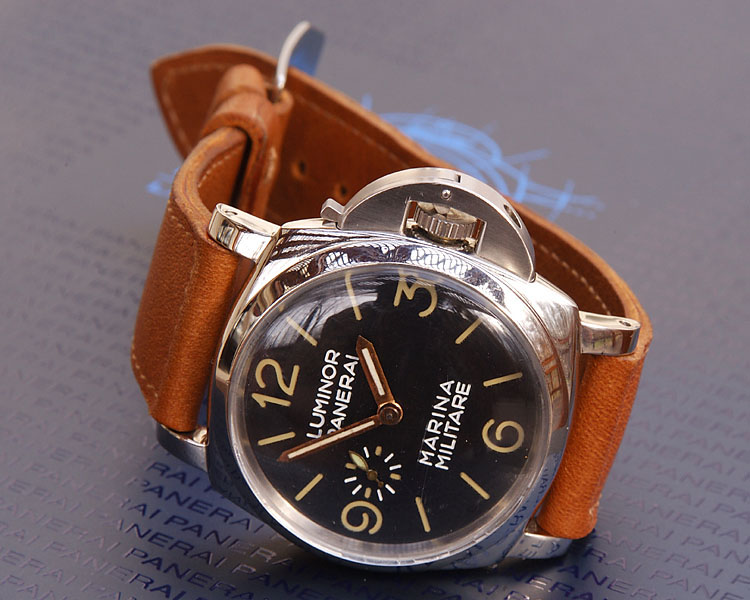
The Luminor's crown guard is immediately recognisable — a lever bridge that locks against the case to seal the winding crown, giving the watch its characteristic three-element silhouette. It is not decorative. It is a patented device designed to solve a specific problem: providing reliable water resistance to 200 metres without using Rolex's screw-down crown mechanism, which Panerai could not employ without infringing a competitor's patent. The solution, patented in November 1955, became the most recognisable element of one of watchmaking's most recognisable designs.
Photo: Piero7 — Public Domain — Wikimedia Commons
The Crown Guard Patent — November 30, 1955
Photo: Piero7 — Public Domain — Wikimedia Commons
The crown-protecting bridge (lever guard / "tight seal device") was patented by Giuseppe and Maria Panerai in Italy on November 30, 1955 . A corresponding US patent application was filed November 26, 1956.
The mechanism works simply: a hinged steel lever pivots over the winding crown and locks against the case, compressing the crown's seal against the tube when the lever is in the closed position. To wind or set the watch, the lever is lifted — releasing the crown for normal operation. Closing the lever re-engages the seal.
The practical result: 200 metres of water resistance through a mechanical seal that does not require the winding crown to be threaded into the case — eliminating wear on the crown threads that was a genuine failure mode in military service. Early military Luminors (Ref. 6152/1) used crown guards that predated the formal 1955 patent, suggesting field testing of the device had begun before the filing.
The "Luminor" trademark itself was registered earlier — on January 11, 1949 — for the tritium-based luminous compound that replaced the radium-based Radiomir compound. The word "Luminor" thus describes both a material and a case type, with the compound predating the patented mechanism by six years.
Luminor Base vs. Luminor Marina vs. Luminor Submersible
Photo: Jay Pulli — Copyrighted Free Use — Wikimedia Commons

The early Luminor family was defined by three distinct configurations:
Luminor Base : Hours and minutes only. No running seconds indicator. The purest Panerai dial — maximum legibility with minimum complication. Early models powered by the Unitas 6497 (OP I calibre).
Luminor Marina : Adds a small seconds subdial at the 9 o'clock position — the running seconds hand that distinguishes the Marina from the Base. In references using the P.9010 automatic movement, a date window also appears at 3 o'clock.
Luminor Submersible : Adds a unidirectional rotating dive bezel with 60-minute graduation, upgraded water resistance to 300m, and a more robust crown seal construction. From 2019, the Submersible became its own standalone collection.
First Commercial Luminor — September 1993
Photo: Historical photograph — Public Domain — Wikimedia Commons
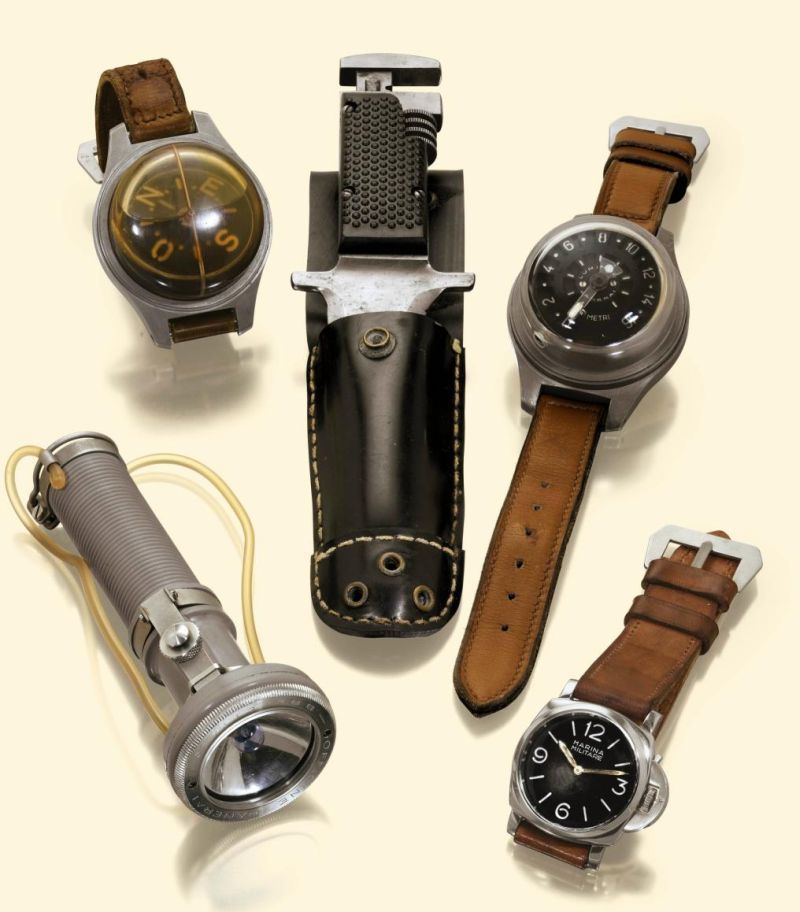
The first Luminor sold commercially was the ref. 5218-201/A "Luminor Logo" , available from September 1993 . Key specifications:
- Case: 44mm stainless steel, Luminor case architecture with crown guard
- Dial: Black sandwich dial (two-layer construction, Arabic numerals cut through the outer layer revealing the white radioluminescent sub-layer)
- Movement: Unitas 6497-based OP calibre (hand-wound)
- Production: Limited run (approximately 677–890 pieces across production runs)
The 44mm case size of the first commercial Luminor was a direct continuation of the military watches' scale — these were not proportioned for civilian fashion. The design had been developed for men wearing diving suits, and no accommodation was made for civilian wrist sizes. This refusal to compromise the proportions became, paradoxically, a commercial asset: in an era of 36–38mm dress watches, Panerai's 44mm case was dramatically distinctive.
PAM00005 — The Canonical Reference
Photo: Piero7 — Public Domain — Wikimedia Commons
PAM00005 — the Luminor Marina Logo — is the reference that most Paneristi identify as the entry point to the modern canon. It is a 44mm stainless steel Luminor Marina with a black sandwich dial, manual-wind movement (Unitas 6497-based OP calibre), and crown guard. It was produced continuously (with some interruptions) from the early Vendôme era through approximately 2019.
Its collector significance is not primarily about rarity — it was not exceptionally limited. Its importance is canonical: PAM00005 is the simplest, purest Luminor Marina expression, and it bridges the pre-Vendôme and manufacture eras. A limited edition of 1,000 pieces exists, boxed and papered, which commands premiums on the secondary market.
Luminor 1950 vs. Standard Luminor
Introduced in 2002 as a 1,950-piece limited edition, the Luminor 1950 is the thicker, more architecturally complex interpretation of the Luminor case.
| Feature | Luminor (Standard 44mm) | Luminor 1950 |
|---|---|---|
| Diameter | 44mm | 44mm or 47mm |
| Thickness | ~15–16mm | ~18mm |
| Lugs | Shorter, angled | Longer, U-shaped profile |
| Crystal | Flat sapphire | Domed sapphire (mimics vintage acrylic) |
| Caseback | Solid | Transparent display |
| Crown guard | Plain | Marked "R.E.G. T.M." |
| First production | 1993 | 2002 (limited) |
The Luminor 1950's domed sapphire crystal and display caseback are the most visually distinctive features. The dome replicates the curved profile of the original 4mm acrylic crystal on military watches; the display back exposes the movement. These choices position the 1950 as a heritage collector's piece rather than the working-watch proposition of the standard Luminor.
Current Luminor 44mm Collection
Photo: Piero7 — Public Domain — Wikimedia Commons
The contemporary Luminor line uses exclusively in-house movements:
P.3000 : Hand-wound manual, 72-hour (3-day) power reserve, 21,600 vph, 21 jewels, 36.60mm diameter. Small seconds at 9 o'clock. No date. The calibre for Luminor Base and some Marina references — the manual-wind purist option.
P.9010 : Automatic, 72-hour (3-day) power reserve, 28,800 vph, 28 jewels. Date at 3 o'clock, small seconds at 9 o'clock. The calibre for Luminor Marina automatic references and Submersible models.
Both movements use two spring barrels in series, providing the 72-hour power reserve. Water resistance on the standard Luminor: 100 metres .
Luminor GMT
The Luminor GMT adds a second time zone via a central 12-hour GMT hand that tracks home time on a 24-hour scale (to distinguish AM from PM). The local time hand is independently adjustable in one-hour increments by pulling the crown to its intermediate position — a Travel Time-style quick-set that does not require stopping the watch.
Current Luminor GMT references use the P.9010 calibre and are available in multiple case materials including ceramic (PAM01783, 40mm black ceramic case).
Latest News
- Panerai Luminor 42 (2026): PAM01710, PAM01711 & PAM01714 Shrink an Icon — September 23, 2026
Frequently Asked Questions
What is the Luminor crown guard?
A patented lever bridge that pivots over the winding crown and locks against the case, compressing the crown's seal when closed. Patented by Panerai in Italy on November 30, 1955. Provides 200m water resistance without a screw-down crown.
What is the difference between Luminor Base and Luminor Marina?
The Luminor Base shows hours and minutes only — no running seconds hand. The Luminor Marina adds a small seconds subdial at 9 o'clock. Automatic Marina references with the P.9010 also include a date at 3 o'clock.
What is PAM00005?
The Luminor Marina Logo — a 44mm stainless steel Luminor Marina with black sandwich dial and manual-wind movement. The canonical modern Panerai reference, produced from the early Vendôme era through approximately 2019. A 1,000-piece limited edition exists.
What is the Luminor 1950?
A thicker, architecturally more detailed interpretation of the Luminor case, introduced as a 1,950-piece limited edition in 2002. Distinguishing features: ~18mm thickness (vs ~15–16mm), domed sapphire crystal, transparent display caseback, "R.E.G. T.M." crown guard marking, longer U-shaped lugs.
What movement powers the current Luminor?
The P.3000 (hand-wound, 72hr, 21,600 vph, 21 jewels) for manual-wind references and the P.9010 (automatic, 72hr, 28,800 vph, 28 jewels) for automatic references. Both are in-house Panerai calibres with two-barrel power reserves.