Panerai Submersible: Dive Watch Heritage from the GPF 2/56 to the Modern Line
Panerai Submersible: The Dive Collection
The Submersible's origins are in combat. Panerai's watches were worn by Italian Navy frogmen on underwater operations — not recreational divers, not professional sports divers, but military swimmers placing limpet mines on enemy warships in the harbours of Alexandria, Gibraltar, and Malta. The dive watch specification that emerged from those requirements — extreme legibility, robust crown protection, and reliable depth rating — is the foundation the Submersible collection continues to build on.
Photo: Piero7 — Public Domain — Wikimedia Commons
Origins: The GPF 2/56 Egiziano
Photo: Jay Pulli — Copyrighted Free Use — Wikimedia Commons
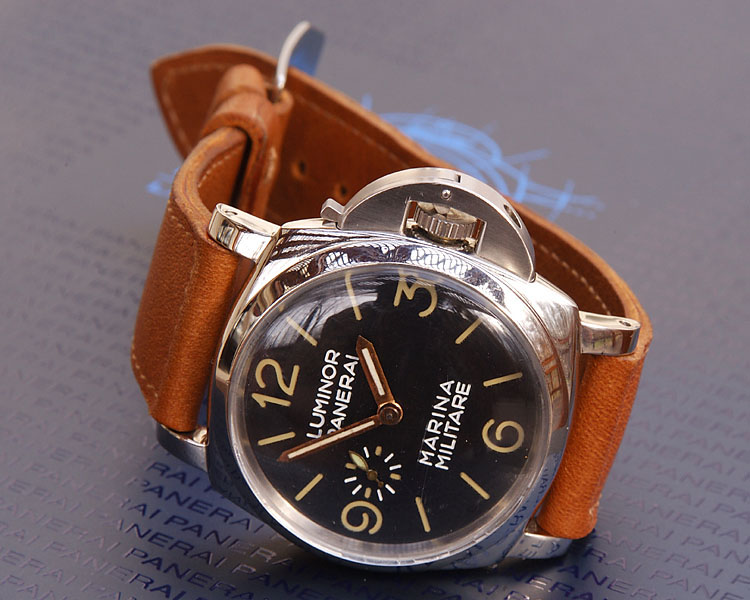
The direct ancestor of the modern Submersible's rotating bezel is the GPF 2/56 "Egiziano" — a watch produced in 1956 for the Egyptian Navy (not Italian). At 60mm in diameter, it was the largest Panerai ever produced. The Egiziano featured a rotating bezel with round five-minute markers and an Angelus 8-day movement. Only approximately 50 examples were made. The bezel marker style that defines the modern Submersible collection — round minute-markers rather than the rectangular index of most dive bezels — traces directly to this reference.
The Italian Regia Marina had not required a rotating bezel on the Ref. 3646 or 6152/1 military watches. The Egyptian commission introduced the dive-timer function, and modern Panerai has maintained it as a defining Submersible specification.
Submersible as a Standalone Collection — 2019
Photo: Piero7 — Public Domain — Wikimedia Commons
Prior to 2019, Submersible references were part of the Luminor family — "Luminor Submersible," "Luminor Submersible 1950," and similar designations. At SIHH 2019 , Panerai elevated the Submersible to its own standalone collection, establishing it as the brand's dedicated dive watch line with its own distinct identity within the catalogue.
The separation acknowledged what collectors had long recognised: the Submersible occupied a different market position from the Luminor. While the Luminor is the canonical Panerai — the watch that defines the brand — the Submersible is the technical frontier, where material innovation (Carbotech, Fibratech, BMG-Tech) and depth specification appear first.
Depth Rating and Bezel Specification
Photo: Piero7 — Public Domain — Wikimedia Commons

Standard depth rating : 300 metres (30 bar) across the current Submersible production range. This satisfies ISO 6425 dive watch requirements and represents professional recreational diving depth (technical divers typically work below 40 metres; the 300m rating provides substantial margin).
Unidirectional rotating bezel : All Submersible models feature a unidirectional (counterclockwise-only) rotating bezel , graduated 0–60 minutes, with the characteristic round pip marker at 12 o'clock. The counterclockwise-only rotation is a safety specification — if the bezel is accidentally knocked during a dive, it can only under-read elapsed time (indicating more time than has passed), never over-read (which could indicate less time remaining than is safe).
Key Materials
Photo: Historical photograph — Public Domain — Wikimedia Commons
Carbotech
(from 2015):
The first Carbotech Panerai was the PAM00616
(Luminor Submersible 1950 Carbotech 47mm, 2015). The material is composed of thin layers of PEEK (polyether ether ketone) carbon fibre composite
, compressed under controlled temperature and pressure. PEEK is an engineering polymer used in aerospace and medical implant applications; it functions as the binder for the carbon fibre layers rather than the more common epoxy.
Properties: 64% lighter than titanium, 80% lighter than steel . Extremely high tensile strength. Corrosion-resistant. Non-magnetic. The compression process creates a distinctive irregular layered grain pattern — no two Carbotech pieces have an identical surface appearance.
Fibratech
(from 2020):
Introduced at Watches & Wonders 2020, Fibratech uses basalt volcanic rock mineral fibres
rather than carbon fibres, bonded with a polymer binder and compressed using the same process as Carbotech. First used in the PAM01119 and PAM01663
(Luminor Marina Fibratech 44mm).
Properties: 60% lighter than steel , highly resilient, corrosion-resistant. The basalt origin gives Fibratech a distinctive earthy brown/grey mottled appearance — warmer in tone than Carbotech's sharp black.
The key distinction: Carbotech uses carbon fibres with a PEEK thermoplastic binder. Fibratech uses mineral fibres from volcanic basalt rock with a polymer binder. Both use the same laminar compression manufacturing process; both produce distinctive surface patterns.
Bronzo
:
Selected Submersible references use a phosphor bronze alloy (CuSn8 — 92% copper, 8% tin)
. The bronze case develops a natural patina over time — darkening and taking on individual character based on the wearer's skin chemistry and exposure. The PAM00968 Submersible Bronzo
(47mm, ceramic bezel insert, P.9010 movement) is the primary bronze reference.
Key References
Photo: Piero7 — Public Domain — Wikimedia Commons
PAM00616 — First Carbotech (2015)
The first commercial watch Panerai produced in Carbotech case material. 47mm, Carbotech case, P.9000 movement (later updated). Its significance in the Panerai collection is as much about material innovation as design — it established Carbotech as a viable watch case material before the rest of the industry had adopted it.
PAM00968 — Submersible Bronzo
47mm, phosphor bronze (CuSn8) case, ceramic bezel insert (matte brown), P.9010 automatic, 300m water resistance. The patina-developing bronze case makes each watch unique to its owner's wear history.
Submersible Mike Horn Edition (PAM00984)
47mm, EcoTitanium
case (recycled titanium with more than 80% post-consumer/industrial scrap content), 300m water resistance. Associated with South African-born Swiss explorer Mike Horn, a Panerai brand ambassador. The EcoTitanium material was introduced with this reference.
Submersible Marina Militare
Available in steel and Carbotech, 44mm, green ceramic bezel insert
. Pays homage to the Marina Militare military heritage. P.900 movement, 300m water resistance.
Movements
P.9010 : Automatic, 28,800 vph, 72-hour (3-day) power reserve, 28 jewels. Date at 3 o'clock, small seconds at 9 o'clock. Two spring barrels. Hacking seconds. The primary movement for 47mm Submersible references.
P.900 : Automatic, 28,800 vph, 72-hour (3-day) power reserve, 23 jewels. Single barrel. Date. Shares base architecture with other Richemont brands via the ValFleurier manufacture. Used in 42mm and 44mm Submersible references.
Both movements exceed the Submersible's 300m water resistance specification without modification — the depth rating is primarily a case and crown guard engineering specification, not a movement limitation.
Frequently Asked Questions
When did the Submersible become a standalone collection?
At SIHH 2019, separating from the Luminor family. Prior to 2019, Submersible references were designated "Luminor Submersible" and similar.
What is the Submersible's depth rating?
300 metres (30 bar) for the standard production range. ISO 6425 compliant.
What is Carbotech?
Thin layers of PEEK (polyether ether ketone) carbon fibre composite, compressed under controlled temperature and pressure. First used by Panerai in 2015 (PAM00616). 64% lighter than titanium, 80% lighter than steel. Non-magnetic, corrosion-resistant, with a distinctive irregular surface grain pattern.
What is Fibratech?
Basalt volcanic rock mineral fibres compressed with a polymer binder — same manufacturing process as Carbotech. Introduced 2020 (PAM01119/01663). 60% lighter than steel. Earthy brown/grey mottled appearance, warmer in tone than Carbotech's black.
What is the connection between the Submersible bezel and the 1956 Egiziano?
The round pip bezel marker style — distinctive to Panerai among dive watches — traces to the GPF 2/56 "Egiziano" (1956), a 60mm watch produced for the Egyptian Navy. The round five-minute markers and unidirectional rotation were established there and have been maintained in the modern Submersible line.