Panerai Luminor Due: The Slim Luminor for Everyday Wear — P.4000 and P.900
Panerai Luminor Due: The Slim Expression
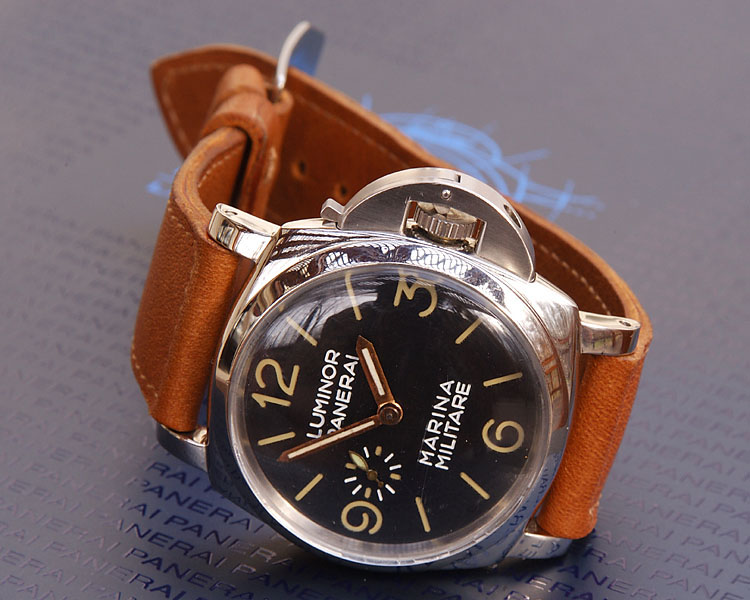
The Luminor Due exists to answer a specific objection: that Panerai's watches are too large for formal contexts and too thick for suit-wearing. The standard Luminor 44mm case sits approximately 16mm off the wrist — dimensionally beyond what most dress watch conventions permit. The Due reduces that to approximately 10.5mm, cuts the case to 38mm or 42mm, and adds polished finishing in place of brushed steel. It looks unmistakably like a Panerai — the crown guard bridge is present, the sandwich dial remains — while occupying a fundamentally different position on the wrist.
Photo: Piero7 — Public Domain — Wikimedia Commons
Introduction — SIHH 2016
Photo: Jay Pulli — Copyrighted Free Use — Wikimedia Commons

The Luminor Due was unveiled at SIHH (Salon International de la Haute Horlogerie) 2016 . "Due" is Italian for "two" — a name referencing the two defining differences from the standard Luminor:
- Smaller case dimensions — 38mm and 42mm versus the standard 44mm
- Dramatically reduced thickness — approximately 10.5–10.7mm versus the standard 44mm Luminor's approximately 16mm
A 40% reduction in thickness in a watch that retains the Luminor's crown guard bridge required specific engineering: an ultra-slim movement, a redesigned case construction, and a modified crown guard profile. None of these could be adapted from existing Panerai architecture — they required new development.
The P.4000 — Enabling the Due
Photo: Historical photograph — Public Domain — Wikimedia Commons
The movement that made the Luminor Due possible is the P.4000 — Panerai's first in-house micro-rotor automatic calibre, introduced at Watches & Wonders 2014 (initially in the Radiomir 1940, then carried into the Due at SIHH 2016).
| Specification | Value |
|---|---|
| Type | Automatic, micro-rotor |
| Diameter | 31mm (13¾ lignes) |
| Thickness | 3.95mm |
| Frequency | 28,800 vph (4 Hz) |
| Jewels | 31 |
| Power reserve | 72 hours (3 days) — two barrels |
| Oscillating weight | Off-centre tungsten micro-rotor |
| Anti-shock | KIF Parechoc |
At 3.95mm , the P.4000 is exceptional for an automatic movement. A conventional automatic with a full rotor typically runs 5–6mm or more in thickness. The micro-rotor architecture — an off-centre oscillating weight that sits within the movement's diameter rather than above it — allows the total movement height to approach that of a thin manual-wind calibre.
The P.4000/10 variant , used in gold Due models, features a skeletonised plate and a 22-carat gold micro-rotor — the same mechanical specification in a more decorative execution visible through the caseback.
The P.900 — The Slim Automatic Alternative
Photo: Piero7 — Public Domain — Wikimedia Commons
The P.900 is the Due's alternative movement option: a conventional (non-micro-rotor) automatic at 4.2mm thick , 23 jewels, 28,800 vph, 72-hour power reserve.
The P.900 is slightly thicker than the P.4000 but uses a different winding architecture (conventional bidirectional rotor rather than micro-rotor). Its base architecture is shared with other Richemont brands via the ValFleurier manufacture — a collaborative production facility used by Cartier (Calibre 1847 MC), IWC (32000 series), and Baume & Mercier (Baumatic). This shared architecture does not diminish the movement's quality — it is a well-regarded and reliable calibre — but collectors should note it is not fully proprietary to Panerai in the way the P.4000 is.
Case Dimensions and Water Resistance
Photo: Piero7 — Public Domain — Wikimedia Commons
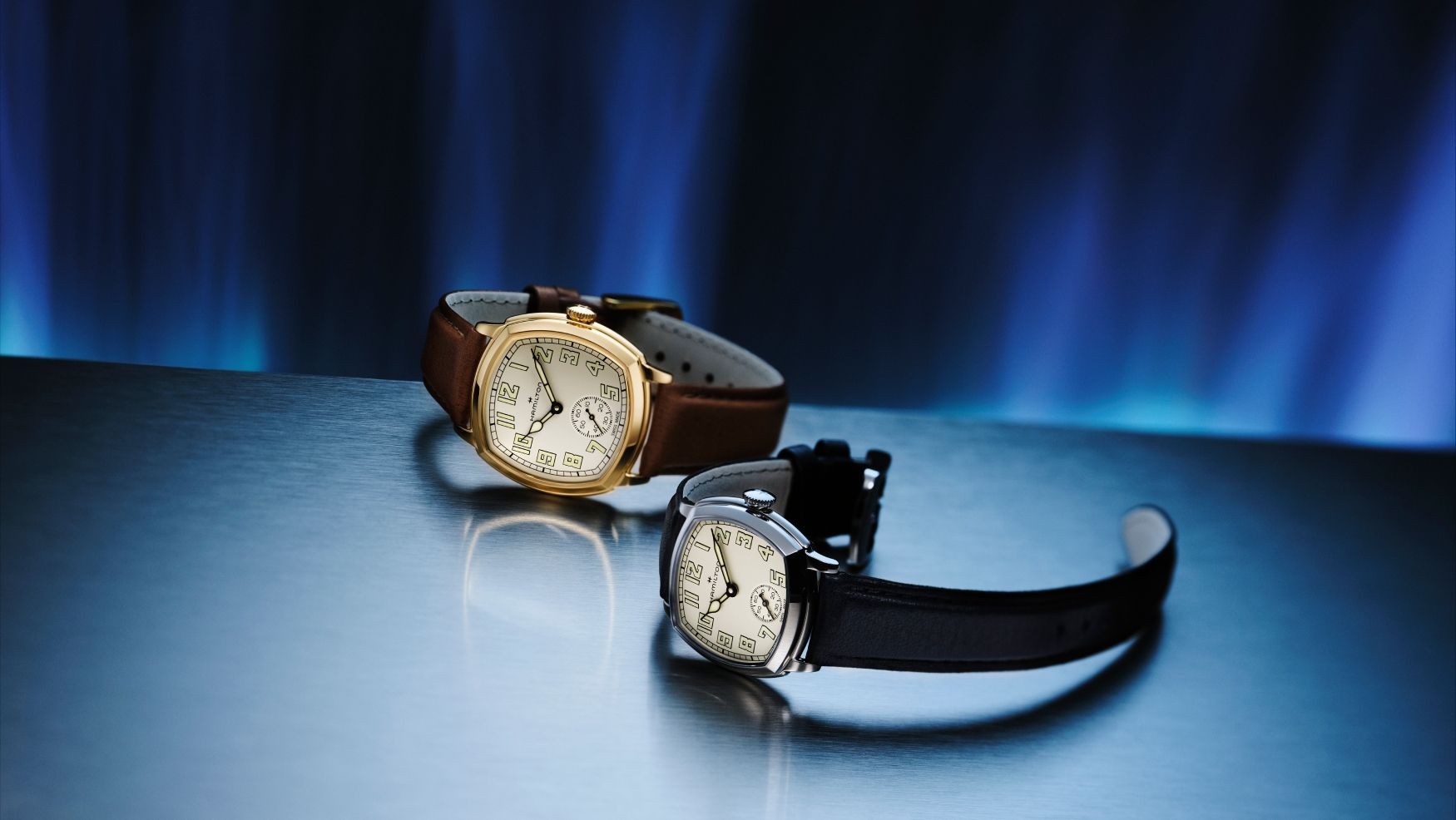
Case sizes : 38mm and 42mm.
Case thickness : Approximately 10.5–10.7mm — roughly 40% thinner than the standard 44mm Luminor.
Water resistance : 30 metres (3 bar) — substantially lower than the standard Luminor (100m) and the Submersible (300m).
The 30m water resistance is an intentional design trade-off. The Due is positioned as a dress watch and everyday lifestyle companion, not a dive watch. The crown guard bridge is retained for aesthetic consistency and brand identity — it looks like a Panerai — but the case construction is optimised for thinness rather than depth rating. The bridge mechanism is present and functional but the case thickness reduction means the engineering margins that produce 100m+ ratings are not replicated.
Practical implication : The Due is splash-resistant and suitable for handwashing and rain. It should not be worn for swimming, and is not a dive watch by any standard. Buyers choosing between the Luminor Due and standard Luminor should consider whether water resistance is a priority.
Design Differences from Standard Luminor
Photo: Piero7 — Public Domain — Wikimedia Commons
Finishing : The Due features significantly more polished surfaces than the standard Luminor's predominantly brushed case. The crown guard and bezel are polished; the overall aesthetic reads as refined rather than instrumental.
Crown guard profile : Present but slightly more slender and elegant than the standard Luminor. The bridge mechanism remains functional but is scaled to the thinner case.
Dial : Sandwich construction retained — the defining Panerai dial specification. The overall dial is cleaner and less overtly military in character than standard Luminor references.
Weight : Substantially lighter than the standard Luminor, both due to the smaller case dimensions and the movement (the P.4000 micro-rotor is significantly lighter than a full-rotor automatic architecture).
Who the Due Is For
The Luminor Due addresses a collector segment that the standard Luminor — designed for combat swimmers and proportioned accordingly — cannot reach. Its buyers typically include:
- Wearers who want the Panerai aesthetic but find 44mm too large for their wrist
- Formal or suit-wearing contexts where 16mm of case thickness is impractical
- Collectors adding a versatile counterpart to a standard Luminor in their collection
- Buyers entering the Panerai world through the dress watch category
The Due does not replace the standard Luminor any more than a dress watch replaces a dive watch. It extends the collection's range into contexts the standard case was never designed to occupy.
Frequently Asked Questions
What does "Due" mean?
Italian for "two" — referencing the two key differences from the standard Luminor: smaller case dimensions (38mm and 42mm versus 44mm) and dramatically reduced thickness (approximately 10.5mm versus approximately 16mm).
When was the Luminor Due introduced?
Unveiled at SIHH 2016. The P.4000 micro-rotor movement that enabled it was introduced at Watches & Wonders 2014.
What movements power the Luminor Due?
The P.4000 (Panerai's first in-house micro-rotor automatic, 3.95mm thick, 31 jewels, 72-hour PR) and the P.900 (automatic, 4.2mm thick, 23 jewels, 72-hour PR, shared ValFleurier architecture). Both run at 28,800 vph.
Why does the Luminor Due only have 30m water resistance?
The case construction is optimised for thinness rather than depth rating. The 30m specification is appropriate for the watch's dress watch positioning — splash-resistant but not suitable for swimming or diving. The crown guard bridge is retained aesthetically but the engineering margins for 100m+ ratings are not replicated in the slim case architecture.
What are the available case sizes?
38mm and 42mm.