Hublot: The Art of Fusion — From 1980 to LVMH
By Zach Charles, Editor, Time on the Move
Hublot's history divides cleanly into two acts: the original brand founded by Carlo Crocco in 1980, which pioneered the fusion of gold with natural rubber, and the brand rebuilt by Jean-Claude Biver from 2004, which turned that fusion concept into the philosophical and commercial engine of one of watchmaking's most recognisable names. The Big Bang of 2005 was the inflection point — before it, Hublot was a niche curiosity; after it, Hublot was a cultural force.
Carlo Crocco and the 1980 Founding
Photo: Clyde94 — CC BY-SA 4.0 — Wikimedia Commons
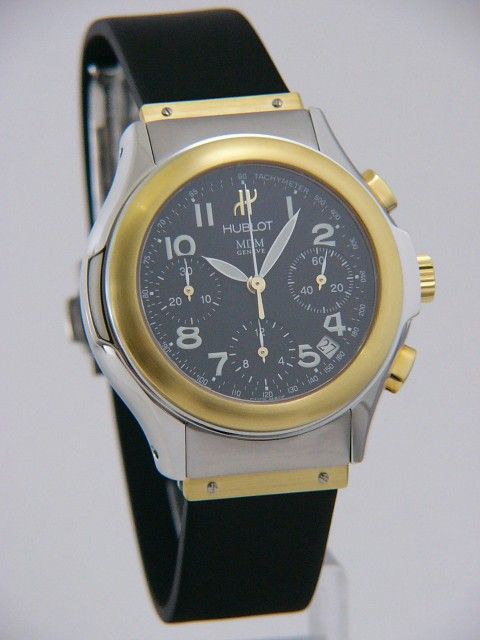
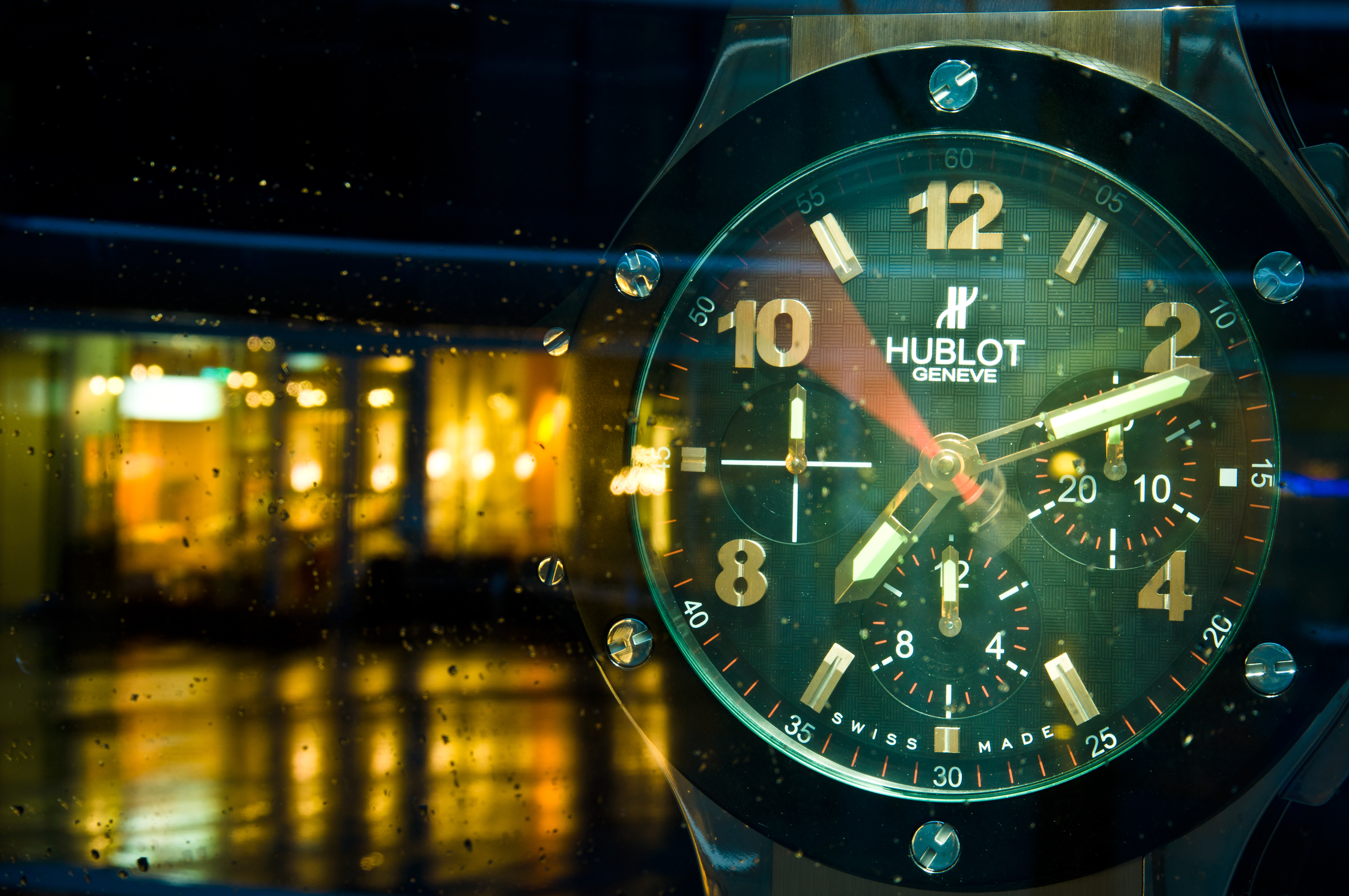
Carlo Crocco , an Italian watchmaker with Swiss connections, founded Hublot in 1980 . The name "Hublot" is French for porthole — a reference to the watch's distinctive round case with screwed bezel, inspired by the portholes of luxury yachts.
Crocco's innovation was material combination: he created a watch in 18-carat gold with a natural rubber strap at a time when luxury watches were universally supplied on leather or metal bracelets. Rubber was considered an industrial material, entirely unsuited to fine watchmaking. Crocco's argument was the opposite: natural rubber, properly processed, is supple, hypoallergenic, comfortable, and durable — superior to leather for an active wearer and superior to metal for skin contact.
The original Hublot was not universally welcomed. The Swiss watch establishment considered the rubber strap inappropriate for a gold watch. But the watch sold — particularly in Italy and among yacht owners who appreciated the material logic of a rubber strap in a marine context.
The Original Hublot — 1980s and 1990s
The original Hublot collection was built around the porthole case aesthetic: a round case with a ring of screws visible on the bezel, referencing the screwed covers of yacht portholes. The movement was a simple automatic — ETA-based, competently assembled, not a complication watch.
The brand occupied a comfortable niche through the 1980s and 1990s: a gold watch with a rubber strap, sold at luxury prices, to buyers who appreciated the material juxtaposition. It was not a major brand by Swiss luxury standards — Crocco was not competing with Patek Philippe or Rolex — but it had a loyal following and consistent sales.
By the early 2000s, however, Hublot was showing its age. The design had not evolved substantially from 1980, and the brand lacked the movement development resources or marketing infrastructure to compete in the increasingly crowded luxury watch market.
Jean-Claude Biver — 2004 Acquisition
Photo: Uhrenhandel.de — CC BY-SA 3.0 — Wikimedia Commons
Jean-Claude Biver acquired Hublot in 2004 . Biver was already legendary in Swiss watchmaking for having led the revival of Blancpain in 1983 and the transformation of Omega in the 1990s. At Hublot, he would execute a third turnaround — faster and more dramatic than either of the previous two.
Biver's diagnosis of Hublot: the brand had a genuine concept (the fusion of luxury materials with industrial materials) but had not pushed that concept far enough. His strategy: take the fusion idea, intensify it, apply it to a completely new watch design, and market it aggressively.
The result was the Big Bang of 2005 — a watch that embedded the original Hublot's rubber-meets-precious-metal concept into a 44mm case architecture that mixed steel, rubber, carbon, ceramic, and gold simultaneously.
The LVMH Acquisition — 2008
Photo: Adam Kliczek — CC BY-SA 3.0 PL — Wikimedia Commons
In 2008 , Hublot was acquired by LVMH (Moët Hennessy Louis Vuitton) — the luxury conglomerate that also owns TAG Heuer, Zenith, and Bulgari in the watch sector. The acquisition valued Hublot at approximately CHF 400–500 million — a remarkable figure for a brand that had been a minor player just four years earlier.
Biver remained as CEO, continuing to direct the brand's expansion. The LVMH acquisition provided distribution resources, retail infrastructure, and the capital for manufacturing expansion — including the construction of a dedicated manufacture facility in Nyon , on the shore of Lake Geneva.
Manufacture Nyon
Photo: La MèreVeille — CC BY-SA 4.0 — Wikimedia Commons
The Hublot manufacture in Nyon was inaugurated in 2009 — a purpose-built facility designed to produce in-house movements alongside assembled watches. The UNICO calibre, developed in-house from 2010, was the first movement produced there.
Nyon was chosen for its location near Geneva, its road and rail connections, and the availability of skilled watchmaking labour in the greater Geneva region. The facility is designed to be visually impressive — a statement of the brand's manufacturing ambitions.
Biver's Departure and Current Leadership
Jean-Claude Biver stepped back from active leadership in 2019 following health challenges, though he maintained a consultative role. Ricardo Guadalupe, who had been CEO since 2012, continued as the brand's operating head.
Under Guadalupe's leadership, Hublot has maintained the Big Bang's cultural momentum while expanding the Classic Fusion collection (for buyers who want Hublot materials without the Big Bang's visual intensity) and deepening the UNICO in-house movement programme.
Hublot's Commercial Scale
By the mid-2020s, Hublot produces approximately 50,000–60,000 watches annually — a substantial volume for a brand in the CHF 10,000–100,000+ price range. Revenue is estimated at over CHF 500 million annually , making it one of LVMH's most commercially significant watch brands.
The brand's global visibility — through football sponsorships (FIFA World Cup, UEFA Champions League), boxing (Floyd Mayweather, Manny Pacquiao), and Formula 1 — has given it recognition far exceeding its production volume. Hublot watches are culturally legible: easily identified, strongly associated with a specific buyer archetype (successful, international, comfortable with ostentation), and deliberately positioned as status objects.
Hublot Model and Technology Guides
Each Hublot collection and key technology has its own in-depth history on Time on the Move:
- Hublot Big Bang: The Watch That Defined a Brand
- Hublot Big Bang Integral: The Integrated Bracelet Sport Watch
- Hublot Classic Fusion: Art of Fusion Without the Volume
- Hublot and Ferrari: Art of Fusion Meets the Prancing Horse
- Hublot Limited Editions: Collaborations, Culture, and Collectibility
- Hublot Materials Innovation: Magic Gold, Ceramic, and Sapphire
- Hublot MP Collection: Extreme Complications and Mechanical Art
- Hublot Spirit of Big Bang: The Tonneau Case Interpretation
- Hublot UNICO Calibre: The In-House Flyback Chronograph