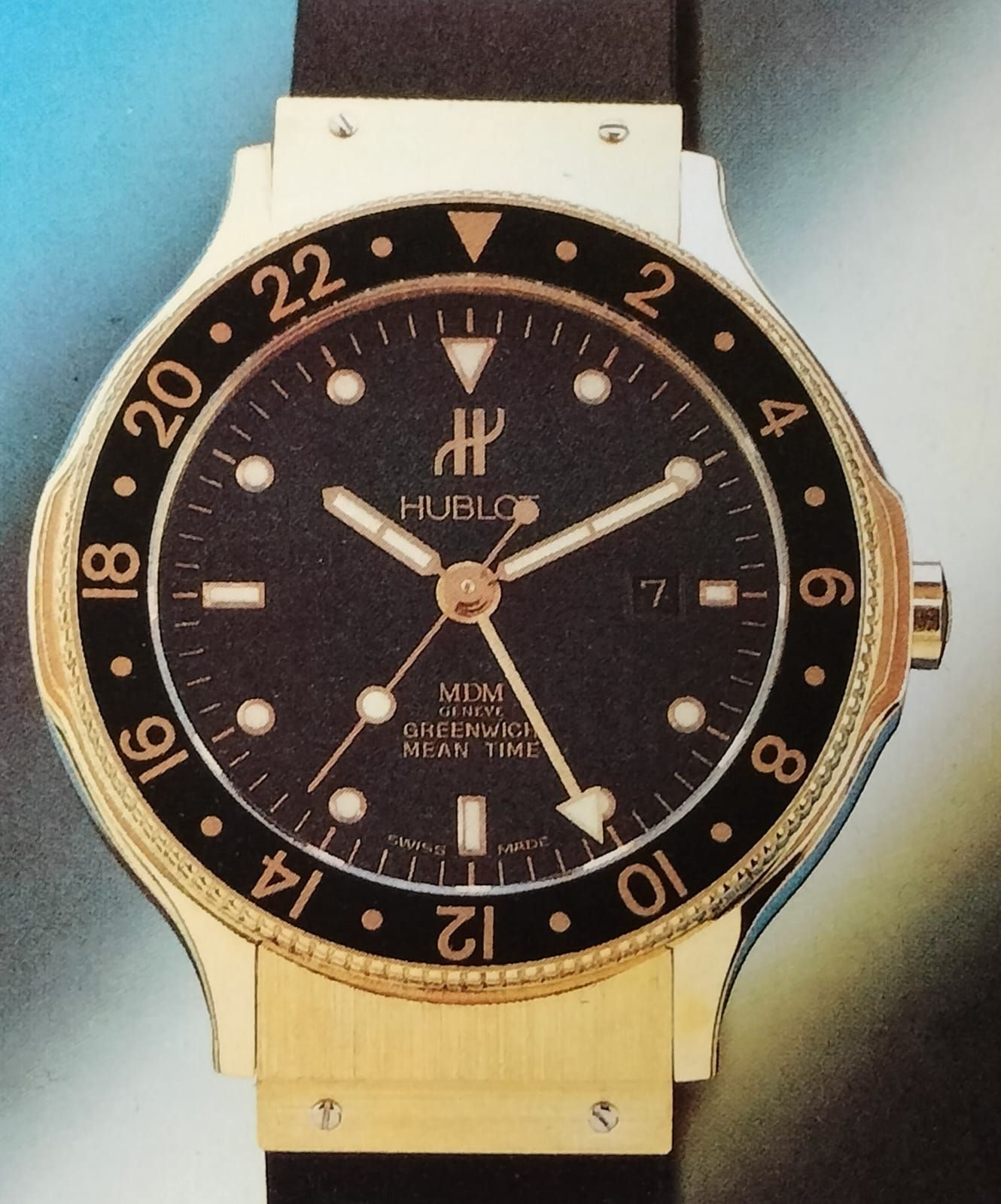
Hublot Big Bang: The Watch That Defined a Brand
The Big Bang is the watch that Jean-Claude Biver used to rebuild Hublot after the 2004 acquisition. It won the Grand Prix d'Horlogerie de Genève in 2005 — the most important award in watchmaking — in its first year of production. More consequentially, it became the visual archetype for a generation of luxury sport watches that combined unconventional materials with complex movements in large cases. Whatever one thinks of the Big Bang aesthetically, its influence on the watch industry is beyond dispute.
The 2005 Design
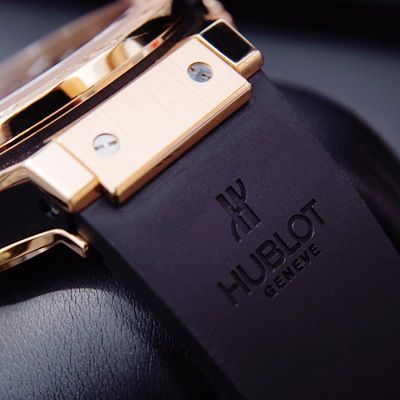
The Big Bang's 44mm case combined six materials simultaneously: titanium, steel, rubber, carbon fibre, ceramic, and optionally gold. No watch of comparable prominence had attempted such a material combination at launch. The case architecture — a cylindrical barrel with H-shaped screws on the bezel, rubber vulcanised directly into the case, a visible gasket between case and bezel — was deliberately industrial in reference while executed to luxury tolerances.
The design was created by Biver and the Hublot design team, with the case architecture referencing the original 1980 Hublot porthole bezel while dramatically expanding the scale and material vocabulary. The result was larger, louder, and more complex than the original Hublot — a statement of intent rather than a refinement.
Art of Fusion — The Concept
Photo: Clyde94 — CC BY-SA 4.0 — Wikimedia Commons
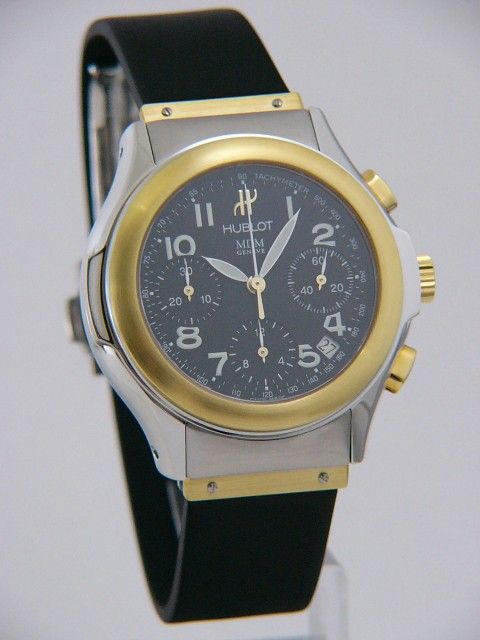
Biver articulated Hublot's philosophy as the "Art of Fusion" — the deliberate combination of materials that conventional luxury watchmaking would consider incompatible. The pairings that defined the Big Bang:
- Gold + rubber: The original Hublot combination, now intensified with a case that integrates rubber structurally rather than merely using it as a strap material
- Carbon + gold: Industrial composite material alongside precious metal — no traditional watchmaker would have paired these
- Ceramic + titanium: Technical materials from aerospace and medical applications, finished to luxury tolerances
- Sapphire + steel: The movement visible through a sapphire caseback on a case that also uses conventional steel
The Art of Fusion concept gave Hublot a philosophical framework that could generate infinite variations — every season brought new material combinations, new colour treatments, new limited editions, all theoretically connected to the founding concept.
The Movement — HUB4100
Photo: Uhrenhandel.de — CC BY-SA 3.0 — Wikimedia Commons
The original Big Bang chronograph was powered by the HUB4100 — a modified version of the ETA 2892 with an added chronograph module. This was not an in-house movement in the strict sense; Hublot was using established Swiss movement architecture and customising it.
The UNICO in-house movement (HUB1240), introduced in 2010, replaced the HUB4100 in the Big Bang chronograph as the brand's internal manufacture capability developed. The UNICO was Hublot's argument that it was a genuine manufacture, not merely a case and strap designer purchasing movements.
Big Bang Case Architecture
Photo: Yorqulov Husan — CC BY 4.0 — Wikimedia Commons
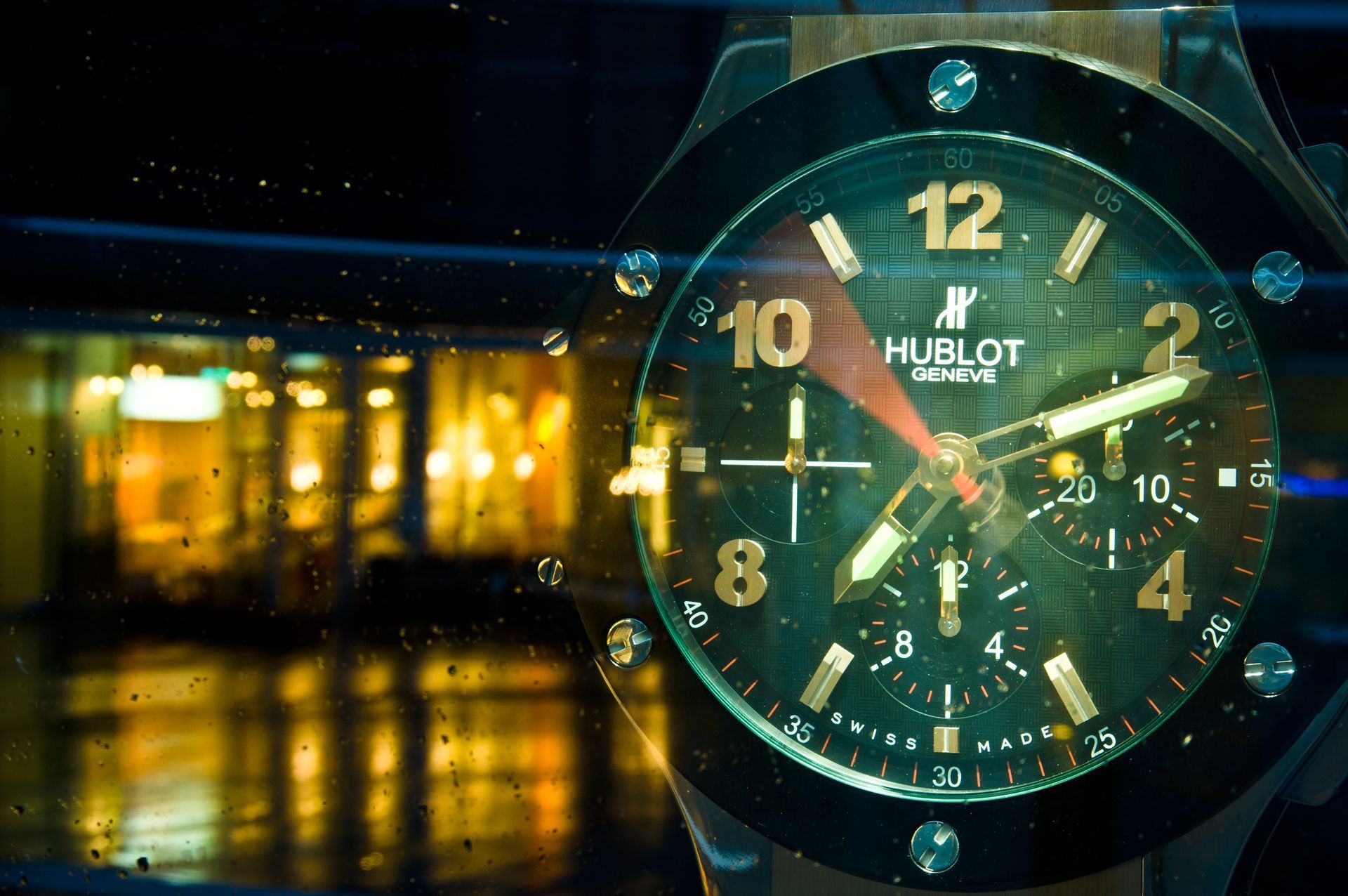
The Big Bang's case is architecturally complex for a sport watch:
- Six screws on the bezel — a structural element referencing a ship's porthole dog bolts
- Integrated rubber strap — vulcanised into the case rather than attached by spring bars, eliminating the traditional lug structure
- Sapphire crystal — domed, anti-reflective coated
- Exhibition caseback — sapphire, revealing the movement
- Interchangeable strap system — proprietary system allowing strap change without tools
The integrated strap system — which Hublot trademarked and developed further over subsequent years — allows the wearer to swap between rubber, leather, fabric, and metal bracelets without removing the watch from the wrist or using tools. This became a significant selling point and a product differentiation strategy.
The Big Bang Family
Photo: Adam Kliczek — CC BY-SA 3.0 PL — Wikimedia Commons

From the original 44mm chronograph, the Big Bang family expanded substantially:
| Reference | Case | Movement |
|---|---|---|
| Big Bang Unico | 42mm or 44mm | UNICO flyback chronograph |
| Big Bang Steel | 41mm | Automatic time-only |
| Big Bang Tourbillon | 45mm | Flying tourbillon |
| Big Bang MP | Various | Masterpiece complications |
| Big Bang Sang Bleu | 45mm | Tattooist-designed dial |
| Big Bang Millennial Pink | 39mm | Fashion-forward colourway |
By the mid-2010s, the Big Bang had become a platform rather than a single watch — a case architecture hosting numerous movements, dials, and material combinations.
Cultural Presence
Photo: La MèreVeille — CC BY-SA 4.0 — Wikimedia Commons
The Big Bang's presence extends beyond watchmaking circles. Hublot became an official FIFA World Cup timekeeper in 2010, placing Big Bang watches on the wrists of referees at every World Cup match and embedding the brand in the most-watched sporting event on earth.
Boxing partnerships — particularly with Floyd Mayweather — connected the Big Bang to sports celebrity culture in a way that traditional watchmaking marketing had not attempted. The Hublot "Big Bang" name itself became a common noun in watch retail: "a hublot" colloquially refers to any large, bold, multi-material sport watch.