Doxa Grafic: The Bauhaus Dress Watch That Was Doxa Before the SUB
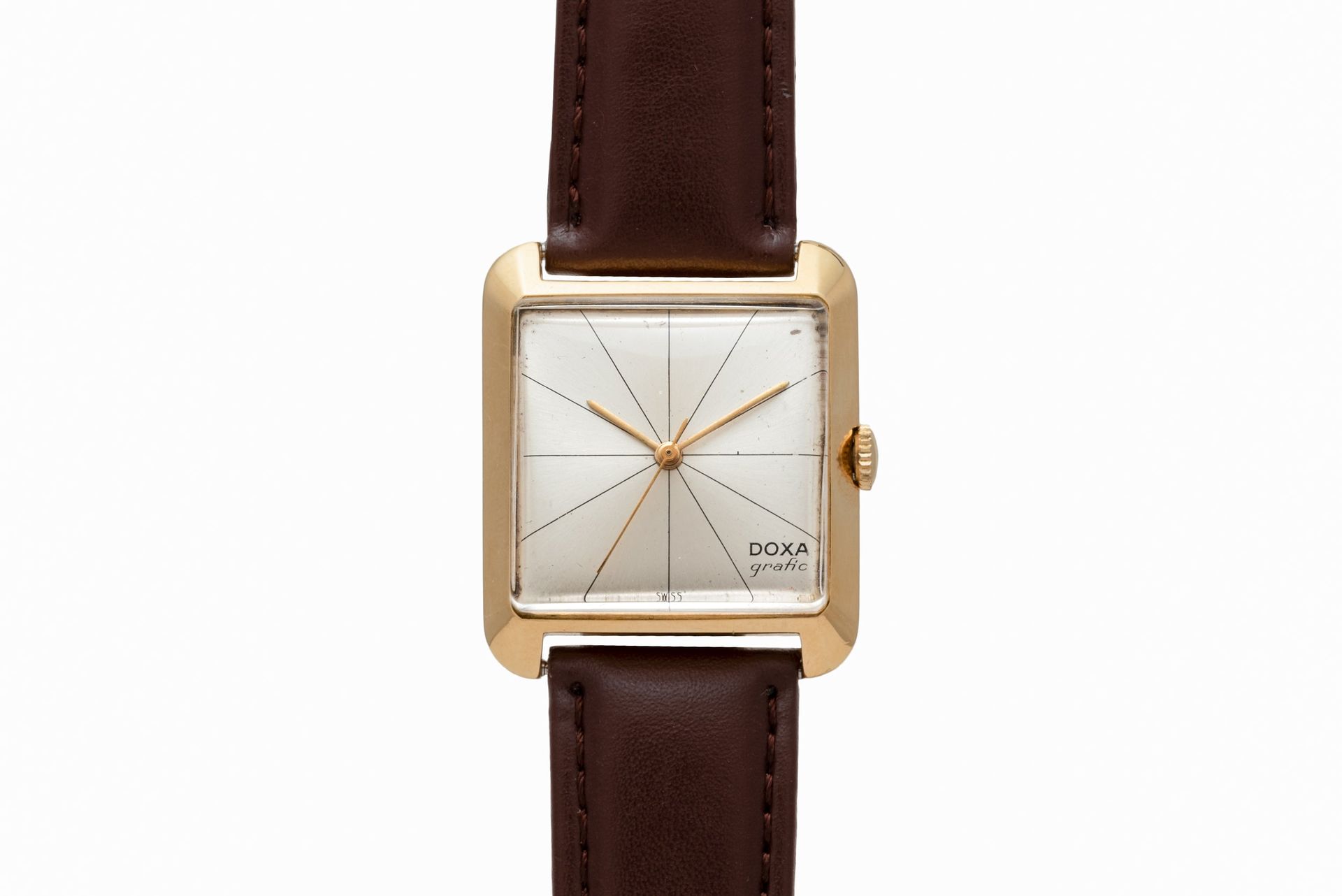
The Doxa Grafic is the watch that most people who know Doxa have never heard of — and the watch that defined the brand for the first two-thirds of its existence. Introduced in the late 1950s, the Grafic was a square-cased stainless steel dress watch in the Bauhaus tradition: geometric, unornamented, built around a clean dial with strong typographic indices. It was Doxa's bestselling line before the SUB 300 arrived in 1967 and redirected the brand entirely. Understanding the Grafic is understanding what Doxa was before it became the orange dive watch company.
The Grafic sits in an interesting position in watch history. The 1950s saw a wave of geometric cases — squares, rectangles, cushion shapes — across Swiss watchmaking, responding to a post-war modernist aesthetic that rejected the organic curves of earlier dress watch design. Doxa's Grafic was among the more refined examples: a genuinely clean case with no decorative flourishes, paired with a dial that prioritized legibility over ornamentation. It was the kind of watch a mid-century architect or designer might wear — not as a statement, but as an extension of the same values they applied to their work.
Design: Bauhaus Principles in a Watch Case
The Bauhaus design movement — founded in Weimar Germany in 1919 and closed by the Nazis in 1933 — held that form follows function, that unnecessary decoration is a failure of design, and that good industrial objects should be honest about their materials and construction. By the time Doxa designed the Grafic in the late 1950s, Bauhaus had been absorbed into the broader design culture of postwar Europe and was informing everything from furniture to typography to consumer electronics.
The Grafic applied these principles directly. The square case in stainless steel was an honest shape — it did not apologize for being a square by rounding its corners into something softer, nor did it add lugs or decorative elements that the movement did not require. The dial carried indices in place of hour numerals, arranged with precision around the chapter ring. The hands were slender and functional. The overall impression was of an object that knew exactly what it was and had nothing to prove about it.
This is the tradition the Grafic stands in: the same logic that produced the Bauhaus Desk Clock, the Braun SK series, and the early work of Dieter Rams at Braun — the idea that the best industrial design is the design that disappears into its function. The Grafic never disappears in the sense of being forgettable, but it never demands attention for its own sake.
The Grafic as Bestseller: Doxa Before the SUB
For most of its history — from 1889 through the mid-1960s — Doxa was a movement manufacturer and dress watch maker without a strong public identity. The Grafic changed this domestically. The square case appealed to the Swiss and European market for precise, serious dress watches, and the Grafic sold well enough through the 1960s to become the brand's defining product before diving took over.
When the SUB 300 arrived in 1967 and the Cousteau partnership gave Doxa a global identity, the Grafic's centrality receded. The brand's new image was the orange dive watch, the no-deco bezel, the professional marine environment. The Grafic was, by comparison, a quiet watch for quiet occasions — still made, still sold, but no longer the brand's statement piece.
The dormancy period (1983–1997) interrupted both lines. When the Jenny family revived Doxa in 1997, the focus was on the SUB family, which had built the brand's collector reputation. The Grafic returned in limited revival editions for collectors interested in the pre-dive Doxa, as a reminder that the brand had a design identity before it became synonymous with orange dials and no-deco bezels.
The Grafic Today: Periodic Revivals and Collector Interest
Modern Doxa produces the Grafic periodically, typically as limited or special editions rather than permanent catalog items. The design has required updating for contemporary wearing — original Grafic movements were hand-wound in small cases; modern revivals use automatic movements in cases proportioned for current wrist sizing — but the essential design language has been preserved. The square case, the clean dial, the absence of decoration: these remain intact.
Collector interest in vintage Grafic examples has grown as the broader vintage Swiss watch market has recognized models outside the standard Rolex/Omega/Patek hierarchy. A good original Grafic — particularly examples with unusual dial configurations or confirmed provenance from the 1960s production peak — represents an honest piece of mid-century European design without the prices that Genta-designed cases command.
For Doxa collectors specifically, the Grafic is the missing piece of the brand's story. Anyone who knows Doxa only as the orange dive watch company encounters something genuinely surprising in the Grafic: a design tradition that preceded the SUB entirely and that holds up, on its own terms, as one of the cleaner dress watch designs of its era.
Introduced: Late 1950s | Case shape: Square | Material: Stainless steel
Design tradition: Bauhaus / Swiss modernism | Significance: Doxa's bestseller before the SUB 300 (1967)
Current status: Periodic limited revivals | Collector relevance: Vintage originals from 1957–1983 period
The Grafic in Context: Swiss Geometric Watches of the 1950s–60s
The Grafic was not unique in exploring square and geometric cases — the 1950s and 1960s saw similar explorations from Jaeger-LeCoultre (Reverso was pre-war, but the rectangular Memovox updated it for the era), Cartier (Tank and Santos), IWC, and others. What distinguished the Grafic from luxury competitors was its material honesty: stainless steel rather than gold, no gem-setting, no engraved case decoration. It was a modernist object in a market where most geometric watches were luxury objects. This put it in a specific niche — serious, precise, modern — that fit a specific buyer: the European professional of the 1960s who valued design over display.
The counterintuitive legacy of the Grafic is that it makes Doxa a more interesting brand than its dive watch reputation alone suggests. A company that produced the Bauhaus-influenced Grafic and then pivoted to the orange professional dive watch demonstrates a consistency of purpose — serious functional objects for serious use — that runs through both designs. The Grafic looks nothing like the SUB 300. But both were designed with the same priority: function first, aesthetics in service of it.
Frequently Asked Questions
What is the Doxa Grafic?
The Doxa Grafic is a square-cased stainless steel dress watch introduced by Doxa in the late 1950s, designed in the Bauhaus tradition — clean geometry, functional indices, no decorative elements. It was Doxa's bestselling product before the SUB 300 dive watch arrived in 1967 and redirected the brand's identity.
Is the Doxa Grafic still made?
The Grafic is not a permanent catalog item in Doxa's current lineup but returns in periodic limited revival editions. Vintage originals from the 1957–1983 production period are available on the secondary market and are of increasing interest to collectors of mid-century Swiss design.
How does the Grafic fit into Doxa's history?
The Grafic represents Doxa's first distinctive design identity — before the brand became synonymous with orange dive watches. Doxa built its pre-1967 reputation as a dress watch and movement maker; the Grafic was the peak expression of that era. Understanding the Grafic reveals a brand with a design philosophy consistent across very different product categories: function-first, material-honest, undecorated.
Sources: Doxa Watches (doxawatches.com), The Hour Markers, Analog:Shift, Wikipedia, Fratello Watches.