
Omega Constellation: History of the Observatory Chronometer Watch

Zach Charles • July 11, 2026

Share this article

Omega Constellation: History of the Observatory Chronometer

The Omega Constellation is the brand's prestige watch line — historically tied to precision chronometry competitions and observatory certifications, and visually defined by one of the most immediately recognisable case designs in luxury watchmaking. Its most distinctive feature is the integrated "claw" or "paw" lugs introduced in the 1982 Manhattan redesign: four prominent polished claws that grip the case and flow into the bracelet, creating a silhouette that identifies the Constellation at a glance from across a room. Whether you find these claws elegant or excessive, they work as design — the Constellation is the rare watch that cannot be confused with anything else.

The collection began in 1952 with a specific and meaningful purpose: to showcase Omega's observatory-grade precision movements at a time when observatory chronometry competitions were the most prestigious public measure of a watch's accuracy. Those competitions — conducted at Neuchâtel and Geneva, with results published and studied by the industry — defined watchmaking excellence in the way that motor racing defines automotive excellence. Omega dominated them. The Constellation was how they showed it.


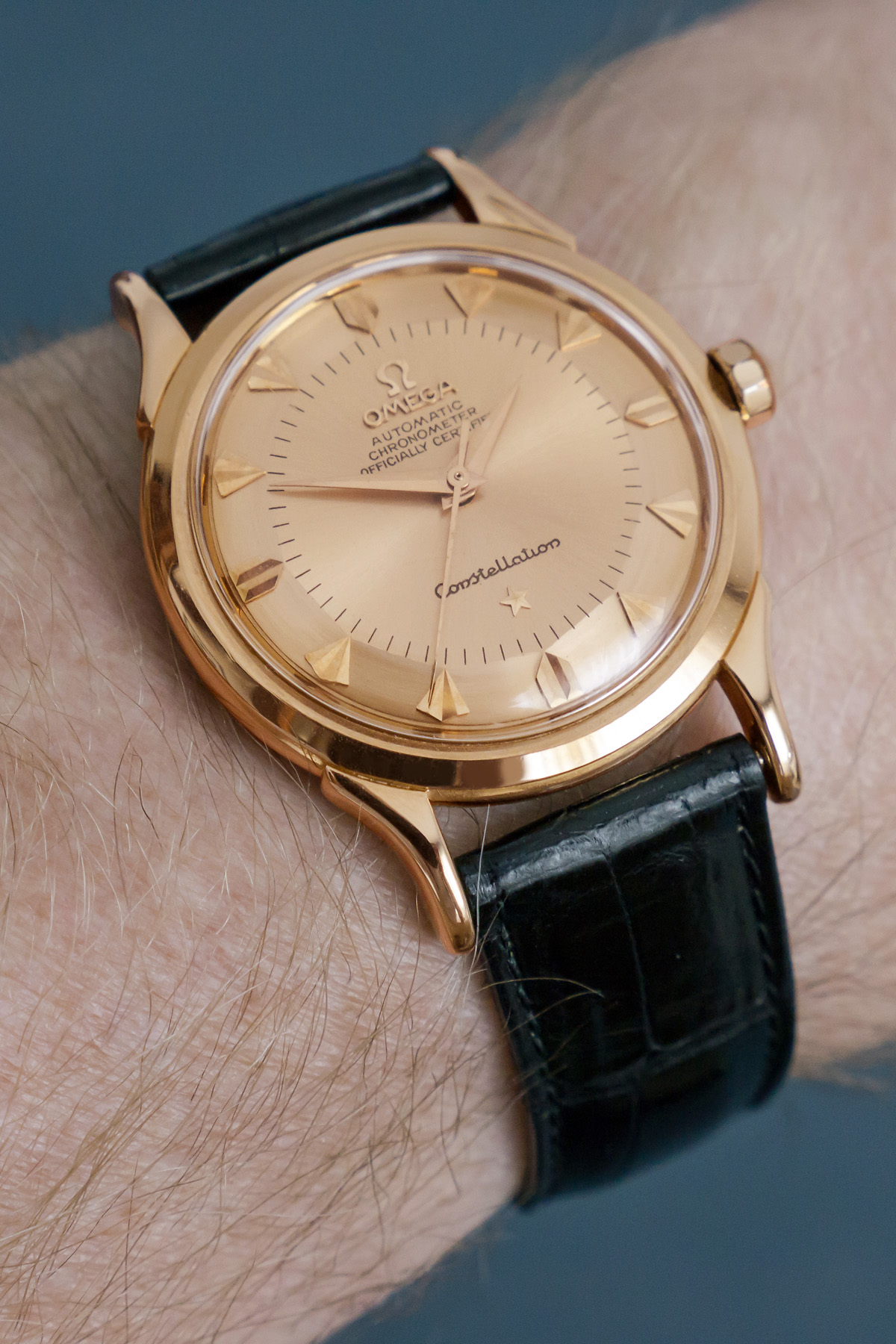
Omega Constellation in rose gold, 1958
An Omega Constellation in rose gold from 1958 — an early example of the watch Omega launched in 1952 as a chronometer-grade dress reference celebrating its observatory competition victories. The Constellation’s pie-pan dial — with its characteristic raised chapter ring and sunburst centre — is among the most recognisable mid-century watch dial designs in Swiss watchmaking.
Photo: Noop1958 — CC BY-SA 3.0 — Wikimedia Commons
Origins — The Observatory Era (1952)

Omega Constellation in rose gold, 1958
An Omega Constellation in rose gold from 1958 — an early example of the watch Omega launched in 1952 as a chronometer-grade dress reference celebrating its observatory competition victories. The Constellation’s pie-pan dial — with its characteristic raised chapter ring and sunburst centre — is among the most recognisable mid-century watch dial designs in Swiss watchmaking.
Photo: Noop1958 — CC BY-SA 3.0 — Wikimedia Commons

In 1952, Omega launched the "Constellation" as an explicit statement of precision ambition. The name itself referenced the constellation symbol stamped on the caseback of each watch — an eight-pointed star inside an observatory dome, commemorating Omega's victories in official chronometry trials. This was not decorative; it was documentary. The caseback star was a badge of horological achievement, marking the watch as a product of movements that had been measured, tested, and found exceptional by independent scientific institutions.

The context matters. Swiss observatories at Neuchâtel and Geneva conducted annual chronometry competitions from the mid-nineteenth century onward. Manufacturers submitted their finest movements for 45-day trials, tested in five positions and three temperatures. Results were published and eagerly followed within the industry. First-place finishes were used in advertising with the confidence that is usually reserved for objective sporting victories. For Omega, which had been systematically refining its movement technology since the Rebberg factory era, these competitions were an ideal venue to demonstrate verifiable superiority.

The first Constellation references — centred on the CK 2852 — were characterised by the "Pie Pan" dial: a sunken centre chapter with a raised outer ring, creating a three-dimensional depth effect that no flat dial can replicate. Faceted cases in steel and solid gold, applied metal logos on the dial, and elaborate case finishing completed the picture. The movement inside, the Calibre 354, was built and regulated to a standard that anticipated COSC certification before COSC existed as a formal institution.


The Pie Pan Dial — Design Icon of the 1950s–70s

Omega Constellation in rose gold, 1958
An Omega Constellation in rose gold from 1958 — an early example of the watch Omega launched in 1952 as a chronometer-grade dress reference celebrating its observatory competition victories. The Constellation’s pie-pan dial — with its characteristic raised chapter ring and sunburst centre — is among the most recognisable mid-century watch dial designs in Swiss watchmaking.
Photo: Noop1958 — CC BY-SA 3.0 — Wikimedia Commons

The Pie Pan dial is the defining aesthetic achievement of early Constellation production and one of the most beautiful dial designs in twentieth-century watchmaking. The construction is simple but the effect is striking: the outer chapter ring is raised above the level of the main dial surface, creating a deep shadow that separates the hour indices from the central area. The centre of the dial is typically finished in brushed or sunburst patterns, while the outer ring carries the minute track. Applied Roman or Arabic numerals sit on the raised ring, catching light from above and casting their own shadows below.

This architecture rewards careful examination in a way that flat dials do not. In different lighting conditions — direct overhead, angled, or diffused — the Pie Pan dial presents different faces. The shadows deepen or flatten; the applied indices catch the light from different angles; the contrast between the raised ring and the recessed centre shifts as the light source moves. It is, in the fullest sense, a three-dimensional object rather than a printed surface.

Collector demand for genuine Pie Pan Constellations in good condition has remained robust for decades. Gold examples with original dials in truly exceptional condition can fetch $10,000 to $30,000 at specialist auction houses — not because they are rare (Omega made many thousands) but because the combination of original dial, original hands, unpolished case, and fully original crown in a specific reference is genuinely difficult to find after seventy-plus years. Steel examples with good original dials are more accessible, ranging from approximately $1,000 to $5,000 depending on reference and condition.


Observatory Chronometry — Winning Competitions

Omega Constellation in rose gold, 1958
An Omega Constellation in rose gold from 1958 — an early example of the watch Omega launched in 1952 as a chronometer-grade dress reference celebrating its observatory competition victories. The Constellation’s pie-pan dial — with its characteristic raised chapter ring and sunburst centre — is among the most recognisable mid-century watch dial designs in Swiss watchmaking.
Photo: Noop1958 — CC BY-SA 3.0 — Wikimedia Commons

Omega's record in observatory chronometry trials during the 1950s and 1960s is a matter of public historical record, not marketing retrospective. The Neuchâtel Observatory annual results were published in a form accessible to the entire industry, and Omega's placement across categories was consistently exceptional.

The 1960 Neuchâtel trials are among the most cited: Omega won 32 first-place positions across the competition's various categories, a record that stood for years and was not quietly maintained but loudly celebrated. These victories were genuine because they were independently verified — the observatory neither knew nor cared which brand's name was on the dial; it measured the movement's rate performance over 45 days and reported what it found.

The chronometry competition era ended in the early 1970s, when quartz technology made the traditional mechanical trial format obsolete — a quartz oscillator simply outperformed any mechanical balance wheel by too wide a margin for the comparison to be meaningful. COSC, the Contrôle Officiel Suisse des Chronomètres, emerged as the successor certification for mechanical movements, standardising accuracy requirements (−4/+6 seconds per day) and providing a commercial alternative to the ceased observatory trials. The Constellation continued to use COSC-certified movements and to carry the observatory dome caseback as a historical reference long after the competitions ended.


The Manhattan — A Bold New Identity (1982)

Omega Constellation in rose gold, 1958
An Omega Constellation in rose gold from 1958 — an early example of the watch Omega launched in 1952 as a chronometer-grade dress reference celebrating its observatory competition victories. The Constellation’s pie-pan dial — with its characteristic raised chapter ring and sunburst centre — is among the most recognisable mid-century watch dial designs in Swiss watchmaking.
Photo: Noop1958 — CC BY-SA 3.0 — Wikimedia Commons

In 1982, Omega redesigned the Constellation radically and controversially. The "Manhattan" Constellation retained the name and the observatory caseback but introduced an entirely new case architecture: four prominent polished claws — sometimes described as "paws" — that grip the sides and top of the case and flow into the integrated bracelet. The case itself became more rounded and cushion-shaped, with a fuller, more three-dimensional profile than the earlier rectangular or round references.

The timing placed the Manhattan among a cluster of integrated-bracelet designs that had emerged from the luxury watch industry in the 1970s following the Audemars Piguet Royal Oak (1972) and the Patek Philippe Nautilus (1976). Those designs had demonstrated that integration between case and bracelet could be more than structural — it could be a primary design statement. The Manhattan pursued a similar philosophy but with a more exuberant vocabulary. Where the Royal Oak's integrated bracelet is taut and angular, the Constellation Manhattan's is rounded and flowing; where the Royal Oak's design is immediately legible as sports watch architecture, the Constellation's is unmistakably a dress watch with sports watch proportions.

The claws polarise opinion to this day. Critics find them excessive and date the design immediately to the maximalist 1980s. Supporters argue that they give the Constellation an irreplaceable visual identity in a market where most designs blur into each other. Both positions have merit. What is indisputable is that the design works as identification: show a watch enthusiast the claws and they will name the Constellation without hesitation. In a market of 36,000 brands and hundreds of thousands of references, that kind of immediate recognisability has genuine value.

This design has remained essentially unchanged since 1982. It is not merely a heritage reference that Omega keeps alive for collectors; it is the current Constellation, the one on sale today in Omega boutiques worldwide.


Modern Constellation — Current Lineup

Omega Constellation in rose gold, 1958
An Omega Constellation in rose gold from 1958 — an early example of the watch Omega launched in 1952 as a chronometer-grade dress reference celebrating its observatory competition victories. The Constellation’s pie-pan dial — with its characteristic raised chapter ring and sunburst centre — is among the most recognisable mid-century watch dial designs in Swiss watchmaking.
Photo: Noop1958 — CC BY-SA 3.0 — Wikimedia Commons

The current Constellation family spans an unusual size range — from 25mm ladies' models to 41mm men's versions — reflecting the collection's broad gender neutrality and Omega's intention to serve the full breadth of the prestige dress watch market.

Cases are available in stainless steel, yellow Moonshine gold, Sedna gold (rose), and two-tone combinations. All retain the four-claw lug design and the integrated bracelet (or single-piece strap in the leather versions). The dial centre features the Omega constellation star logo at 6 o'clock, replacing the earlier practice of placing it on the caseback; the observatory dome continues to appear on the caseback of most current models.

Dial colours for the current generation include electric blue, green, champagne, silver, chocolate brown, and black — the blue and green variants in particular have benefited from broad industry interest in those colours since approximately 2020. The tachymeter chapter that appeared on some vintage Constellation references has been retired; current dials focus on clean, legible layouts without functional complications beyond the date window.


Movement — Master Chronometer Cal. 8700/8701/8702

Current Constellation movements are the Co-Axial Master Chronometer Calibre 8700 (or 8701/8702 variants for specific configurations), bringing the watch into the same certification tier as the Seamaster and De Ville.

The Master Chronometer certification means the Constellation's movement has been independently tested by METAS over ten days, including exposure to a 15,000-gauss magnetic field and subsequent rate measurement within ±0/+5 seconds per day. The silicon balance spring, like that used across Omega's current Master Chronometer range, is inherently non-magnetic and thermally stable, contributing both to the anti-magnetic performance and to long-term rate consistency. The Co-Axial escapement reduces friction and extends service intervals in the manner established by the Cal. 2500 in 1999 and refined through every subsequent generation.

For ladies' models, smaller-diameter Co-Axial movements maintain the certification standard in the reduced sizes required by 25mm and 29mm cases — a technically more demanding achievement than simply fitting an existing movement into a smaller case.


Constellation vs. Rolex Datejust

The Constellation and Rolex Datejust occupy the same market segment: prestigious Swiss watches with dates, available in steel and precious metal, sized for both men and women, appropriate for business and formal occasions. The comparison is made constantly and is genuinely instructive.

The Datejust's advantages are well-established. Secondary market performance for most Datejust references is excellent — retail prices are frequently maintained or exceeded on the pre-owned market, particularly for desirable dial and bracelet combinations. The Cyclops lens provides meaningful date legibility. Rolex's after-sales service infrastructure is comprehensive and widely distributed. And the Datejust's design, which has evolved incrementally since 1945 without any Manhattan-scale redesign, carries a design continuity that communicates timelessness rather than fashion.

The Constellation's advantages are different in character. The Co-Axial Master Chronometer movement is technically superior to the Datejust's Cal. 3235 on measurable parameters — METAS certification represents a more demanding standard than COSC, and the co-axial escapement demonstrably reduces friction in ways the Datejust's Chronergy escapement does not. The Constellation's design, for those who respond to the Manhattan claws as original rather than excessive, offers genuine visual distinction in a sea of round cases and simple integrated bracelets. And the Constellation on the pre-owned market typically trades below retail — a disadvantage for sellers, but a genuine buying opportunity for those who prioritise movement quality and design originality over resale calculations.


Collecting Vintage Constellations

The vintage Constellation market is coherent, knowledgeable, and surprisingly affordable given the historical significance of the pieces involved.

Pie Pan dials (1952–approximately 1970): the most collected and the most beautiful. Gold case examples in collector condition — original, unrefined, with original crown and intact lume on the hands — command $5,000 to $20,000 and occasionally more for exceptional references. Steel examples with original dials are accessible from $1,000 to $5,000.

Pre-Manhattan period (approximately 1970–1981): less consistently collected but historically interesting, representing the transition from the Pie Pan era to the 1982 redesign. Values are lower, $500 to $2,000 for most references, which can represent excellent buying opportunities for condition-focused collectors.

Early Manhattan (1982–approximately 1990): the claws at their most angular and architectural. Pre-owned examples range from $500 to $2,000 depending on metal and condition. Gold examples from this period are available at meaningful discounts to current retail.

Modern Master Chronometer : current pre-owned market places these close to retail, $3,000 to $6,000 for steel examples — the certification and movement quality hold value, though secondary market demand is lower than for the Seamaster or Speedmaster.


Frequently Asked Questions

What are the "claws" on the Omega Constellation?
The four distinctive integrated lugs introduced in the 1982 "Manhattan" redesign — polished protrusions that grip the case and flow into the bracelet, creating the Constellation's signature silhouette. They were intended to give the watch an unmistakable identity in the dress watch category, and they succeeded: the Constellation is one of the few watches identifiable from its case architecture alone.

What is a "Pie Pan" Constellation?
A vintage Constellation (approximately 1952–1970) with a stepped, raised outer dial ring resembling an upside-down pie pan. The three-dimensional construction creates depth and shadow effects impossible on a flat dial, and these early Constellations are considered among the most beautiful dial designs in twentieth-century Swiss watchmaking. They are among the most collectible vintage Omega references.

How does Constellation accuracy compare to COSC?
The modern Master Chronometer Constellation exceeds COSC: METAS-certified to ±0/+5 seconds per day even after exposure to 15,000 gauss magnetic fields, compared to COSC's ±4 seconds per day measured at only approximately 60 gauss. The Constellation also carries the co-axial escapement, designed to maintain this accuracy more consistently between service intervals than conventional lever escapements.


Related Articles

Recent Posts

By Zach Charles • October 10, 2026
Hamilton's American Classic Cushion Mechanical revives its 1926 Art Deco cushion watches, seen in Oppenheimer, in 30mm and 34mm with the new hand-wound…
Doxa SUB 200: The Accessible Everyday Diver
By Zach Charles • October 10, 2026
Complete guide to the Doxa SUB 200 — 42mm, 200m, four colorways, Sellita SW200-1. The accessible entry to the Doxa SUB family with the full…
By Zach Charles • October 10, 2026
The Breitling Top Time B01 Aston Martin DB5 pairs a cushion-shaped 41mm case, a wooden inner ring and the in-house Caliber 01 across three limited…
By Zach Charles • October 10, 2026
TAG Heuer developed the Mikrograph (2011, 1/100th second), Mikrotimer Flying 1000 (2011, 1/1000th second), and Mikrogirder (2012, 1/2000th second).
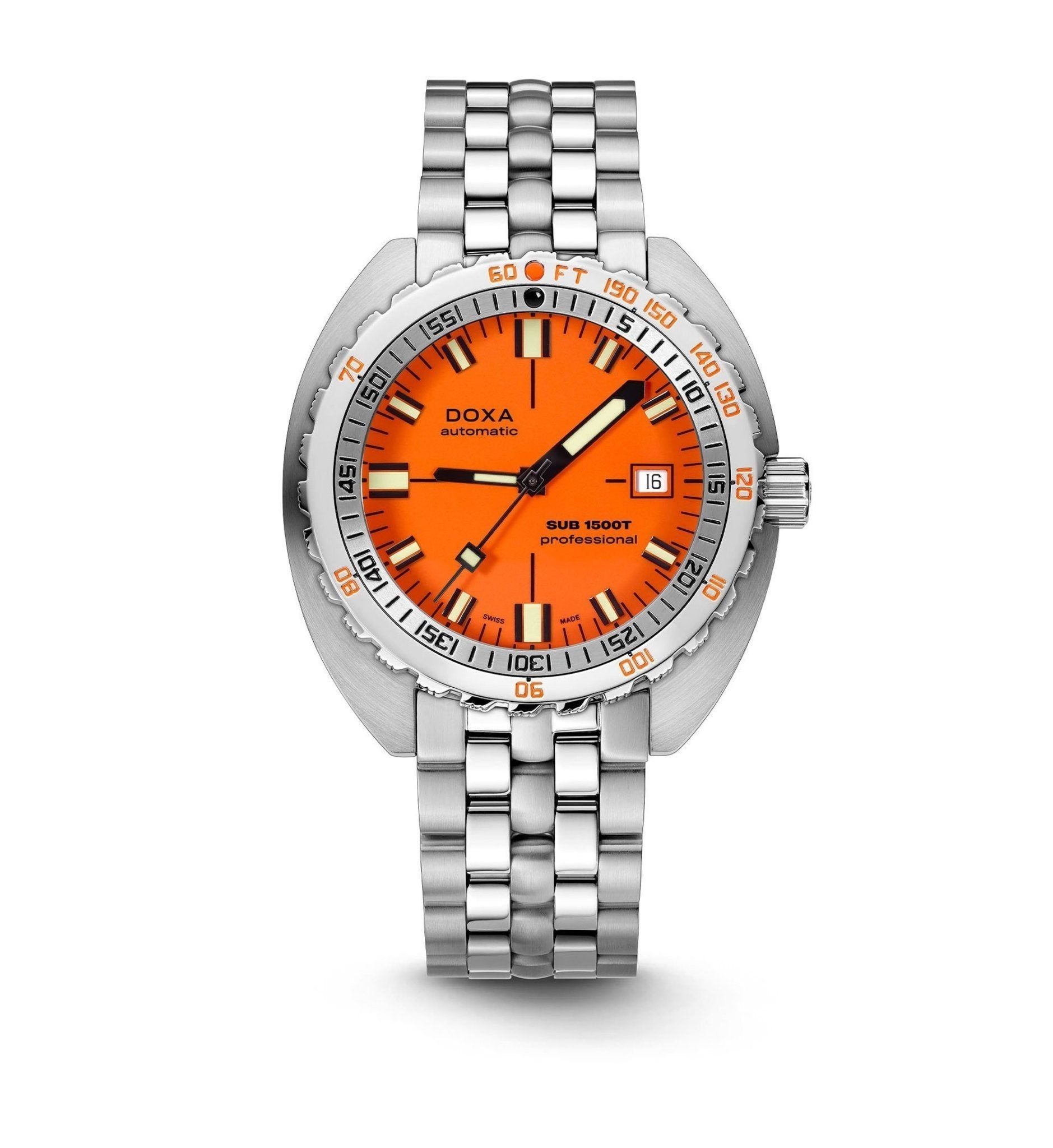
Doxa SUB 1500T: The 1,500-Metre Depth-Rating Flagship
By Zach Charles • October 10, 2026
Complete guide to the Doxa SUB 1500T — 45mm, 1,500m depth rating, helium escape valve, ETA 2892-2 movement, USD 2,690.

Audemars Piguet Royal Oak 'Jumbo' ref. 15202 with blue tapisserie dial and integrated steel bracelet
By Zach Charles • October 10, 2026
The Audemars Piguet × Swatch Royal Pop is a $400 bioceramic pocket watch in 8 colourways, powered by a new hand-wound SISTEM51 with 90+ hour power…

Time on the Move logo
By Zach Charles • October 10, 2026
Zach Charles is the editor of Time on the Move, an independent watch reference covering brand and model histories, buying guides and release news…
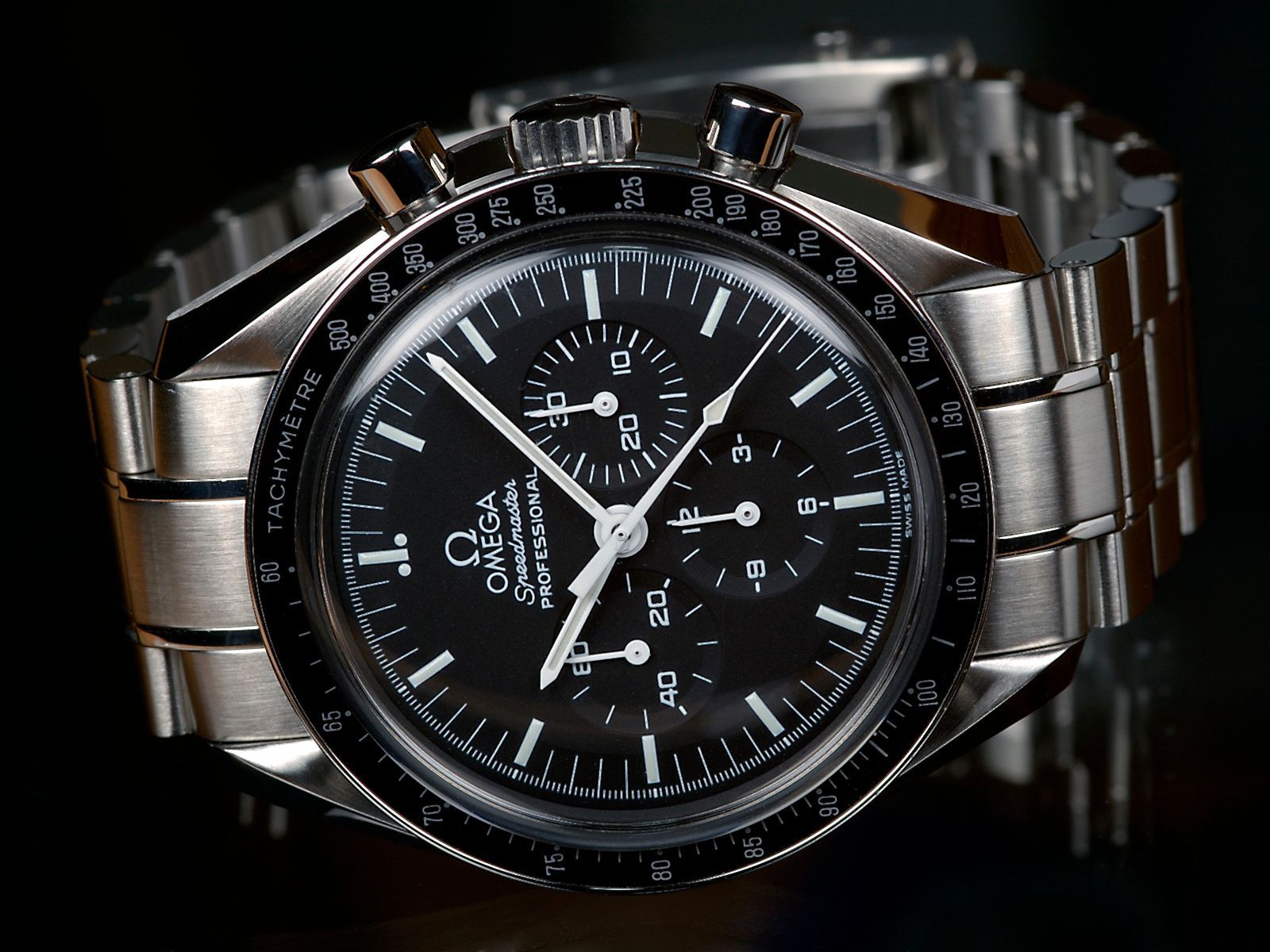
Omega Speedmaster Professional 'Moonwatch' chronograph, front view on steel bracelet
By Zach Charles • October 9, 2026
Find the best watches at every price point from $500 to $15,000 — new and pre-owned. Covers every budget tier with specific reference picks, brand…
By Zach Charles • October 9, 2026
The latest watch news: new releases, Watches and Wonders coverage, discontinuations, industry analysis, and market trends. Currently 1 article.
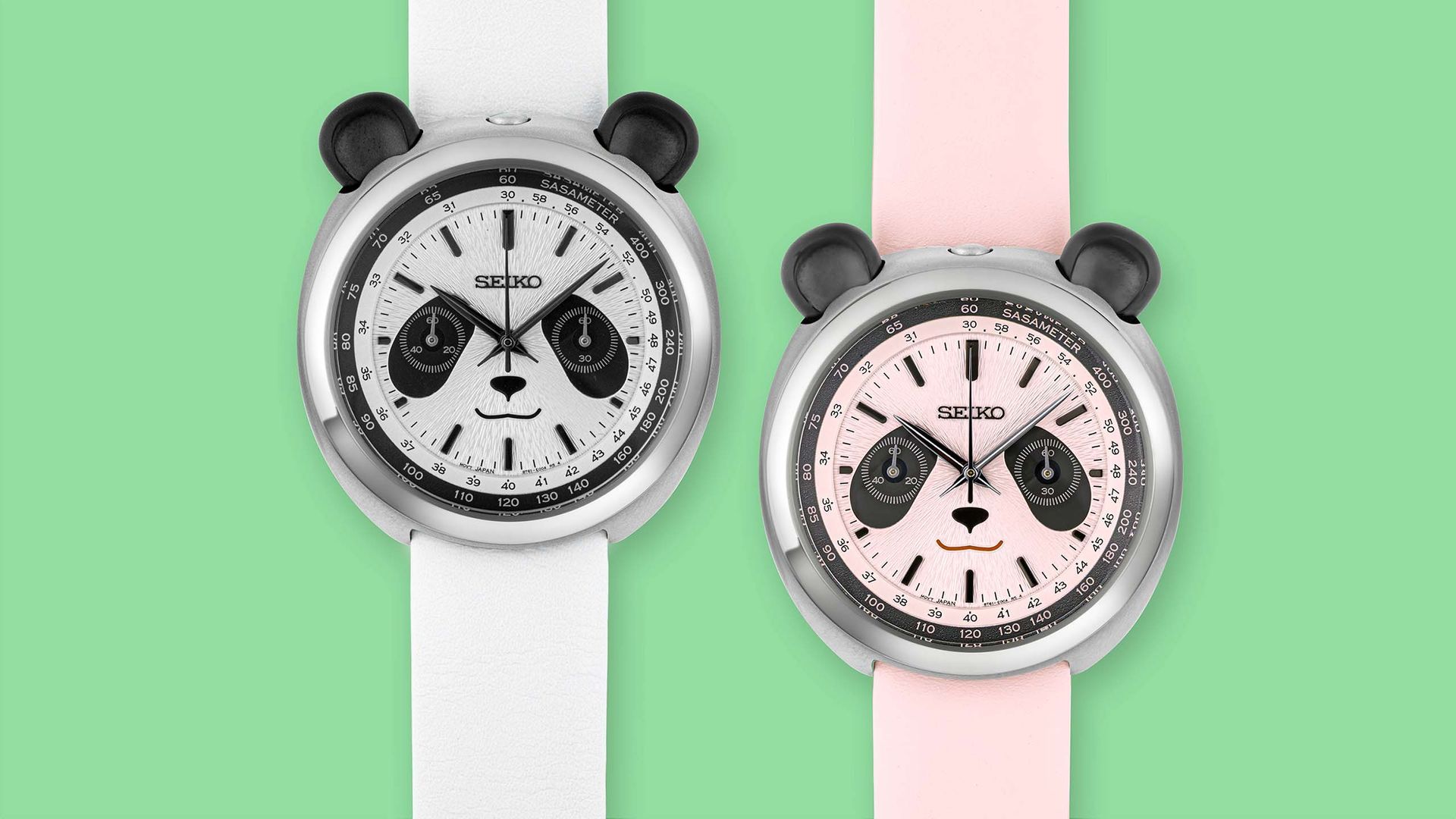
Seiko's New Panda Chronograph Is Literally a Panda: The Power Design Project HHK001 and HHK002
By Zach Charles • October 8, 2026
Seiko's Power Design Project panda chronograph (HHK001, HHK002) turns the panda dial into an actual panda face, with ear pushers, a 'Sasameter' and a 3D…
Show More