Tudor Royal: The Sport-Dress Watch
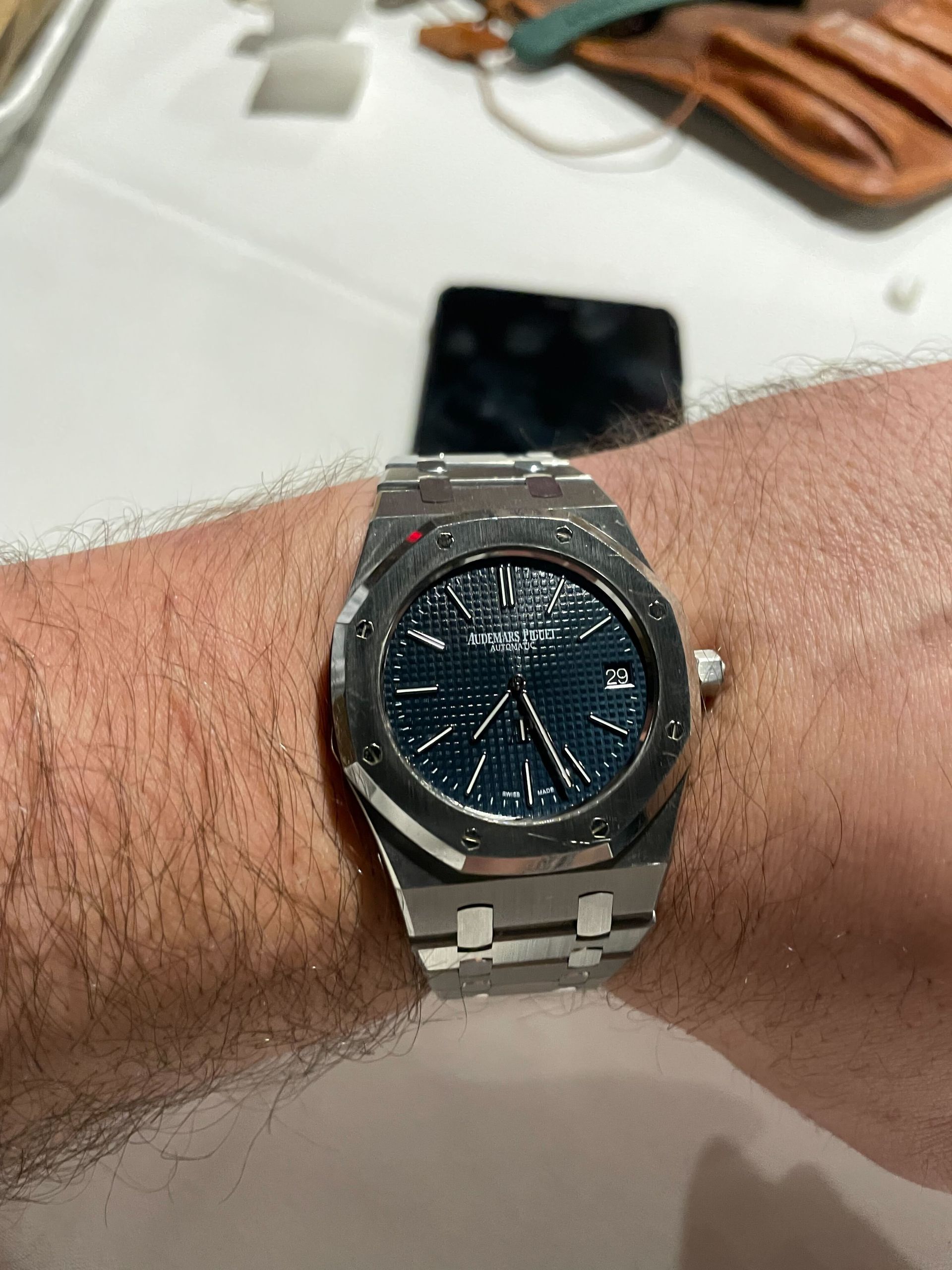
The Tudor Royal arrived at Watches & Wonders 2021 with an integrated bracelet — a design choice that immediately positioned it within a specific Swiss watchmaking tradition. The integrated bracelet, where the bracelet flows seamlessly from the case without the angular transition of a conventional lug, was the defining design innovation of the early 1970s Swiss sport watch: the Audemars Piguet Royal Oak (1972), the Patek Philippe Nautilus (1976), the IWC Ingenieur. Those watches became the reference points for a category — the sport-dress watch, equally at home in a meeting room and at a summer barbecue — that has remained commercially potent for fifty years.
Tudor's entry into this category with the Royal was a deliberate positioning move. The Royal's integrated bracelet, octagonal bezel, and guilloché dial pattern situate it directly in the Royal Oak tradition — aesthetically adjacent without replicating a protected design. At $2,600–$3,500 depending on configuration and size, it occupies a price point several multiples below an entry Royal Oak and represents Tudor's most formally dressed production watch since the Prince line's discontinuation.
Photo: Clyde94 — CC BY-SA 4.0 — Wikimedia Commons
Design Language: The 1970s Sport Watch Reference
The Royal Oak's design — Gerald Genta's creation for Audemars Piguet in 1972 — established a specific visual grammar: an octagonal bezel with visible screws at each corner, an integrated bracelet with tapering links that merge into the case, a horizontally striped "Grande Tapisserie" guilloché dial. The Tudor Royal references this grammar selectively.
The Tudor Royal's bezel is octagonal. The bracelet integrates with the case in a flowing transition. The dial uses a guilloché-inspired pattern. But the specific execution — the screw positions, the bracelet link architecture, the proportions — is Tudor's own. The Royal Oak's design is not simply replicable; it is a specific arrangement of elements whose overall composition is distinctive. The Tudor Royal borrows the category convention without copying the specific execution.
This places the Royal in a small group of watches that have successfully occupied the integrated-bracelet sport-dress category alongside the originals: the TAG Heuer Carrera Sport, the Bell & Ross BR 05, and others. Each argues that the integrated bracelet's visual proposition — the watch and bracelet as a single flowing object — is worth applying beyond the Genta originals and their Rolex-adjacent equivalents.
In Tudor's own catalogue, the Royal is closest in spirit to a watch that predated it by forty years: the Rolex Oysterquartz. The Oysterquartz (1977–2003) was Rolex's own integrated bracelet response to the Royal Oak era — an angular, architecturally distinct case with a bracelet that flowed from it rather than attaching to it. The Oysterquartz was discontinued in 2001–2003 and replaced by no direct successor until the Rolex Land-Dweller in 2025. The Tudor Royal, in 2021, stepped into the Oysterquartz's commercial vacancy at a lower price point within the same family of ownership.
Size Range and Configurations
The Royal is Tudor's most size-inclusive watch — available across a range that accommodates the full spectrum of wrist sizes and wearing conventions.
28mm: The smallest Royal, positioned explicitly as a ladies' dress watch. Thinner case profile, smaller dial, but with the same integrated bracelet architecture. Movement: quartz or ETA automatic depending on configuration. Available with diamond-set bezels for formal dress contexts.
34mm: The transitional size — universally wearable, appropriate for both men and women, particularly popular with buyers who find 38mm+ references oversized for everyday office wear. ETA automatic movement in most configurations.
38mm: The commercial sweet spot. Large enough to read as a deliberate choice; small enough to wear under a shirt cuff without discomfort. ETA 2824-based automatic with date. The 38mm Royal is the reference most frequently purchased as an everyday wear watch across both genders.
41mm: The largest and most assertive Royal configuration — appropriate for buyers who wear 40–41mm sport watches as their standard reference and want the sport-dress aesthetic at that size. ETA automatic, date complication.
Dial colours:
The Royal's dial palette is broader than the dive-focused Black Bay family, appropriate to its sport-dress positioning:
- Silver/white (most formal)
- Blue (the most commercially popular, referencing the Royal Oak's own blue dial as a category signifier)
- Black (most versatile across formal and casual contexts)
- Green (introduced later in production; resonant with the Rolex "Hulk" effect in watch marketing, where green dials command disproportionate buyer attention)
Gold and steel (S&G) variants: Yellow gold accents on bezel, bracelet links, and crown are available on the 38mm and 41mm references — a two-tone execution that gives the Royal a more overtly precious character.
Movement: ETA and the Price Equation
The Tudor Royal is powered by ETA-supplied movements across most configurations — the ETA 2824-2 in automatic date variants, quartz movements in some smaller-size references. This is a deliberate commercial decision: ETA movements allow Tudor to price the Royal at $2,600–$3,500, making it the brand's most accessible automatic dress watch.
The ETA 2824 in this context is entirely appropriate. A sport-dress watch worn daily to office environments does not require a manufacture movement's extended power reserve or COSC-certified accuracy. It requires reliability, easy servicing, and a thin profile compatible with the case's overall height. The ETA 2824 provides all of these. The Royal's case is not a manufacturing showcase — it is a design object, and the movement's job is to support that design competently.
The Royal is therefore Tudor's explicit entry-level watch for buyers who want the brand's design sensibility and integrated bracelet aesthetic without the manufacture movement premium that the Black Bay family commands. It is honest about this positioning: Tudor markets the Royal as a design and lifestyle watch, not as a movement showcase.
Tudor Royal vs. Rolex Oysterquartz: The Spiritual Successor
The Rolex Oysterquartz(1977–2001/2003) was Rolex's integrated-bracelet dress watch — angular, architecturally distinctive, available in Datejust and Day-Date configurations. It was discontinued after twenty-four years of production and replaced by no equivalent until the Land-Dweller in 2025.
The Tudor Royal, introduced in 2021 — eighteen years after the Oysterquartz's discontinuation — occupies a closely related commercial niche. Both are integrated-bracelet sport-dress watches within the Wilsdorf Foundation family of brands. Both are positioned as the "design" alternative to the conventional Oyster-case watch. The Royal is significantly more affordable than the Oysterquartz's current secondary market pricing for desirable examples.
This is not a genealogical relationship Tudor markets directly. The Royal does not claim to be an Oysterquartz successor. But the design logic — same ownership structure, same category (integrated bracelet sport-dress), same positioning relative to conventional Oyster-case references — makes the parallel more than coincidental.
Current Specifications and Pricing
Case sizes:
28mm, 34mm, 38mm, 41mm
Movement:
ETA 2824-2 (automatic, date) or quartz depending on size and configuration
Water resistance:
100m
Crystal:
Flat sapphire with anti-reflective coating
Bracelet:
Integrated Oystersteel, flowing case transition
Retail price (April 2026):
~$2,600 (34mm) to ~$3,500 (41mm S&G)
Latest News
- Tudor Royal 2026: In-House MT Manufacture Calibers and New Dial Colors — September 2, 2026