Rolex Oysterquartz: The Angular Experiment
In 1977, Rolex did something it has never fully repeated: it designed a watch from the outside in. Not a case to accept a movement, not a tool specification to engineer around, but an aesthetic statement — angular, integrated, architectural — that responded directly to the most influential watch design of the decade.
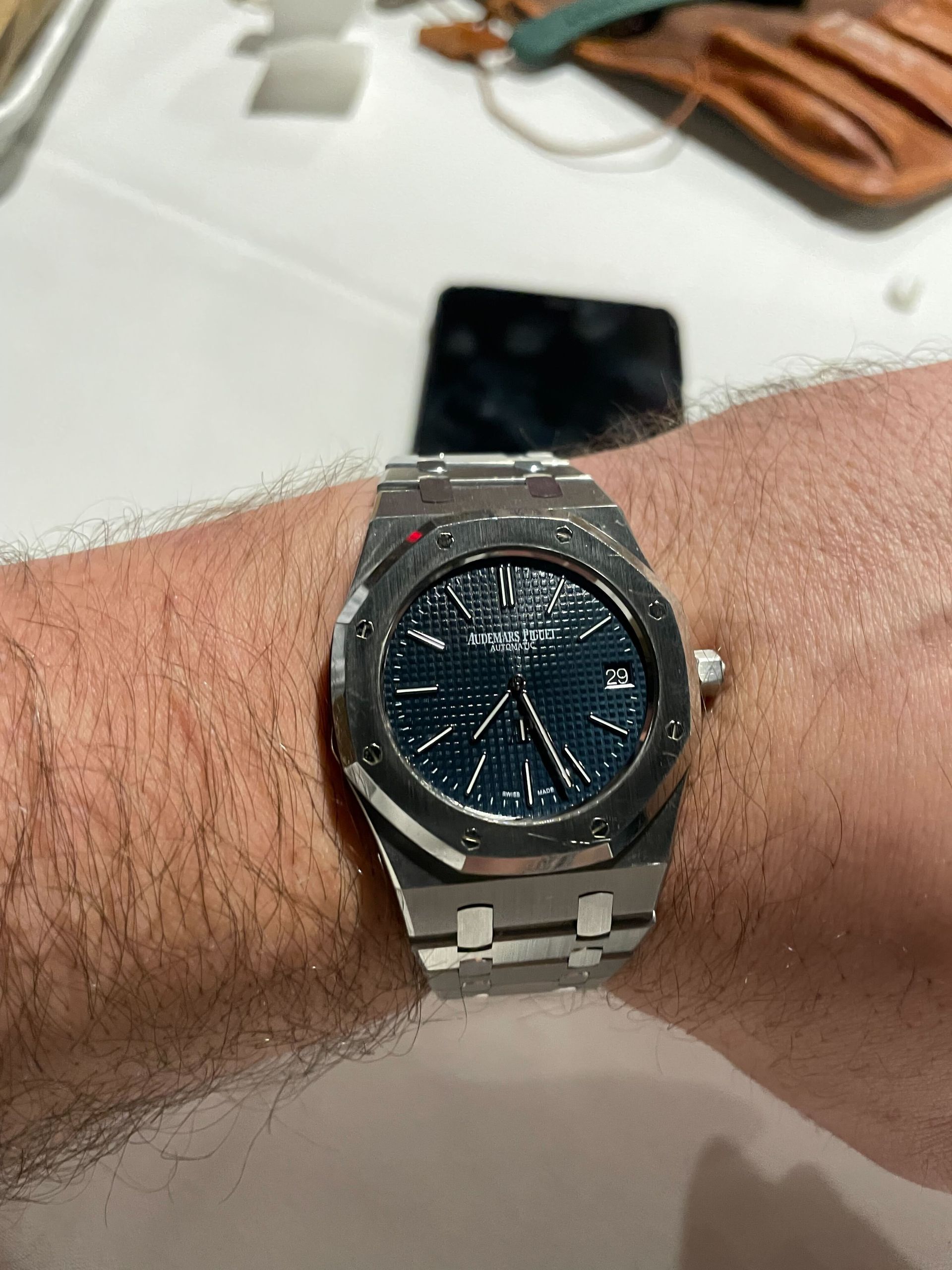
The Audemars Piguet Royal Oak had arrived in 1972. Gérald Genta's angular octagonal case with its exposed screws and integrated brushed steel bracelet had turned the assumptions of luxury watchmaking upside down: steel was now prestige, integration was now elegance, and geometric boldness was now refinement. The Patek Philippe Nautilus followed in 1976, also designed by Genta. The integrated-bracelet, angular-case sports-luxury category had been invented, and it was selling.
Rolex's response was the Oysterquartz. It was angular. It had an integrated bracelet with brushed and polished links flowing directly from the case. It was available in a Datejust variant and a Day-Date variant. And it was powered by quartz — the only time in Rolex's modern history that the company committed to quartz movement technology for a production wristwatch line.
The Oysterquartz was produced from 1977 to approximately 2001–2003. It is now one of the most interesting collectibles in the Rolex catalog: distinctive, genuinely rare in clean condition, misunderstood for decades, and increasingly recognised as the design ancestor of a philosophy that Rolex returned to nearly fifty years later in the Land-Dweller's integrated flat Jubilee bracelet.
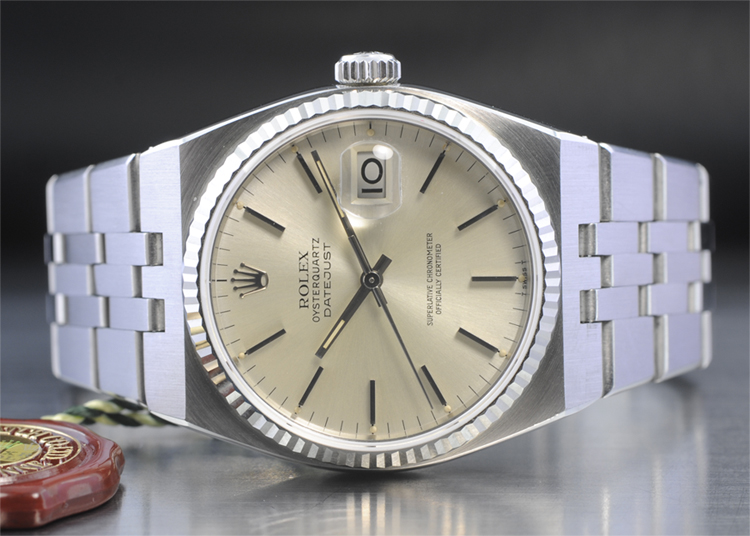
Photo: Esperto Orologi at Italian Wikipedia — CC BY-SA 3.0 — Wikimedia Commons
Context — The Quartz Crisis and the Luxury Response
The mid-1970s were the most disruptive period in the history of watchmaking. Japanese quartz movements, pioneered by Seiko's Astron in 1969, were more accurate than any mechanical watch, cheaper to produce, and immune to the variables — temperature, gravity, winding state — that affected mechanical timekeeping. Swiss manufacturers faced an existential question: what justified the price premium of a mechanical movement when a $20 quartz watch was more accurate than a $2,000 Rolex?
The Swiss industry's answers took several forms. One answer was to double down on complication: perpetual calendars, minute repeaters, tourbillons — things that quartz could not offer. Another answer was to redefine luxury not as technical performance but as aesthetic distinction and material quality: the Royal Oak's case and integrated bracelet said "luxury" in a visual language that had nothing to do with timekeeping accuracy.
Rolex pursued a third path simultaneously: they developed their own quartz movement technology while also working on the integrated-bracelet aesthetic that the market had shown it wanted. The Oysterquartz was the intersection of these two responses.
Cal. 5035 (for the Datejust Oysterquartz) and Cal. 5055 (for the Day-Date Oysterquartz) were high-frequency quartz oscillators — substantially more accurate than any mechanical movement. They were developed in Switzerland, manufactured by Rolex, and represented a genuine technical commitment to quartz at a time when the Swiss industry was being forced to take quartz seriously or lose its market.
What Rolex never fully resolved was whether the Oysterquartz was primarily a technical statement (the best quartz watch money could buy) or an aesthetic statement (a bold angular design for those who wanted something other than the round Oyster). The ambiguity showed in how it was marketed and, ultimately, in its discontinuation.
The Design — Architecture as Identity
The Oysterquartz case is a sharp departure from everything else in the Rolex catalog. Where the Oyster case — the standard Rolex case form — uses a round middle case with curved lugs, polished top surfaces, and a traditional attachment to the bracelet via spring bars and end links, the Oysterquartz is architectural: a trapezoidal case with beveled and brushed surfaces, angular transitions, and a bracelet that emerges from the case flanks as though the two were designed as a single object.
The bracelet itself is notable. The links alternate between brushed and polished surfaces — a technique that creates visual depth and catches light differently depending on viewing angle. The overall width of the bracelet tapers from the case outward, and the link construction is integrated into the case at the lugs in a way that leaves no visible gap or spring bar. The bracelet is part of the watch; removing it would leave the case incomplete.
This was precisely the aesthetic language that the Royal Oak and Nautilus had established. Rolex executed it with their own engineering approach: the Oyster case's screw-down crown and caseback remained, water resistance was maintained at 100m, and the angular design was achieved without compromising the fundamental sealing architecture that Rolex had built since 1926.
The dial was also distinctive. On the Datejust Oysterquartz, the date appears at 3 o'clock with a cyclops lens, consistent with the Datejust tradition. The dial markers and hands were adapted to suit the more formal, architectural case aesthetic: applied indices, a refined dial layout without the sportiness of the tool watches. On the Day-Date Oysterquartz, the day-of-week aperture appeared at 12 o'clock with the date at 3, matching the standard Day-Date layout but within the angular case.
The Datejust Oysterquartz — References 17000 and 17013
The Datejust Oysterquartz launched as reference 17000 in steel and 17013 in Rolesor (two-tone). The 36mm case was larger than the standard Date but matched the Datejust in diameter. The Cal. 5035 movement inside offered ±0.5 seconds per day accuracy — dramatically better than the Datejust's Cal. 3035 of the same era, and competitive with any production watch available.
Reference variations within the Datejust Oysterquartz are significant for collectors:
17000
: Stainless steel, smooth bezel. The most accessible configuration.
17013
: Rolesor — steel case with yellow gold bezel and bracelet center links. The two-tone version most commonly seen.
17014
: 18k yellow gold. Full precious metal Datejust Oysterquartz, rare relative to steel.
17016
: Diamond-set bezel variants. Rare.
Dial configurations include black, silver, champagne, and various exotic options. The Oysterquartz's angular case pairs particularly well with black or champagne dials that emphasise its architectural quality.
The Day-Date Oysterquartz — References 19000 and 19018
The Day-Date Oysterquartz translated the Presidential watch into the angular idiom. Available only in precious metals — yellow gold, white gold, and platinum — the Day-Date Oysterquartz references (19000, 19018, 19019) are among the rarest and most expensive Oysterquartz variants.
Cal. 5055 powered the Day-Date Oysterquartz: a higher-specification quartz movement with day and date display integration. The same high accuracy as Cal. 5035. The same integrated bracelet. The same angular case, now in 18k gold or platinum.
The Day-Date Oysterquartz in platinum (reference 19019 or similar) is one of the rarest Rolex watches produced in the 20th century. The combination of platinum, Day-Date function, and the Oysterquartz case means production numbers were extremely small. These are genuinely specialist-collector territory.
Quartz in a Mechanical World
By the time the Oysterquartz was discontinued — around 2001 to 2003, phased out quietly rather than announced — the watch world had undergone another inversion. The quartz crisis of the 1970s had been survived not by converting to quartz but by positioning mechanical watches as luxury objects that quartz could not replicate. The Swiss industry's recovery was built on the argument that mechanical movement was itself the point — the craft, the tradition, the visible complexity. A watch buyer who understood this argument had no use for a quartz Rolex.
Rolex recognised this. The Oysterquartz's discontinuation was, in retrospect, an acknowledgment that the company's identity was inseparable from the mechanical movement — from the Perpetual rotor that wound it, from the COSC certification that validated it, from the Calibre numbers that successive generations had accumulated reputations around. A quartz Rolex was, for a committed Rolex buyer, a contradiction.
But the design philosophy survived.
The Land-Dweller Connection — A Lineage of Integration
In April 2025, Rolex unveiled the Land-Dweller at Watches & Wonders Geneva. The watch that attracted the most technical attention was the Calibre 7135 with its Dynapulse escapement — 32 patents, 5Hz, rolling-contact escapement, ceramic balance staff. But the design that contextualised the Land-Dweller within Rolex's own history was the integrated flat Jubilee bracelet.
The Land-Dweller's bracelet emerges from the case flanks directly, with flat beveled links and no traditional lug-and-spring-bar attachment. The case and bracelet read as a unified object. Under different lighting conditions, the alternating brushed and polished surfaces of the bracelet catch light in ways that animate the watch.
This is the Oysterquartz's aesthetic thesis, resolved and refined for a contemporary movement and a contemporary buyer. Where the Oysterquartz used an angular case that was a significant visual departure from the round Oyster family, the Land-Dweller integrates the bracelet into a case that retains Rolex's fundamental round-case architecture. Where the Oysterquartz was powered by quartz — a statement of technical priority — the Land-Dweller is powered by Calibre 7135, the most sophisticated mechanical movement Rolex has produced.
The Oysterquartz demonstrated, in 1977, that Rolex could build an integrated-bracelet watch. The Land-Dweller, in 2025, demonstrated what Rolex could achieve when it returned to that concept with fifty years of additional manufacturing capability and a movement architecture that was itself the primary story.
Collectors who appreciate this lineage will find the Oysterquartz's reputation undergoing quiet reassessment. It was not a failed experiment — it was the proof of concept.
Collecting the Oysterquartz Today
The Oysterquartz spent approximately two decades after its discontinuation in the shadow of the mechanical Rolex lineup. Collectors focused on Submariners, Daytonas, GMT-Masters. The Oysterquartz was bought by those who specifically wanted it — often for its aesthetic rather than its name — and largely ignored by the mainstream Rolex market.
This created an unusual situation: a discontinued Rolex, produced for roughly 25 years, in relatively small numbers, with a distinctive design that no other Rolex has replicated, trading at prices below similarly aged mechanical Rolex references. Secondary market prices for Datejust Oysterquartz references have historically ranged from approximately $3,000 to $8,000 depending on configuration, condition, and bracelet integrity. Day-Date Oysterquartz references in gold trade higher — $8,000 to $25,000 — reflecting the precious metal content and greater rarity.
The bracelet is the critical condition variable. Oysterquartz bracelets are not the standard Oyster bracelet; replacement links are not universally available, and a stretched or damaged bracelet materially affects the watch's wearability and value. Full-length original bracelets in good condition are essential for a strong example.
Dial condition: the integrated design meant that quartz accuracy was the watch's functional highlight. The dials in good condition — without moisture damage, fading, or replacement — are the key to originality.
What to look for
:
- Original bracelet, full-length, with appropriate wear for the age — not stretched, not replaced
- Original dial in original condition — no moisture, no fading, no replacement pieces
- Original crown and case — no polishing (which removes the sharpness of the angular brushed surfaces)
- Service history if available — the quartz movements are reliable but do require battery and service attention
The current opportunity : the Land-Dweller's integrated bracelet design has drawn fresh attention to the Oysterquartz as a precursor. Collectors who connect these design dots are now looking at the Oysterquartz with renewed interest. Whether this translates to sustained price appreciation is unclear — but the analytical foundation for reappraisal is present.