Rolex Land-Dweller: The Next Chapter in Watchmaking
Rolex Land-Dweller: The Next Chapter in Watchmaking
Rolex does not revolutionize. This is not a criticism — it is the company's deliberate, considered philosophy. While other manufacturers chase novelty, Rolex refines. The Oyster case has been in production since 1926. The bidirectional rotor since 1931. The COSC chronometer certification since 1976. Cal. 3135 — the movement that powered the Submariner, GMT-Master II, Datejust, and much of the professional lineup — ran for 32 years before its successor arrived. Rolex's competitive advantage has always been depth of development, not breadth of announcement.
This makes the Land-Dweller, unveiled at Watches & Wonders 2025 in Geneva, genuinely extraordinary. Not because Rolex added a new complication or introduced a new metal or expanded to a new case size. But because Rolex, for the first time in decades, challenged the fundamental architecture of the mechanical escapement — the mechanism that has regulated mechanical watch movements since the 18th century — and built a production watch around the answer.
The Land-Dweller is not an incremental Rolex. It is a statement that the company's engineers had been working on something they believed was important enough to change the course of how a Rolex movement works. The result is Calibre 7135, the Dynapulse escapement, and a watch that will be remembered as a watershed moment in the brand's technical history.
The Dweller Family — Completing the Trilogy
The name carries deliberate weight. Rolex has named watches for the environments they master: the Sea-Dweller (1967) for professional saturation divers who live underwater. The Sky-Dweller (2012) for the international traveler who inhabits multiple time zones simultaneously. The Land-Dweller (2025) for the person whose domain is daily terrestrial life — offices, cities, travel, the full texture of modern existence.
The Sea-Dweller is a tool watch in the most literal sense: it exists because saturation divers needed it and worked with Rolex to develop it. The Sky-Dweller is a complicated dress watch with an annual calendar and dual time zone, built for business travelers. The Land-Dweller occupies the space between them — refined enough for the dress and business contexts the Sky-Dweller inhabits, technically elevated in ways that no tool watch designation captures.
The trilogy is also a naming philosophy: three domains of human activity, three watches designed to inhabit those domains with precision. The Land-Dweller completes a set that has been building since 1967, though it took 58 years to arrive.
The Escapement Problem — Two Hundred Years of Swiss Lever
The Swiss lever escapement is one of the most successful mechanical designs in the history of technology. Abraham-Louis Breguet refined it in the early 19th century. By the late 1800s, it had become the universal standard for mechanical watches. It has been refined, optimized, made in silicon, made in nickel-phosphorus, and subjected to more than a century of incremental improvement — but the fundamental architecture has not changed.
The Swiss lever works through sliding contact. The pallet stones — small pieces of synthetic ruby or, in modern variants, silicon — slide across the teeth of the escape wheel, alternately locking and releasing the wheel as the balance oscillates. Every time the pallet engages the escape wheel, a small amount of energy is lost to friction. This friction must be overcome by the mainspring's stored power, which means more energy expenditure, shorter power reserve, and some inherent inconsistency in the impulse delivered to the balance at each beat.
Rolex addressed this with the Chronergy escapement, introduced in Calibre 3255 in 2015 and now throughout the 32xx movement family. The Chronergy uses silicon pallet forks and escape wheel geometry optimized for more efficient engagement, delivering approximately 15% more efficiency than the traditional Swiss lever. This improvement allowed Cal. 3235 to achieve a 70-hour power reserve compared to the 48-hour reserve of its predecessor Cal. 3135, using similar mainspring architecture.
Fifteen percent is a meaningful gain achieved through refinement. The Dynapulse is a different category of change.
Calibre 7135 — The Dynapulse Escapement
The Dynapulse escapement, which powers Calibre 7135 in the Land-Dweller, eliminates sliding contact from the escapement entirely.
Instead of a single escape wheel engaging pallet stones through sliding friction, the Dynapulse uses a double-wheel architecture — two co-axial escape wheels that tangentially impulse a lever, which in turn drives the balance. The critical distinction is how energy transfers: in the Dynapulse, the escape wheels contact the lever tangentially, meaning the contact is rolling rather than sliding. Rolling contact transmits energy without the friction losses inherent in sliding engagement.
The result, according to Rolex, is 30% greater efficiency compared to the traditional Swiss lever escapement — double the improvement the Chronergy achieved. This is not a refinement of the Swiss lever; it is a parallel architecture built from different principles.
The entire escapement — both escape wheels, the lever — is manufactured in silicon. Silicon is harder than steel (Vickers hardness of approximately 1,000 HV versus 600–700 HV for hardened steel), requires no lubrication because the low-friction surface geometry makes lubricants unnecessary and potentially harmful over time, and is insensitive to magnetic fields because it contains no ferrous material. The silicon components are produced using LIGA or deep reactive ion etching processes that achieve geometric precision impossible with conventional machining.
The Dynapulse operates at 5Hz — 36,000 beats per hour, compared to the 4Hz (28,800 bph) standard of most Rolex tool watch movements. Higher frequency divides time into finer increments, improving potential accuracy. The traditional engineering tradeoff — higher frequency consumes more power, shortening the power reserve — is overcome by the Dynapulse's efficiency. Despite beating 25% faster than a standard Rolex tool movement, Cal. 7135 achieves a 66-hour power reserve. This is slightly less than Cal. 3235's 70 hours but achieved at meaningfully higher frequency.
The ceramic balance staff : New to Cal. 7135, the balance pivot (the staff on which the balance oscillates) is made from ceramic rather than steel. The ceramic is shaped and mirror-polished by femtolaser — a laser operating at femtosecond pulse durations, short enough to ablate material without the heat damage that conventional machining or longer laser pulses would cause. The result is a perfectly cylindrical pivot with a perfectly smooth surface, achieved to tolerances that mechanical polishing cannot match. Ceramic requires no lubrication at the pivot, eliminating a wear point that traditionally requires service every five to seven years.
The Syloxi hairspring : Cal. 7135 uses a Syloxi silicon hairspring developed from the same technology as the hairspring in Cal. 7140 — the movement in Rolex's 1908 dress watch. Silicon hairsprings are paramagnetic (no ferrous content, immune to magnetic fields), and silicon's elastic modulus is more stable across temperature ranges than Nivarox alloy (the traditional hairspring material), meaning the spring's stiffness — and therefore the balance's frequency — changes less with temperature. The Syloxi's overcoil geometry ensures concentric breathing; the spring expands and contracts equally on all sides, improving isochronism across positions.
32 patents : Calibre 7135 is covered by 32 total filed patents, 18 unique to the watch, 16 specific to the movement. For comparison, Calibre 3235 — itself one of the most patent-dense movements Rolex had produced — was covered by 14 patents at launch. The 7135 represents more than double the intellectual property density.
The Honeycomb Dial — Design and Memory
The Land-Dweller's dial is finished with a honeycomb texture — a hexagonal pattern laser-etched across the dial surface. Under direct light, the texture creates a three-dimensional depth effect, the hexagonal cells catching and deflecting light at different angles as the wearer moves. Under diffuse light, the surface reads as a subtle, almost geological texture.
The honeycomb dial is not without precedent in Rolex's history. The Milgauss reference 6543, the prototype produced in limited numbers beginning in 1956, featured a honeycomb dial — a design choice for the scientific anti-magnetic watch that was later abandoned when the reference 6541 moved to a plain dial. The Land-Dweller's honeycomb recalls this earlier moment of Rolex innovation: the 1956 Milgauss was itself a technical departure, introducing the Faraday cage architecture for anti-magnetic protection. The Land-Dweller's honeycomb is a quiet acknowledgment that the two watches share something — both represent Rolex at its most technically ambitious.
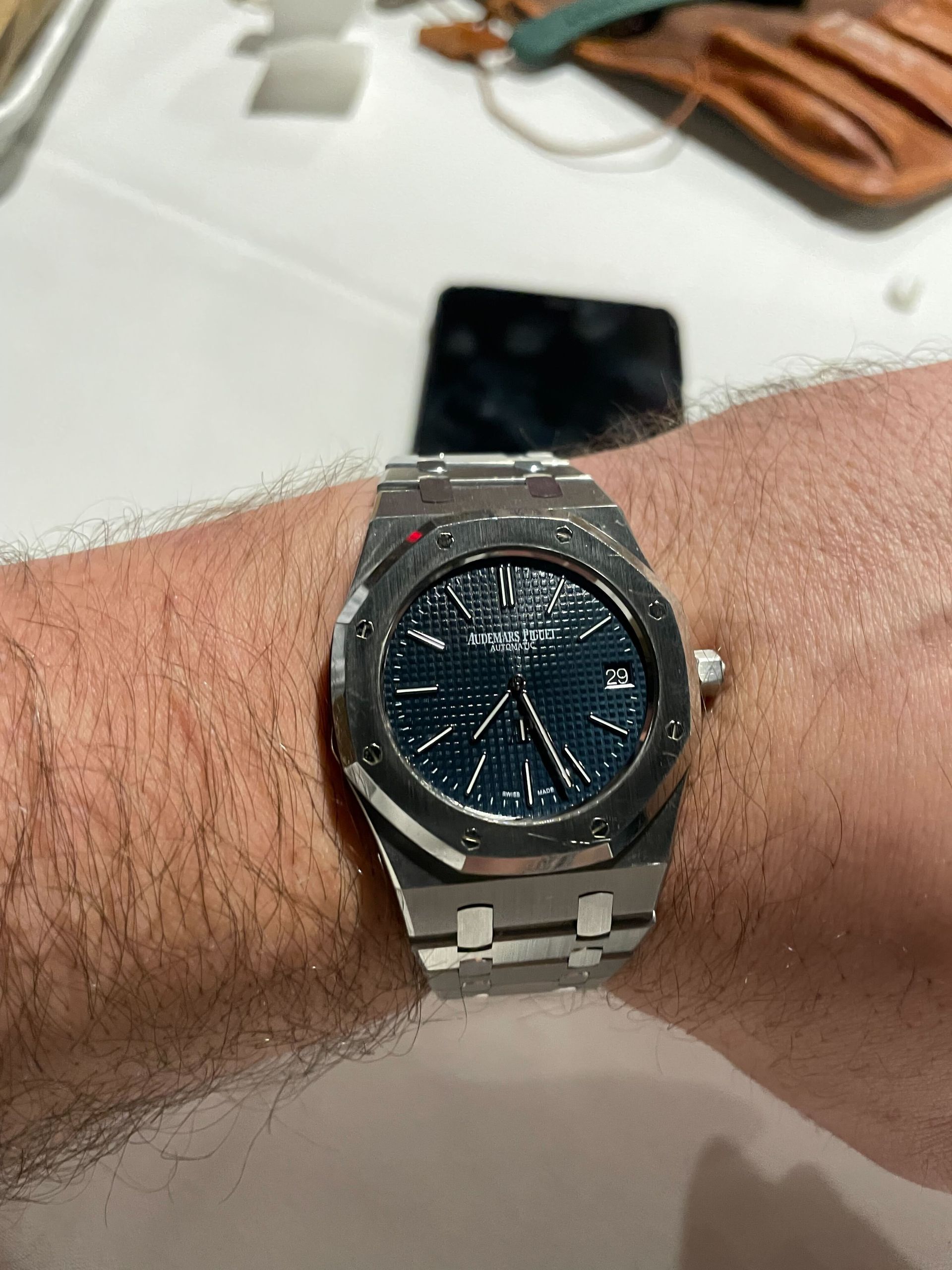
The integrated flat Jubilee bracelet is the other primary design statement. The traditional Jubilee — introduced in 1945 for the Datejust — uses five-piece links with a slightly domed profile. The Land-Dweller's Jubilee bracelet uses flat, beveled links that flow directly from the case's flanks without a traditional lug structure breaking the line. The case and bracelet read as a unified object, recalling the integrated bracelet design philosophy of the Audemars Piguet Royal Oak (1972) and the Patek Philippe Nautilus (1976) — but more importantly, within Rolex's own history, completing an arc that began with the Oysterquartz.
The Rolex Oysterquartz, introduced in 1977, was Rolex's first integrated-bracelet watch: an angular, architectural case with a brushed-and-polished bracelet flowing directly from the case flanks, no spring bars, no traditional lug attachment. The Oysterquartz was discontinued around 2001–2003 as the quartz movement it was built around became difficult to position in a market that had reasserted mechanical horology as the luxury standard. But the design principle — integration, not attachment — was never wrong. The Land-Dweller is Rolex's return to that principle, resolved in a round case, with the movement architecture now matching the ambition of the bracelet design. The Oysterclasp includes the Easylink comfort extension system for half-centimeter adjustment without tools.
The Case — 36mm and 40mm
The Land-Dweller is available in two sizes: 36mm and 40mm. At 9.7mm height, it wears slimmer than the tool watches — the Submariner ref 126610 is 12.5mm tall; the GMT-Master II ref 126710 is 11.7mm. The Land-Dweller's profile sits closer to the Datejust than the dive watches, reinforcing its identity as a refined everyday watch rather than a professional instrument.
Water resistance is 100m — adequate for swimming and showering but not professional diving. This is appropriate: the Land-Dweller is not a dive watch. It is a watch for life on land, water resistance included as a practical standard rather than a technical specification to build the watch around.
The materials available at launch reveal Rolex's positioning:
Rolesor (Oystersteel + 18k white gold) at approximately $14,900 is the entry point. Unusually, there is no full Oystersteel version of the Land-Dweller — the entry begins with Rolesor, combining a steel case and bracelet with white gold bezel. This places the Land-Dweller above the standard tool watches (Explorer at ~$7,100, GMT-Master II at ~$9,700) and in the range of the Sky-Dweller in steel (~$15,100). Rolex's decision to forgo a steel-only version signals that the Land-Dweller is positioned as a premium model from the outset.
Platinum at approximately $63,500 represents the prestige tier. Platinum in the Rolex lineup has historically been reserved for the most elevated expressions — the Day-Date in platinum, the Sky-Dweller in platinum. Its inclusion in the Land-Dweller's launch range confirms the model's intended positioning at the top of the everyday wear category.
Everose gold with a diamond-set bezel at approximately $88,300 is the jewellery expression. Everose is Rolex's proprietary 18k rose gold alloy formulated with platinum to resist the color fading that standard rose gold experiences over time.
The Rolex 1908 Connection — A New Movement Family
Calibre 7135 is not descended from the 32xx tool watch movement family that has powered most Rolex professional models. It belongs to a different lineage — one that began with Calibre 7140, introduced in the Rolex 1908 dress watch.
The 1908 (introduced approximately 2023) was Rolex's first serious foray into the ultra-thin dress watch category — a 39mm case with a 2.6mm-thick movement designed for formal and dress contexts where the tool watch architecture was either too large or too thick. The Cal. 7140 represented Rolex building a parallel movement architecture, distinct from the robust, high-power-reserve tool watch movements.
Cal. 7135 takes the 7140 platform and elevates it: the Syloxi hairspring shares design elements with the 7140's hairspring, and the general calibre architecture is related. But the Dynapulse escapement, the ceramic balance staff, the 5Hz frequency, and the 32-patent technology stack represent a significant departure from the 7140 in complexity and ambition.
What this establishes is that Rolex now has two distinct movement families: the 32xx family for tool watches and date complications, and the 71xx family for elevated everyday and dress applications. This is the infrastructure for a different category of Rolex.
The Market Reception at Watches & Wonders 2025
Rolex does not typically generate significant technical debate at watch fairs. New references are evaluated on dial color, material, bracelet refinements, and price changes. Calibre 3235's introduction in 2015 was noted for its 14 patents and 70-hour reserve, but the watch press moved on quickly.
The Land-Dweller produced something different: sustained technical analysis that extended weeks and months after the announcement. Watchmakers, movement historians, and engineers who cover the industry found the Dynapulse escapement genuinely novel — not a variation on the Omega Co-Axial (which uses a different but equally interesting approach to reducing escapement friction), not a scaled competitor to the silicon escapement work done by independent makers like Ulysse Nardin. A new double-wheel, rolling-contact, fully-silicon escapement from the world's largest watch manufacturer, built for mass production, certified as a COSC chronometer.
The precedents for a single Rolex movement generating this level of technical response are few: the Perpetual rotor in 1931 changed how automatic watches worked. The Oyster case in 1926 changed how cases were sealed. The Land-Dweller's place in this sequence is not yet established — that requires decades of use, observation, and the perspective of time. But the Dynapulse is unambiguously the most technically significant escapement Rolex has produced, and the 5Hz Land-Dweller is the first production Rolex to beat at that frequency.
Collecting and Investment — Too New for a Secondary Market
The Land-Dweller launched in April 2025. As of the time of writing, it is a new model without a secondary market track record. Some observations:
The Rolesor entry point at $14,900 is priced above most of Rolex's steel tool watches but at parity with the steel Sky-Dweller. The value proposition is different: where the Sky-Dweller's premium is justified by two complications (annual calendar and dual time), the Land-Dweller's premium is justified by a superior movement — the Dynapulse escapement, the ceramic staff, the 5Hz beating, the 32 patents. This is an unusual sale to make to a market conditioned to evaluate Rolex on complications and materials rather than movement architecture.
Whether the Land-Dweller commands secondary market premiums will depend on two things: waitlists (if demand exceeds supply at ADs, premiums follow) and whether the movement develops a reputation for accuracy and reliability over years of use. Cal. 3135's reputation for robust, accurate operation over decades is what built its legend — Cal. 7135 will earn its reputation in the same way.
The no-steel-only positioning may create a bifurcated future market: Rolesor as the "accessible" variant that ages into collectibility, and platinum/Everose as the objects that retain premium. This is speculation; the model is too new for confident prediction.
What is not speculative: movements that define eras become collectible. If Cal. 7135 proves as significant in practice as it appears on paper, the early Land-Dweller references will be sought after. Landmark Rolex movements — the Perpetual, Cal. 1570, Cal. 3135 — have been recognized as such in hindsight. Cal. 7135 has the technical credentials to join that list.
Who Should Buy the Land-Dweller
The Land-Dweller is not a tool watch. It will not dive to 300 meters, track a second time zone, or time a lap. It is not trying to. It is a refined everyday watch for someone who values what is inside the case at least as much as what is on the dial — someone who finds the Dynapulse escapement's engineering genuinely interesting, who appreciates that owning the first production Rolex with a double-wheel silicon escapement beating at 5Hz is historically meaningful, and who wants an elevated daily wear watch that is neither a dive watch nor a complication-heavy dress watch.
Compare it to the alternatives at this price level: the Patek Philippe Calatrava (beautiful, less technically adventurous), the Audemars Piguet Royal Oak Selfwinding (integrated bracelet, more presence, similar price in steel), the Omega Speedmaster Master Chronometer (co-axial escapement, space heritage, lower price). The Land-Dweller is the only watch in this cohort with the Dynapulse.
The 36mm will suit a wide range of wrist sizes and wear well in both business and casual contexts. The 40mm provides more presence for those who prefer a contemporary scale. Both sizes wear slimmer than they read on paper due to the integrated bracelet and the 9.7mm height.
For collectors: buy this reference. Not because it is guaranteed to appreciate, but because it represents a genuine moment in Rolex's technical history — the kind of moment that the company produces rarely and that becomes obvious in retrospect.
Related Articles
Design Heritage
The Dweller Family
Everyday Rolex
The Foundation
Recent Posts