TAG Heuer Monaco: The Square Watch That Changed Watchmaking
TAG Heuer Monaco: The Square Chronograph
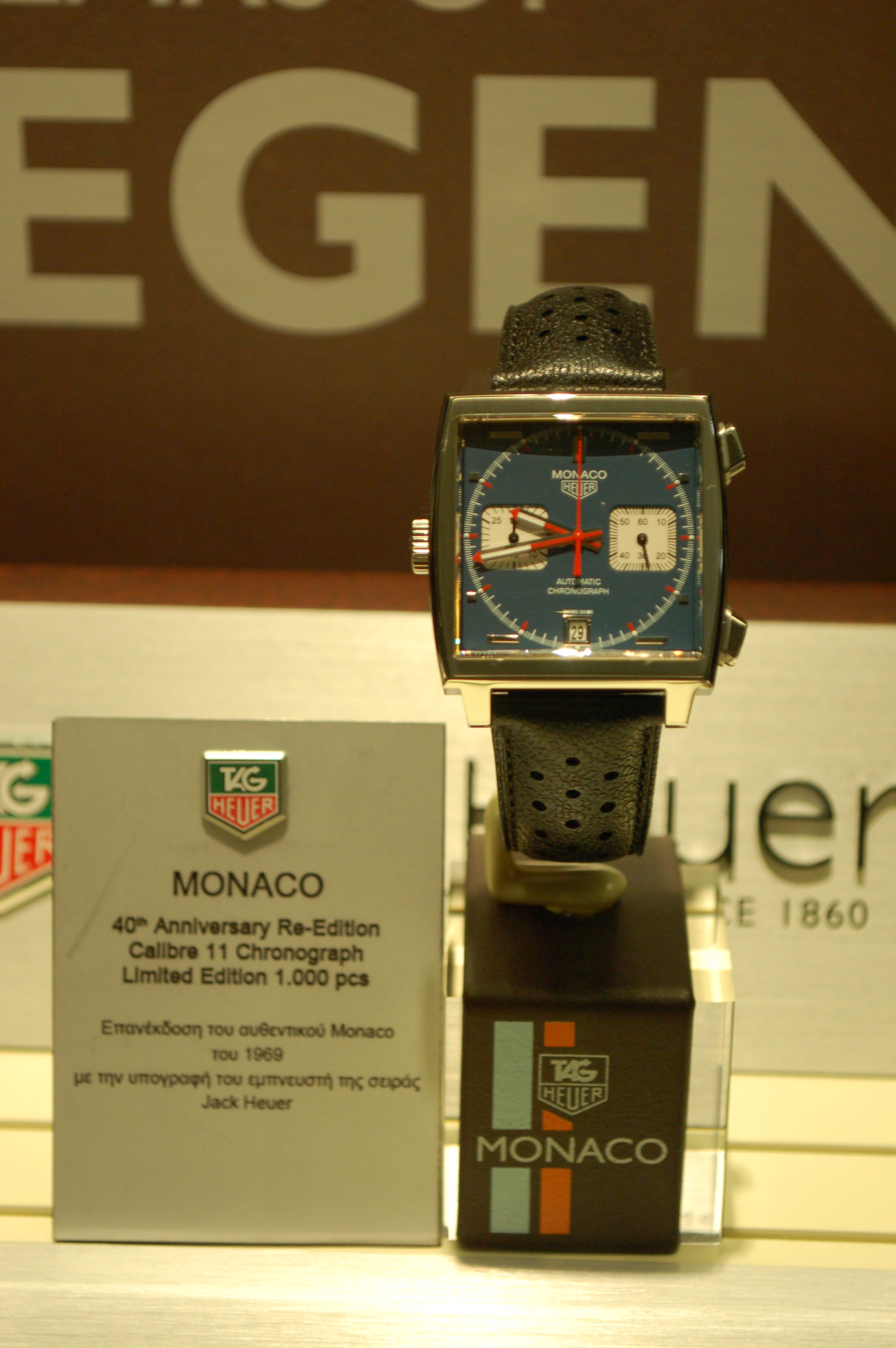
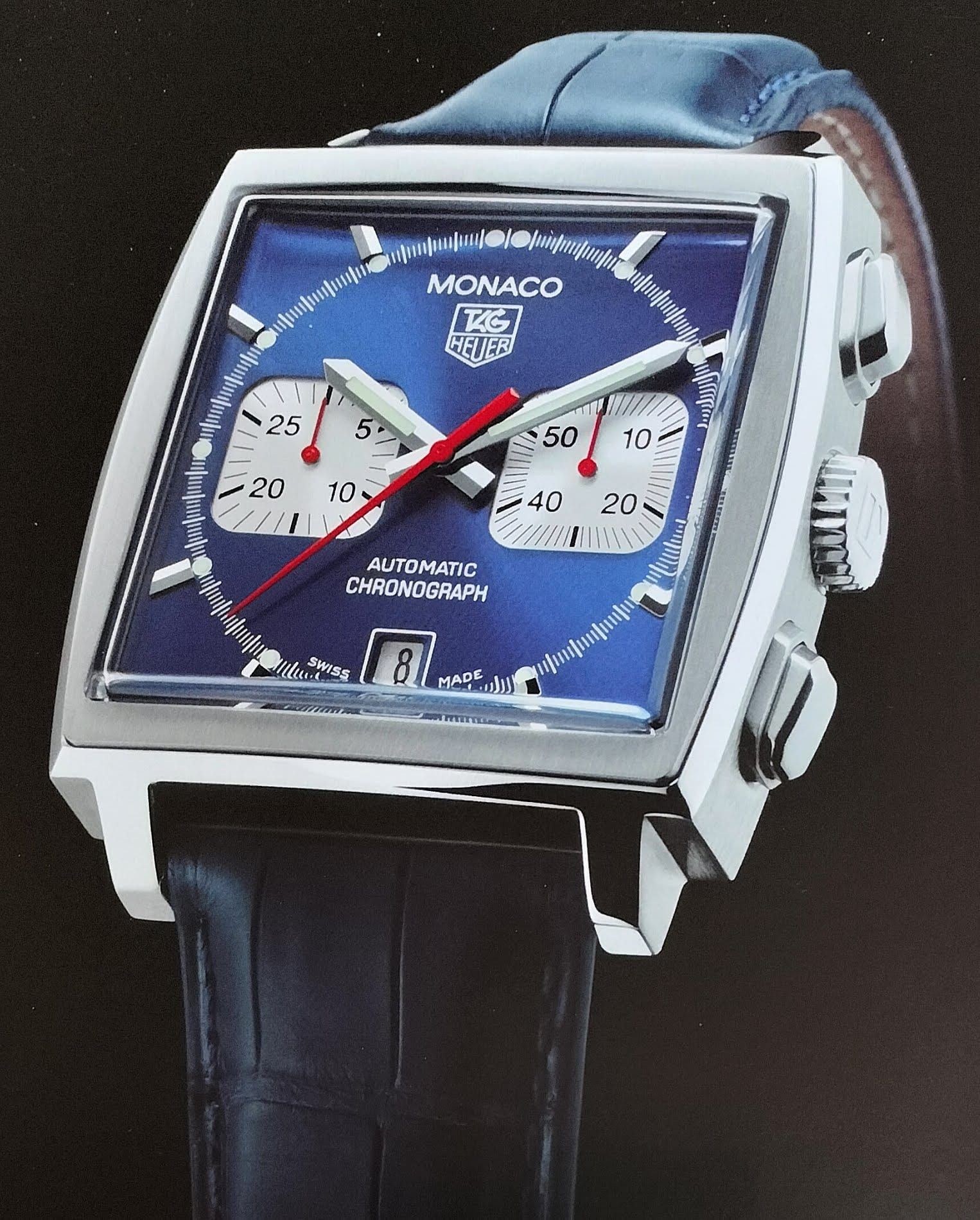
On 3 March 1969, Heuer held simultaneous press conferences in Geneva, New York, Hong Kong, and Beirut to announce the Calibre 11 — the world's first automatic integrated chronograph movement. The watch chosen to showcase this movement was the Monaco. Square case. Blue dial. Crown at 9 o'clock. Water resistant to 10 ATM. Nothing like it existed in Swiss watchmaking in 1969, and nothing that came after it has ever completely escaped its shadow.
Photo: Ferengi — CC BY-SA 3.0 — Wikimedia Commons
Introduction — 3 March 1969
The Heuer Monaco ref. 1133B was introduced on 3 March 1969 alongside the Calibre 11 automatic chronograph. The date is significant: the Monaco and the Calibre 11 were presented as a unit — the Monaco was the primary showcase vehicle for the new movement.
The "B" in "1133B" denotes blue (French: bleu ). The earliest examples carried the word "Chronomatic" above the Heuer shield on the dial — Chronomatic was the consortium's commercial branding for the Calibre 11. A grey-dial variant, the ref. 1133G , was also produced.
The name "Monaco" required Heuer to obtain the rights from the Société des Bains de Mer (which held naming rights for the Principality). Jack Heuer acquired those rights — the watch was named after the Grand Prix circuit where Formula 1 racing had made its name, and where Heuer watches were already prominent on racing drivers' wrists.
The Square Case
Photo: Ferengi — CC BY-SA 3.0 — Wikimedia Commons
The Monaco case was manufactured by Piquerez , a specialist Swiss case-maker. The case measured approximately 39 × 39 mm — a square format that was unusual in 1969 Swiss watchmaking to the point of being provocative.
The technical challenge of a square automatic chronograph case was significant. The conventional approach to water resistance — a crown sealed by gaskets on the case side — required the crown to be positioned in a specific relationship to the case band. The Calibre 11's architecture placed the crown on the left side of the case (at approximately the 9 o'clock position) rather than the conventional right side, because the movement's winding mechanism was on that side.
Piquerez's solution was a four-notch snap-fit caseback that achieved water resistance through compressive tension at the snap points rather than through conventional crown-side sealing. The result: the Monaco was rated at 10 ATM (100 metres) water resistance — impressive for a square-cased automatic chronograph with a left-side crown.
The Calibre 11
Photo: Ferengi — CC BY-SA 3.0 — Wikimedia Commons
The Monaco's movement, the Calibre 11 , was the product of a commercial consortium:
- Büren Watch Co. (later Hamilton-Büren): Manufactured the micro-rotor base automatic movement
- Dubois-Dépraz : Developed the chronograph module stacked on top of the base movement
- Heuer-Léonidas SA and Breitling : Commercial partners who financed production and marketing
The Calibre 11 specifications:
- Frequency
: 19,800 vph (2.75 Hz)
- Jewels
: 17
- Dimensions
: 31 mm × 7.7 mm
- Power reserve
: 42 hours
- Display
: Bi-compax — 30-minute counter at 3 o'clock, 12-hour counter at 9 o'clock
- Crown position
: Left side (9 o'clock on the case)
The micro-rotor base meant the rotor sat within the movement's plane rather than above it — a design that reduced movement height and was essential for fitting an automatic chronograph into a case of reasonable thickness.
The Calibre 11 was not the only automatic chronograph announced in 1969. Zenith had announced the El Primero on 10 January 1969, beating the Calibre 11 consortium by nearly two months. The Zenith movement ran at a higher frequency (36,000 vph) and was a fully integrated design rather than a modular stack. The competition between the two movements — and which was truly "first" — remains one of watchmaking's persistent debates.
Steve McQueen and Le Mans
Photo: DavidBSV12 — CC BY-SA 4.0 — Wikimedia Commons
In 1970 , property master Don Nunley approached Heuer to supply chronographs for the racing film Le Mans , starring Steve McQueen. Six Monaco ref. 1133B watches — matte painted blue dial, steel case — were sent to the set: two on steel bracelets, four on leather straps.
McQueen wore the Monaco throughout the film's production in 1970. Le Mans was released in June 1971. The association between Steve McQueen and the Monaco became one of the most potent celebrity endorsements in watch history — achieved not through a paid advertising campaign but through the simple fact of a film that depicted racing as McQueen personally understood it, with a watch on the protagonist's wrist.
A ref. 1133B worn by McQueen during filming sold at Phillips for USD 2,208,000 . The Monaco's value in the secondary market for vintage examples is driven substantially by the McQueen connection.
The Gulf Livery
Photo: Ferengi — CC BY-SA 3.0 — Wikimedia Commons
The Gulf Oil livery — powder blue and vivid orange — is among the most iconic colour schemes in motorsport. It appeared on the Gulf-sponsored Porsche 917 that McQueen drove in Le Mans. The association between the Monaco and Gulf livery follows naturally from this connection.
TAG Heuer introduced the first Gulf-themed Monaco edition ( ref. CW2118 ) in 2005 , featuring the light blue and orange Gulf colour scheme. TAG Heuer and Gulf Oil formalised an official commercial partnership around Baselworld 2018 , after which Gulf Monaco editions became regular annual releases. The combination of square blue case, orange accents, and the McQueen association makes the Gulf Monaco one of the most legible design propositions in contemporary watchmaking.
Production Continuity and Discontinuity
Photo: EMore98 — CC BY-SA 4.0 — Wikimedia Commons
The Monaco was discontinued in 1975 — a casualty of the quartz crisis and declining demand for mechanical chronographs. It was reintroduced in 1998 for the 30th anniversary of the Calibre 11, initially as a limited edition. The reintroduction was sufficiently successful that the Monaco became a permanent collection reference.
Current Monaco references are powered by the Calibre Heuer 02 — TAG Heuer's in-house automatic chronograph with 80-hour power reserve and COSC chronometer certification. Split-seconds (rattrapante) Monaco references ( CBW2181, CBW2182, CBW2190 ) have appeared in the 2024–2025 collection, representing the most complex Monaco variants produced since the original.
Frequently Asked Questions
When was the Monaco introduced?
On 3 March 1969, simultaneously with the Calibre 11 automatic chronograph announcement. Press conferences were held in Geneva, New York, Hong Kong, and Beirut on the same day.
What makes the Monaco unusual?
It is a square-cased automatic chronograph — the world's first when introduced in 1969. The crown is positioned at 9 o'clock (left side) rather than the conventional 3 o'clock, because the Calibre 11's architecture placed the winding crown on the left.
Did Steve McQueen wear the Monaco?
Yes. In the 1971 film Le Mans
, McQueen wore a ref. 1133B Monaco (matte blue dial) throughout production. An example worn by McQueen sold at Phillips for USD 2,208,000.
When was the Monaco discontinued and reintroduced?
Discontinued in 1975 during the quartz crisis. Reintroduced in 1998 for the Calibre 11's 30th anniversary.
What movement does the current Monaco use?
The Calibre Heuer 02 — an in-house automatic column-wheel chronograph with 80-hour power reserve, COSC chronometer certified.