Heuer Autavia: The Pilot's and Driver's Chronograph
TAG Heuer Autavia: The Original Dashboard Watch
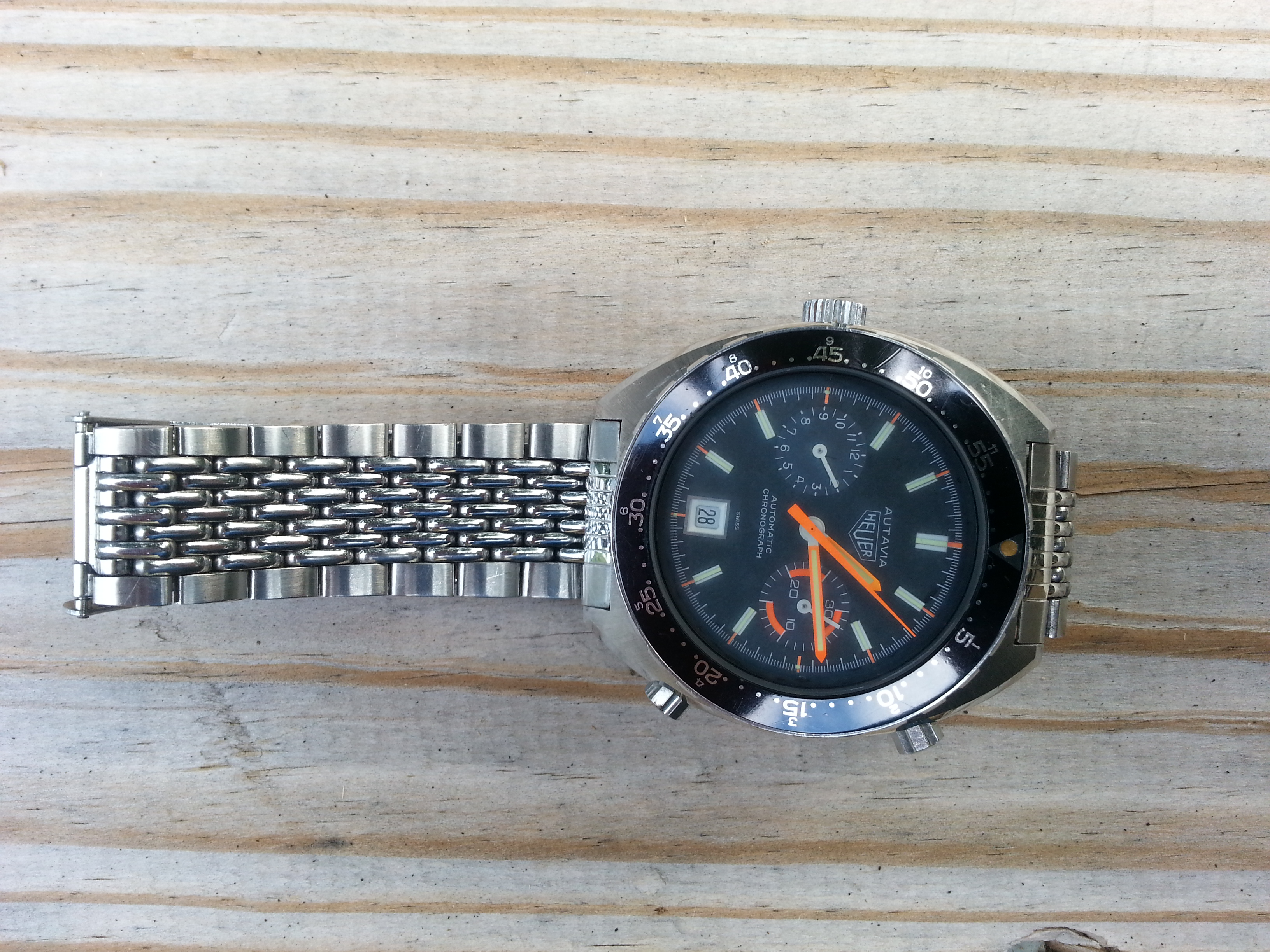
The Autavia's name predates Jack Heuer's involvement with the company by nearly thirty years. Heuer coined it in 1933 for a dashboard stopwatch — a precision instrument for cars and aircraft, not a wristwatch. When Jack Heuer converted the name to a wrist-worn chronograph in 1962, he was borrowing an established Heuer identity and extending it to a new category. The resulting watch became the most collectible Heuer reference of the manual-wind era, worn by Jo Siffert, Jochen Rindt, and other Formula 1 drivers who needed to time their races from the cockpit.
Photo: Alex Peters (photo); Pittigrilli (retouching) — CC BY-SA 3.0 — Wikimedia Commons
The Name — 1933
AUTAVIA is a portmanteau of AUTO mobile and AVIA tion — coined by Heuer in 1933 for a dashboard stopwatch instrument. The 1933 instrument was a mechanical timer for mounting in vehicle dashboards and aircraft cockpits, measuring elapsed time for navigation, pacing, and precision driving. The name reflected the instrument's dual audience: automobiles and aircraft were the two emerging technologies that required precision elapsed-time measurement in the early twentieth century.
The 1933 Autavia predates Jack Heuer's involvement with the company — Jack was born in 1932. When he became majority shareholder in 1962, the Autavia name existed in the Heuer catalogue as a dashboard product. Jack's decision to attach it to a wristwatch was an act of brand extension: applying an established Heuer identity to a new format.
The Wristwatch — 1962
Photo: Alex Peters (Ape10000) — CC BY-SA 3.0 — Wikimedia Commons

In autumn 1961 , Jack Heuer decided to develop a wristwatch. He chose the Autavia name from the existing dashboard instrument catalogue. The Autavia wristwatch launched in 1962 — the first wristwatch Jack Heuer personally designed.
The original ref. 2446
featured:
- Case diameter: 39 mm
(large for 1962)
- A rotating bezel — unusual for a Swiss wristwatch of the era
- Stark black dial, luminous markers
- Manual-wind chronograph movement
The rotating bezel gave the Autavia a functional character distinguishing it from dress chronographs of the period. It could be used as a second elapsed-time measurement, supplementing the chronograph's sub-registers. The large case and functional specification positioned it as a motorsport and aviation instrument rather than a dress watch.
Jo Siffert and the Autavia
Photo: BBCLCD — CC BY-SA 4.0 — Wikimedia Commons
Jo Siffert — Swiss Formula 1 driver (1936–1971) — was Heuer's first brand ambassador. Jack Heuer chose Siffert personally, describing the decision later as "one of the best marketing moves I ever made." Siffert introduced Heuer to the closed world of Formula 1 and facilitated the Scuderia Ferrari sponsorship that began in 1971.
Siffert wore the Autavia in both its manual-wind and automatic eras. The white-dialed variants of the ref. 2446 — with their clean, high-contrast layout — became known in collector circles as "Siffert" Autavias . After 1969, when the Autavia received the Calibre 11, the automatic variants with Siffert associations are generally the ref. 1163T — a cushion-shaped case with white dial, black sub-dials, and blue chronograph hand.
Jo Siffert died in a racing accident at Brands Hatch on 24 October 1971 — the year the Heuer Ferrari sponsorship had begun. He was 35 years old. His personal relationship with Jack Heuer meant the loss was not merely commercial but a genuine bereavement for the Heuer team.
Jochen Rindt and the Black Dial
Jochen Rindt — Austrian Formula 1 World Champion in 1970 (posthumously, following his death at Monza during qualifying) — favoured the black-dial Autavia. The black-dialed, three-register Autavia produced circa 1967 is associated with Rindt in collector references, contrasting with Siffert's preference for the white dial.
The Rindt/Siffert dial distinction — black vs. white — within the same reference family is one of the better-documented collector differentiations in vintage Heuer. The two drivers wore different variants of the same model, creating a sub-classification within the ref. 2446 family that continues to drive auction premiums.
The Calibre 11 Era
Photo: Ferengi — CC BY-SA 3.0 — Wikimedia Commons
After 1969, the Autavia was updated to house the Calibre 11 automatic chronograph. The case evolved to a cushion shape — rounder and larger, accommodating the automatic movement's greater thickness. The ref. 1163 family, in its various dial configurations, represents the Calibre 11 Autavia.
The Autavia continued in production through the 1970s but was discontinued as the quartz crisis reduced demand for mechanical chronographs. Unlike the Monaco and the Carrera, which received significant heritage attention in the 1990s–2000s, the Autavia's collector rehabilitation came later — and dramatically.
The Autavia Cup — 2017
Photo: Jorjum — CC BY-SA 3.0 — Wikimedia Commons
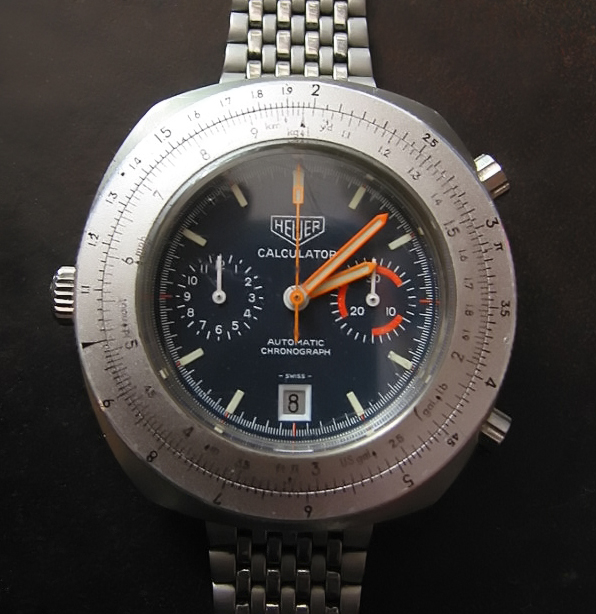
In 2016 at Baselworld , TAG Heuer announced the Autavia Cup — a head-to-head, knockout-format fan vote to determine which vintage Autavia reference TAG Heuer would reissue.
Format : 16 vintage Autavia references competed in a bracket tournament. Public voting ran online over several weeks. Over 50,000 votes were cast.
Winner : The ref. 2446 Mark 3 (circa 1966, black dial, three-register) — the variant associated with Jochen Rindt.
The 2017 reissue that resulted — the Autavia Calibre Heuer 02 — was powered by the in-house automatic chronograph movement. It honoured the Rindt-associated Mark 3's design vocabulary: black dial, three registers, clean typography.
The Autavia Cup was notable as a marketing exercise for what it revealed: a significant community of collectors who knew their vintage Heuer references well enough to vote with conviction. Putting the reissue decision in fans' hands was credible only because the audience had the expertise to make a meaningful choice.
Current Autavia
Photo: Dr.mgf.winkelmann — CC BY 3.0 — Wikimedia Commons
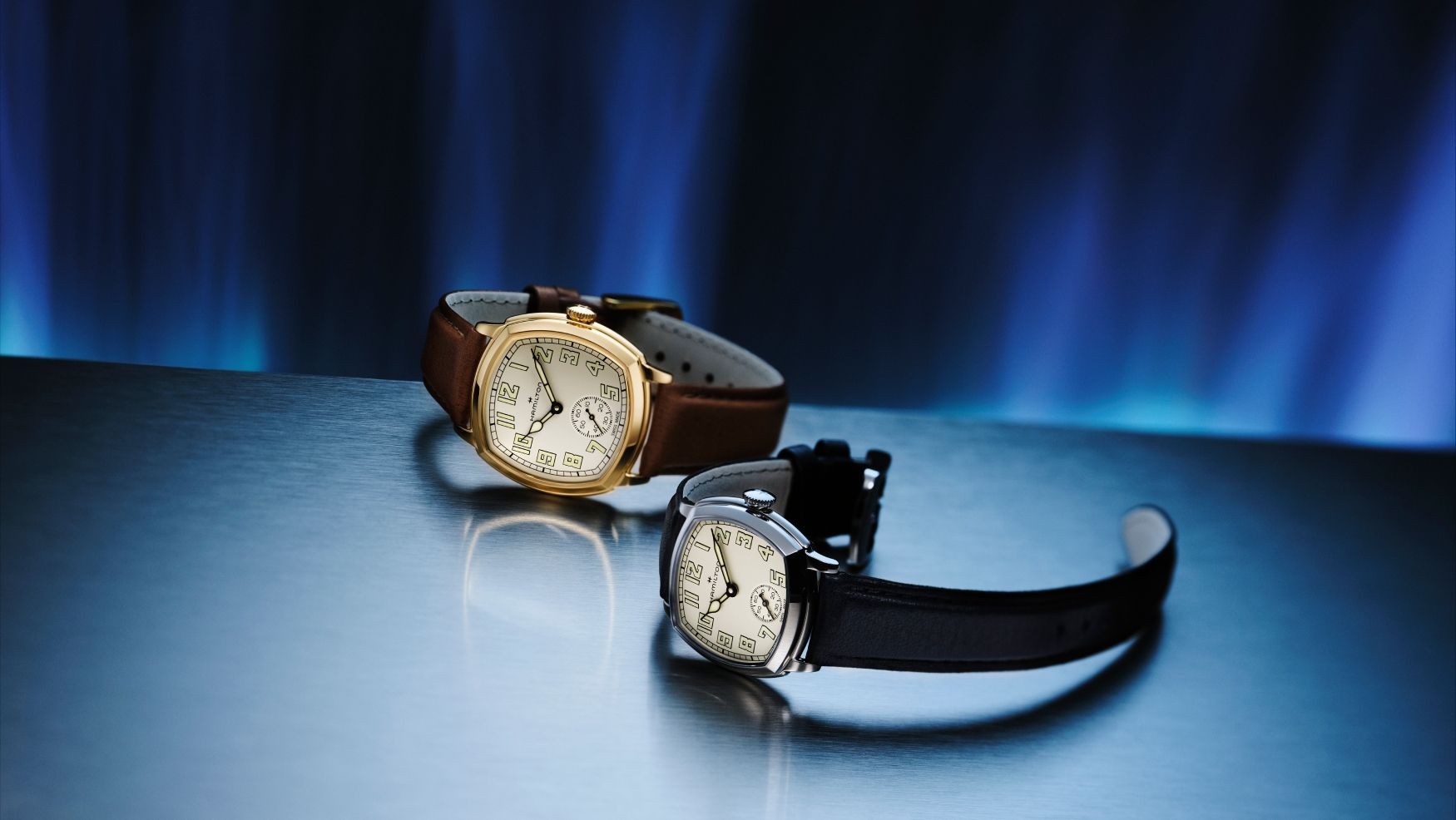
The current Autavia collection is powered by the Calibre Heuer 02 — 28,800 vph, 80-hour power reserve, column wheel, COSC certified. Cases in steel and titanium, in both black and steel-tone dial variants. The collection occupies the same position as the Carrera in the TAG Heuer lineup — automatic in-house chronograph with explicit vintage reference — but with a more pronounced collector emphasis due to the Autavia Cup's prominence.
Frequently Asked Questions
What does Autavia mean?
It is a portmanteau of AUTomobile and AVIAtion. The name was coined by Heuer in 1933 for a dashboard stopwatch instrument used in cars and aircraft.
When was the Autavia wristwatch introduced?
In 1962 — the first wristwatch Jack Heuer personally designed. The original reference was the 2446, featuring a rotating bezel and 39mm case.
Who are the key drivers associated with the Autavia?
Jo Siffert (Swiss F1 driver, Heuer's first brand ambassador, died 1971) wore white-dial Autavias. Jochen Rindt (Austrian F1 World Champion 1970, died at Monza during qualifying) wore black-dial variants.
What was the Autavia Cup?
A 2016/2017 fan vote in which over 50,000 people voted to determine which vintage Autavia TAG Heuer would reissue. The winner was the ref. 2446 Mark 3 (black dial, three-register, Rindt-associated).
What movement does the current Autavia use?
The Calibre Heuer 02 — in-house automatic, 28,800 vph, 80-hour power reserve, COSC certified.