TAG Heuer Aquaracer: The Dive Watch Range
TAG Heuer Aquaracer: The Dive Collection
TAG Heuer's approach to the dive watch is different from its approach to the chronograph. The Monaco, Carrera, and Autavia all carry explicit historical weight — they are named after events, designed around specific motorsport needs, and shaped by the personal decisions of identifiable individuals. The Aquaracer carries no such mythology. It is an instrument watch positioned on its technical merits: depth rating, bezel function, legibility, water resistance. That directness is both the Aquaracer's strength and the honest description of what it is.
Photo: Juho Eskeliä (Detonator2112) — CC BY-SA 3.0 — Wikimedia Commons
Origins — The TAG Heuer 2000 Sport
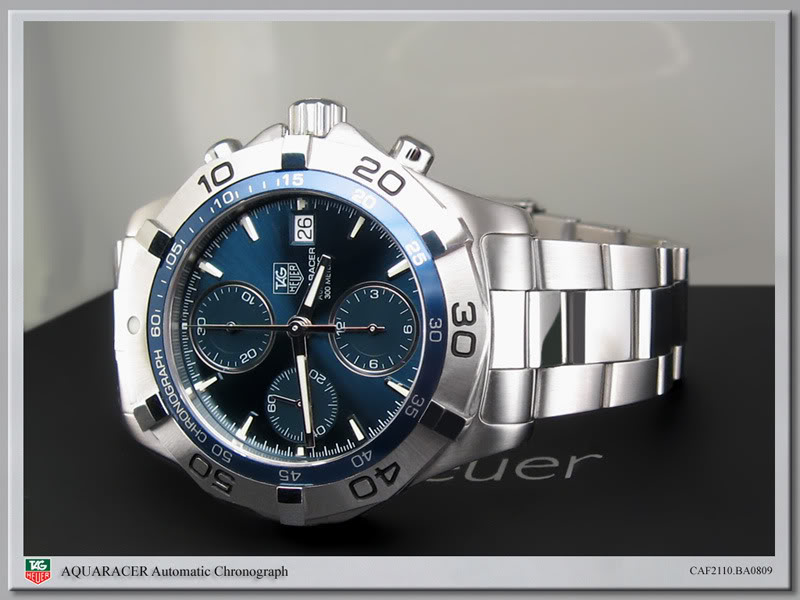
TAG Heuer's dive watch lineage traces to the TAG Heuer 2000 series, which had existed in the catalogue since the 1980s under various configurations — the 2000, 2000 Aquagraph, and 2000 Sport. These models established the brand's presence in the sport/dive category but carried no collector mythology comparable to the chronograph heritage.
In 2004 , TAG Heuer relaunched and renamed the line as the Aquaracer , a name chosen for its directness: aqua (water) + racer (pace/competition). The 2000 Sport's specifications were carried forward: the baseline Aquaracer rated at 300 metres water resistance — the standard professional dive watch specification — with a unidirectional rotating bezel calibrated for elapsed dive time.
Aquaracer Generations
Photo: Juho Eskeliä (Detonator2112) — CC BY-SA 3.0 — Wikimedia Commons
Generation 1 (2004) : The original Aquaracer in 38.5mm (quartz) and 41mm (automatic). Unidirectional rotating bezel, screw-down crown, 300m water resistance. Sapphire crystal with anti-reflective coating. Powered by Calibre 5 (ETA 2824-derived) in automatic variants.
Generation 2 (2009) : Updated case profile with a more angular bezel. 40.5mm primary size. Introduced the "shark fin" unidirectional bezel — a distinctive stepped design that increased grip when turning the bezel under water with gloved hands. Chronograph variants powered by Calibre 16 (ETA 7750-derived).
Generation 3 (2017) : Revised dial architecture. Increased applied index height for improved legibility. Updated bracelet with a folding clasp with safety extension. 43mm became the primary size for automatic models.
Generation 4 — Aquaracer Professional 300 (from 2021) : A substantial redesign with cleaner lines and a revised bezel profile. Available in 40mm and 43mm . The 40mm addresses the market demand for a smaller, more versatile dive watch capable of serving as an everyday watch beyond dive contexts.
Aquaracer Professional 300 — Current Specification
Photo: Ferengi — CC BY-SA 3.0 — Wikimedia Commons
The current Aquaracer Professional 300 is the mainstream offering:
| Specification | Value |
|---|---|
| Case diameter | 40mm or 43mm |
| Depth rating | 300 metres |
| Crystal | Sapphire, anti-reflective coating |
| Bezel | Unidirectional rotating, ceramic insert |
| Movement (automatic) | Calibre 5 (ETA 2824-2 derived), 38-hour power reserve |
| Water resistance | Screw-down crown, screw-in caseback |
The ceramic bezel insert is a meaningful upgrade from earlier metal and aluminium bezels: ceramic is scratch-resistant and does not fade, maintaining the bezel's colour and legibility over years of use. This specification is now standard at the CHF 1,000–2,000 dive watch tier, and the Aquaracer delivers it.
Aquaracer Professional 1000 Superdiver
Photo: 사나운 — CC BY-SA 4.0 — Wikimedia Commons

The Aquaracer Professional 1000 Superdiver is the technical halo product:
- Depth rating : 1,000 metres (100 ATM)
- Helium escape valve : Present — required for saturation diving, where mixed gases absorbed into the watch case at depth need a controlled egress path during decompression
- Case size : 45mm — functional requirement for the additional case thickness needed for 1,000m pressure resistance
- Bezel : Unidirectional, with 60-minute graduation
The 1,000m rating positions the Superdiver alongside professional-specification dive tools from Seiko (MarineMaster 1000m), Citizen, and Casio G-Shock rather than lifestyle dive watches. At this depth rating, the watch is specified for commercial and military diving applications where the 300m rating is insufficient.
Aquaracer vs. Competitors
Photo: BBCLCD — CC BY-SA 4.0 — Wikimedia Commons
The Aquaracer Professional 300 competes directly with:
- Omega Seamaster 300M (CHF 4,500–6,000) — higher price, movement with co-axial escapement and Master Chronometer certification
- Breitling Superocean 42 (CHF 3,500–4,500) — comparable specification, Breitling's aviation-derived brand identity
- Rolex Submariner (CHF 9,000+) — significantly higher price point, brand premium and secondary market value
The Aquaracer Professional 300 enters at approximately CHF 1,500–2,000 for the automatic variant — below the Seamaster and Superocean, making it the accessible entry into the Swiss professional dive watch category among established luxury brands. The ceramic bezel, 300m rating, and Swiss movement at this price point represent a legitimate specification rather than a compromise.
Frequently Asked Questions
Photo: EMore98 — CC BY-SA 4.0 — Wikimedia Commons
When was the Aquaracer introduced?
The Aquaracer name was introduced in 2004, replacing the TAG Heuer 2000 Sport line. The current Aquaracer Professional 300 was introduced in 2021.
What is the Aquaracer's depth rating?
The standard Aquaracer Professional 300 is rated to 300 metres. The Aquaracer Professional 1000 Superdiver is rated to 1,000 metres.
Does the Aquaracer have a ceramic bezel?
Yes. Current Aquaracer Professional 300 models feature a unidirectional rotating bezel with a ceramic insert — scratch-resistant and colour-stable over time.
What movement powers the Aquaracer?
The automatic Aquaracer Professional 300 uses the Calibre 5, derived from the ETA 2824-2, with approximately 38 hours of power reserve. Chronograph variants use the Calibre 16 or Calibre Heuer 02.
What is the Aquaracer Professional 1000 Superdiver?
A 45mm, 1,000m-rated professional dive watch with a helium escape valve. Specified for saturation diving applications where pressurised mixed gases require controlled egress during decompression.