Breitling Superocean: The 1957 Dive Watch to the Modern Heritage Line
Breitling Superocean: Complete History of the Dive Watch (1957–Today)
Few watches carry the weight of historical coincidence as gracefully as the Breitling Superocean. Born in 1957 — the same pivotal year that gave the world the Rolex Submariner Date and the Omega Seamaster 300 — the Superocean arrived at a moment when the Swiss watch industry was waking up to the commercial and technical possibilities of professional-grade underwater timekeeping. It was a watch designed for depth, built for work, and defined by a clarity of purpose that has never entirely left it. Across seven decades, through a long dormancy during the quartz upheaval and a confident revival in the early 2000s, the Superocean has evolved without losing the core identity that made it remarkable in the first place.
Breitling in 1957 was not yet the aviation-obsessed brand it would later become synonymous with. The company was, in the mid-twentieth century, producing precision instruments for pilots, navigators, and scientists. The Superocean represented a conscious reach in another direction: downward, beneath the surface of the water, into a professional market that was still in its infancy. Jacques Cousteau had completed his early Calypso expeditions. Scuba equipment was becoming more reliable. A market for serious dive instruments was forming, and Breitling moved to claim a piece of it.
Photo: EMore98 — CC BY-SA 4.0 — Wikimedia Commons
1957 and the Holy Trinity of Dive Watches
Photo: Phil Guest — CC BY-SA 2.0 — Wikimedia Commons
The year 1957 stands as one of the most consequential in dive watch history. Within months of each other, Rolex released the Submariner Date, Omega introduced the Seamaster 300 (ref. CK 2913), and Breitling launched the Superocean reference 1004. These three watches collectively established the visual and technical vocabulary of the professional dive watch genre.
The Superocean ref. 1004 arrived with 200 metres of water resistance — genuinely impressive for the era. The case measured approximately 38mm, standard for the period, and featured a unidirectional rotating bezel calibrated in minutes for tracking dive duration. The dial was built around legibility: large lumed hour markers, bold hands, and a layout stripped of unnecessary ornamentation. In the water, at depth, in low visibility, the ref. 1004 was designed to be read instantly and unambiguously.
Comparing the three 1957 watches reveals subtle but meaningful differences in philosophy. The Rolex Submariner was already gravitating toward a more refined, slightly dressier expression. The Omega Seamaster 300 offered perhaps the cleanest dial architecture of the three. The Breitling Superocean ref. 1004 occupied a more overtly utilitarian position: larger indices, more emphatically instrumental presentation. It was the watch of someone who expected to use it hard.
The Quartz Era and a Long Interlude
The late 1960s and 1970s brought a crisis that reshaped the Swiss watch industry permanently. Breitling — like many of its peers — struggled through the quartz revolution and filed for bankruptcy in 1979, subsequently purchased by Ernst Schneider. The Navitimer chronograph became the brand's flag-bearer; dive watches were largely set aside.
The original Superocean line did not survive the transition intact. Through the 1970s and into the 1980s the watch faded from active production — not forgotten by collectors who valued the ref. 1004's historical significance, but dormant as a living product line for more than two decades. This gap is important context for understanding the 2003 revival: Breitling was not iterating on a continuous line but making a conscious decision to resurrect a dormant name and invest it with new meaning.
The 2003 Revival — Tool Watch Clarity
Photo: EMore98 — CC BY-SA 4.0 — Wikimedia Commons
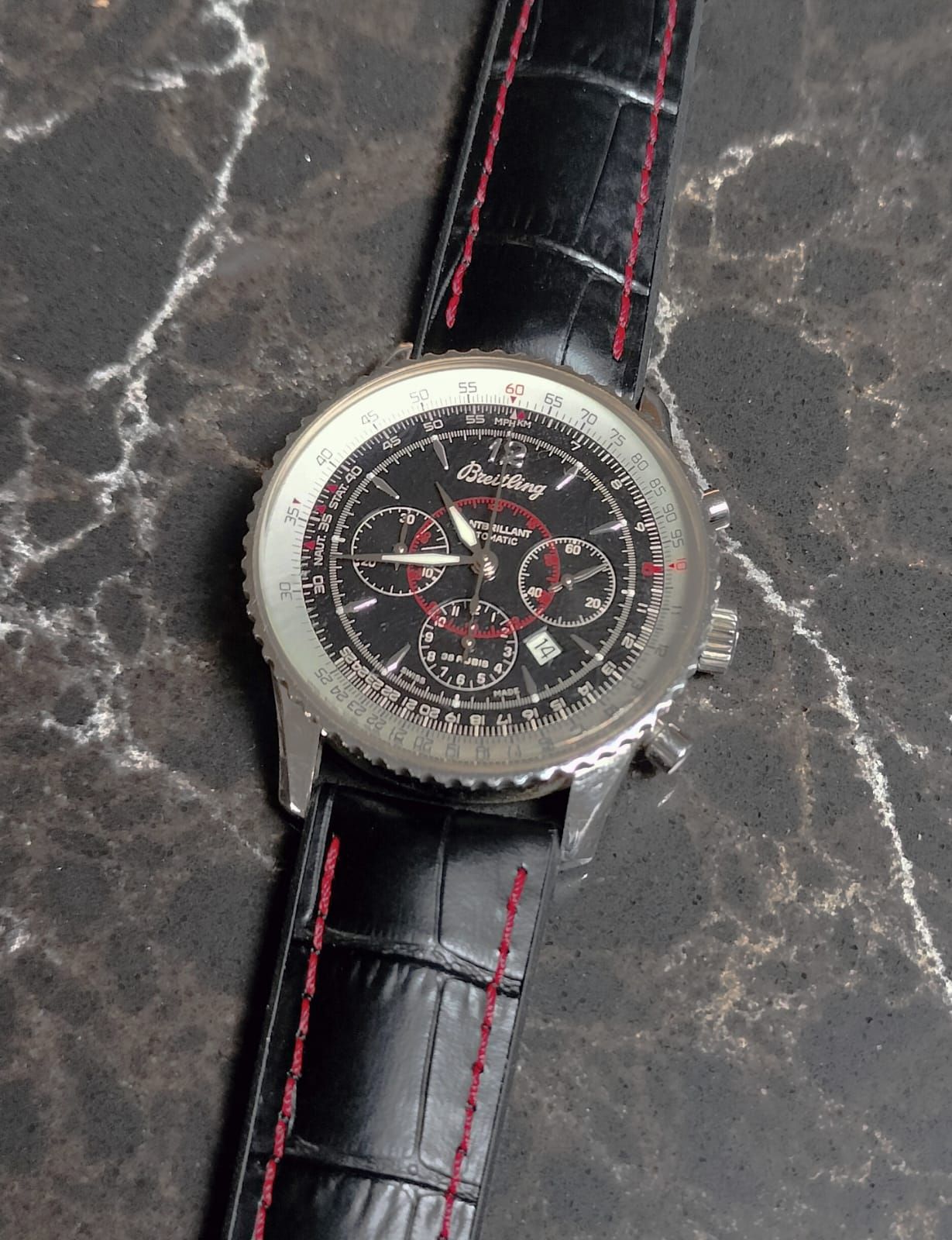
When Breitling relaunched the Superocean in 2003, the decision reflected a broader market trend. The early 2000s saw a resurgence of interest in mechanical watches and, specifically, in the functional dive watch aesthetic that had been overshadowed during the quartz years. Breitling's response leaned hard into the tool watch identity: the 2003 Superocean arrived in a 42mm case with a high-contrast dial, a unidirectional rotating bezel with a distinct tactile click, and an emphatically professional character.
The aesthetic language was deliberately contemporary rather than retrospective. Breitling was not trying to recreate the ref. 1004; they were building a dive watch for the twenty-first century. The case construction was robust, the overall impression one of a watch that had been engineered rather than styled. It was a credible re-entry into the professional dive watch market, positioning the Superocean as a genuine alternative to the Omega Seamaster Professional 300M.
Superocean Heritage — Returning to 1957
Photo: Phil Guest — CC BY-SA 2.0 — Wikimedia Commons
Around 2007, Breitling launched the Superocean Heritage: a vintage-inspired interpretation of the 1957 original that offered collectors a more explicitly retro aesthetic alongside modern mechanical reliability. Where the revived Superocean was forward-looking, the Heritage was an exercise in curated nostalgia.
The Heritage line introduced design elements drawn directly from the ref. 1004: broader, more widely-spaced dial indices; rounded lugwork reminiscent of 1950s case finishing; and the "Mariner" strap — a mesh or fabric option evoking the professional straps of the mid-century era. Domed crystals on certain references gave a period-correct visual depth that flat sapphire could not replicate.
The Heritage line created a clear bifurcation in the Superocean family: the standard Superocean for those wanting a thoroughly modern, technically maximalist dive watch; the Heritage for those drawn to the aesthetic vocabulary of postwar watchmaking. Tropical dial variants — naturally aged dials that shift from original black or blue to warm brown tones — have made certain Heritage references particularly sought after on the secondary market, echoing similar collector enthusiasm for aged Rolex and Heuer dials.
Superocean II — Technical Maximalism
Photo: EMore98 — CC BY-SA 4.0 — Wikimedia Commons
The modern Superocean II represents the technical zenith of the line. Available in 42mm, 44mm, and 46mm, it is powered by the COSC-certified Breitling Calibre B17 or B18, meeting the Contrôle Officiel Suisse des Chronomètres standard of -4/+6 seconds per day.
The headline specification is water resistance: 2,000 metres (200 ATM). Achieving this requires case construction and sealing technology of a fundamentally different order than a standard 300m dive watch. The case back, crown guards, and crystal mounting must withstand pressures that would destroy a conventional sports watch. In practical terms, almost no civilian diver will ever need 2,000m of water resistance; the specification functions as a statement of engineering confidence.
The Abyss Orange variant — vivid orange dial and bezel insert — draws on the high-visibility colour conventions of professional dive equipment and has become one of the most visually distinctive references in the Superocean II range.
Superocean Heritage B20 — The Modern Vintage Reference
Photo: Clyde94 — CC BY-SA 4.0 — Wikimedia Commons
Until the 2025 overhaul, the Superocean Heritage was powered by the B20 calibre, is the most technically mature expression of the vintage-inspired line. The B20 is built on the foundation of the Tudor MT5612 movement — produced by Kenissi — and features a silicon hairspring for improved magnetic resistance, a 70-hour power reserve, and COSC-level accuracy. Available in 42mm and 46mm, the Heritage B20 offers dial configurations that closely evoke the 1957 ref. 1004, making it the purest expression of the Superocean's original design DNA in a contemporary, serviceable package.
Superocean Heritage 2025–2026 — Slimmer Cases and Yellow Gold
In 2025 Breitling overhauled the Superocean Heritage with slimmer cases, shorter lugs and ceramic bezel inserts in sizes from 36mm to 44mm, moving most three-hand models to the in-house B31 calibre (78-hour power reserve) and keeping the COSC-certified Breitling Calibre 10 for the 36mm.
2026 — yellow gold. In October 2026 Breitling added two two-tone Superocean Heritage Automatic 36 references with a solid 18k yellow-gold bezel, gold hands and a white dial: D10390A71A1S1 on white rubber (US$7,100) and D10390A71A1A1 on steel mesh (US$7,500), both 36mm × 10.42mm and water resistant to 200m. See our news coverage: Breitling Superocean Heritage 36 in Yellow Gold (2026).
Sustainability — The Outerknown Collaboration
Breitling's partnership with Outerknown — the sustainable apparel company co-founded by professional surfer Kelly Slater — produced a Superocean Heritage fitted with a strap manufactured from recycled ocean plastic: yarn produced from discarded fishing nets and other ocean-recovered nylon waste. The initiative connects the Superocean's aquatic heritage to contemporary environmental consciousness. For buyers who care about the ecological context of a dive watch, the Outerknown Superocean Heritage offers a coherent, substantiated story.
Superocean vs. Seamaster 300M and Submariner
Against the Omega Seamaster Professional 300M, the Superocean offers a more overtly tool-watch aesthetic and, in the Superocean II, a dramatically superior water resistance rating. The Seamaster counters with the Co-Axial Master Chronometer movement (METAS-certified, stricter than COSC) and James Bond association.
Against the Rolex Submariner the comparison is starker. The Submariner carries the strongest secondary market values and the most universal recognition of any dive watch. The Superocean offers greater size variety, more accessible pricing, and a higher technical specification ceiling. For buyers seeking an alternative to either watch — something that honours the dive watch tradition without waiting lists or grey-market premiums — the Superocean Heritage B20 makes a compelling case.
Frequently Asked Questions
What is the difference between the Superocean and Superocean Heritage?
The Superocean II is Breitling's modern tool-oriented dive watch: contemporary aesthetic, 2,000m water resistance, COSC-certified B17/B18 movements. The Superocean Heritage is a vintage-inspired line paying homage to the 1957 ref. 1004: softer dial layouts, domed crystals on certain references, and the automatic B20 calibre (based on the Tudor MT5612). Choose the Superocean II for maximum technical specification; choose the Heritage for vintage aesthetic with modern internals.
Is the Superocean a good Submariner alternative?
Yes, particularly the Heritage. It offers robust automatic movements, excellent water resistance, and strong visual identity rooted in 1950s dive watch design — at prices typically more accessible than a Submariner on the primary or secondary market. Where the Submariner wins on brand recognition and resale values, the Superocean wins on technical specification, size variety, and retail availability.
What is the Superocean II water resistance rating?
The Superocean II carries 2,000 metres (200 ATM) of water resistance — one of the highest ratings from any major Swiss manufacturer, exceeding the Submariner (300m), Seamaster 300M (300m), and many purpose-built saturation dive instruments.
What movement does the Superocean Heritage use?
The Superocean Heritage B20 uses Breitling's Calibre B20, built on the Tudor MT5612 base by Kenissi. It features a silicon hairspring, approximately 70-hour power reserve, and COSC-equivalent accuracy — the same movement architecture found in Tudor's Black Bay range.
How deep can I actually dive with a Superocean?
The Superocean Heritage B20 is rated to 300 metres — more than adequate for any recreational diving scenario. Recreational diving is limited by certification to 40 metres; technical diving to around 100 metres. The Superocean II's 2,000m rating exceeds what any human can physically dive. You will never stress either watch's water resistance in normal use. The ratings are an engineering statement as much as a practical specification.
Related Articles
- Breitling: The Instrument Watch Maker Since 1884
- Breitling Navitimer: The Complete History of Aviation's Greatest Chronograph
- Breitling Chronomat: The Complete History of the Pilot's Sports Watch
- Breitling Avenger: History of the Military Instrument Watch
- Omega Seamaster: Complete Collection History