Seiko Sumo: The SBDC Series and Calibre 6R35
Seiko Sumo: The Barrel-Case Diver
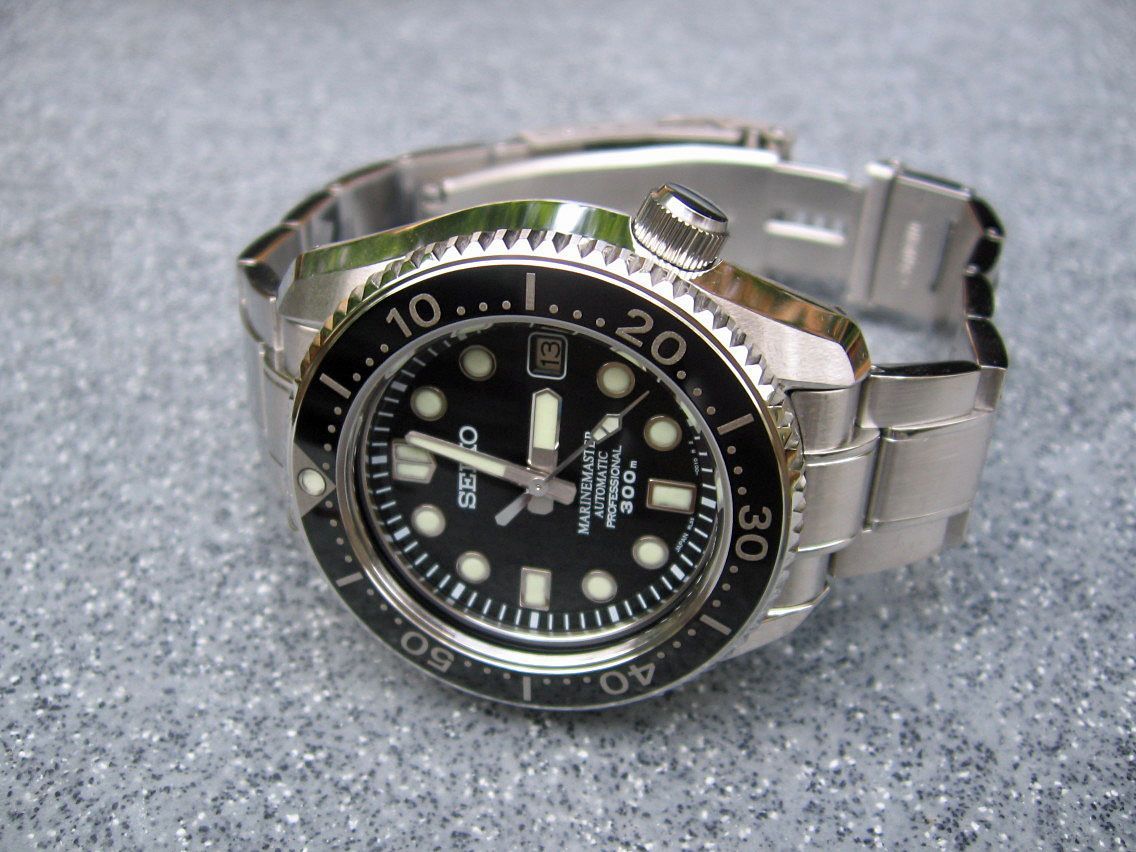
The Seiko Sumo sits differently on the wrist than other Seiko dive watches. Where the Turtle curves, the Sumo looms. Where the Samurai angles sharply, the Sumo spreads wide and low. The barrel-shaped case — broader at the shoulders than the lugs, with a distinctive stepped bezel — creates a physical presence that inspired the community's comparison to Japan's wrestling tradition. It is a watch that communicates weight and substance even before you know anything about the movement inside. Since 2007, the Sumo has evolved through successive generations, each retaining the essential barrel case form while upgrading the movement and specifications beneath it.
Photo: Francis Flinch — Public Domain — Wikimedia Commons
Introduction — 2007
Photo: Francis Flinch — CC BY-SA 3.0 — Wikimedia Commons
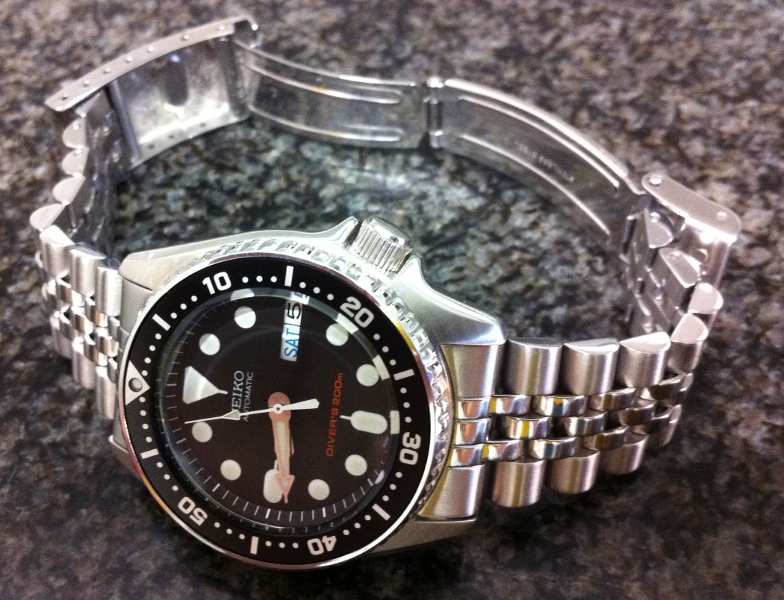
The first-generation Sumo was introduced in 2007 with three references:
| Reference | Dial |
|---|---|
| SBDC001 | Black |
| SBDC003 | Blue |
| SBDC005 | Orange |
These were initially Japan Domestic Market references, with international availability following through grey-market distribution and, later, official export channels.
First-Generation Specifications
| Specification | Value |
|---|---|
| Case diameter | 45mm |
| Case shape | Barrel (broad, wide shoulders) |
| Case thickness | ~13.5mm |
| Water resistance | 200m |
| Crystal | Sapphire (standard from first generation) |
| Movement | Calibre 6R15 (23 jewels, 21,600 vph, 50hr PR , hacking, manual wind) |
The Sumo launched with the 6R15 movement — a meaningful advantage over the concurrent SKX007 and first-generation Monster, which used the 7S26 without hacking or manual winding. The 6R15 offered hacking, hand-winding, and a 50-hour power reserve that gave the Sumo more practical daily usability than the 7S26 references. Combined with the sapphire crystal standard from launch, the Sumo entered the market as a meaningfully more capable watch than its price point might have suggested.
The barrel case shape is the Sumo's defining characteristic. The case widens from the lug attachment points outward, creating a shouldered profile that is immediately recognisable on a table or at a glance. The stepped bezel sits lower than on more conventional dive watch designs, contributing to the watch's broad, planted visual weight. The "Sumo" nickname captures this exactly — the watch is wide, solid, and immovable-looking.
Photo: inside_loop — CC BY-SA 3.0 — Wikimedia Commons
Movement Upgrade — Calibre 6R35
Photo: Les Zetlein — Public Domain — Wikimedia Commons
The most significant specification upgrade in the Sumo's history was the transition from the 6R15 (50-hour power reserve) to the 6R35 (70-hour power reserve). This upgrade, applied across the modern Sumo range, delivered a 40% improvement in running time between windings — allowing a fully wound Sumo to run from Friday evening through the weekend and into Monday without requiring winding or daily wear to maintain power.
| Calibre | Jewels | Frequency | Power Reserve | Hacking | Manual Wind |
|---|---|---|---|---|---|
| 6R15 | 23 | 21,600 vph | 50 hours | Yes | Yes |
| 6R35 | 24 | 21,600 vph | 70 hours | Yes | Yes |
The 6R35 also uses Seiko's SPRON alloy mainspring, developed for its resistance to fatigue and elasticity degradation over time. The sapphire crystal remained standard throughout.
Current Generation — SBDC081 and SBDC083
Photo: Olgierd Rudak — CC BY-SA 4.0 — Wikimedia Commons
The current primary Sumo references are:
| Reference | Dial |
|---|---|
| SBDC081 | Green |
| SBDC083 | Black |
These represent the Sumo at its most refined: Calibre 6R35 (70-hour power reserve), sapphire crystal, 200m water resistance, and the barrel case design that has defined the family since 2007. The green dial SBDC081 became one of the most discussed Seiko references of the 2020s, as collector interest in green dials across the broader watch market found a natural expression in a watch that had always handled colour dial variants well.
The SBDC series positioning — primarily JDM with international availability through authorised dealers and grey-market sources — keeps the Sumo in a slightly different commercial tier from the internationally widely distributed SRPD and SRPE references. This positioning reflects the Sumo's status as a more focused collector's choice within the Prospex range.
The Sumo in the Prospex Hierarchy
Photo: Ferengi — CC BY-SA 3.0 — Wikimedia Commons
The Sumo occupies a specific position within Seiko's dive watch range — above the Monster and Turtle (which use the 4R36 at 41-hour power reserve) and below the Marinemaster professional line. The 6R35 movement and standard sapphire crystal justify a higher retail position, while the 45mm barrel case and maximum 200m water resistance place it in the same general category as the other named Prospex divers.
Within the collector community, the Sumo is valued for the 6R15/6R35 movement quality and the immediacy of its case design. It is a watch where the visual identity and the movement specification are equally strong selling points — unusual for a watch at this price level, where typically one is compromised in favour of the other.
Frequently Asked Questions
Why is it called the Sumo?
Community nickname derived from the barrel-shaped case's broad, wide-shouldered, planted visual presence — evoking the physical character of sumo wrestling. Seiko does not use the name in official marketing.
What is the difference between the Sumo's first generation and current generation?
Movement upgrade from Calibre 6R15 (50-hour power reserve) to 6R35 (70-hour power reserve). Both generations carry sapphire crystal as standard and 200m water resistance. Case shape and diameter (45mm) are unchanged.
Is the Sumo a JDM watch?
The SBDC references are Japan Domestic Market designations, but the Sumo has been available internationally through authorised dealers and grey-market channels throughout its production life. It is not exclusively Japan-only in practice.
What movement does the Seiko Sumo use?
Current generation: Calibre 6R35 — 24 jewels, 21,600 vph, 70-hour power reserve, hacking, and manual winding. Earlier generations used the 6R15 (50-hour power reserve).