Glashütte Original Perpetual Calendar: Saxon Accuracy Across Four Years
The perpetual calendar is the complication that most clearly demonstrates a watchmaker's mastery of mechanical programming. A watch that can track the irregular Gregorian calendar — February's 28 or 29 days, the mixed 30- and 31-day months — without manual correction is exhibiting a form of encoded intelligence: information about the calendar embedded permanently in the geometry of mechanical components. Glashütte Original's perpetual calendar watches, produced under the Senator name, represent the Saxon manufacture's contribution to this tradition.
The Perpetual Calendar Mechanism
Photo: Rama — CC BY-SA 2.0 FR — Wikimedia Commons
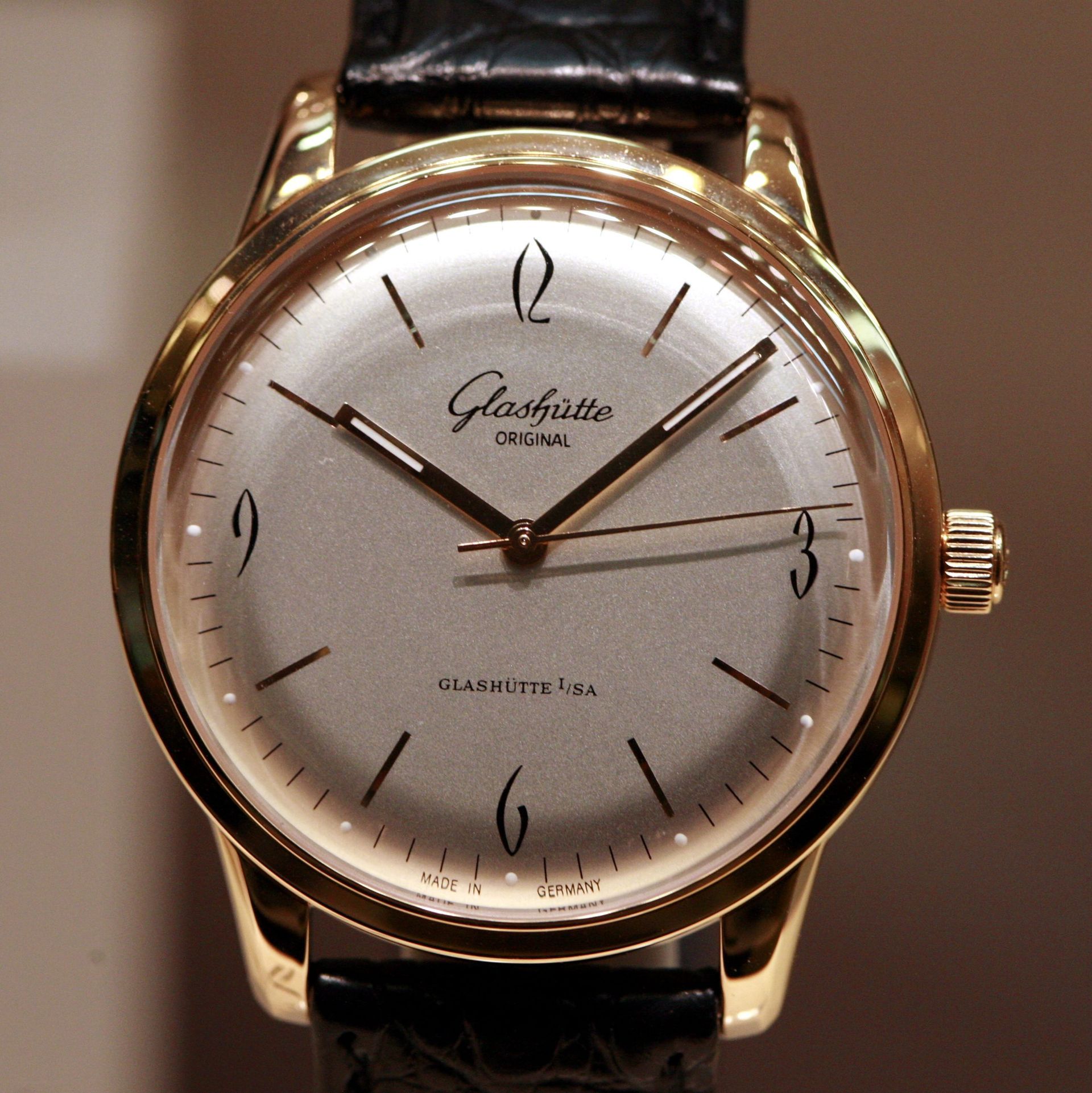
A perpetual calendar automatically displays the correct date for every month of the Gregorian calendar. The mechanism encodes the calendar's irregular structure in a four-year cam — a disc that makes one complete revolution per leap year cycle (1,461 days), with a shaped outer profile that drives date transitions at each month end.
The profile of the cam determines how many date positions to skip at each month transition:
- 30-day months: advance 1 position (from 30 to 1)
- February, non-leap year: advance 3 positions (from 28 to 1)
- February, leap year: advance 2 positions (from 29 to 1)
- 31-day months: no skip needed (31 to 1 is a standard advance)
The encoding is entirely mechanical — no electronics, no battery. The four-year cam is shaped once at manufacture and maintains its accuracy indefinitely as long as the watch continues running.
The 2100 exception: The Gregorian calendar's century-end rule holds that years divisible by 100 are not leap years unless also divisible by 400. Thus 2100 will not be a leap year, but the perpetual calendar's four-year cam assumes it will be. A single manual correction will be required on March 1, 2100.
Senator Perpetual Calendar — Architecture
Photo: Rama — CC BY-SA 2.0 FR — Wikimedia Commons
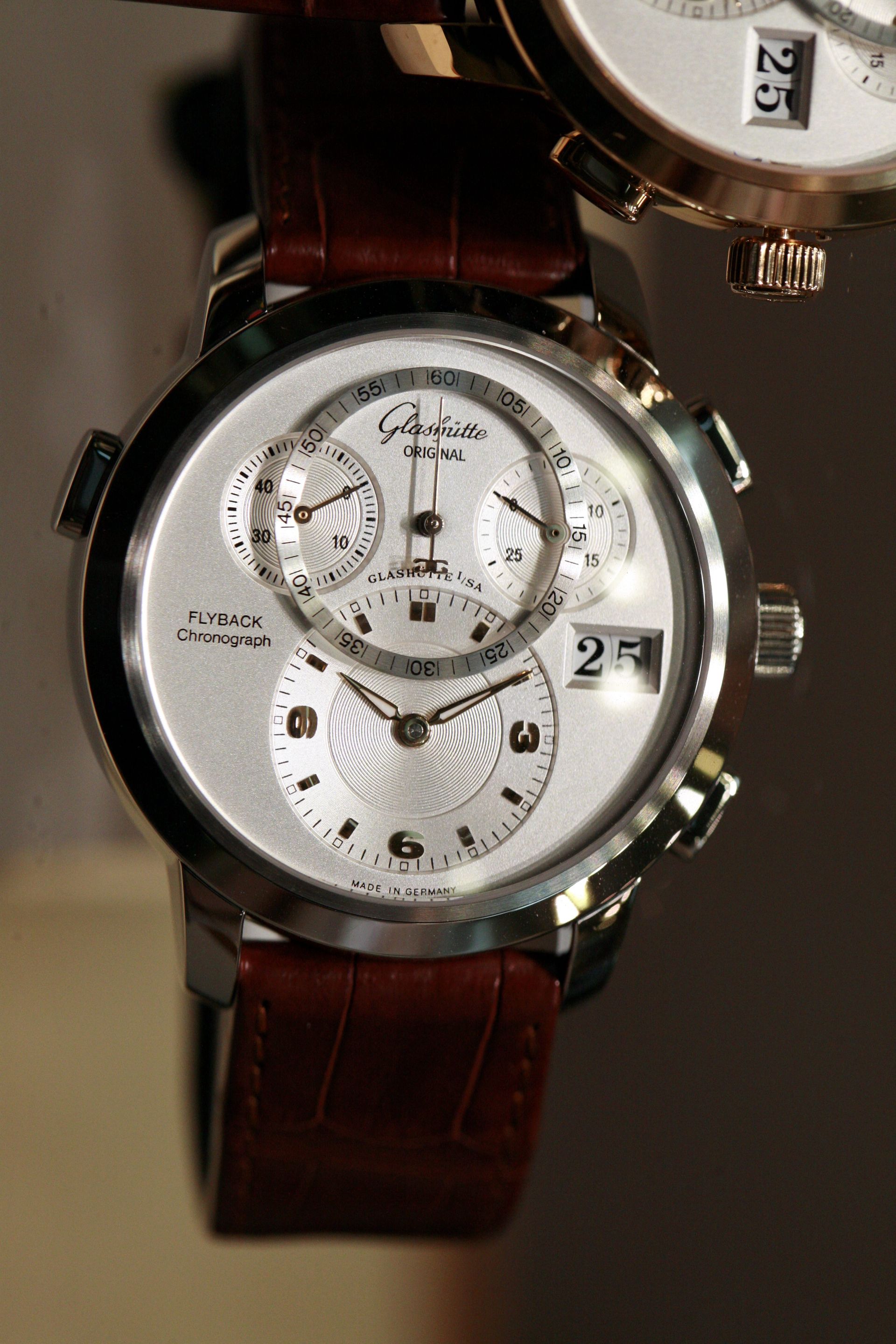
Glashütte Original's approach to the perpetual calendar mechanism is to integrate the four-year cam within the base movement rather than applying it as a separate stacked module above the going train.
The integrated approach has several advantages:
- Lower total movement height (no stack of modules above the base calibre)
- More reliable interaction between the calendar and going train (fewer intermediate transmission points)
- Better long-term regulation stability (fewer surfaces subject to wear)
The disadvantage: it requires designing the base calibre with the perpetual calendar in mind from the beginning, rather than adapting an existing calibre with an add-on module. This is a higher initial development cost but produces a better mechanical result.
Calibre 65-02 — The Senator Perpetual Calendar Movement
Photo: Rama — CC BY-SA 2.0 FR — Wikimedia Commons
| Specification | Detail |
|---|---|
| Calibre | 65-02 |
| Power reserve | 55 hours |
| Frequency | 28,800 vph |
| Complications | Perpetual calendar, moonphase |
| Displays | Day, date, month, year, moonphase |
| Finishing | Three-quarter plate, Glashütte ribbing |
The day, date, month, and year displays are presented through four apertures in the dial — a clean, read-at-a-glance layout that avoids the complexity of a retrograde display while providing complete calendar information.
The moonphase is driven by a 59-tooth lunar wheel that advances once per day, completing one revolution in 29.5 days — representing one lunar cycle. The accuracy: one 29.5-day correction required approximately every 122 years.
Senator Perpetual Calendar on the Caseback
Photo: Ferengi — CC BY-SA 3.0 — Wikimedia Commons
The exhibition caseback of the Senator Perpetual Calendar reveals the three-quarter plate in its full articulation — the large plate spanning most of the movement, the Glashütte ribbing across its surface, blued screws, and the intricate perpetual calendar mechanism visible through apertures in the plate.
Observing the calendar mechanism through the caseback provides a mechanical education: the four-year cam rotates with imperceptible slowness during ordinary timekeeping, but at month transitions — particularly at February end in non-leap years — its shaped profile drives the date disc through a three-position advance in a single snap. The speed of this correction (less than one second for a transition that may have been building for 28 days) is a characteristic of the perpetual calendar mechanism.
Annual Calendar — The Intermediate Option
Photo: Thomasbj — CC BY-SA 3.0 — Wikimedia Commons
Glashütte Original also produces watches with an annual calendar — a mechanism that accounts for all month lengths except February, requiring a single manual correction once per year (at the end of February). The annual calendar is simpler to manufacture than a perpetual calendar but more useful than a simple date, which requires correction at the end of every short month.
The Senator Annual Calendar provides this intermediate solution, paired with the Panorama Date for exceptional legibility. Priced below the perpetual calendar, it offers a practical calendar complication at a more accessible price point.
Practical Ownership — Setting the Perpetual Calendar
Photo: Thomasbj — CC BY-SA 3.0 — Wikimedia Commons
Setting a perpetual calendar requires care. On Glashütte Original's perpetual calendar references, dedicated corrector pushers advance each display independently: date, day, month, and year each have a separate corrector. Advancing these correctors must be done outside the danger zone — roughly 9 PM to 1 AM local time — when the calendar mechanism is in the process of advancing the date and forced correction can damage the mechanism.
The process of setting from cold (e.g., after a long period in storage): advance all displays to the correct values using the correctors, following the movement instructions. The process takes a few minutes but preserves the mechanism's long-term integrity.