
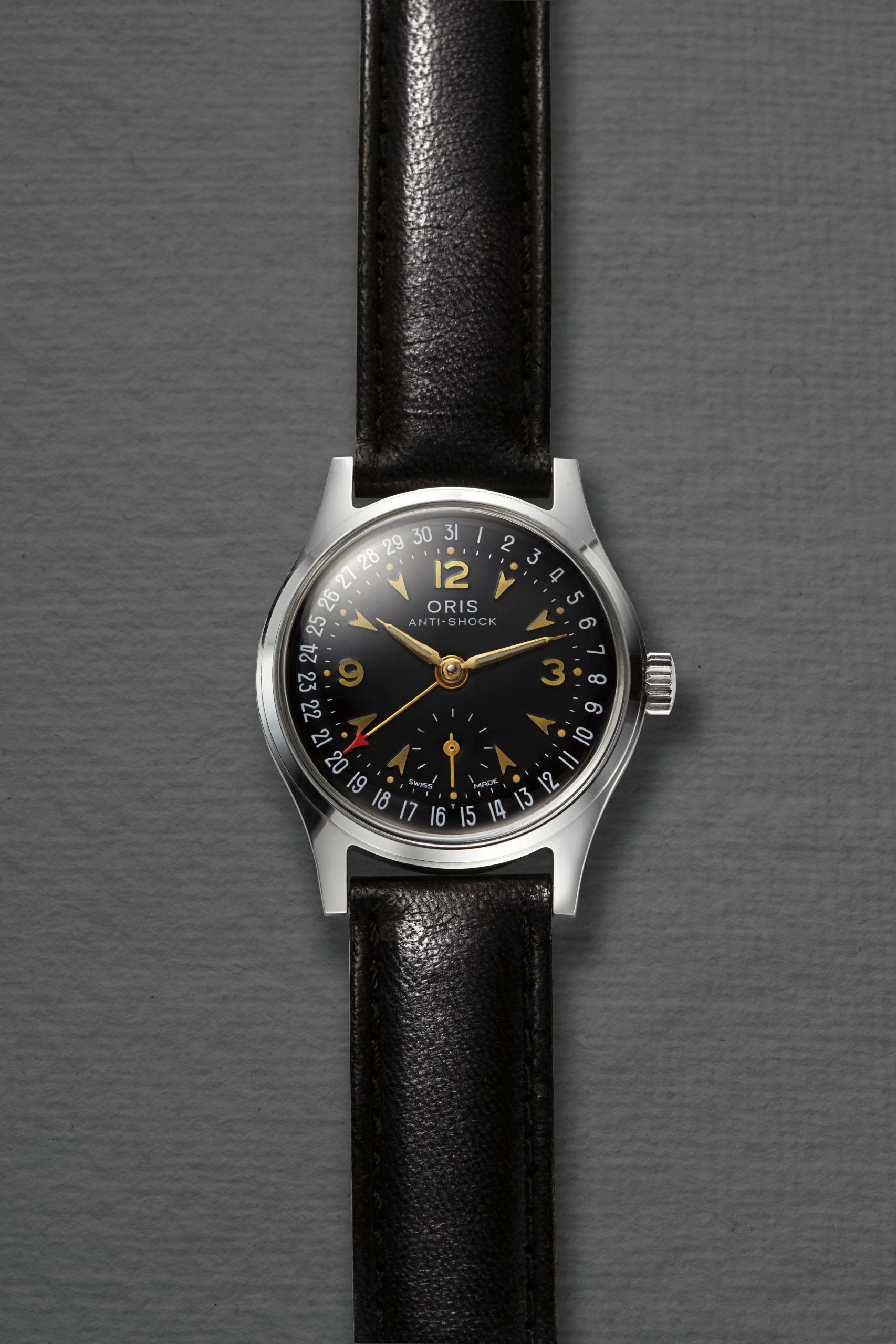
Oris Pointer Date: The Retrograde Date with Colored Hand

Zach Charles • August 4, 2026

Share this article

Oris Pointer Date: The Retrograde Date with Colored Hand

The Pointer Date is Oris's most historically distinctive complication — a retrograde date display in which a coloured hand sweeps across an arc-shaped scale rather than pointing to a number in a window. First seen on Oris pilot watches in the 1940s and revived continuously since, the Pointer Date requires more mechanical complexity than a conventional date mechanism but delivers substantially better readability at a glance.


The Problem with Conventional Dates

Oris Pointer Date 1938 heritage model
Oris Pointer Date 1938 — a heritage model showcasing the retrograde arc date display with colour-coded pointer hand, Oris’s signature complication since the 1940s.
Photo: Oris SA — CC BY-SA 3.0 — Wikimedia Commons

Conventional date displays fall into two principal categories:

Date window (disc): A numbered disc rotates beneath a window cut in the dial, showing the current date through the aperture. Standard since the 1950s. Disadvantages: the window is small, requiring close inspection to read; the disc must be visible through a limited aperture; at 12 and 13, the digits can be misread; the jump occurs over a short period around midnight.

Date subdial: A small subdial with a hand pointing to a date scale printed around the subdial perimeter. More legible than a window but requires visual focus; the scale is small if the subdial is small.

Both formats share a limitation: you must look closely at a specific small area to read the date. For pilots in flight, or for anyone checking quickly, this is suboptimal.


The Pointer Date Mechanism

Oris Artelier Calibre 111 with 10-day power reserve
Oris Artelier Calibre 111 — featuring the proprietary Calibre 111 movement with 10-day power reserve and left-hand crown, from the Artelier dress watch collection.
Photo: Oris SA — CC BY-SA 3.0 — Wikimedia Commons

The Oris Pointer Date solves the readability problem through scale expansion and colour coding :

A long retrograde hand (typically matching the length of the minute hand) sweeps across a scale that occupies roughly half the dial circumference — an arc printed at the dial's outer ring, typically running from 7 o'clock to 5 o'clock through the 12 position. This arc scale is dramatically larger than any date window or subdial, and the long hand pointer allows reading from any angle and distance.

Colour coding adds a second layer of information: the pointer hand is split into two colours — typically red for the first half of the month (days 1–15) and black for the second half (days 16–31), or vice versa. This allows the wearer to determine not only the specific date but its approximate position in the month with a single glance — even before reading the number precisely.

The retrograde mechanism: Unlike a standard date that advances continuously in one direction, a retrograde mechanism advances the pointer from 1 to 31 and then snaps back instantly to 1 at month end. This requires a cam profile on the date wheel and a spring-loaded lever that follows the cam. At the snap-back point, the cam profile drops suddenly, releasing the spring and driving the pointer back in an instant.


1940s Origins on Pilot Watches

Oris ProDiver Chronograph titanium dive watch
Oris ProDiver Chronograph — a 1000-metre water-resistant automatic dive-chronograph in titanium, representing Oris’s technical dive watch capability.
Photo: Johntorcasio — CC BY-SA 3.0 — Wikimedia Commons

The Pointer Date appeared on Oris pilot watches in the 1940s — the same era as the Big Crown, and for the same practical reason: legibility under operational conditions. A pilot checking elapsed time in flight needs to read the date quickly, without sustained focus on the instrument.

The enlarged arc scale and colour-coded hand addressed this directly. The early versions used a three-part colour system — red for early month, black for mid-month, returning to red near month end — allowing rough position in the month to be assessed from the colour alone.

The 1940s Oris pilot references with Pointer Date typically had black dials, white Arabic numerals, a large red hand with a coloured tip, and the arc scale printed in white against the black dial. The aesthetic was unambiguously functional.


Calibre 754 and the Modern Mechanism

Oris Aquis Depth Gauge dive watch white dial
Oris Aquis Depth Gauge — featuring the capillary depth gauge system built into the crystal, reading depth via direct water pressure without electronics.
Photo: Olaf Köster / Oris SA — CC BY-SA 3.0 DE — Wikimedia Commons

The movement most commonly used in contemporary Oris Pointer Date watches is the Calibre 754 — an Oris-modified Sellita SW220-1 base with the Pointer Date module. The module adds approximately 1.5mm to the movement height.

The mechanism within Cal. 754: The date wheel carries a heart-shaped or kidney-shaped cam profile. A lever follower rests on the cam's outer surface. As the date wheel rotates (one revolution per 31 days), the lever follows the cam profile, driving the retrograde hand from 1 to 31. At day 31 (or at the snap-back position), the cam profile drops to its lowest point, the lever spring drives the follower inward, and the pointer snaps to 1.

For months with fewer than 31 days (28, 29, 30), the wearer must manually advance the date — a minor inconvenience that the Pointer Date shares with all simple calendar mechanisms.


Pointer Date in the Current Collection

Oris Divers Sixty-Five reissue
Oris Divers Sixty-Five (Ref. 01 733 7707 4064) — the 2015 reissue of Oris’s original 1965 diver, with Calibre 733 automatic.
Photo: Wiki Peter Jan — CC BY-SA 4.0 — Wikimedia Commons
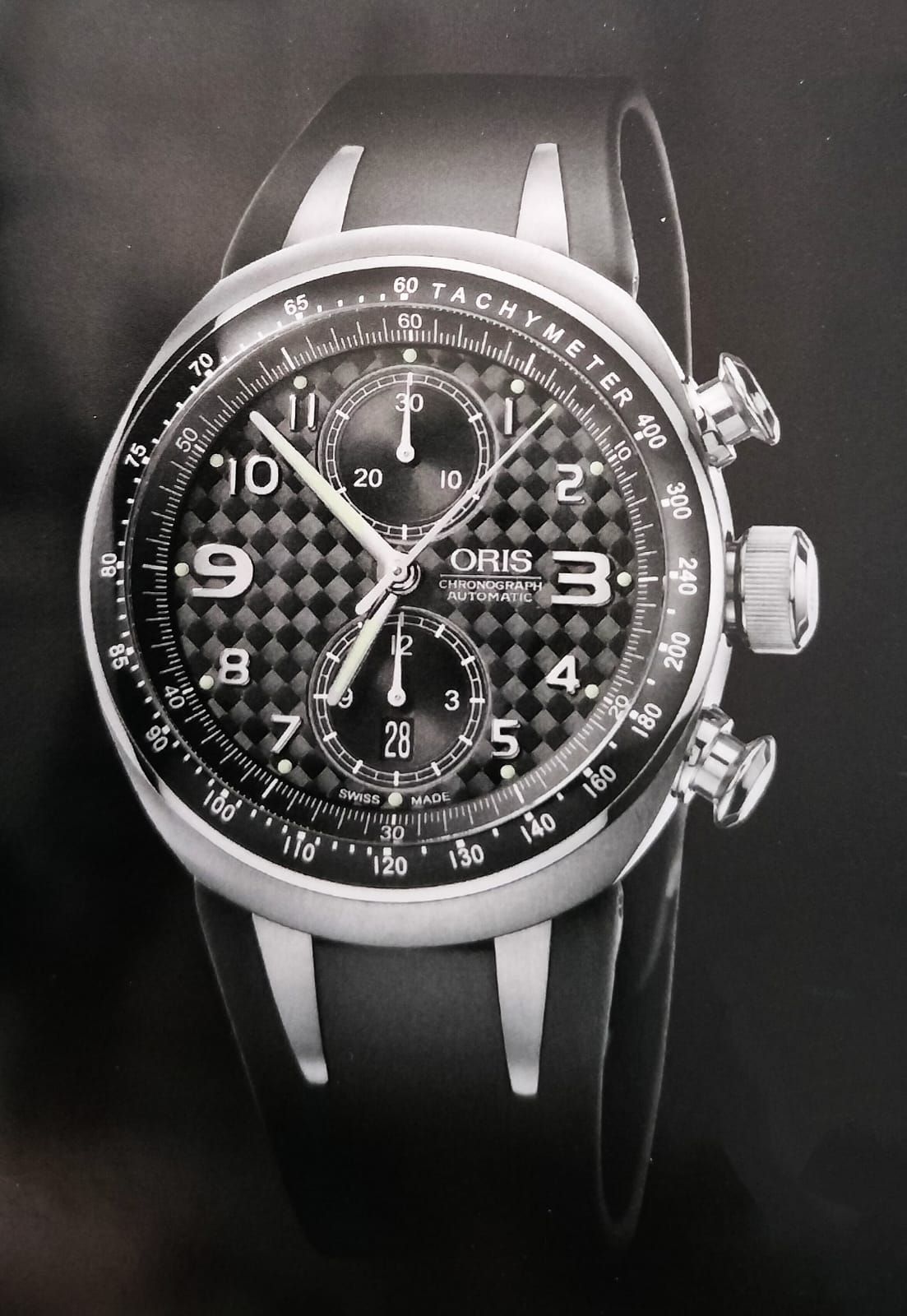
The Pointer Date appears on three current Oris collection families:

Big Crown Pointer Date — The primary Pointer Date reference. 40mm steel case, Cal. 754, red and black pointer hand. The most direct continuation of the 1940s pilot watch tradition.

Big Crown Original — Manual-wind version with Pointer Date, 40mm.

ProPilot Calibre 111 — Oris's proprietary long-power-reserve movement for the ProPilot incorporates a Pointer Date function with the 9 o'clock crown layout.

Artelier Pointer Date — In the dress watch context, the Pointer Date takes on a different character: the arc scale and coloured hand become a design element rather than purely functional, adding visual complexity to an otherwise simple dial.


Cultural Significance for Oris

Oris Williams TT3 Formula 1 collaboration watch
Oris Williams TT3 — a Formula 1 collaboration piece with the Williams F1 team, illustrating Oris’s motorsport partnership history.
Photo: Clyde94 — CC BY-SA 4.0 — Wikimedia Commons

The Pointer Date is the one complication that belongs uniquely to Oris in the way that, say, the Reverso belongs uniquely to Jaeger-LeCoultre or the jumping hour belongs to certain watchmakers. No other major production brand has maintained a retrograde arc date with a coloured hand as a continuous signature for eight decades.

This continuity gives Oris a genuinely distinctive complication heritage — not a tourbillon, not a perpetual calendar, but a practical, readable retrograde mechanism with a coloured hand that pilots could actually use. The Pointer Date is an argument for the idea that functionality and identity can be the same thing.


Recent Posts

By Zach Charles • October 10, 2026
Hamilton's American Classic Cushion Mechanical revives its 1926 Art Deco cushion watches, seen in Oppenheimer, in 30mm and 34mm with the new hand-wound…
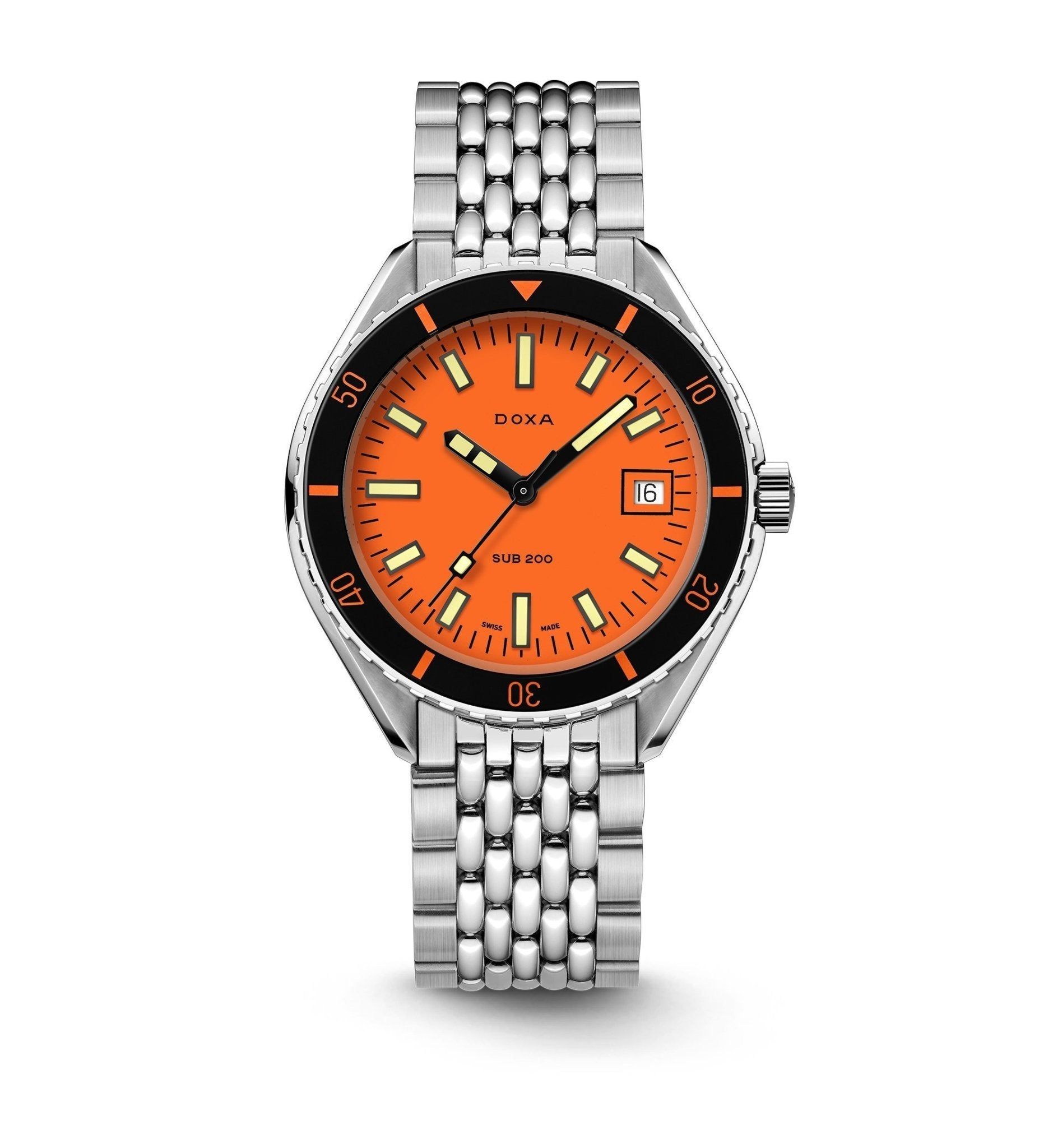
Doxa SUB 200: The Accessible Everyday Diver
By Zach Charles • October 10, 2026
Complete guide to the Doxa SUB 200 — 42mm, 200m, four colorways, Sellita SW200-1. The accessible entry to the Doxa SUB family with the full…

By Zach Charles • October 10, 2026
The Breitling Top Time B01 Aston Martin DB5 pairs a cushion-shaped 41mm case, a wooden inner ring and the in-house Caliber 01 across three limited…
By Zach Charles • October 10, 2026
TAG Heuer developed the Mikrograph (2011, 1/100th second), Mikrotimer Flying 1000 (2011, 1/1000th second), and Mikrogirder (2012, 1/2000th second).

Doxa SUB 1500T: The 1,500-Metre Depth-Rating Flagship
By Zach Charles • October 10, 2026
Complete guide to the Doxa SUB 1500T — 45mm, 1,500m depth rating, helium escape valve, ETA 2892-2 movement, USD 2,690.

Audemars Piguet Royal Oak 'Jumbo' ref. 15202 with blue tapisserie dial and integrated steel bracelet
By Zach Charles • October 10, 2026
The Audemars Piguet × Swatch Royal Pop is a $400 bioceramic pocket watch in 8 colourways, powered by a new hand-wound SISTEM51 with 90+ hour power…

Time on the Move logo
By Zach Charles • October 10, 2026
Zach Charles is the editor of Time on the Move, an independent watch reference covering brand and model histories, buying guides and release news…

Omega Speedmaster Professional 'Moonwatch' chronograph, front view on steel bracelet
By Zach Charles • October 9, 2026
Find the best watches at every price point from $500 to $15,000 — new and pre-owned. Covers every budget tier with specific reference picks, brand…
By Zach Charles • October 9, 2026
The latest watch news: new releases, Watches and Wonders coverage, discontinuations, industry analysis, and market trends. Currently 1 article.

Seiko's New Panda Chronograph Is Literally a Panda: The Power Design Project HHK001 and HHK002
By Zach Charles • October 8, 2026
Seiko's Power Design Project panda chronograph (HHK001, HHK002) turns the panda dial into an actual panda face, with ear pushers, a 'Sasameter' and a 3D…
Show More