Cartier Baignoire: History of the Oval Jewellery Watch
Cartier Baignoire: History of the Oval Masterpiece
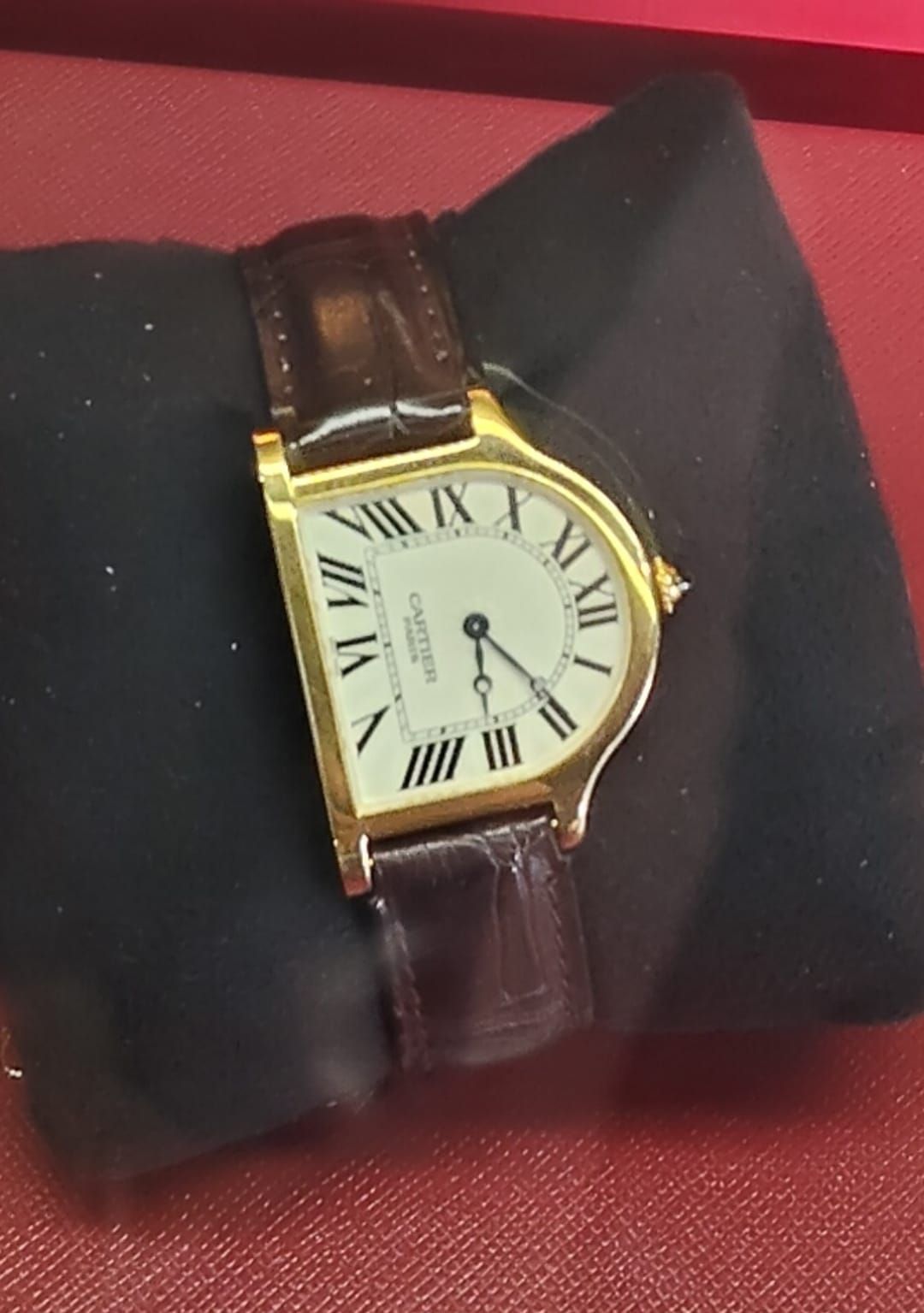
The Cartier Baignoire is named for the French word for a bathtub — a name that captures both the shape of the case (oval, curved, following the contours of the wrist) and Cartier's characteristically precise wit in its product naming. It is among the most formally elegant watches ever made by any manufacturer, an oval case that sits on the wrist with a naturalness that no round or rectangular case can quite match, and one of the purest expressions of Cartier's jewellery intelligence applied to watchmaking.
The Baignoire's origin traces to Louis Cartier's early experiments with non-circular case forms in the years after 1904. While the Santos established the square case and the Tortue established the cushion form, the oval case was always part of Cartier's vocabulary — a natural extension of the jewellery tradition in which oval and elliptical forms have been used since antiquity. The Baignoire reached its most refined commercial expression in the 1950s and 1960s, and the "Baignoire Allongée" — the elongated variant with a dramatically stretched oval — is one of the most glamorous dress watches ever produced.
Photo: EMore98 — CC BY-SA 4.0 — Wikimedia Commons
Origins — The Oval Form (1906–1950s)
Photo: EMore98 — CC BY-SA 4.0 — Wikimedia Commons
Louis Cartier produced oval-cased watches from approximately 1906 onward, though the specific name "Baignoire" and the formalised design identity associated with it came later. These early oval watches were characterised by the same design vocabulary that defined all of Louis Cartier's work: Roman numerals, fine dial execution, case shapes derived from the jewellery tradition rather than the watchmaking tradition.
The connection between the oval watch case and Cartier's jewellery is direct and intentional. Cartier's brooch and pendant designs of the same period were full of oval and elliptical forms — the oval cabochon, the elliptical brooch, the egg-shaped pendant gem. Translating these into a watch case was not a stretch but a natural extension of the design vocabulary the house had already developed. Where other watchmakers derived their case shapes from clocks and pocket watches (round, rectangular), Cartier derived them from jewellery.
The formalised Baignoire as a distinct product line emerged in the 1950s, when Cartier began producing the oval case in a commercially consistent form: a defined case shape, a specific dial layout, a range of sizes oriented primarily at women's watches. This is the period from which most collectible vintage Baignoires come.
The Baignoire Allongée
Photo: EMore98 — CC BY-SA 4.0 — Wikimedia Commons
The Baignoire Allongée — "elongated bathtub" — is the most dramatic expression of the Baignoire design concept and one of the most unusual watch shapes in the Cartier catalogue. Where the standard Baignoire is a relatively conventional oval, the Allongée extends the vertical axis dramatically, producing a case that is much taller than it is wide — closer to an oblong than to an oval, with an elongation that is immediately striking on the wrist.
The Allongée is typically offered in yellow gold or white gold, with a matching bracelet or a leather strap. The dial, constrained by the narrow case width, is laid out with exceptional precision: the Roman numerals must be sized and spaced to be legible within a very restricted horizontal space, which requires the kind of dial design intelligence that distinguishes serious watchmaking from assembled components.
The Baignoire Allongée is the case shape that gave rise to the Crash. The story that a client's Allongée was distorted in a car fire, and that the distorted case inspired the Crash's design, is disputed but plausible — the Allongée's already-elongated form lends itself to further distortion in a way that a round or square case would not.
Baignoire as Jewellery Watch
Photo: EMore98 — CC BY-SA 4.0 — Wikimedia Commons
The contemporary Baignoire occupies a position in the Cartier catalogue that is explicitly at the jewellery end of the watch spectrum. Current references are offered in yellow gold, white gold, and rose gold, with diamond-set bezels as the primary decoration. The movements are predominantly quartz — the case dimensions of the Baignoire do not easily accommodate a mechanical calibre of useful size — and the design treatment is frankly jewellery-first.
This positioning is appropriate and honest. The Baignoire buyer is not looking for a mechanical complication or a robust sports watch; she is looking for a beautiful object to wear on her wrist that happens to tell the time. The Baignoire serves this purpose exceptionally well: the oval case in yellow gold with a diamond bezel, on a silk strap, is as beautiful as any bracelet in the Cartier range and more functional.
The Baignoire Allongée continues in limited production as one of Cartier's most prestigious references, offered in the highest quality materials with the most refined finishing. A diamond-set Allongée in white gold represents Cartier at its most jewellery-focused: a watch that is really a piece of high jewellery, created by people who understand both disciplines equally.
Collecting Vintage Baignoires
Photo: EMore98 — CC BY-SA 4.0 — Wikimedia Commons
Vintage Baignoires — particularly the Allongée and the oval Baignoire in yellow gold from the 1950s–1970s — are among the most undervalued collectibles in the Cartier range. Their oval format means they don't fit neatly into the "dress watch" or "sports watch" categories that dominate collector discourse, and their explicitly feminine orientation has historically limited their collector base to women and to the small number of male collectors who collect jewellery watches without gender anxiety.
This is changing. As the watch collector demographic has broadened and as the jewellery watch category has gained prestige (driven partly by the Panthère's revival), vintage Baignoires in good condition are attracting more attention. Oval Baignoires in yellow gold from the 1950s–1960s typically sell for $3,000–$8,000 in good condition; Allongée examples in white gold with original dials command $8,000–$25,000 depending on the level of diamond setting and the condition of the original dial.
Frequently Asked Questions
Why is it called the Baignoire?
"Baignoire" means bathtub in French. The name references the oval, curved case shape, which Louis Cartier reportedly felt resembled the elongated oval form of a period bathtub. The name was applied to the formalised commercial product in the 1950s, though oval Cartier watches had been made since approximately 1906.
What is the Baignoire Allongée?
The Allongée ("elongated") is a dramatically extended version of the Baignoire's oval case, stretched vertically to produce an oblong shape. It is one of the most unusual and elegant case shapes in the Cartier catalogue, produced primarily in precious metals with diamond setting, and is the case form that is often cited in the origin story of the Crash.
Is the Baignoire still made?
Yes. The Baignoire is a current production model, offered primarily in precious metals with quartz movements. The Allongée continues as a high jewellery reference in limited production.