Cartier Tortue: History of the Barrel-Case Watch
Cartier Tortue: History of the Cushion Case Classic
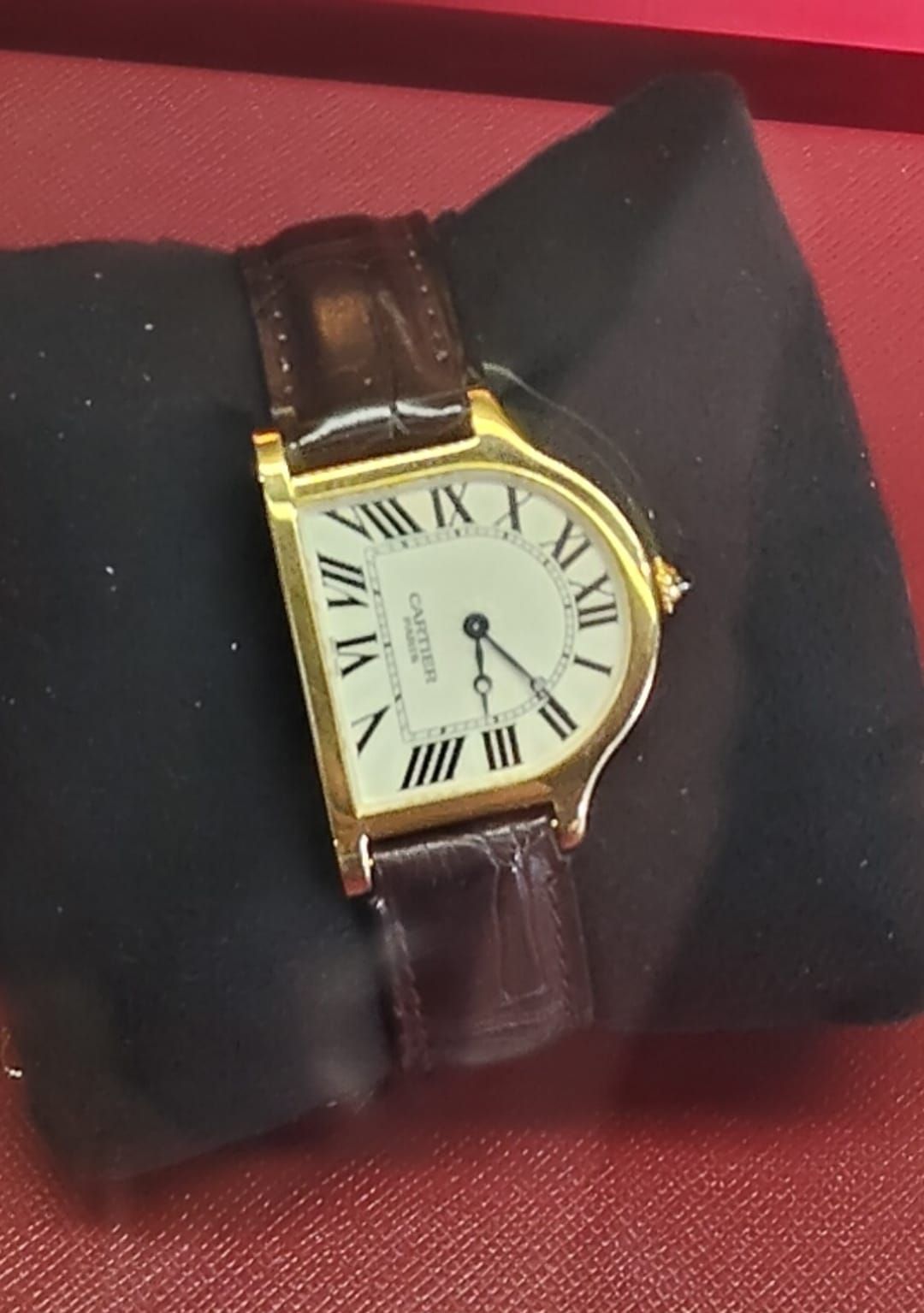
The Cartier Tortue — "tortoise" in French — is one of the oldest watch designs in continuous heritage, a cushion-shaped case first produced in 1912 that predates virtually every other watch case shape in current production. Its form is immediately legible: a square softened at every corner to generous curves, producing a shape that is neither round nor rectangular but something older and more organic — a shape found in nature, in furniture, in architectural ornament from the baroque period through Art Deco.
The Tortue arrived eight years after the Santos and five years before the Tank, during the period when Louis Cartier was systematically exploring what a watch case could be. The Santos had established the square; the Tortue established the cushion. Both forms fed directly into the Tank's rectangle and the Baignoire's oval, forming the vocabulary that has defined Cartier's design language for over a century.
The Tortue today occupies a rarefied position in the Cartier catalogue: it is among the least commercially prominent of Cartier's historic designs, offered primarily as a vehicle for the house's most ambitious complications, and it represents Cartier at its most historically conscious and most watchmaking-serious.
Photo: EMore98 — CC BY-SA 4.0 — Wikimedia Commons
Design Origins (1912)
Photo: EMore98 — CC BY-SA 4.0 — Wikimedia Commons
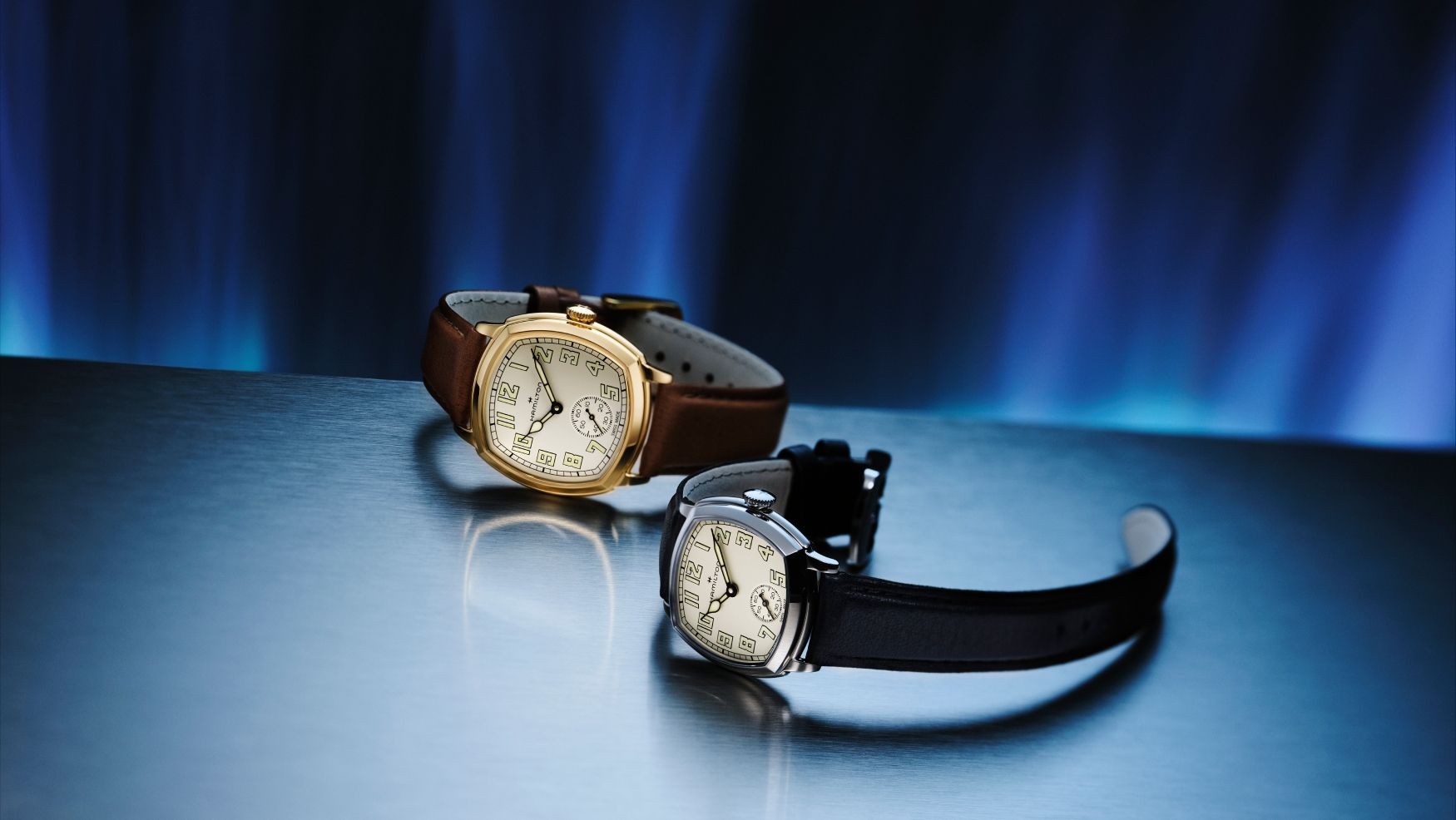
Louis Cartier designed the Tortue in 1912, extending the formal experiments that had begun with the Santos. The cushion shape — a square with curved sides and rounded corners — appears throughout the applied arts history that surrounded Louis Cartier: cushion-shaped clasps in Renaissance jewellery, cushion-cut gemstones (at the time the dominant cut for diamonds and coloured stones), cushion-shaped furniture details in the French decorative arts tradition that Cartier's aesthetic drew from.
The name "Tortue" — tortoise — refers to the shape's resemblance to a tortoise shell viewed from above: the gentle arch of the back, the rounded form without sharp edges, the quality of being simultaneously structured and organic. It is one of Cartier's more poetic product names, in the company of the Baignoire (bathtub) and the Tank, all three of which tell the design story in a single word.
Early Tortue references were produced in gold with leather straps and fitted with movements purchased from Swiss ébauche makers. The case finishing — polishing, chamfering, the precise relationship between the curved sides and the rounded corners — was executed to the high standard of Cartier's jewellery production. Each early Tortue is, in this sense, a piece of jewellery as much as a watch.
The Tortue and Fine Watchmaking
Photo: EMore98 — CC BY-SA 4.0 — Wikimedia Commons
The Tortue's most important current role is as the case that Cartier chooses for its most complex horological statements. This is a deliberate positioning: the Tortue's unusual case shape, its historical depth, and its relatively limited commercial profile make it an appropriate vessel for complications that are themselves unusual and limited.
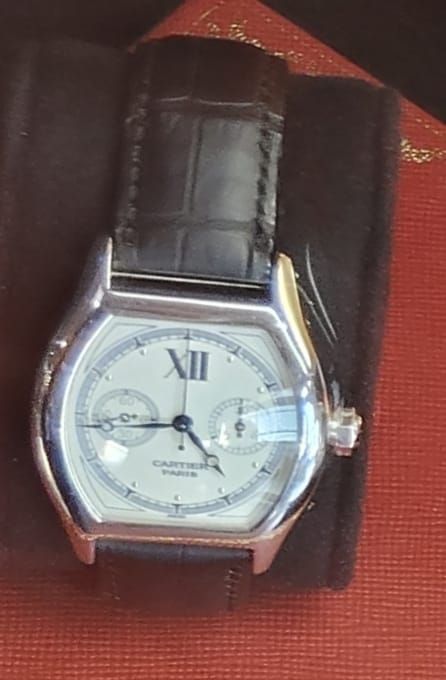
The Tortue Monopoussoir Chronograph — a single-pusher chronograph in yellow gold — is one of Cartier's most classical complications, its single-pusher mechanism a reference to the early-twentieth-century chronograph design that predates the twin-pusher format that became standard after the 1930s. The Tortue case suits the single-pusher format precisely: the additional pusher of a conventional chronograph would disrupt the case's clean architecture; the single crown-integrated pusher of the Monopoussoir is barely visible.
The Tortue Perpetual Calendar places a full perpetual calendar — displaying day, date, month, and year with automatic correction for different month lengths — in the Tortue case. This is among Cartier's most technically ambitious pieces, and its presence in the Tortue case (rather than the more commercially prominent Tank or Santos) signals that the Tortue occupies a position at the apex of the collection: the case for when the complication matters more than the commercial identity.
The Rotonde de Cartier Astrotourbillon — while not technically in a Tortue case — shares the Tortue's philosophy of placing technical achievement in a form-conscious case that prioritises the watchmaking over the brand communication.
Cushion Case Tradition
Photo: EMore98 — CC BY-SA 4.0 — Wikimedia Commons
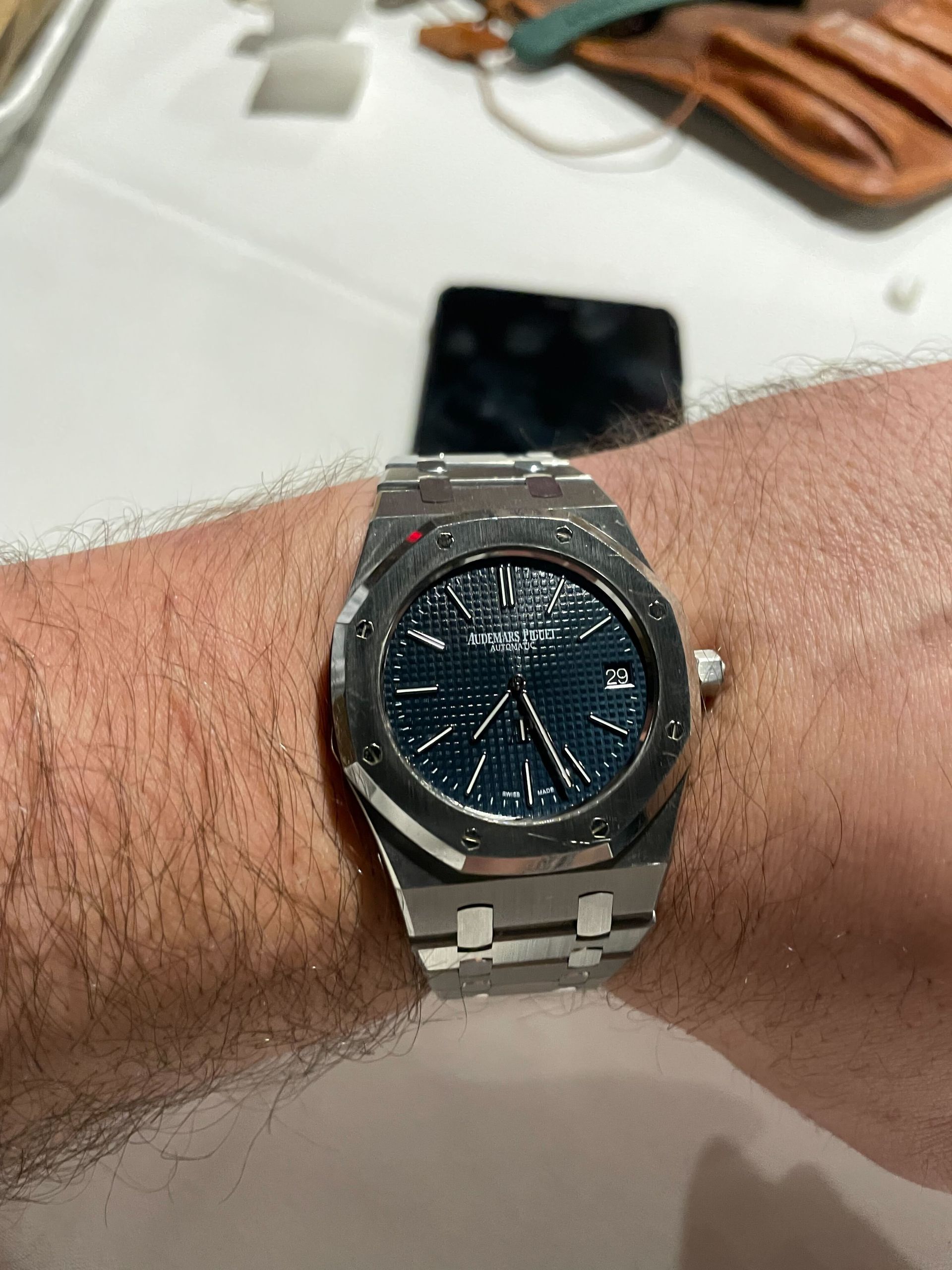
The Tortue is the origin point for the cushion-case tradition in watchmaking, a tradition that has produced some of the most significant watches of the past fifty years. When Audemars Piguet launched the Royal Oak in 1972, its cushion case drew on the same formal vocabulary that the Tortue had established six decades earlier. When IWC produced its Ingenieur references in cushion cases, when Vacheron Constantin created the Overseas, when Patek Philippe produced various cushion-cased references — all of these were working within a tradition that the Tortue had been the first to formalise for wristwatch use.
This lineage does not diminish the Royal Oak's achievement or the other designs' originality; a case shape that has been used successfully across many manufacturers over more than a century is one whose formal properties are genuinely strong. The cushion case sits well on the wrist, reads clearly at a glance, and offers design flexibility that the pure circle and the pure rectangle do not. The Tortue deserves credit for being the first serious custodian of that form.
Current Production and Collecting
Photo: EMore98 — CC BY-SA 4.0 — Wikimedia Commons
The Tortue is currently produced in very limited numbers, primarily as a vehicle for complications. This limited production makes new Tortue references genuinely rare: a collector who wants a Tortue Monopoussoir or Perpetual Calendar will typically need to visit a Cartier boutique and discuss availability, rather than finding one on the shelf.
On the secondary market, vintage Tortue references in gold from the 1920s–1950s represent excellent value for collectors interested in early Cartier. These are pieces with genuine historical significance — among the first cushion-case wristwatches ever made — and their price, typically $5,000–$20,000 depending on the reference and condition, is modest relative to their historical importance and relative to comparable vintage Tank or Santos references.
Modern Tortue complications — the Monopoussoir, the Perpetual Calendar — trade at or near their original retail prices on the secondary market, which are themselves substantial: $30,000–$80,000 depending on the specific reference. These are not entry-level pieces but serious watches for serious collectors.
Frequently Asked Questions
Why is it called the Tortue?
"Tortue" means tortoise in French. Louis Cartier named the watch for the resemblance between its cushion-shaped case — a square with curved sides and rounded corners — and the domed, organic form of a tortoise shell. It was designed in 1912 as one of Cartier's early explorations of non-circular, non-rectangular case shapes.
Is the Tortue still made?
Yes, but in very limited numbers. The Tortue is produced primarily as a vehicle for complex complications — the Monopoussoir single-pusher chronograph and the Perpetual Calendar are the key current references. It is not a standard catalogue piece and availability is restricted.
What makes the Tortue historically significant?
The Tortue, designed in 1912, is the original cushion-case wristwatch — the design that established the cushion form for wristwatches before the Royal Oak, the Overseas, or any other significant cushion-case design. It predates all of them by at least half a century and represents Louis Cartier's systematic exploration of what a watch case could be.
Where does the Tortue fit in Cartier's range?
At the top. The Tortue is Cartier's choice of case for its most complex and most historically ambitious pieces. Its relative commercial obscurity, compared to the Tank or Ballon Bleu, is precisely what makes it appropriate for complications that are meant for serious collectors rather than general buyers.