Cartier Santos: History of the First Men’s Wristwatch
Cartier Santos: The Watch That Created the Wristwatch
The Cartier Santos is the oldest continuously produced wristwatch in the world, and the only watch that can legitimately claim to have created the category it occupies. Made by Louis Cartier for his friend Alberto Santos-Dumont in 1904, it was the first wristwatch specifically designed as a functional timekeeping instrument for a man — not a lady's bracelet watch, not a pocket watch on a strap, but a watch conceived from the beginning to be worn on the wrist while performing a demanding practical task.
That task was aviation. Santos-Dumont, the Brazilian-born Parisian who was among the most celebrated men in Europe in the early 1900s, had a practical complaint: when flying his experimental aircraft, he could not check his pocket watch. He needed both hands on the controls; the pocket watch was useless. Louis Cartier's solution — a square-cased watch, worn on the wrist, with a sturdy strap and visible screws on the bezel as structural elements — resolved the problem and, in so doing, established the wristwatch as a serious instrument.
The Santos was placed into commercial production in 1911. It is in production today, essentially unchanged in its fundamental design, making it over 120 years old as a commercial object. No other watch comes close to that record of continuity.
Photo: Pittigrilli — CC BY-SA 4.0 — Wikimedia Commons
Alberto Santos-Dumont — The Man and His Problem
Photo: EMore98 — CC BY-SA 4.0 — Wikimedia Commons
Alberto Santos-Dumont (1873–1932) was one of the most extraordinary figures of the early aviation era. Born into a wealthy Brazilian coffee-plantation family, he moved to Paris in 1891 and became obsessed with flight. By 1901 he had won the Deutsch de la Meurthe Prize for completing a controlled flight around the Eiffel Tower in his airship No. 6 — a feat that made him internationally famous and earned him the prize money of 100,000 francs, which he gave to his mechanics.
Santos-Dumont's friendship with Louis Cartier was one of the natural social connections of Belle Époque Paris: both were prominent figures in the fashionable circles where art, technology, and wealth intersected. The story of the watch's origin — Santos-Dumont's complaint about the impracticality of pocket watches during flight, Cartier's offer to solve the problem — is documented in enough contemporary sources to be considered reliable, though like all origin stories it has acquired romantic embellishment over the century since.
What is certain is that Santos-Dumont wore a wristwatch from approximately 1904, that the watch was made by Cartier, that it had a square case (remarkable in an era when all watches were round), and that it incorporated visible screws on the bezel as part of its design vocabulary. Whether those screws were purely decorative or served a genuine structural function has been debated, but their presence on the original watch and their reproduction on every Santos since is the most immediately recognisable feature of the design.
The 1904 Design and Its Innovations
Photo: Pittigrilli — CC BY-SA 4.0 — Wikimedia Commons
The original Santos watch was radical in three distinct ways, each of which became influential.
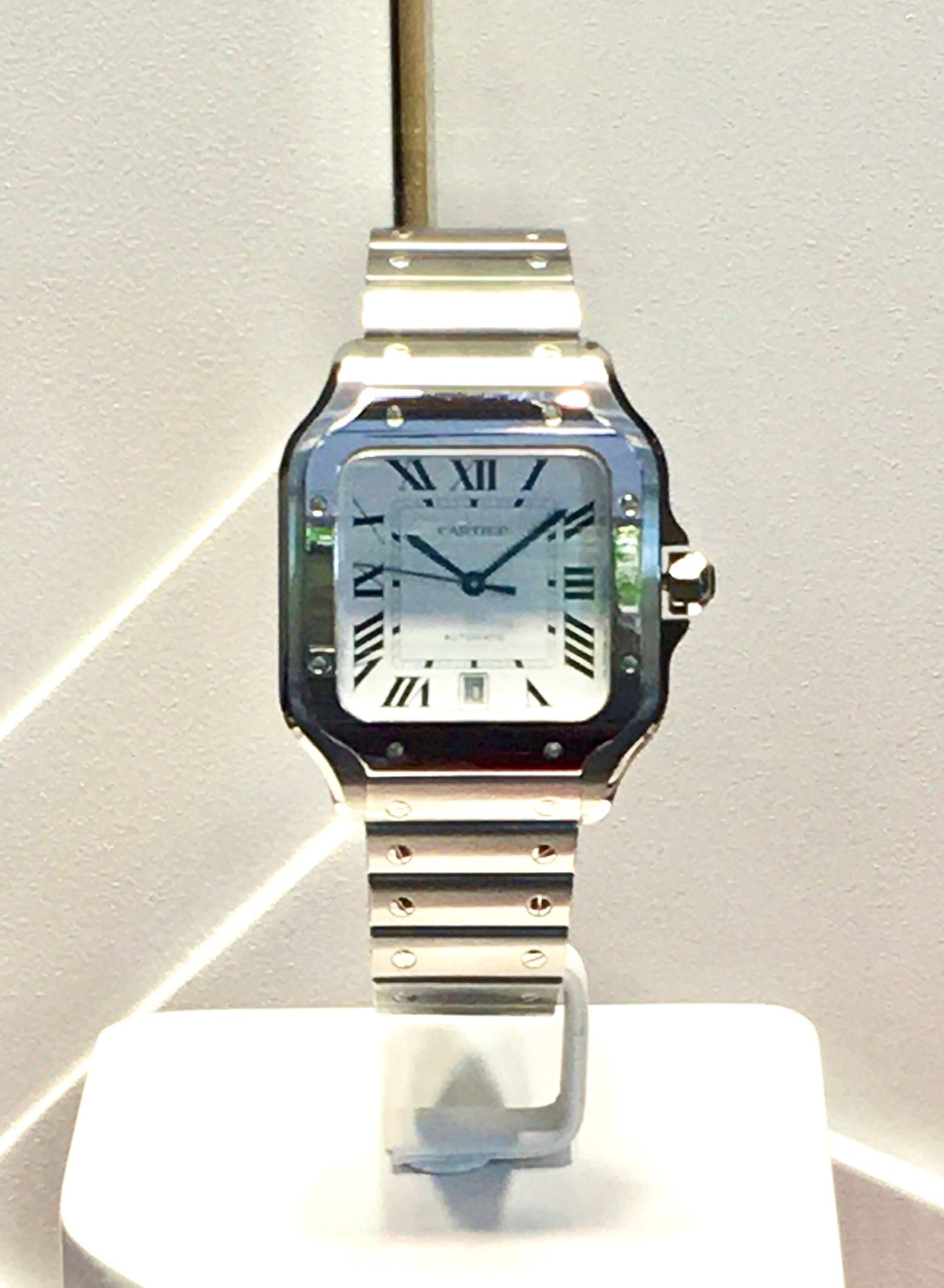
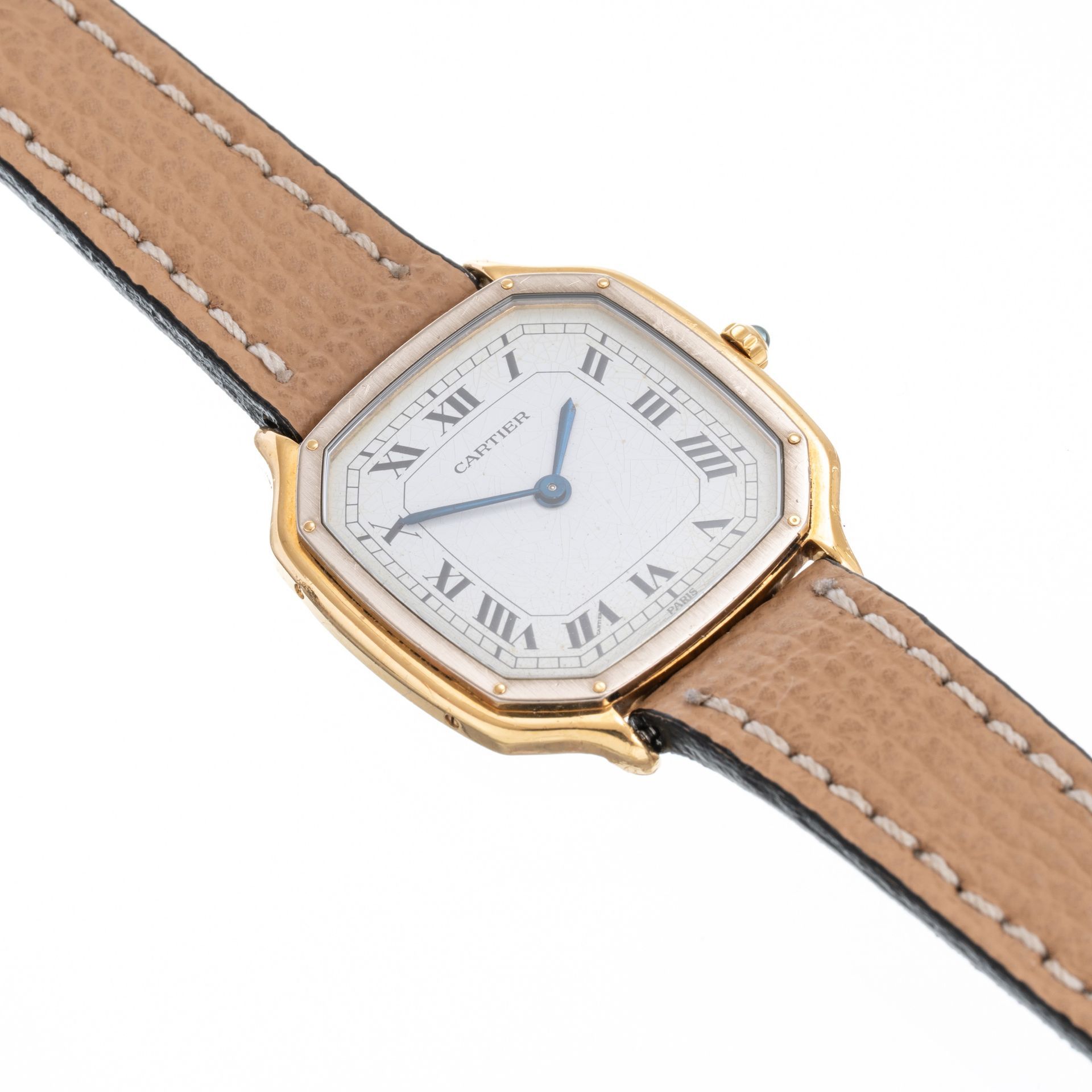
Square case : In 1904, all watches — pocket watches and the few wristwatches that existed — were round. The circle was not merely conventional; it was considered the natural form for a timepiece, derived from the geometry of the sun and the clock face. A square case was architecturally unusual and visually forceful in a way that the circle was not. Louis Cartier chose it because it gave the watch presence and legibility on the wrist, where a round watch might be confused with a bracelet. The square case of the Santos is the origin of Cartier's subsequent design vocabulary of non-circular forms: the Tank's rectangle, the Tortue's cushion, the Baignoire's oval.
Visible screws : The exposed screws on the Santos bezel are functional in the sense that they hold the bezel in place, but they are designed to be seen rather than concealed. In a period when precision watchmaking prided itself on concealing its mechanical means, making the screws visible was an aesthetic statement: the watch is a machine, and its machined character is part of its beauty. This was an anticipation by decades of the "visible construction" aesthetic that would become explicit in the Royal Oak and Nautilus in the 1970s.
Bracelet integration : The first Santos used a leather strap with a gold deployant clasp — a clasp mechanism that had not been used on wristwatches before and that made it significantly easier to put on and take off a watch one-handed. The deployant clasp is now standard across high watchmaking; in 1904 it was a Santos innovation.
Commercial Launch (1911) and Early Success
Photo: EMore98 — CC BY-SA 4.0 — Wikimedia Commons
The Santos was placed into commercial production in 1911, seven years after the prototype was made for Santos-Dumont. This seven-year gap is significant: Cartier was establishing a commercial wristwatch category that did not yet exist for men. The public had to be persuaded, and the Santos's association with Santos-Dumont's celebrity was the primary persuasive tool.
It worked. Within a few years of the 1911 launch, the Santos had established that men's wristwatches were viable and desirable, and other watchmakers began producing their own. The First World War (1914–1918) completed the transformation: soldiers and officers found pocket watches impossible in the trenches and adopted the wristwatch universally. By 1920 the wristwatch had replaced the pocket watch as the dominant form for men's timekeeping, and the Santos's 1911 commercial launch had been the tipping point.
The early Santos models were available in yellow gold with a yellow gold deployant-clasp bracelet, or with a leather strap. The case proportions were smaller than contemporary references — men's watches of the period ran to approximately 25–30mm, which seems small by modern standards but was appropriate for the era's suit-and-waistcoat dress conventions.
The Santos Dumont and Santos de Cartier
Photo: Pittigrilli — CC BY-SA 4.0 — Wikimedia Commons
The contemporary Santos family divides into two distinct lines that serve different purposes and markets.
Santos-Dumont : The Santos-Dumont is the closest modern equivalent to the 1904 original — slim, elegant, with a relatively flat profile and a leather strap. It uses ultra-thin quartz or mechanical movements (the Cal. 430 MC, one of the thinnest Cartier calibres) to achieve a case height typically under 7mm. The Santos-Dumont is explicitly a dress watch, designed to slide under a shirt cuff without creating a bump, and its proportions — approximately 27–34mm in the available sizes — are deliberately classical.
Santos de Cartier : The Santos de Cartier is the larger, more modern interpretation — available in steel and gold, with the QuickSwitch interchangeable strap/bracelet system, and a choice of medium (35.1mm) or large (39.8mm) sizes. The Cal. 1847 MC automatic powers the key references. The Santos de Cartier is the "wear everywhere" version: substantial enough to be visible at a business meeting, versatile enough in its strap options to function as a casual weekend watch.
The QuickSwitch system, introduced in 2018, is a genuine functional innovation: the strap and bracelet can be exchanged without tools in approximately five seconds, using a pusher concealed in the lug. This solves the perennial Cartier Santos problem — the beautiful steel bracelet versus the beautiful leather strap — by making the choice a matter of thirty seconds rather of a trip to the boutique.
Santos vs. Rolex Explorer / Submariner
Photo: EMore98 — CC BY-SA 4.0 — Wikimedia Commons
The Santos occupies an unusual competitive position: it is simultaneously a dress watch (in the Santos-Dumont configuration) and a sport-adjacent watch (in the Santos de Cartier configuration), which means it competes with different references depending on which version is being considered.
For the Santos de Cartier in steel, the natural comparison is with the Rolex Explorer or, at a stretch, the stainless steel Submariner. The Explorer is a cleaner, more austere design; its secondary market performance is stronger, and its value proposition for buyers concerned with resale is considerably more favourable. The Santos de Cartier, by contrast, offers a more distinctive design, a more capable interchangeable strap system, and a Cartier design heritage that the Explorer does not have. The Santos de Cartier in steel retails at approximately $6,900–$8,500; the Explorer at $7,650 at retail and frequently above on the secondary market.
The comparison is not meaningless but it is not quite fair: the Explorer buyer and the Santos buyer are usually motivated by different things. The Explorer buyer values a coherent sport watch identity with strong secondary market support; the Santos buyer values design originality and the historical significance of wearing the world's first men's wristwatch.
Santos-Dumont's Later Life
Alberto Santos-Dumont's later story is both inspiring and melancholy, and it is inseparable from the watch named for him. His aviation achievements continued after 1904 — his 14-bis aircraft made the first public powered aeroplane flight in Europe in 1906, predating the Wright Brothers' public demonstrations in Europe by two years. He became the most celebrated man in France.
But Santos-Dumont developed multiple sclerosis in 1910 and spent his later years watching aviation be turned into a military technology. When, in 1932, he saw Brazilian military aircraft bombing civilian targets during a revolt in São Paulo, he reportedly said that aviation had been "turned into an instrument of war." He died by suicide in a hotel room in Guarujá, Brazil, a few hours later. He was 59 years old.
The watch that bears his name continued in production through all of this and has outlasted him by nearly a century. It is perhaps the most poignant object in watch history: a revolutionary instrument named for a revolutionary man, both of whom changed the world in ways they could not entirely control.
Frequently Asked Questions
Who was the Santos watch made for?
The Santos was made for Alberto Santos-Dumont (1873–1932), the Brazilian-French aviation pioneer who was among the most celebrated men in Belle Époque Paris. He asked his friend Louis Cartier to design a watch he could read while flying, without taking his hands off the controls.
Is the Santos the first wristwatch ever made?
The Santos (1904/1911) is the first purpose-designed men's wristwatch — the first watch designed from the beginning as a practical instrument to be worn on a man's wrist. Earlier wristwatches existed as ladies' jewellery items (bracelets with small watch movements incorporated), but they were not designed for precision timekeeping or for practical use in demanding situations.
What are the visible screws on the Santos bezel?
The exposed screws on the bezel are structural — they hold the bezel to the case — but are designed to be visible as part of the aesthetic. Their presence references the watch's mechanical character and its origins in aviation technology. They are the Santos's most immediately recognisable design feature and have appeared on every Santos since the 1904 original.
What is the Santos QuickSwitch system?
Introduced in 2018, QuickSwitch allows the strap and bracelet of the Santos de Cartier to be exchanged without tools in approximately five seconds, using a concealed pusher in the lug. A steel bracelet and leather strap are included with the watch, and additional strap options are available separately.