Cartier Panthère: History of the Integrated Bracelet Watch
Cartier Panthère: History of the Art Deco Jewellery Watch
The Panthère de Cartier is a watch that refuses to choose between jewellery and timekeeping. Launched in 1983, it combines a square case set into an ultra-supple interlocking link bracelet — the "Panthère" bracelet, inspired by the spotted coat of a panther — with movements serious enough to carry Cartier's reputation. It is simultaneously the most jewellery-like watch Cartier makes and a genuinely functional timepiece, and the tension between those two identities is precisely what makes it interesting.
Few watches have had a commercial trajectory as dramatic as the Panthère's. Launched during the golden decade of yellow gold jewellery watches, it became one of Cartier's most successful models of the 1980s and 1990s, then effectively disappeared from the catalogue when sports watches and steel dominated the early 2000s, then returned in 2017 to find a market that had been waiting for it. The revival was not nostalgic marketing but a genuine recalibration: a younger generation drawn to the 1980s aesthetic, to yellow gold, and to jewellery watches with genuine brand provenance found in the Panthère exactly what they wanted.
Understanding the Panthère means understanding Cartier's longest-running design motif — the panther — and the woman most responsible for it.
Photo: Gisling — CC BY-SA 3.0 — Wikimedia Commons
The Panther Motif in Cartier's History
Photo: Gisling — CC BY-SA 3.0 — Wikimedia Commons
The panther entered Cartier's vocabulary in 1914, when the house created an onyx and diamond brooch for the Duchess of Windsor in the form of a reclining panther. The execution — black onyx for the spots, white diamonds for the body, emeralds for the eyes — was a technical and artistic achievement that established the panther as a Cartier signature. What cemented it as a permanent identity was the relationship between Cartier and Jeanne Toussaint.
Jeanne Toussaint (1887–1978) joined Cartier in 1918 and became director of fine jewellery in 1933, a position she held for decades. She was known internally as "La Panthère" — a nickname given to her by Louis Cartier that referred both to her animal-like grace and to her affinity for the panther motif. Under Toussaint's direction, the panther became Cartier's most elaborate recurring subject: three-dimensional panther brooches crouching on gem-set spheres, panther bangles, panther bracelets in yellow gold and onyx. The Duchess of Windsor commissioned an entire suite of panther jewellery that remains among the most extraordinary objects in Cartier's history.
By the time the Panthère watch was launched in 1983, the panther had been associated with Cartier for nearly seven decades. Naming the watch for it was not a casual branding decision but an acknowledgement that this was the continuation of the house's most personal artistic tradition.
Launch and Design (1983)
Photo: Gisling — CC BY-SA 3.0 — Wikimedia Commons
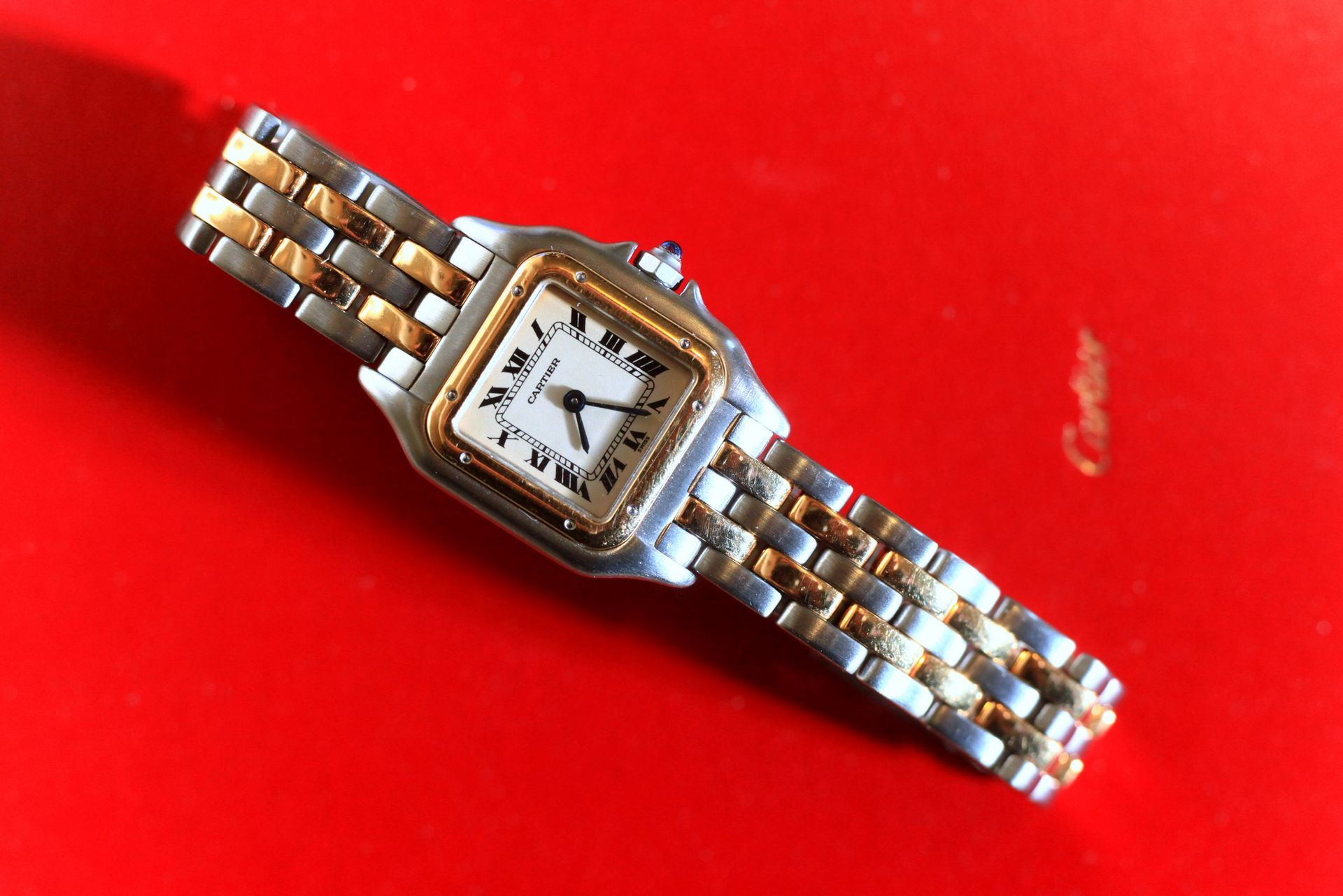
The Panthère de Cartier debuted in 1983 as a square-cased watch set into a bracelet of interlocking gold links unlike anything else in production at the time. The links — small squares connected by oval rings in a precise pattern — created a bracelet of extraordinary suppleness, flowing over the wrist rather than sitting rigidly against it. The overall effect was of movement and life, the links catching the light differently as the wrist turned, like the shifting spots of a panther's coat.
The case itself is a squared form, slightly arched in section to follow the wrist's curve, with rounded corners that soften the geometry. The dial is typically white or cream, with Roman numerals — always Roman on a Cartier — and the blue Breguet-style sword hands that are the house's aesthetic signature. The crown is set with a blue cabochon sapphire, the "secret signature" that appears on Cartier's finest models. The overall effect is of enormous refinement achieved through very simple means.
The initial launch offered the Panthère in yellow gold only, in a range of sizes — extra small, small, medium, and large — a decision that was sophisticated for 1983. By offering multiple sizes for the same design, Cartier acknowledged that the Panthère would be worn by different people in different contexts, from an XS worn as a delicate bracelet watch to an LG that made a genuine statement. Yellow gold dominated the early production; white gold and rose gold variants came later, as did steel options that significantly broadened the accessible price range.
The Panthère Bracelet — An Engineering Achievement
Photo: Gisling — CC BY-SA 3.0 — Wikimedia Commons
The Panthère bracelet is not merely decorative. It is one of the most technically demanding watch bracelets in continuous production, and its creation requires a level of craftsmanship that takes Cartier's artisans years to master.
Each link in the Panthère bracelet must interlock precisely with its neighbours. The interlocking is not mechanical in the sense of a hinge; it is geometric — each square link sits within its neighbours at an exact angle, held in position by the oval connectors that run through them. The result is a bracelet with no obvious hinge points but enormous flexibility in every direction, which is what creates the "liquid" quality of the drape over the wrist. Achieve this over hundreds of links to a single tolerance and the bracelet works perfectly. Deviate from it and the bracelet either binds or rattles.
The integration between bracelet and case is equally demanding. There are no traditional lugs on the Panthère; the bracelet connects directly to the case architecture. The case and bracelet are designed as a single object, which is why the Panthère looks so coherent — because it is. Modern versions of the Panthère include a length adjustment system that allows the bracelet to be sized precisely without the need for link removal, an engineering refinement that makes daily wear more comfortable while maintaining the visual integrity of the design.
Off-Market and Revival (1998–2017)
Photo: EMore98 — CC BY-SA 4.0 — Wikimedia Commons
The Panthère's disappearance from Cartier's catalogue in the late 1990s was a casualty of fashion rather than design failure. The early 2000s were hostile territory for yellow gold jewellery watches. The sports watch dominated: steel, ceramics, rubber straps, technical complications. The luxury watch market had pivoted decisively toward masculine, activity-oriented designs. A square-cased gold bracelet watch — however beautifully made — was not what the market wanted.
Cartier discontinued the Panthère around 1998–2000. The decision was rational given the commercial environment, but it created an unexpected secondary market. Vintage Panthères in good condition became sought-after precisely because they were no longer being made. A small XS in yellow gold could be found for under $2,000 in the early 2000s; by 2015, as the yellow gold revival gathered momentum and 1980s aesthetics returned to fashion, the same piece was selling for considerably more.
The 2017 relaunch of the Panthère de Cartier was impeccably timed. Yellow gold had been returning to fashion since approximately 2013; the 1980s aesthetic was being celebrated across fashion, film, and music; and a younger luxury consumer demographic — the generation that had grown up with Rihanna and Solange Knowles as style references — was actively seeking luxury objects that expressed femininity through confidence rather than restraint. The Panthère offered exactly this. It was not subtle or modest. It was yellow gold, supple, square, and unmistakably Cartier.
Famous Wearers
Photo: Gisling — CC BY-SA 3.0 — Wikimedia Commons
The Panthère's cultural history is inseparable from the women who wore it during its first era. Diana Ross wore the Panthère throughout the 1980s, as did Grace Jones, whose image — bold, geometric, maximalist — aligned perfectly with the watch's own aesthetic. The Panthère was present at every major moment of 1980s excess and glamour, worn by women who understood that a watch could be jewellery without apology.
The 2017 revival brought a new generation. Rihanna has been photographed wearing the Panthère more than any other single watch in recent years — a positioning that is neither accidental nor merely commercial. She wears it the way Diana Ross wore it: as an object of personal significance, a piece of yellow gold jewellery that happens to tell time. The Panthère also appears regularly on Dua Lipa, Olivia Rodrigo, and Hailey Bieber — a demographic cross-section that suggests the watch has genuinely transcended its era of origin and become a permanent fixture in the luxury watch landscape.
Panthère vs. Rolex Lady-Datejust
The comparison between the Panthère de Cartier and the Rolex Lady-Datejust is the natural one at the luxury women's watch level, and it illuminates both designs clearly.
The Lady-Datejust's advantages are substantial and well-known. Rolex's secondary market for ladies' watches is more liquid than Cartier's; the Lady-Datejust in yellow gold holds its value exceptionally well and frequently trades above retail for desirable dial configurations. The Cyclops lens magnifies the date window meaningfully. The Rolex name carries cultural prestige that no technical specification can replicate. Water resistance is a genuine advantage: the Lady-Datejust is rated to 100 metres versus the Panthère's 30 metres.
The Panthère's advantages are different in character. Its design is more distinctive — no other watch looks like the Panthère bracelet, and the integrated case-bracelet construction is more architecturally coherent than the Datejust's traditional lugs and separate bracelet. Its fashion credibility, driven by the endorsers mentioned above, is arguably stronger at this moment. And in the jewellery watch category specifically — where a watch is chosen as much for its appearance as an object on the wrist as for its timekeeping — the Panthère is simply more jewellery-like.
Price at retail is broadly comparable: the Panthère in steel begins around $5,500 and the Lady-Datejust steel around $7,500, but the Datejust commands a significant secondary market premium while the Panthère typically sells closer to or below its original retail price on the pre-owned market.
Current Lineup (2024)
The contemporary Panthère de Cartier is offered in four sizes — extra small (22mm), small (27mm), medium (30mm), and large (36mm) — in yellow gold, rose gold, white gold, and stainless steel. The size range allows the design to function as a delicate ladies' watch at the XS end and a genuine unisex statement piece at the large size.
Diamond-set options are available at every level: bezel diamonds, bracelet diamonds, full pavé configurations. Movement options are Cal. 157 quartz for most standard models, with some limited editions offering more complex movements. The Panthère is positioned at the core of Cartier's high jewellery watch offer — the piece that most directly expresses what the house means when it describes itself as a jeweller that makes watches.
Frequently Asked Questions
Why is it called the Panthère?
The watch takes its name from Cartier's long-standing panther motif, which traces to Jeanne Toussaint — Cartier's legendary creative director from 1933, nicknamed "La Panthère" by Louis Cartier. The interlocking bracelet links evoke a panther's spotted coat in motion, and the panther has been Cartier's most personal recurring artistic subject since 1914.
Is the Panthère discontinued?
The original Panthère was discontinued around 1998 but relaunched as the Panthère de Cartier in 2017. It is currently one of Cartier's best-selling and most commercially important lines.
What metal is the Panthère made in?
Yellow gold, rose gold, white gold, and stainless steel. Diamond-set versions are available in white gold and yellow gold. The original 1983 Panthère was yellow gold only; the broader metal range was introduced progressively.
Is the Panthère a good investment?
As a pre-owned buy, the Panthère typically trades at or below retail — unlike Rolex, which often commands a premium. For buyers who intend to wear rather than resell, this means the Panthère represents better value than comparable Rolex models. Yellow gold vintage Panthères in good condition have appreciated meaningfully since the 2017 revival.