
Audemars Piguet Grand Complications: History of AP’s Most Complex Watches

Zach Charles • July 13, 2026

Share this article

Audemars Piguet Grand Complications: Minute Repeater Heritage Since 1875

Grand complications — minute repeaters, tourbillons, perpetual calendars, and their combinations — are not achievements that manufacturers achieve once and then catalogue. They are ongoing capabilities: skills that must be maintained in living craftspeople, mechanisms that must continue to be built by hand because they cannot be automated, and standards of acoustic and visual performance that must be re-earned with each piece produced. For Audemars Piguet, grand complications are not a heritage claim. They are a current practice, unbroken since the brand's founding in 1875.

This matters more than it initially appears. Most manufactures that discuss "tradition" are discussing history. AP's grand complication capability is operational today in the same form it was operational in the 1890s: people in the Vallée de Joux, using specialized knowledge accumulated across generations, building mechanisms that can announce the time in sound, track the calendar for four years without correction, and correct for the gravitational errors in a portable timekeeping instrument. The 1899 Grande Complication pocket watch had 1,168 parts and 21 functions. The 2020 Universelle has fewer parts and more sophisticated ones. The knowledge that connects them is direct.


Audemars Piguet ref. 25831 with date, power reserve and tourbillon, 1997
An Audemars Piguet reference 25831 from 1997, combining date, power reserve indicator, and tourbillon complication. AP’s 1986 tourbillon — the first self-winding tourbillon — established the manufacture’s position at the apex of Swiss horology. The automatic tourbillon, previously considered technically contradictory (the oscillating rotor mass working against the tourbillon’s vibration-isolation function), was AP’s most significant achievement of the decade.
Photo: EMore98 — CC BY-SA 4.0 — Wikimedia Commons

What Constitutes a Grand Complication

Audemars Piguet Jules Audemars chronograph, perpetual calendar and minute repeater, skeletonised dial
An Audemars Piguet Jules Audemars combining chronograph, perpetual calendar, and minute repeater complications with a skeletonised dial — a grand complication in the traditional sense. The combination of three major complications (striking, calendar, and time measurement) in a single movement is among the most demanding achievements in mechanical watchmaking, requiring years of development and hand-finishing.
Photo: Clyde94 — CC BY-SA 4.0 — Wikimedia Commons

The term "grand complication" has no universally binding technical definition, but within Swiss watchmaking practice it conventionally refers to a watch that combines at least three of the major complication categories:

Striking work (sonnerie): The watch announces the time in sound — on demand (minute repeater), at intervals (quarter repeater), or continuously (grande sonnerie). The minute repeater is the most demanding: the owner presses a slide that sets the striking train in motion, and the watch sounds hours, quarter hours, and minutes in sequence on two gongs. The execution requires correct calibration of hammer weight, gong tension, spring strength, and the acoustic properties of the case.

Calendar complications: At minimum, a perpetual calendar — a mechanism that tracks month lengths, including February's variation in leap years, over a four-year cycle without manual correction. More demanding: an equation of time display, which models the variation between solar time and mean time across the calendar year.

Astronomical or time-measuring complications: A tourbillon (rotating escapement cage to average positional errors), a chronograph (elapsed time measurement), or other mechanisms that address the watch's fundamental timekeeping or measurement function.

A "Grande Complication" watch typically combines all three: striking mechanism, calendar function, and a tourbillon or chronograph. The manufacture capability required to combine all three in a single movement, at wristwatch scale, defines what AP calls its grand complications heritage.


The 1899 Pocket Watch — The Historical Benchmark

Audemars Piguet ref. 25831 with date, power reserve and tourbillon, 1997
An Audemars Piguet reference 25831 from 1997, combining date, power reserve indicator, and tourbillon complication. AP’s 1986 tourbillon — the first self-winding tourbillon — established the manufacture’s position at the apex of Swiss horology. The automatic tourbillon, previously considered technically contradictory (the oscillating rotor mass working against the tourbillon’s vibration-isolation function), was AP’s most significant achievement of the decade.
Photo: EMore98 — CC BY-SA 4.0 — Wikimedia Commons

In 1899, AP completed a pocket watch commissioned to be the most complicated watch in the world. The specifications were intended as a demonstration of what the Vallée de Joux could achieve, and specifically what AP — then twenty-four years from its founding — could produce:

  • 1,168 components in total
  • 21 functions , including: minute repeater, perpetual calendar, equation of time, split-seconds chronograph, grande sonnerie (striking the hours and quarters continuously), petite sonnerie (striking on demand), tourbillon, sunrise and sunset times for a specific location, moon phase, moon age, and additional astronomical indications
  • The resulting pocket watch was, at its creation, the most complex mechanical watch ever made

It was presented at the Paris Exposition Universelle in 1900, where it won a gold medal. The watch established AP's grand complications reputation at the moment the brand needed an international statement of its capabilities.

The 1899 pocket watch is not an isolated achievement. It represents the synthesis of capabilities AP had been building since 1875 — decade by decade, movement by movement. The 21 functions it housed were not assembled from purchased components; they were built from expertise developed within AP's workshop in Le Brassus.


The Minute Repeater — AP's Most Sustained Achievement

Audemars Piguet Jules Audemars with jumping hours and minute repeater, ref. 26151OR
An Audemars Piguet Jules Audemars with jumping hours and minute repeater, reference 26151OR. The Jules Audemars collection is AP’s formal dress watch family, named for Jules-Louis Audemars himself and dedicated to grand complications in precious metal cases. The minute repeater — which chimes the hours, quarter-hours, and minutes on demand — represents one of the most demanding acoustic complications in watchmaking.
Photo: EMore98 — CC BY-SA 4.0 — Wikimedia Commons

Of all grand complications, the minute repeater is the one that most consistently distinguishes AP's capabilities from those of other manufacturers. The mechanism's requirements are:

Mechanical precision: The striking sequence — hours on the low-pitched gong, quarter hours on both gongs in a two-tone chord, minutes on the high-pitched gong — must be exactly correct. One extra strike, one missed strike, or a stuck mechanism is a catastrophic failure in a watch priced above CHF 200,000. The tolerance for error is zero.

Acoustic performance: The striking mechanism produces sound through the case, which is also a vibration damper. The case material, its thickness, its geometry, and the gong attachment all affect the acoustic output. A minute repeater that functions mechanically but sounds muffled or thin has failed at its primary purpose. Getting the acoustic performance right requires calibration that cannot be specified in a production document — it requires the judgment of a skilled watchmaker who knows what a good minute repeater sounds like.

Scale: A pocket watch minute repeater operates in a volume that is acoustically forgiving. A wristwatch minute repeater must achieve comparable performance in a fraction of the volume and mass. This is not a proportional reduction problem — it is a qualitatively different engineering challenge.

AP has been building minute repeater mechanisms for wristwatches since the early twentieth century. The accumulated experience — in gong tuning, hammer calibration, case resonance, and striking train sequencing — represents a capability that cannot be acquired in a decade or transferred from a pocket watch programme without significant re-engineering.


The Supersonnerie — RD#1

In 2015, AP published the results of its RD#1 research project: a new minute repeater striking mechanism it named the Supersonnerie. The research addressed the acoustic engineering problem directly.

Conventional minute repeaters transmit vibration to the case through the movement plate and case structures — a chain of damping interfaces, each absorbing some fraction of the striking energy. The gong vibrates; the movement plate damps it; the case damps it further; the air transmits whatever remains.

The Supersonnerie introduced a dedicated membrane — a resonating element tuned specifically to transmit the gong's vibration directly to the case exterior with minimal damping loss. The result was a measurable improvement in auditory volume and clarity relative to conventional minute repeater mechanisms of comparable case size. The Supersonnerie received a Swiss patent. Its acoustic performance has been independently evaluated by reviewers who describe it as among the clearest and loudest minute repeater sounds available in a wristwatch.

The Supersonnerie technology was first deployed in the Royal Oak Concept and has since been integrated into references across the portfolio — including the Jules Audemars collection and the Code 11.59 Universelle.


The Tourbillon — Flying and Conventional

Audemars Piguet ref. 25831 with date, power reserve and tourbillon, 1997
An Audemars Piguet reference 25831 from 1997, combining date, power reserve indicator, and tourbillon complication. AP’s 1986 tourbillon — the first self-winding tourbillon — established the manufacture’s position at the apex of Swiss horology. The automatic tourbillon, previously considered technically contradictory (the oscillating rotor mass working against the tourbillon’s vibration-isolation function), was AP’s most significant achievement of the decade.
Photo: EMore98 — CC BY-SA 4.0 — Wikimedia Commons

AP has produced tourbillon wristwatches since the mid-twentieth century, and its flying tourbillon capability — without an upper bridge, cantilevered from a single lower bearing — is one of the brand's most visually recognized achievements.

The flying tourbillon distinction: In a conventional tourbillon, the cage is supported by both an upper bridge and a lower bearing. The upper bridge stabilizes the cage but obstructs the view of the tourbillon's rotation. In a flying tourbillon, the upper bridge is eliminated — the cage is held only by the lower bearing, appears to rotate freely without support, and the full rotation of the escapement and balance wheel assembly is unobstructed. This is more demanding to engineer than the conventional design, as the single bearing carries all loads.

AP's first self-winding tourbillon movement — Calibre 2870 — was produced in 1986, a claimed technical first in wristwatch production. Whether this specific claim is precisely defensible depends on how "self-winding tourbillon" is defined, but the capability has been in continuous development since.

The flying tourbillon is the defining visual element of the Royal Oak Concept, and appears across the portfolio in Jules Audemars, Millenary, and Code 11.59 references.


The Universelle — RD#4

The apex of AP's current grand complications production is the Code 11.59 Universelle, the product of RD#4 research. It combines:

  • The Supersonnerie minute repeater (RD#1)
  • The ultra-thin perpetual calendar (RD#2)
  • The self-winding flying tourbillon (RD#3)

In a single wristwatch movement, this combination requires three major complication systems to coexist without interference — the striking train must not affect the perpetual calendar's cam sequence; the tourbillon must not compromise the self-winding efficiency; the thin architecture required by RD#2 must accommodate the mass and volume requirements of RD#1 and RD#3.

The Universelle is produced in extremely small numbers — dozens of pieces, at prices well above CHF 1,000,000. It is acknowledged across the industry as one of the most technically ambitious wristwatches in current production.


Collector Position

Audemars Piguet Jules Audemars chronograph, perpetual calendar and minute repeater, skeletonised dial
An Audemars Piguet Jules Audemars combining chronograph, perpetual calendar, and minute repeater complications with a skeletonised dial — a grand complication in the traditional sense. The combination of three major complications (striking, calendar, and time measurement) in a single movement is among the most demanding achievements in mechanical watchmaking, requiring years of development and hand-finishing.
Photo: Clyde94 — CC BY-SA 4.0 — Wikimedia Commons
AP grand complications — across collections — occupy the upper tier of the manufacture's pricing structure and the collector market simultaneously. The minute repeater in particular commands prices that reflect both the production cost (extraordinary, given the hand calibration required) and the scarcity (extremely limited annual production).

Why grand complications are rare: A grand complication is not scarce because it has been artificially limited. It is scarce because the people capable of building it are few, the time required is long, and the rejection rate for pieces that do not meet acoustic and functional standards is real. AP rejects minute repeaters that do not sound correct. The cost of that rejection is absorbed by the manufacture; the buyer receives a piece that has been evaluated to a standard that cannot be specified in a table of tolerances.

For collectors who evaluate watches on the basis of manufacture capability — what the brand can actually do, not what it charges or allocates — AP's grand complications represent the clearest evidence of what 150 years of unbroken practice produces.


Frequently Asked Questions

What is a grand complication?
A watch combining at least three major complication categories — typically striking work (minute repeater), calendar function (perpetual calendar), and a timekeeping complication (tourbillon or chronograph). The combination of all three in a wristwatch is the conventional definition of a grand complication and the most demanding test of manufacture capability.

What makes AP's minute repeaters distinctive?
AP has built minute repeater mechanisms continuously since the nineteenth century. The accumulated expertise — in gong tuning, hammer calibration, and case acoustic engineering — is active and operational, not historical. The Supersonnerie (RD#1, 2015) introduced a patented resonating membrane that measurably improved acoustic output relative to conventional striking mechanisms.

What is the Supersonnerie?
AP's patented minute repeater striking mechanism, first deployed in 2015 as RD#1. It uses a dedicated resonating membrane to transmit gong vibration directly to the case exterior, improving volume and clarity compared to conventional mechanisms that rely on the movement plate and case structure for acoustic transmission.

What was the 1899 AP pocket watch?
A 1,168-part, 21-function pocket watch completed by AP and presented at the Paris Exposition Universelle in 1900, where it won a gold medal. At its creation it was the most complicated mechanical watch ever built, and it established AP's grand complications reputation internationally.

What is the Code 11.59 Universelle?
AP's RD#4 research watch, combining the Supersonnerie minute repeater, ultra-thin perpetual calendar, and self-winding flying tourbillon in a single movement housed in the Code 11.59 case. One of the most technically ambitious wristwatches in current production, produced in extremely limited numbers at prices well above CHF 1,000,000.


Related Articles

Recent Posts

By Zach Charles • October 10, 2026
Hamilton's American Classic Cushion Mechanical revives its 1926 Art Deco cushion watches, seen in Oppenheimer, in 30mm and 34mm with the new hand-wound…
Doxa SUB 200: The Accessible Everyday Diver
By Zach Charles • October 10, 2026
Complete guide to the Doxa SUB 200 — 42mm, 200m, four colorways, Sellita SW200-1. The accessible entry to the Doxa SUB family with the full…
By Zach Charles • October 10, 2026
The Breitling Top Time B01 Aston Martin DB5 pairs a cushion-shaped 41mm case, a wooden inner ring and the in-house Caliber 01 across three limited…
By Zach Charles • October 10, 2026
TAG Heuer developed the Mikrograph (2011, 1/100th second), Mikrotimer Flying 1000 (2011, 1/1000th second), and Mikrogirder (2012, 1/2000th second).
Doxa SUB 1500T: The 1,500-Metre Depth-Rating Flagship
By Zach Charles • October 10, 2026
Complete guide to the Doxa SUB 1500T — 45mm, 1,500m depth rating, helium escape valve, ETA 2892-2 movement, USD 2,690.
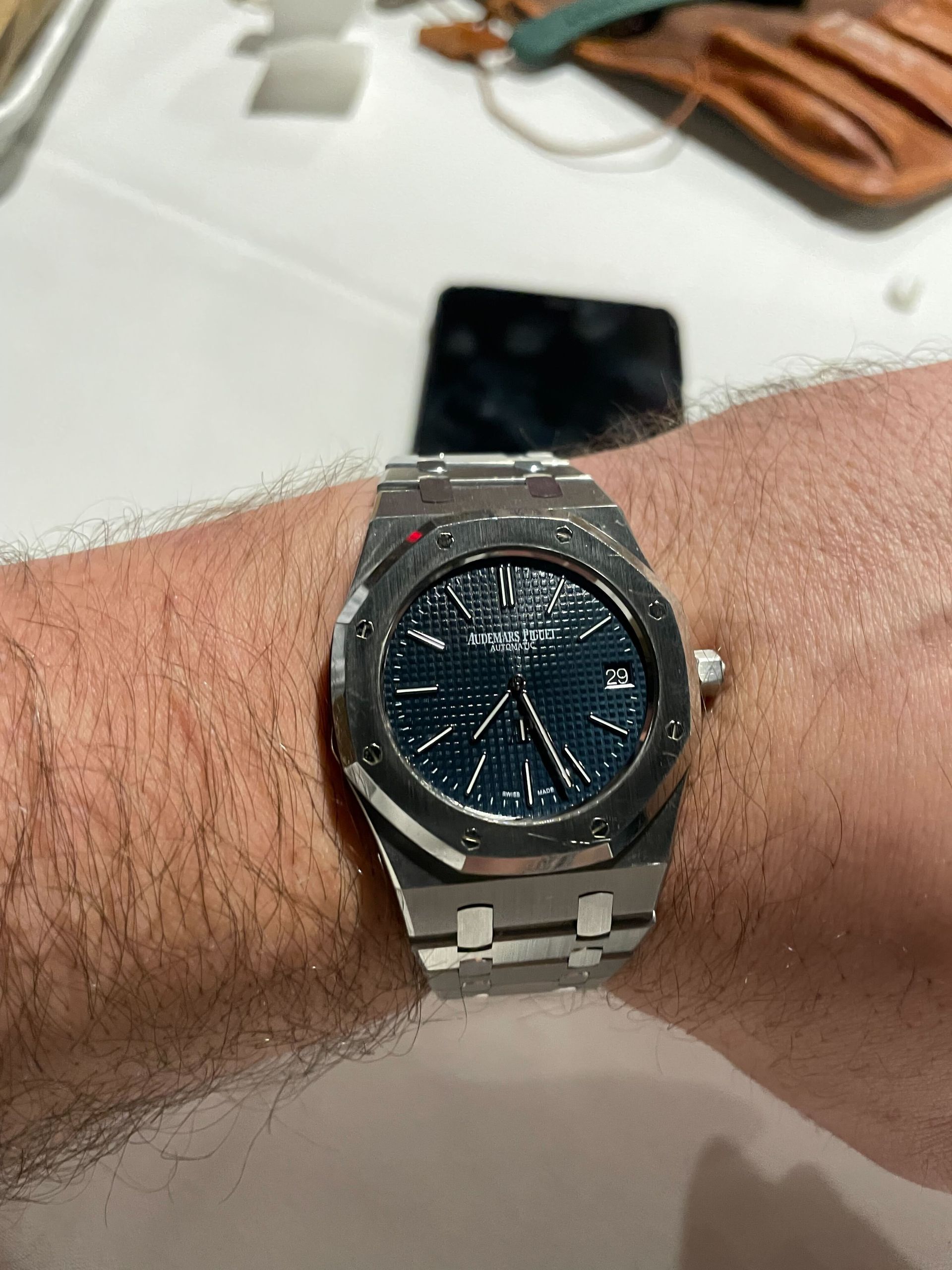
Audemars Piguet Royal Oak 'Jumbo' ref. 15202 with blue tapisserie dial and integrated steel bracelet
By Zach Charles • October 10, 2026
The Audemars Piguet × Swatch Royal Pop is a $400 bioceramic pocket watch in 8 colourways, powered by a new hand-wound SISTEM51 with 90+ hour power…

Time on the Move logo
By Zach Charles • October 10, 2026
Zach Charles is the editor of Time on the Move, an independent watch reference covering brand and model histories, buying guides and release news…
Omega Speedmaster Professional 'Moonwatch' chronograph, front view on steel bracelet
By Zach Charles • October 9, 2026
Find the best watches at every price point from $500 to $15,000 — new and pre-owned. Covers every budget tier with specific reference picks, brand…
By Zach Charles • October 9, 2026
The latest watch news: new releases, Watches and Wonders coverage, discontinuations, industry analysis, and market trends. Currently 1 article.

Seiko's New Panda Chronograph Is Literally a Panda: The Power Design Project HHK001 and HHK002
By Zach Charles • October 8, 2026
Seiko's Power Design Project panda chronograph (HHK001, HHK002) turns the panda dial into an actual panda face, with ear pushers, a 'Sasameter' and a 3D…
Show More