
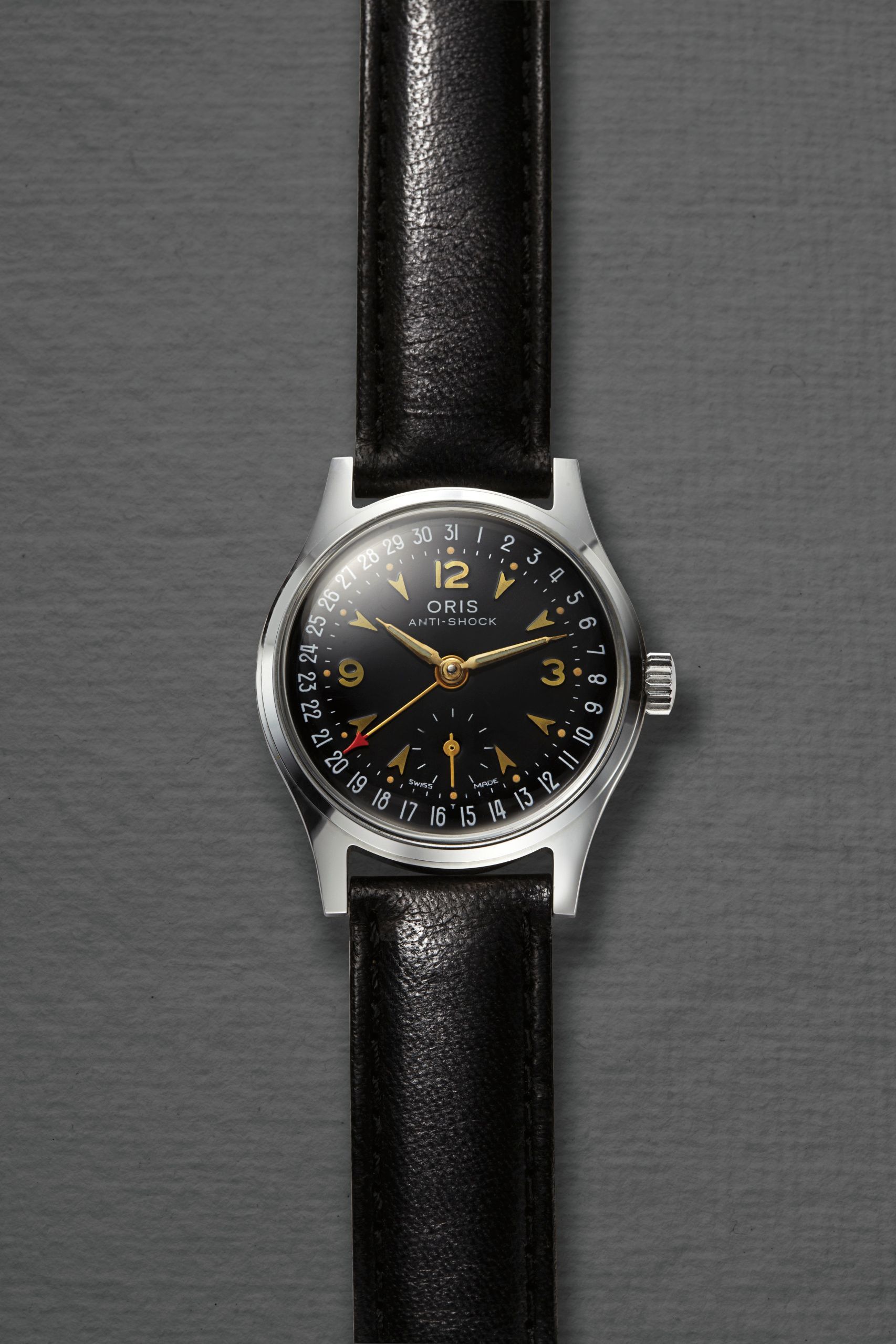
Oris Big Crown: Pilot Watches and the Oversized Crown
The Big Crown name is one of the most literally accurate in watchmaking: it describes a functional feature rather than an invented concept. Oris made pilot watches with genuinely oversized crowns so that gloved aviators could wind and set their watches without removing their gloves. The name has persisted for nearly a century because it remains descriptive of a real distinguishing characteristic.
Origins in 1930s Aviation
Photo: Oris SA — CC BY-SA 3.0 — Wikimedia Commons
Oris began producing dedicated pilot watches in the 1930s , a decade when commercial aviation was expanding rapidly and instrument watches for cockpit use were a genuine market. The critical practical problem for pilot watches of the era was not water resistance or shock protection — it was operability in cold, high-altitude conditions where pilots wore heavy leather or wool gloves.
A standard watch crown measures 4–5mm in diameter — too small to grip and turn with even moderately thick gloves. Oris enlarged the crown to 8–10mm , making it a prominent feature visible at a distance and operable through glove fabric. This enlarged crown became the defining visual characteristic of Oris pilot watches and the origin of the "Big Crown" name.
Early 1930s and 1940s Oris pilot references had the oversized crown at 3 o'clock on round cases, with high-contrast black dials, large Arabic numerals, and central sweep seconds for timing. The cases were typically steel, in sizes from 36–40mm — large for the era.
The Pointer Date Mechanism
Photo: Oris SA — CC BY-SA 3.0 — Wikimedia Commons
The Pointer Date appeared on Oris Big Crown watches in the 1940s and has remained a signature complication. Rather than displaying the date through a window (disc with numbers) or a subdial, the Pointer Date uses a retrograde hand that sweeps across an arc-shaped scale printed on the dial:
- The hand sweeps from 1 to 31 across a scale (typically at 6 o'clock position)
- At month end, the hand jumps back to 1 instantly (retrograde mechanism)
- The hand is coloured — typically red and black , or red alone — with the colour changing at mid-month to help quick calendar reading
The mechanism requires a cam and lever system in the movement to drive the retrograde action. It is mechanically more complex than a simple date wheel but provides a dramatically legible display readable at a glance without rotating the wrist to align a window.
Big Crown ProPilot Split
Photo: Johntorcasio — CC BY-SA 3.0 — Wikimedia Commons

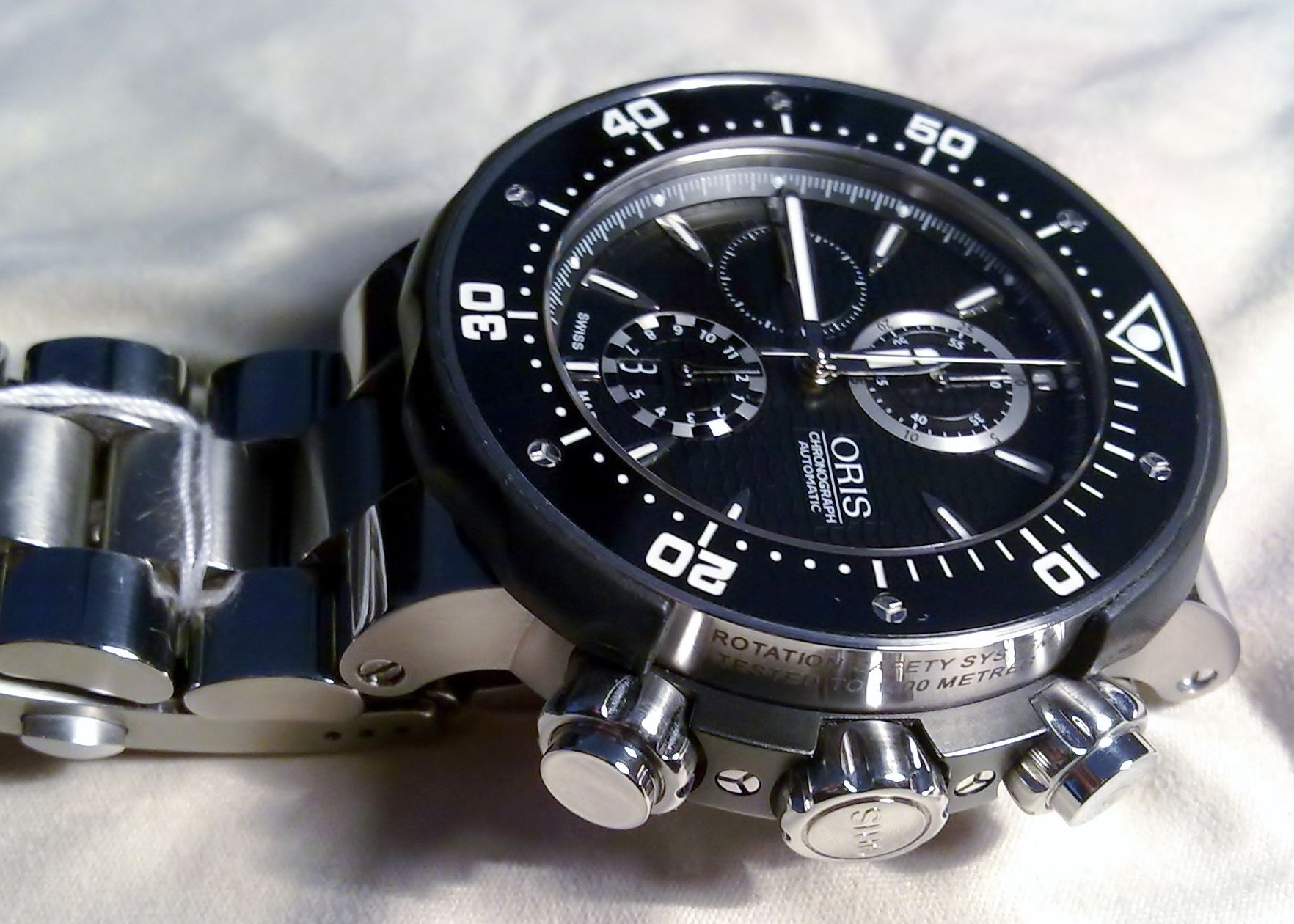
In the 2000s, Oris divided its pilot watch range into two families: Big Crown (heritage, smaller, vintage-inspired) and ProPilot (modern, larger, technical). This distinction remains current.
The Big Crown retained the 1930s–1950s aesthetic — relatively compact cases (36–40mm), vintage-style dials, the Pointer Date as signature complication — while ProPilot absorbed the larger, more rugged aviation watch brief.
Modern Big Crown Collection
Photo: Wiki Peter Jan — CC BY-SA 4.0 — Wikimedia Commons

The current Big Crown range (2024) includes several references:
Big Crown Pointer Date — The core heritage reference. 40mm steel case, Calibre 754 (automatic with Pointer Date), black or blue dial, the coloured retrograde hand, the bracelet or leather strap. This is the closest to the 1940s original.
Big Crown Original — Manual-wind version (Calibre 754 manual), emphasising the simplicity of the original concept. 40mm, more accessible price point.
Big Crown Complication — Adds a day indicator alongside the Pointer Date, using a dedicated complication module. More complex dial layout.
Big Crown Worldtimer — Incorporates a world time display showing 24 time zones simultaneously on a rotating disc around the dial. The worldtimer complication on an affordable mechanical watch is a rarity; most worldtimers are considerably more expensive.
Big Crown Date — Simplified version with conventional date window rather than Pointer Date, lower price point.
The 36mm Big Crown
Photo: Olaf Köster / Oris SA — CC BY-SA 3.0 DE — Wikimedia Commons
In 2019, Oris launched the Big Crown 36 — a 36mm version of the heritage pilot line aimed at smaller wrists. The smaller case uses a manual-wind movement and retains the characteristic Big Crown oversized crown, which looks proportionally even more prominent on a compact 36mm case.
The 36mm addressed growing market interest in compact watches and expanded the Big Crown's addressable market significantly. The combination of small case and prominent crown produces a distinctive aesthetic that has attracted non-traditional watch buyers to the pilot category.
Calibre 754 and Movement Architecture
Photo: Clyde94 — CC BY-SA 4.0 — Wikimedia Commons

The movement most associated with Big Crown watches is the Calibre 754 — an Oris-modified Sellita SW220 base with the Pointer Date module. Specifications: automatic, 38 hours power reserve, 28,800 vph.
The Cal. 754 Pointer Date module adds approximately 1.5mm to the movement height compared to a standard date. The retrograde mechanism is driven by a kidney-shaped cam mounted on the date wheel, with a lever follower that translates cam rotation into the sweeping pointer hand action and executes the snap-back at month end.
Oris has not yet integrated Calibre 400 into the Big Crown range (as of 2024) — the Cal. 400 architecture does not currently support the Pointer Date complication. Development of a Cal. 400 variant with retrograde date would represent a significant technical investment.