
Breitling Navitimer: The Pilot’s Chronograph Since 1952

Zach Charles • May 25, 2026

Share this article

Breitling Navitimer: The Complete History of Aviation's Greatest Chronograph

There is a particular kind of object that transcends its original purpose and becomes, in the fullness of time, a cultural artefact. The Breitling Navitimer is one such object. Launched in 1952 as a precision instrument for working aviators, it carried on its bezel a circular slide rule capable of resolving in seconds the calculations that governed life and death at altitude. Over the seventy-plus years since its introduction, the Navitimer has accumulated a mythology as dense and stratified as the dial variants that collectors spend lifetimes cataloguing. It was on the wrist of Scott Carpenter when the Cosmonaute became the first Swiss watch in orbit. It was the instrument of choice for the Aircraft Owners and Pilots Association, whose logo graced the earliest dials. And it is, by almost any measure, the single most recognisable pilot's chronograph in the history of watchmaking.

To understand the Navitimer fully — to appreciate why the dial is busy in the way it is, why the case grew to 40mm before 40mm was fashionable, why the movement history reads like a survey of twentieth-century Swiss horology — is to understand something important about the relationship between precision timekeeping and human ambition.


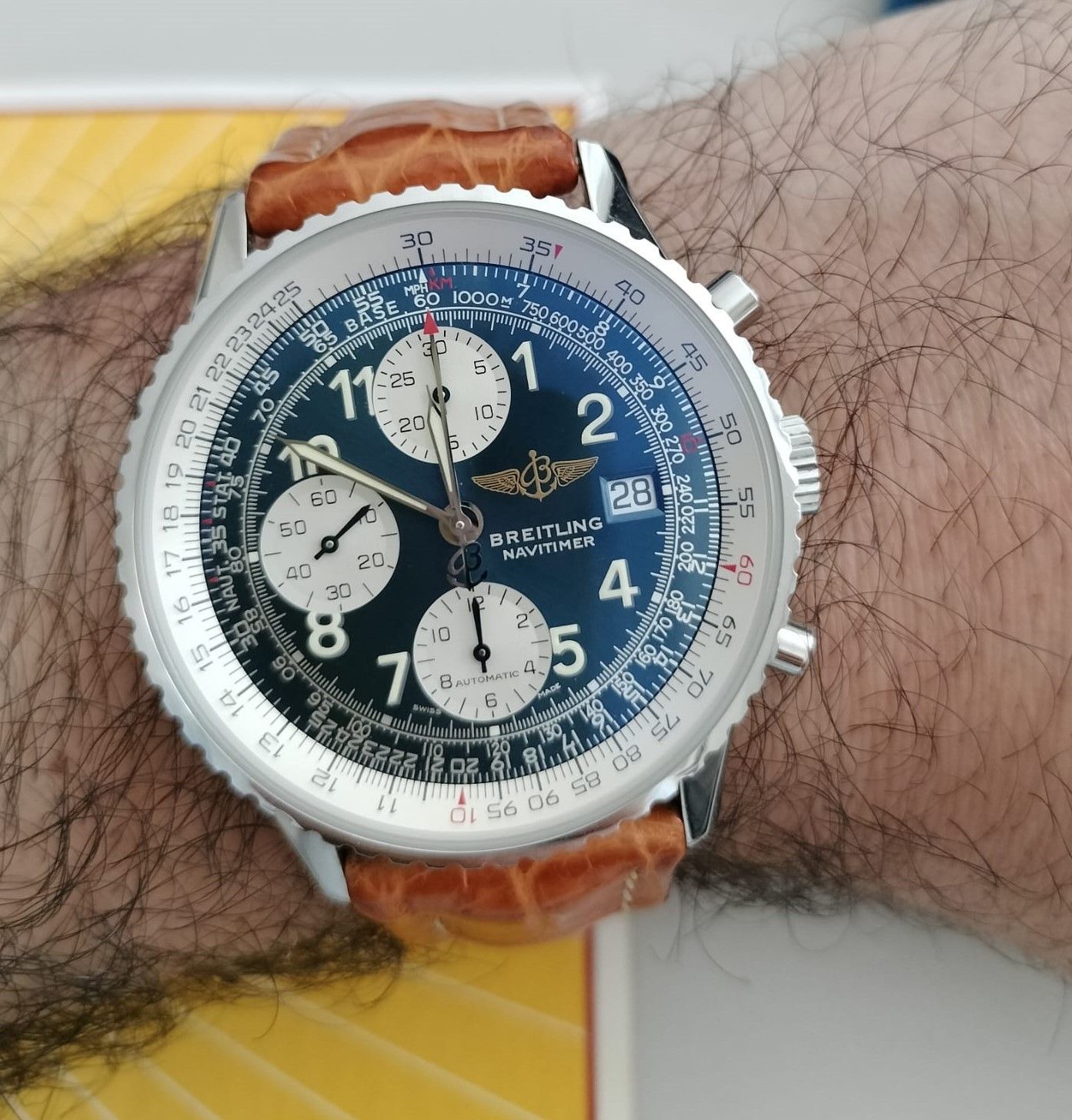
Breitling Old Navitimer ref. A13322 — early 2000s
A Breitling Old Navitimer ref. A13322 from the early 2000s — the circular slide rule bezel, a defining Navitimer feature since 1952, allows pilots to perform airspeed, fuel consumption, and distance calculations without a separate computer.
Photo: EMore98 — CC BY-SA 4.0 — Wikimedia Commons
Origins: Breitling and Aviation Before 1952

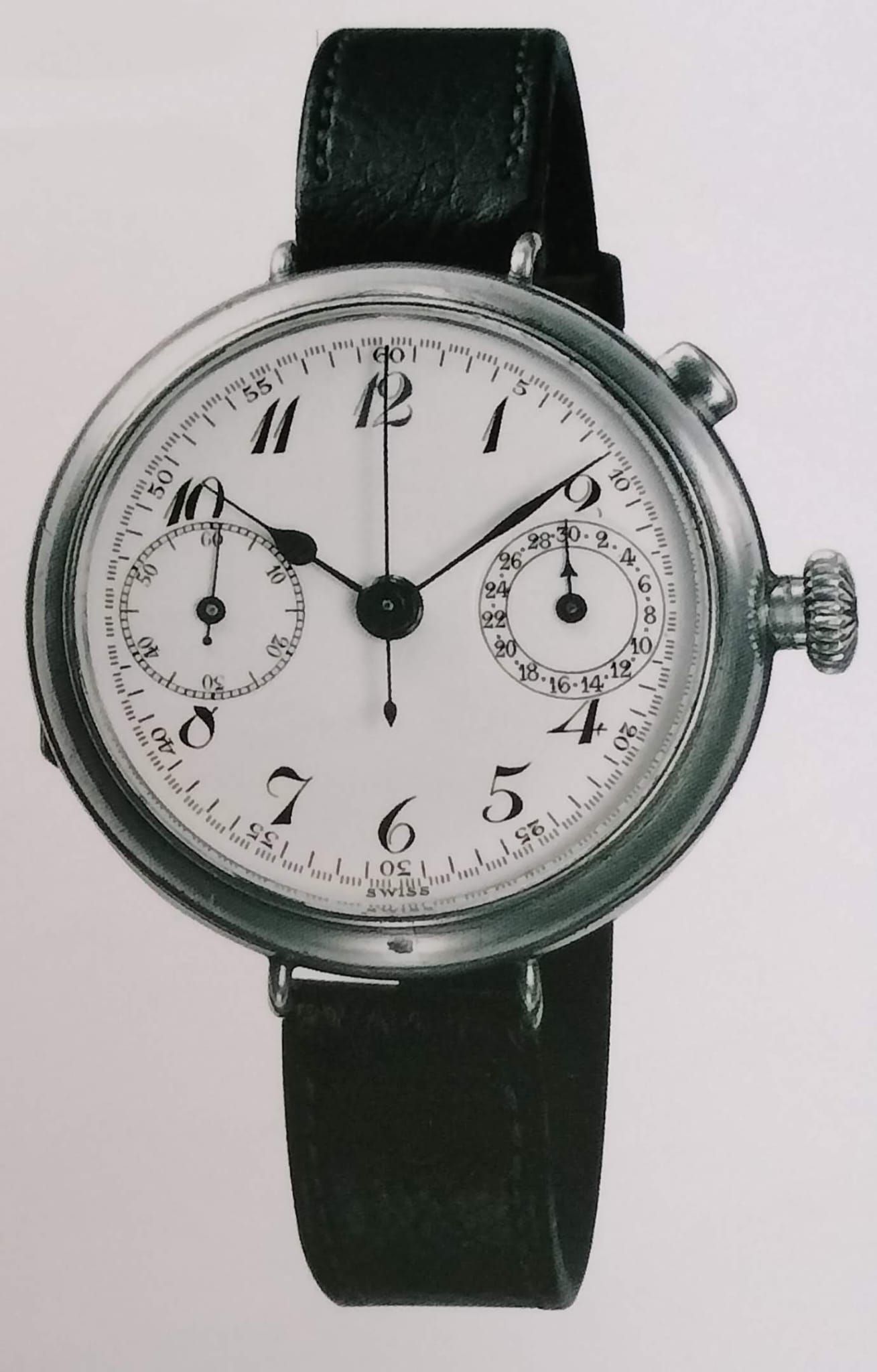
Antique Breitling single-push chronograph — vintage wristwatch
A vintage Breitling single-push chronograph — illustrating the single-pusher column-wheel mechanism that was standard before the independent start/stop/reset system. Breitling patented the independent chronograph push-piece in 1915 and the fly-back (retour en vol) in 1934.
Photo: EMore98 — CC BY-SA 4.0 — Wikimedia Commons
Breitling's association with aviation predates the Navitimer by decades. By the 1930s the firm was supplying cockpit chronographs to air forces and commercial airlines, and the 1936 RAF supply contract cemented a reputation for legibility and robustness under operational conditions. The 1940s saw Breitling develop its first slide rule bezel concepts, and by the time Willy Breitling was running the company, the logical next step was clear: marry the circular slide rule to a wrist-worn chronograph for civilian pilots in the postwar aviation boom.

America was producing pilots in enormous numbers. Private aviation was expanding rapidly. The Aircraft Owners and Pilots Association — founded in 1939 and growing quickly through the late 1940s — represented exactly the customer Breitling needed to reach.


The 1952 Launch and the AOPA Connection

Breitling Old Navitimer ref. A13322 — early 2000s
A Breitling Old Navitimer ref. A13322 from the early 2000s — the circular slide rule bezel, a defining Navitimer feature since 1952, allows pilots to perform airspeed, fuel consumption, and distance calculations without a separate computer.
Photo: EMore98 — CC BY-SA 4.0 — Wikimedia Commons
The Navitimer made its commercial debut in 1952, catalogued as Reference 806. Its most immediately striking feature was the AOPA logo printed on the dial — a winged emblem that announced the watch's institutional purpose before a single calculation had been made on its bezel. Breitling had secured an endorsement arrangement with the AOPA making the Navitimer the official watch of the association. The earliest AOPA-issued versions bore no Breitling branding on the dial; when Breitling launched the watch publicly under its own name in late 1955, the AOPA winged logo was retained alongside the Breitling name on reference 806.

The reference 806 with AOPA logo is today among the most sought-after vintage Breitlings in existence. Examples in good condition command significant premiums over non-AOPA 806s, and the condition of the AOPA printing itself is a primary determinant of value.


The Circular Slide Rule Bezel — How It Works

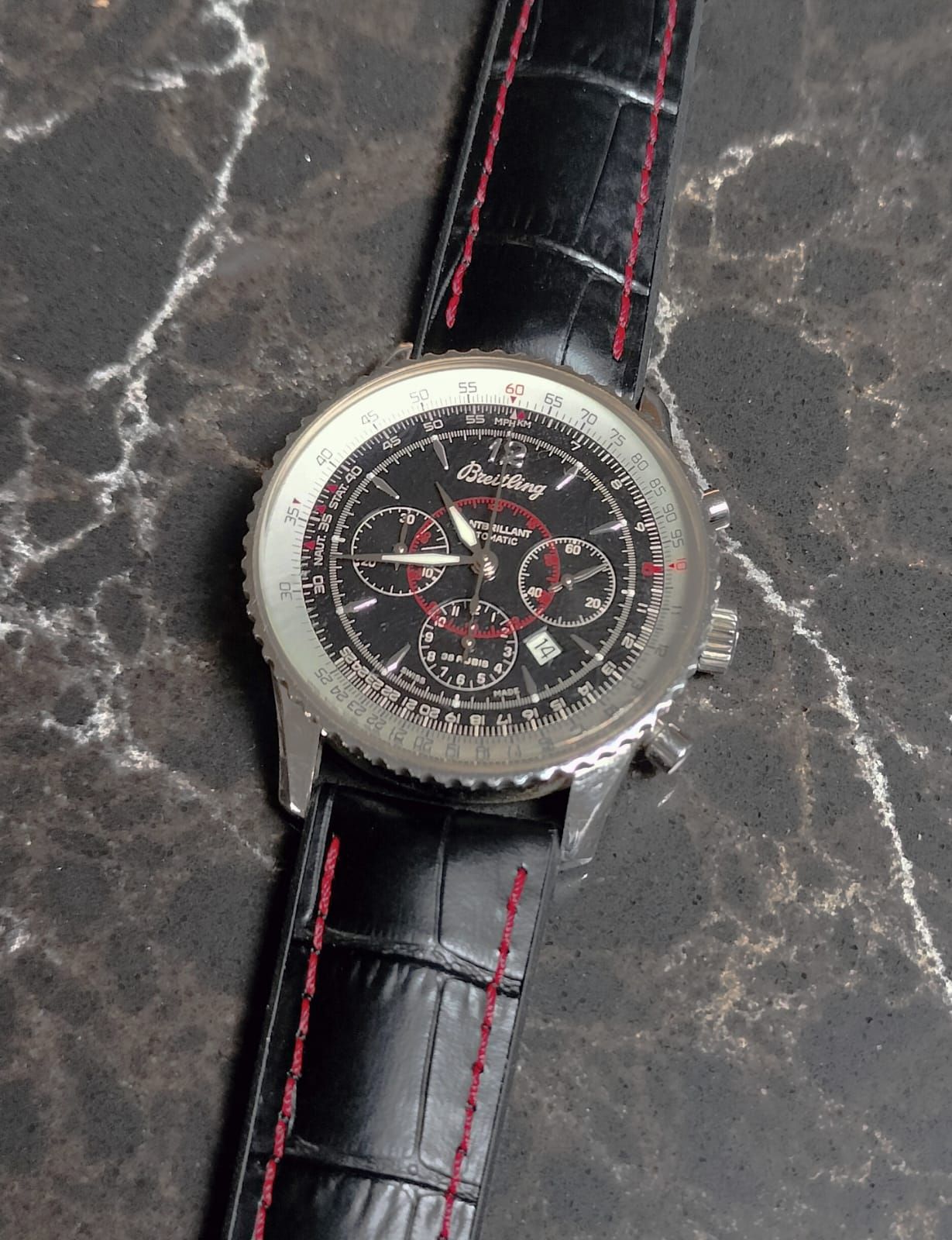
Breitling Montbrilliant — mid-2000s
A Breitling Montbrilliant from the mid-2000s — a 38mm round-case chronograph with circular slide rule, representing the more elegant end of the Breitling catalogue. The Montbrilliant references Breitling’s address at Rue Montbrilliant in Geneva and the original 1915 chronograph push-piece design.
Photo: Clyde94 — CC BY-SA 4.0 — Wikimedia Commons

The bezel is the reason the Navitimer exists. Not merely decorative, not simply a tachymeter, the circular slide rule is a genuine analogue computer — a two-scale logarithmic instrument whose outer ring rotates against a fixed inner scale to perform multiplication, division, and a suite of derived calculations a pilot in 1952 would need to perform routinely and rapidly:

Airspeed corrections. True airspeed differs from indicated airspeed depending on altitude and air density. The slide rule allows rapid conversion between the two.

Rate of climb and descent. Entering distance and time on the scales yields rate values directly.

Fuel consumption. Given a burn rate per hour and a flight duration, the pilot reads off total fuel required — or determines remaining range from fuel on board.

Distance calculations. Speed multiplied by time, computed without mental arithmetic while simultaneously managing airspace, weather, and radio communications.

Unit conversions. Nautical miles to statute miles, kilometres to miles, imperial to metric fuel measurements.

The mechanical consequence of this bezel system is a large diameter case. The slide rule requires sufficient circumference to space its logarithmic graduations with enough resolution to be readable. At a case diameter smaller than roughly 40mm, the markings would be too compressed to use without a magnifier. The original 806's 40mm case was an engineering requirement, not an aesthetic choice — anticipating the larger case sizes that became fashionable a generation later.


Reference History — A Collector's Roadmap

The Navitimer reference history is among the richest in vintage watch collecting, combining mechanical variation with dial variation in combinations ensuring no two collections are identical.

Reference 806 (1952–c. 1961): The original, available with AOPA logo and without. Venus 178 movement. "Tropical" dial examples — brown or chocolate-toned from chemical changes to the original black lacquer over decades — are among the most admired variants in any vintage collection. "Gilt" dials, with gold-coloured printing on black, are similarly prized.

Reference 765 "Big Eye": A smaller-cased variant produced concurrently with the 806, featuring a large 30-minute counter at six o'clock that earned the collector nickname "Big Eye." The smaller case was intended for pilots who found the 806 unwieldy, but the compromise in slide rule resolution meant it never displaced the larger reference.

Reference 809 Cosmonaute: The most historically significant variant — see below.

Reference 816: An update incorporating an improved calibre and minor case refinements, serving as a transitional reference between the Venus-era watches and the Valjoux period.

The Valjoux era: From the early 1970s, Breitling moved to the Valjoux 72 and subsequently the 7740 and 7750 automatic calibres. The 7750 became the workhorse of Breitling's entire line for nearly three decades. A pragmatic choice — reliable, serviceable, with genuine self-winding convenience — but a departure from the manually wound column-wheel movements that purists preferred.


The Cosmonaute — First Swiss Watch in Space

Breitling Old Navitimer ref. A13322 — early 2000s
A Breitling Old Navitimer ref. A13322 from the early 2000s — the circular slide rule bezel, a defining Navitimer feature since 1952, allows pilots to perform airspeed, fuel consumption, and distance calculations without a separate computer.
Photo: EMore98 — CC BY-SA 4.0 — Wikimedia Commons

On May 24, 1962, astronaut Scott Carpenter completed three orbits of the Earth aboard the Mercury capsule Aurora 7. On his wrist was a Breitling Navitimer Cosmonaute, Reference 809, fitted with a 24-hour dial. It was the first Swiss watch worn in space.

The rationale for the 24-hour dial was specific and practical. In the absence of a perceivable day-night cycle from the capsule — or rather, with a radically compressed cycle as the spacecraft completed an orbit every 90 minutes — a conventional 12-hour dial would be ambiguous. The 24-hour dial eliminated that ambiguity by running the hour hand through a complete circuit only once per day. Carpenter is reported to have approached Breitling personally to request the modification.

The 24-hour Cosmonaute dial required twice the angular resolution for hour markers, producing a dial of exceptional complexity and density. Cosmonaute examples in collector-grade condition are rare; the variant was never produced in large numbers, and the Aurora 7 mission's historical significance ensures demand perpetually outstrips supply.


Movement History — From Venus 178 to the B01

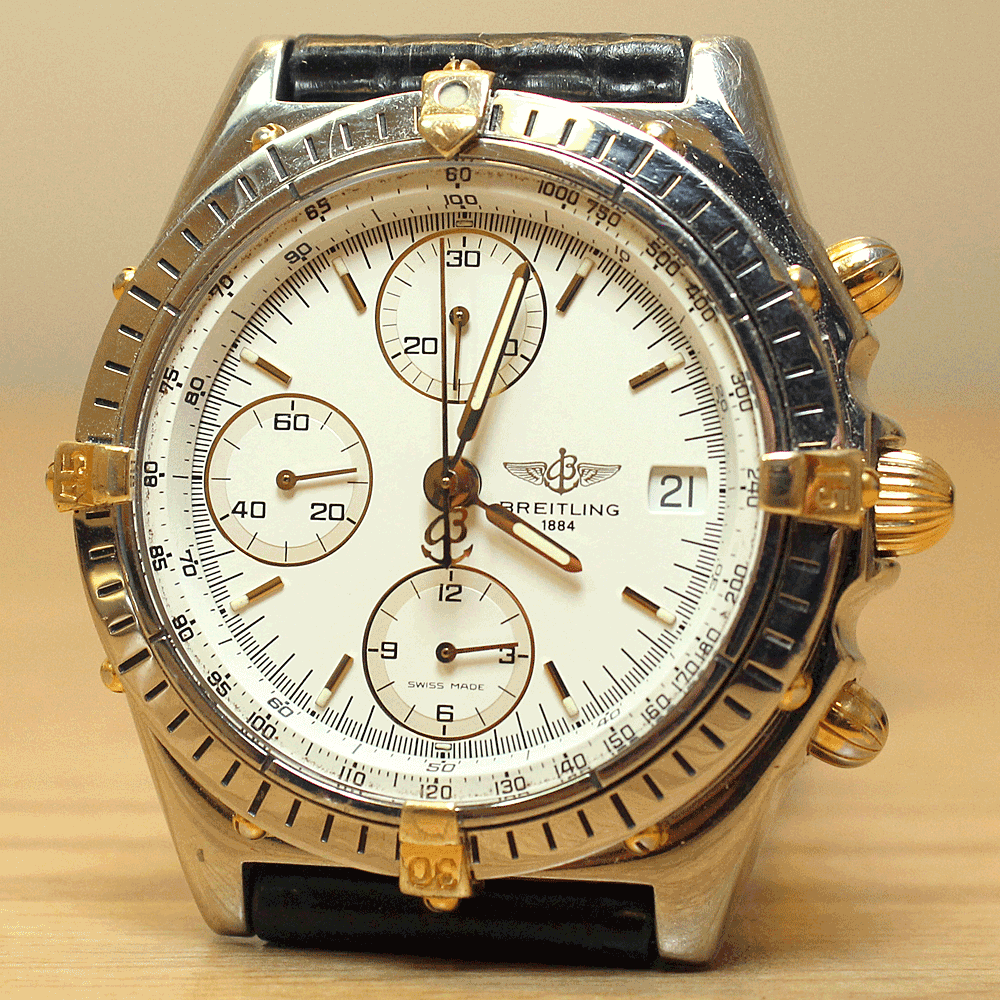
Breitling B13050 Chronomat Automatic — 18K gold and stainless steel
The Breitling B13050 Chronomat Automatic in 18K gold and stainless steel — a two-tone variant of the Chronomat with the Rouleaux bracelet. Based on the Valjoux 7750 automatic, the B13050 represents the 1990s Chronomat at its most opulent.
Photo: Jonathan Mauer — CC BY 4.0 — Wikimedia Commons
Venus 178: The original calibre, a manually wound column-wheel chronograph with horizontal clutch engagement. Admired today for its clean architecture and direct lineage to the classical watchmaking tradition. Powered all early 806 and 765 examples.

Valjoux 72: A manually wound column-wheel movement adopted during the late 1960s and early 1970s transition period. Strong collector following in its own right.

Valjoux 7740/7750: The self-winding era. The 7750 became synonymous with Breitling's output from the mid-1970s onward, valued for robustness, ease of servicing, and widespread parts availability. Critics noted that the oscillating weight's position required the chronograph pushers to be repositioned relative to their logical location.

Breitling B01 (2009): Breitling's first in-house chronograph calibre. A COSC-certified, column-wheel chronograph with vertical clutch engagement and a 70-hour power reserve. The B01 addressed every criticism levelled at the 7750: clean architecture, precise and smooth chronograph action, generous power reserve. It debuted in the Navitimer B01 and has since become the movement around which Breitling's serious watchmaking credentials are organised.


Dial Variations — The Collector's Universe

Among serious Navitimer collectors, the dial is everything. The range of configurations across the reference history is staggering: silver, black, panda, reverse panda, blue, and intermediate tonalities that decades of ageing have created from originally standardised colours. Salmon dials from aged silver lacquer, warm chocolate from tropical blacks, varied gold tones across production runs — these distinctions separate a generic vintage Navitimer from pieces worth significant multiples of production-era value. For a watch made in relatively large quantities, the Navitimer offers an almost unreasonable depth of variation.


Navitimer vs. IWC Pilot's Chronograph

The inevitable comparison is the IWC Pilot's Chronograph — the Mark series and the Fliegerchronograph. Both have genuine aviation heritage; both feature serious chronograph movements; both occupy the upper tier of sports watch collecting.

The philosophical difference is significant. IWC's pilot watches prioritise legibility above all else, following the Bauhaus-influenced principle that a tool watch should communicate exactly one thing: the time. The dials are spare, the indices bold, the aesthetic one of functional austerity. The Navitimer takes the opposite position entirely. Its dial is an instrument panel, a working computational surface that demands engagement and rewards fluency. Where IWC says "read me at a glance," the Navitimer says "use me."

Where the Navitimer computes and times, the Chronomat was designed for the physical demands of aerobatic aviation — rider-tabbed bezel, Rouleaux bracelet, robustness above all. The Aerospace takes a third path entirely: a SuperQuartz instrument that answers the question of what accuracy actually demands in professional aviation. Each represents a distinct answer to the same question Breitling has been asking since 1884.


Current Lineup

Navitimer B01 Chronograph 43 — the direct continuation of the original concept, powered by the in-house B01 in a 43mm case. Available in steel, two-tone, and precious metal with silver, black, and blue dial options echoing the chromatic tradition of the vintage references.

Navitimer Automatic 41 — a non-chronograph option for those who want the slide rule bezel and Navitimer aesthetic without the complication. Powered by calibre B17 at a more modest price point.

Navitimer 1 B03 Rattrapante Édition Unitée — a split-seconds chronograph movement in the Navitimer case, produced in limited edition. Breitling's argument about its haute horlogerie ambitions in the model that best deserves to receive it.


Frequently Asked Questions

Is the circular slide rule bezel useful today?
In day-to-day civilian use, rarely in its original aviation application — GPS and electronic flight computers have displaced most analogue calculations. That said, the bezel functions well for unit conversions, simple multiplication and division, and other practical uses. For many Navitimer owners, active use is beside the point; the bezel's presence is what makes the watch what it is.

What is the rarest vintage Navitimer?
Rarity is multidimensional. The Reference 806 with AOPA logo in original unrestored condition with a tropical dial is among the most valuable. Cosmonaute examples with documented provenance are extremely rare. Certain transitional dial configurations produced in single-year batches appear at auction rarely enough to generate intense competition among collectors.

Is the B01 movement good?
Yes, by any objective standard. COSC certification, column-wheel chronograph mechanism, vertical clutch engagement, and 70-hour power reserve make it architecturally correct and practically generous. Independent watchmakers have consistently reported well-finished components and reliable long-term performance.

Why did Breitling wait until 2009 for an in-house movement?
Commercial pragmatism. The Valjoux 7750 was reliable, widely serviced, and cost-effective. Breitling made the investment when the market — increasingly valuing manufacture status as a differentiator — made the business case clear.

Is the Navitimer a good investment?
Vintage references — particularly AOPA 806 examples in original unrestored condition — have appreciated meaningfully and command significant premiums at auction. Contemporary references (Navitimer B01 Chronograph 43) trade near retail on the secondary market without the premium of a Rolex Daytona. As a long-term keeper: excellent. The B01 movement, COSC certification, and 70-year design heritage give it enduring relevance that few watches at its price point can match.


Related Articles

Recent Posts

By Zach Charles • October 10, 2026
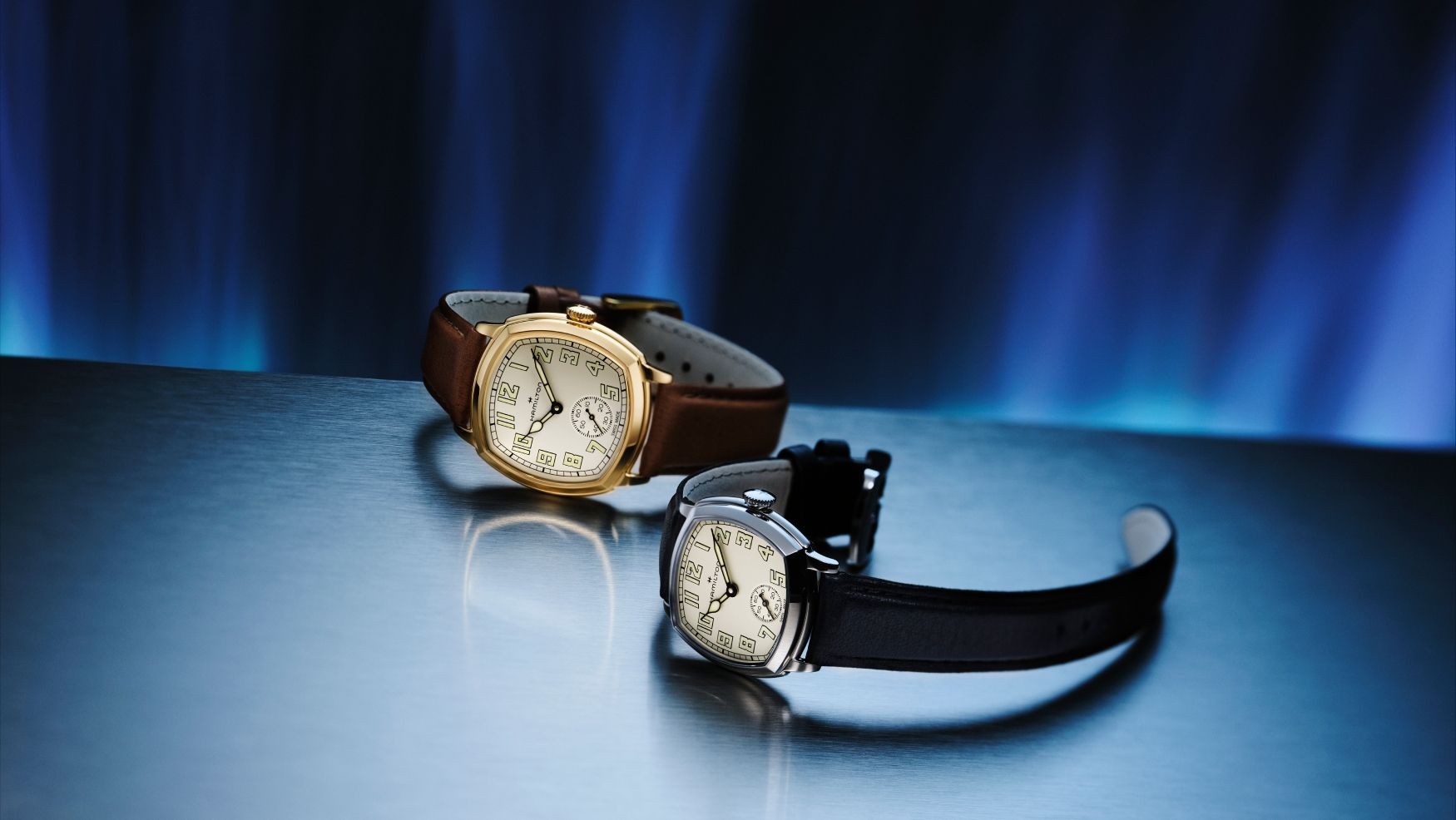
Hamilton's American Classic Cushion Mechanical revives its 1926 Art Deco cushion watches, seen in Oppenheimer, in 30mm and 34mm with the new hand-wound…
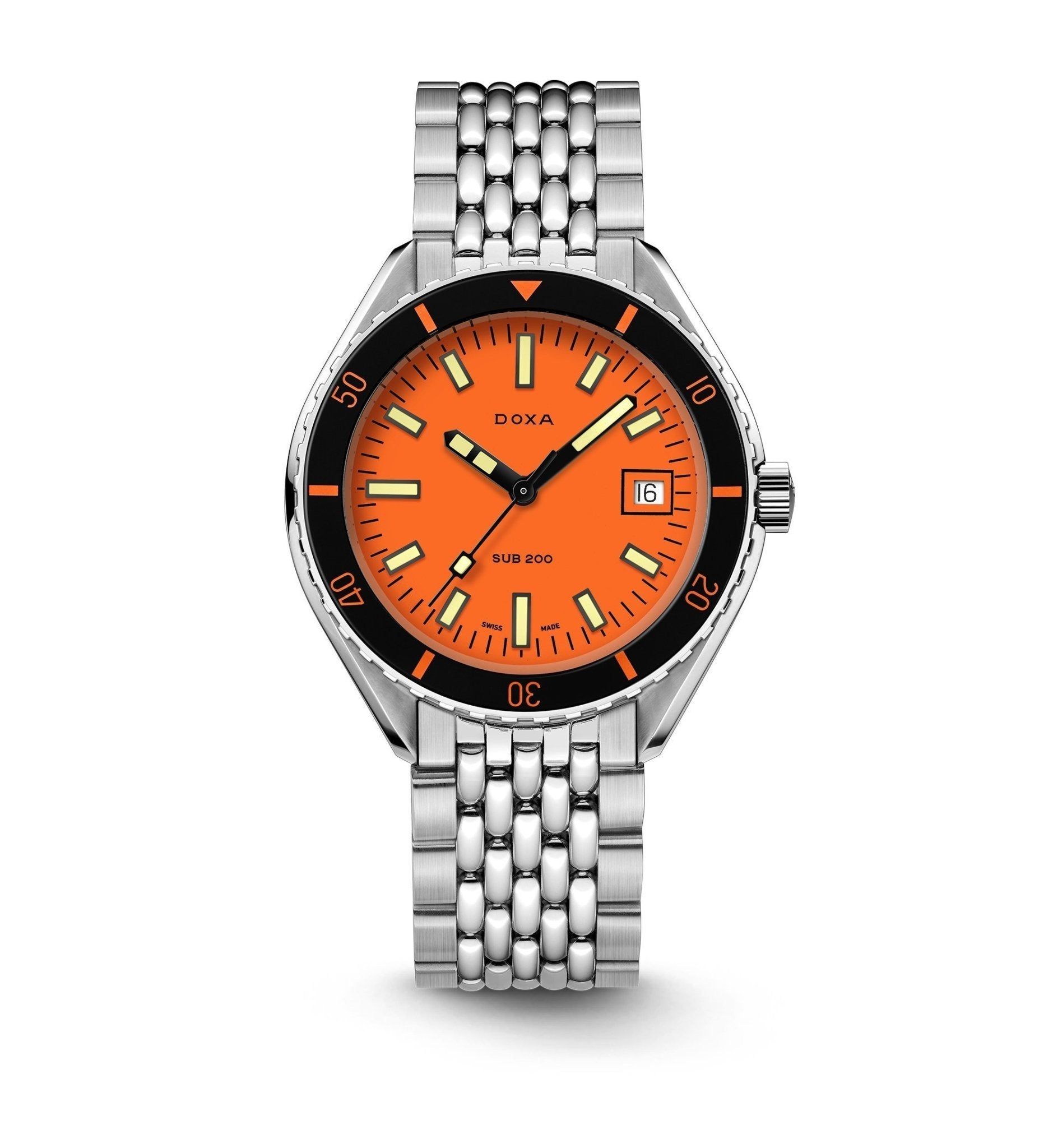
Doxa SUB 200: The Accessible Everyday Diver
By Zach Charles • October 10, 2026
Complete guide to the Doxa SUB 200 — 42mm, 200m, four colorways, Sellita SW200-1. The accessible entry to the Doxa SUB family with the full…
By Zach Charles • October 10, 2026
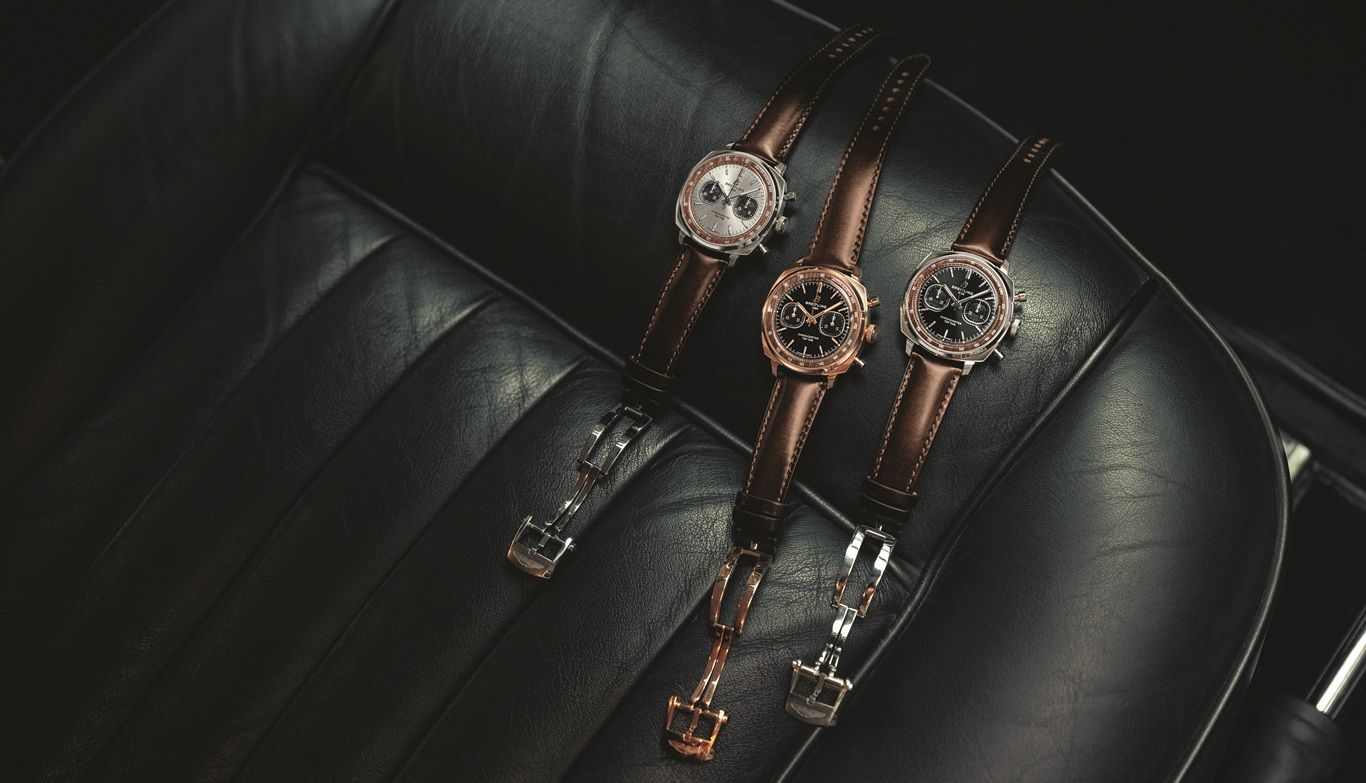
The Breitling Top Time B01 Aston Martin DB5 pairs a cushion-shaped 41mm case, a wooden inner ring and the in-house Caliber 01 across three limited…
By Zach Charles • October 10, 2026
TAG Heuer developed the Mikrograph (2011, 1/100th second), Mikrotimer Flying 1000 (2011, 1/1000th second), and Mikrogirder (2012, 1/2000th second).
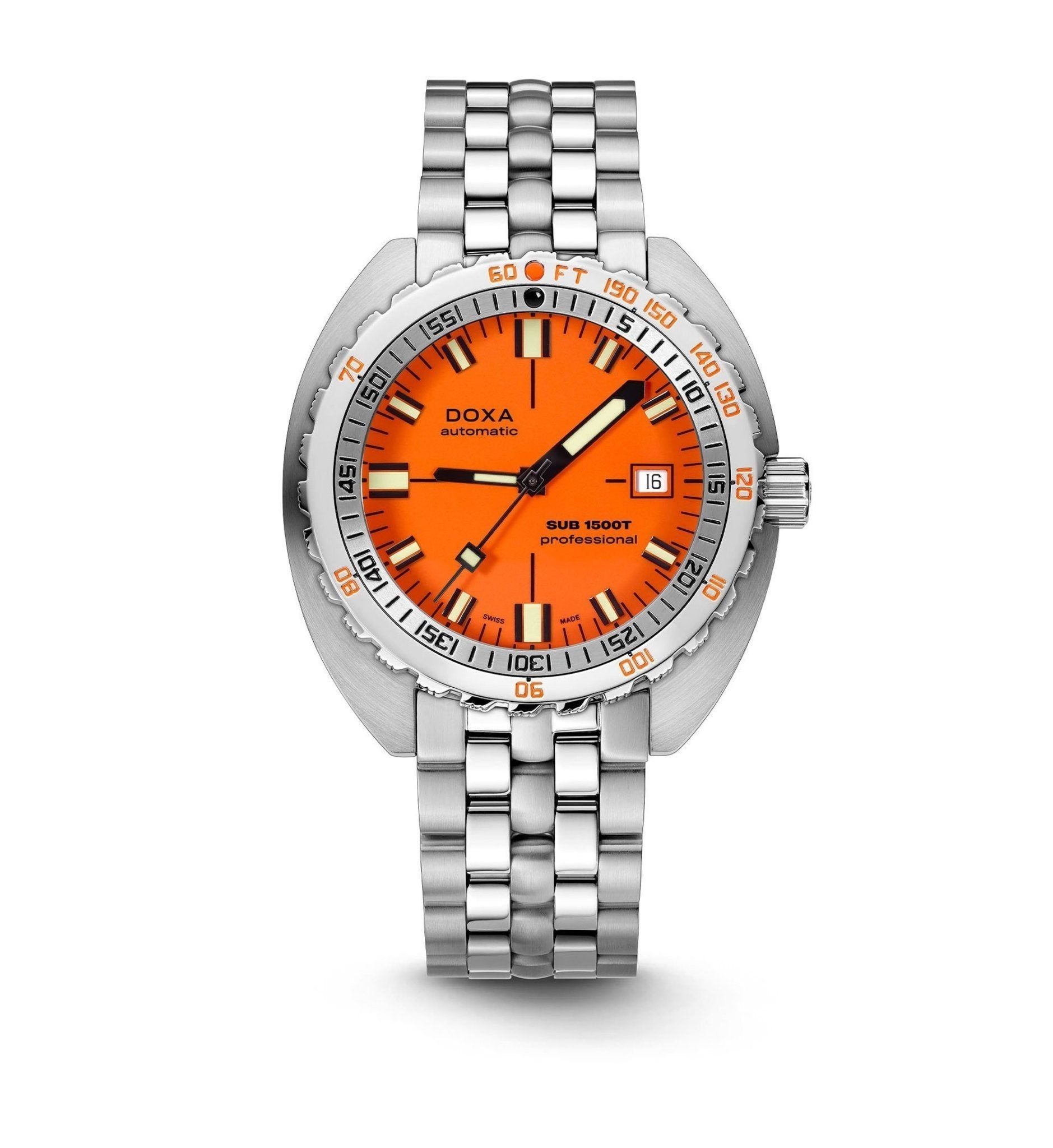
Doxa SUB 1500T: The 1,500-Metre Depth-Rating Flagship
By Zach Charles • October 10, 2026
Complete guide to the Doxa SUB 1500T — 45mm, 1,500m depth rating, helium escape valve, ETA 2892-2 movement, USD 2,690.

Audemars Piguet Royal Oak 'Jumbo' ref. 15202 with blue tapisserie dial and integrated steel bracelet
By Zach Charles • October 10, 2026
The Audemars Piguet × Swatch Royal Pop is a $400 bioceramic pocket watch in 8 colourways, powered by a new hand-wound SISTEM51 with 90+ hour power…

Time on the Move logo
By Zach Charles • October 10, 2026
Zach Charles is the editor of Time on the Move, an independent watch reference covering brand and model histories, buying guides and release news…
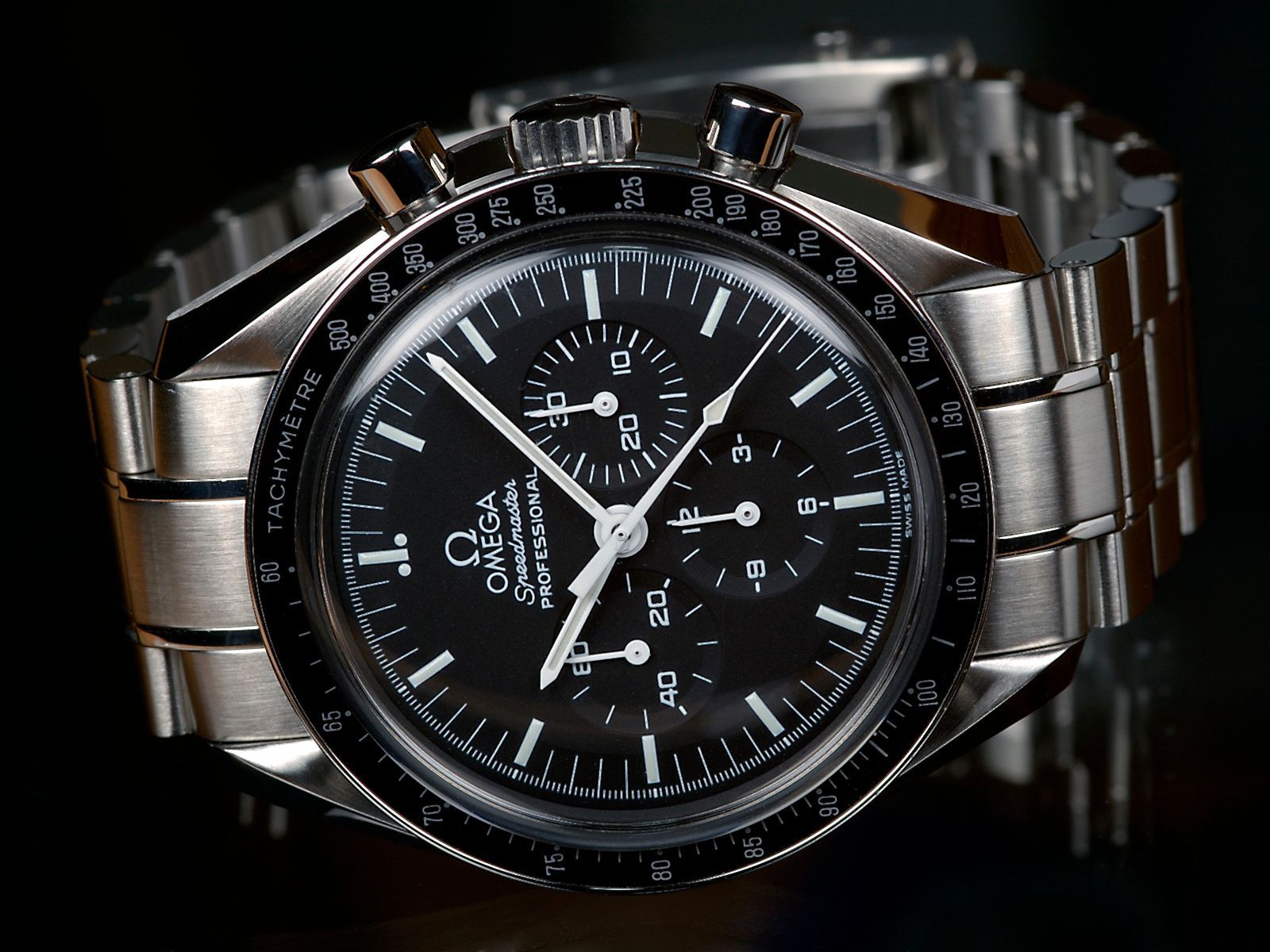
Omega Speedmaster Professional 'Moonwatch' chronograph, front view on steel bracelet
By Zach Charles • October 9, 2026
Find the best watches at every price point from $500 to $15,000 — new and pre-owned. Covers every budget tier with specific reference picks, brand…
By Zach Charles • October 9, 2026
The latest watch news: new releases, Watches and Wonders coverage, discontinuations, industry analysis, and market trends. Currently 1 article.

Seiko's New Panda Chronograph Is Literally a Panda: The Power Design Project HHK001 and HHK002
By Zach Charles • October 8, 2026
Seiko's Power Design Project panda chronograph (HHK001, HHK002) turns the panda dial into an actual panda face, with ear pushers, a 'Sasameter' and a 3D…
Show More