Breitling Chronomat: From 1942 Reference 769 to the B01 Era
Breitling Chronomat: The Complete History of the Pilot's Sports Watch
In 1984, Breitling was a company in search of a direction. The quartz crisis had decimated the Swiss watch industry through the previous decade, and Breitling had not been immune. Ernst Schneider, an engineer and pilot who had acquired the company in 1979 after Willy Breitling's retirement, understood that survival required not merely a new watch but a new statement — a design so emphatically mechanical, so unapologetically large and complex, that it would make a counter-argument in steel and sapphire to everything that battery-powered timekeeping represented. What emerged from that conviction, in collaboration with designer Gerd-Rüdiger Lang and the Italian Air Force's Frecce Tricolori aerobatic display team, was the Chronomat: a watch that not only saved the brand but defined an entire category of purpose-built luxury sports chronograph.
But the story begins earlier — in the decade when Swiss watchmaking first confronted the question of what a pilot's watch with computational capability might look like.
Photo: EMore98 — CC BY-SA 4.0 — Wikimedia Commons
The Original Chronomat — Reference 769 (1942)
Photo: EMore98 — CC BY-SA 4.0 — Wikimedia Commons
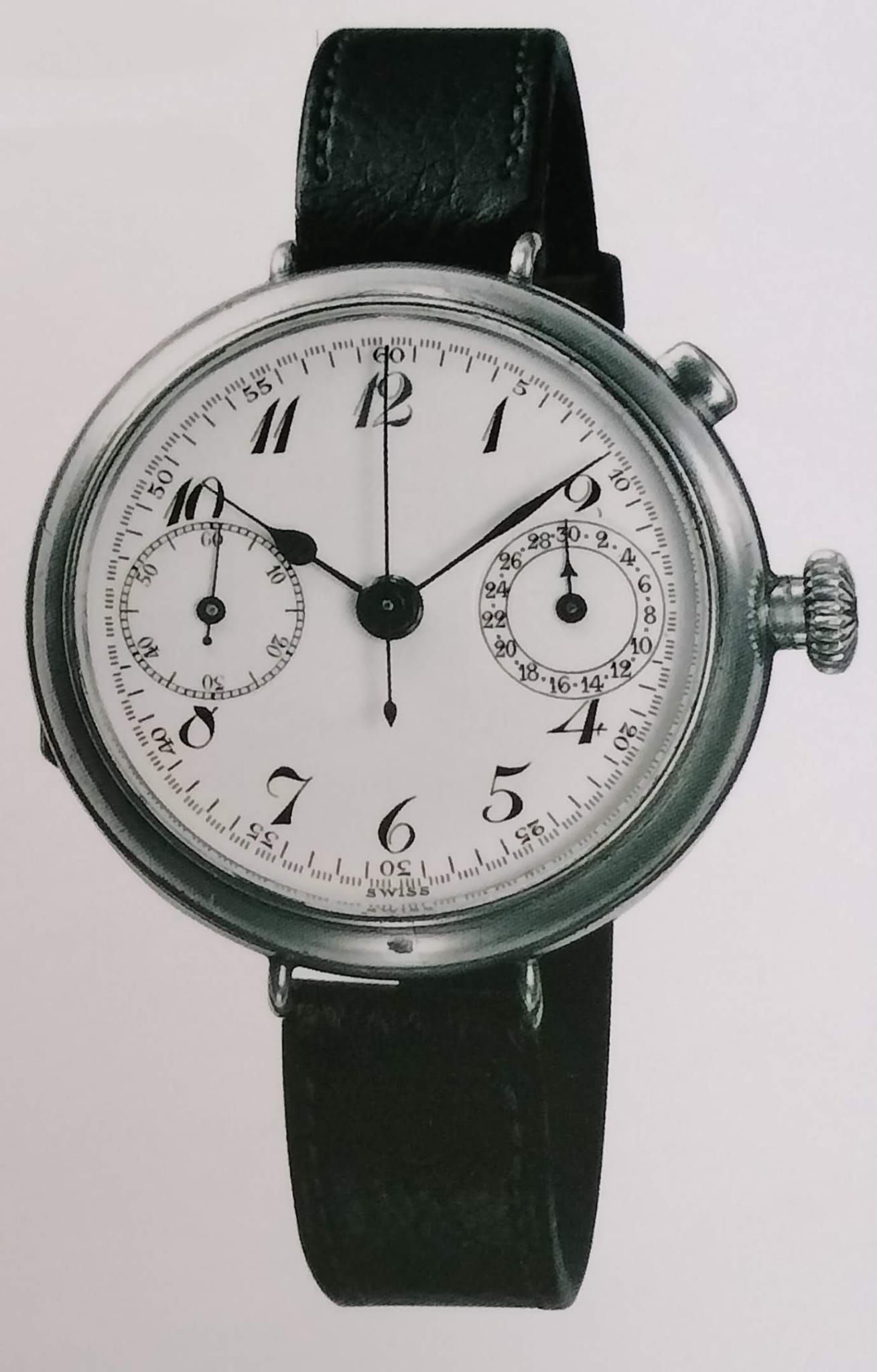
The Chronomat name first appeared in Breitling's catalogue in the mid-1940s, applied to Reference 769 — the first Breitling to combine a slide rule with a chronograph complication. Patented in 1940 and launched publicly in 1942, the original Chronomat was a smaller, cleaner instrument than its 1984 successor: a manually wound movement in a modest case, the slide rule bezel less elaborate than the one that would distinguish the Navitimer when it arrived in 1952, and the aesthetic one of functional wartime utility rather than assertive postwar ambition.
The Reference 769 is today primarily of historical interest — a footnote in the Chronomat's lineage rather than a collectible in its own right. What it established was a precedent: the Chronomat name had meaning within Breitling's own history, and when Schneider chose to revive it four decades later, he was consciously invoking that heritage even as he was creating something categorically new.
The name itself derives from a portmanteau of "chronograph" and "mathématique" — reflecting the original ambition of a watch that computed as well as timed.
The 1984 Relaunch — Schneider, Lang, and the Frecce Tricolori
Photo: Jonathan Mauer — CC BY 4.0 — Wikimedia Commons
Understanding why the 1984 Chronomat looks the way it does requires understanding who commissioned it and for what purpose. Ernst Schneider's partnership with the Frecce Tricolori — the Pattuglia Acrobatica Nazionale of the Italian Air Force, whose ten-aircraft MB-339 formation displays are among the most technically demanding in international airshow competition — was not a marketing association negotiated after the watch was designed. The Frecce Tricolori commission came in 1983; the watch was shaped by the team's operational requirements first, and opened to the public in 1984 as the Chronomat.
The Frecce Tricolori pilots operated under extreme physical stress: high-g manoeuvres, vibration, the necessity of reading instruments while wearing flight gloves. These were not hypothetical use cases. When Schneider and designer Gerd-Rüdiger Lang sat down with the team's requirements, the brief resolved into a set of design imperatives from which the Chronomat's most distinctive features follow directly.
What emerged was Reference 81950 — large, aggressive, and built around the two features that would define the Chronomat family for every generation that followed.
Rider Tabs — Form Follows Function
Photo: EMore98 — CC BY-SA 4.0 — Wikimedia Commons
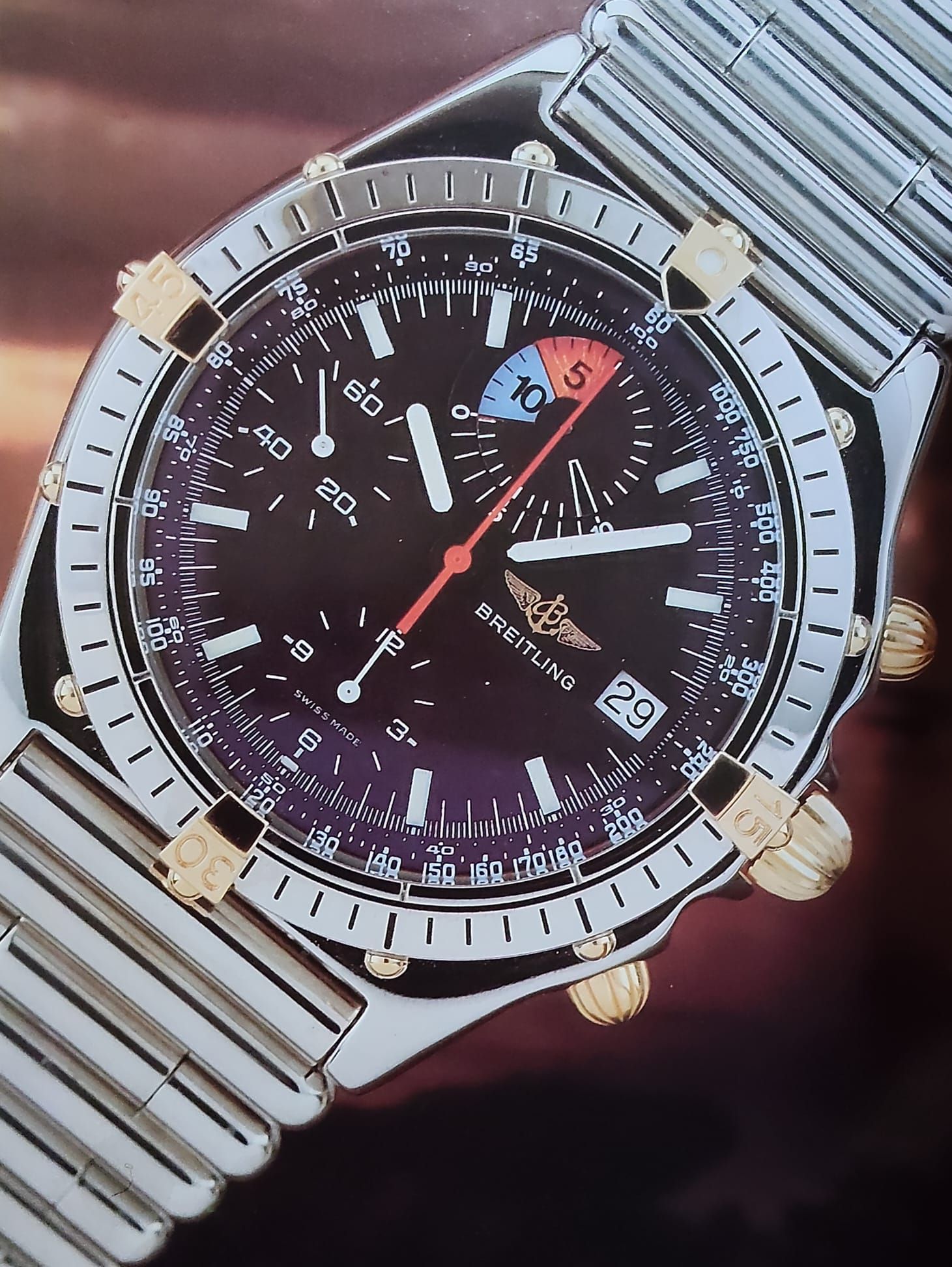
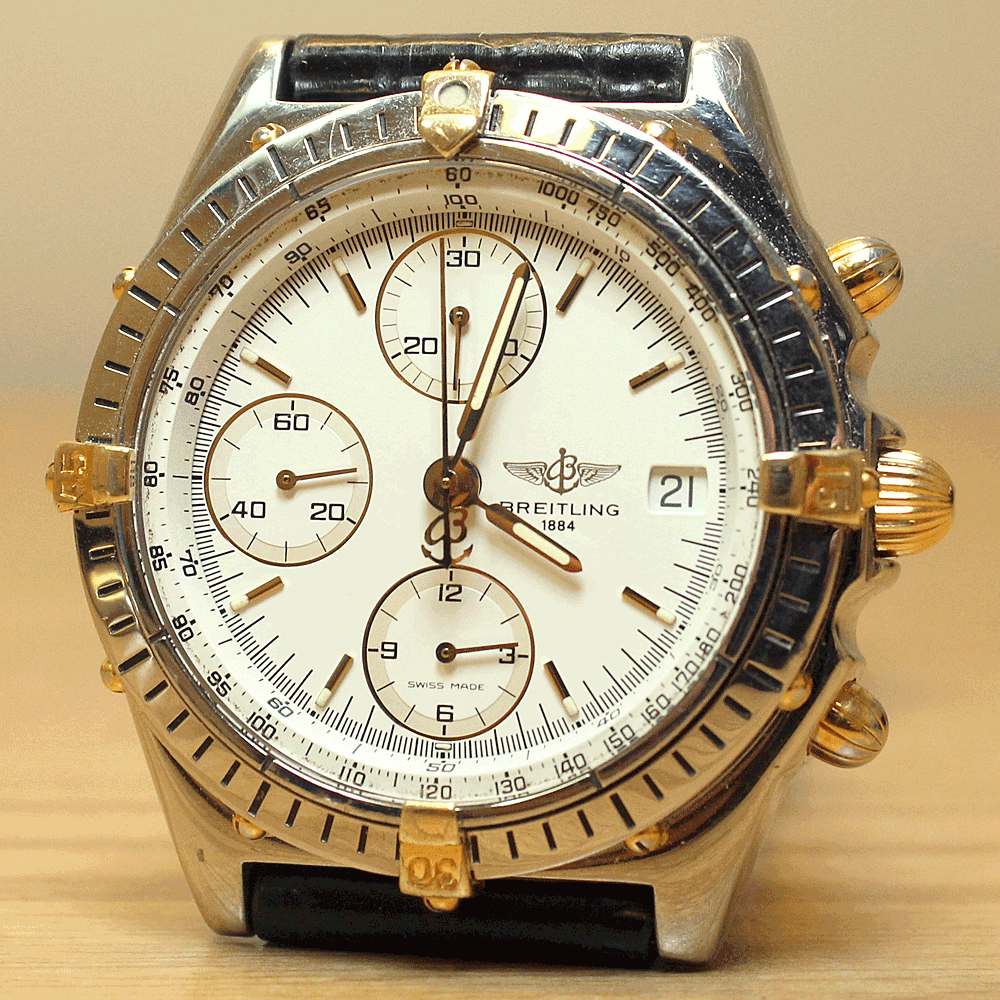
The most immediately identifiable feature of the 1984 Chronomat, and the one most directly traceable to the Frecce Tricolori brief, is the set of four raised markers on the rotating bezel. These "rider tabs" — large, riveted protrusions dividing the bezel into quadrants — provide tactile purchase for a gloved hand attempting to rotate the bezel during flight.
A conventional knurled bezel is adequate for bare-fingered operation but impractical in gloves. The rider tabs solve this by presenting a surface large enough that even a thick flight glove can engage it positively, without fine motor precision that g-forces might compromise.
The functional logic is impeccable. The aesthetic consequence was unforeseen as a primary goal: the rider tabs gave the Chronomat an aggressive, sculptural quality that read as boldness and authority on the wrist in a way no conventional bezel treatment had achieved. Within a few years, the rider tabs had become a Breitling house signature, appearing across multiple references and eventually becoming as strongly associated with the brand as the Navitimer's slide rule. A Breitling with rider-tabbed bezel is immediately legible as a Breitling at distances where no other design element is visible.
The Rouleaux Bracelet — Links as Identity
Paired with the rider tabs was the Rouleaux bracelet — so distinctive that it has become, for many observers, the single most recognisable element of the Chronomat's identity. The Rouleaux bracelet uses H-shaped links with cylindrical rollers seated between the link walls, giving each link a three-dimensional quality that catches light differently from conventional flat-link or oyster-style bracelets. The overall visual effect is one of mechanical density that reads as substance rather than decoration.
The bracelet's practical advantages reinforced its aesthetic ones. The roller construction distributes wear more evenly than simple pin-and-tube connections, and the H-link architecture provides flexibility without lateral slop. Under the physical stress of Frecce Tricolori operations, a bracelet that flexed comfortably but held its shape was a genuine functional requirement.
The Rouleaux bracelet has been refined across the decades but has remained structurally constant. Contemporary Chronomat bracelets use the same fundamental H-link and roller construction as their 1984 predecessors. Along with the rider tabs, it is the visual continuity that links every Chronomat produced across four decades.
Reference Evolution — From 81950 to the B01 Era
Photo: Jonathan Mauer — CC BY 4.0 — Wikimedia Commons
The original 1984 Reference 81950 was powered by the Valjoux 7750 — the robust automatic chronograph that had become the industry standard for serious sports chronographs in the post-quartz period. Breitling continued to specify it across the entire Chronomat line for nearly twenty years.
Reference B13 represented a significant evolution: refined case proportions, improved finishing, updated bracelet — while retaining the fundamental design language. B13 examples became the dominant vintage Chronomat configuration of the 1990s and are today the most commonly encountered vintage Chronomats at auction.
Through the 1990s and 2000s the Chronomat continued in various configurations, including coloured bezels, bidirectional calibrations for specific purposes, and GMT complications, all with the Valjoux 7750 as a constant mechanical foundation.
The arrival of the in-house B01 movement in 2009 prompted the transition to the Chronomat B01 44 — the first truly new Chronomat in the watch's modern history: the familiar design language applied to a movement that made no compromises.
Chronomat B01 44 — Current Core Reference
Photo: EMore98 — CC BY-SA 4.0 — Wikimedia Commons
The Chronomat B01 44 is the centre of gravity in the current collection — 44mm, B01 movement, column-wheel chronograph operation, COSC-certified accuracy, 70-hour power reserve. The dial architecture follows the Chronomat tradition: three registers in classic configuration, tachymeter scale on the chapter ring, rotating graduated bezel with rider tabs above. Controlled complexity — many elements, none superfluous.
Breitling produces the B01 44 in an extensive range of dial and case material combinations: steel with bracelet or rubber strap, coloured dials in blue, red, black, and silver. The availability of these options acknowledges that contemporary buyers are as likely to be choosing the watch as a statement of identity as working pilots. This is not a contradiction of the Chronomat's heritage; it is an honest acknowledgement of how the market has evolved.
Super Chronomat — B01 44 Origins
Within the current lineup, the Chronomat B01 44 Origins variants explicitly invoke the 1984 founding moment — specific dial colour combinations, bracelet configurations, and finishing choices referencing the original 81950 rather than contemporary convention. The movement is identical to the standard B01 44. For collectors with specific interest in the 1984 founding design, the Origins variant carries meaningful additional resonance.
Chronomat Automatic 36 and 38
Around 2020, Breitling introduced the Chronomat Automatic 36 and 38 — non-chronograph versions in smaller cases, positioned explicitly as gender-neutral alternatives to the full-size B01 44. These smaller references carry the rider tabs and Rouleaux bracelet of the larger models but scale the proportions to accommodate a wider range of wrists. Powered by calibre B10 (based on a Kenissi movement), they represent a genuine Chronomat experience at a more accessible case size, and have developed a following among collectors who find 44mm impractical for everyday wear.
Chronomat vs. Rolex Daytona vs. Omega Speedmaster
The Rolex Daytona occupies the peak of demand for luxury sports chronographs, with waiting lists and secondary market premiums that dwarf retail price. Its design is spare and classical — a relatively small case, a clean dial, no bezel computation. Against the Chronomat it reads as restrained, almost minimal. The collector bases overlap at the margins but are largely distinct: Daytona collectors tend to prioritise investment value and brand prestige; Chronomat collectors tend to prioritise design character and mechanical engagement.
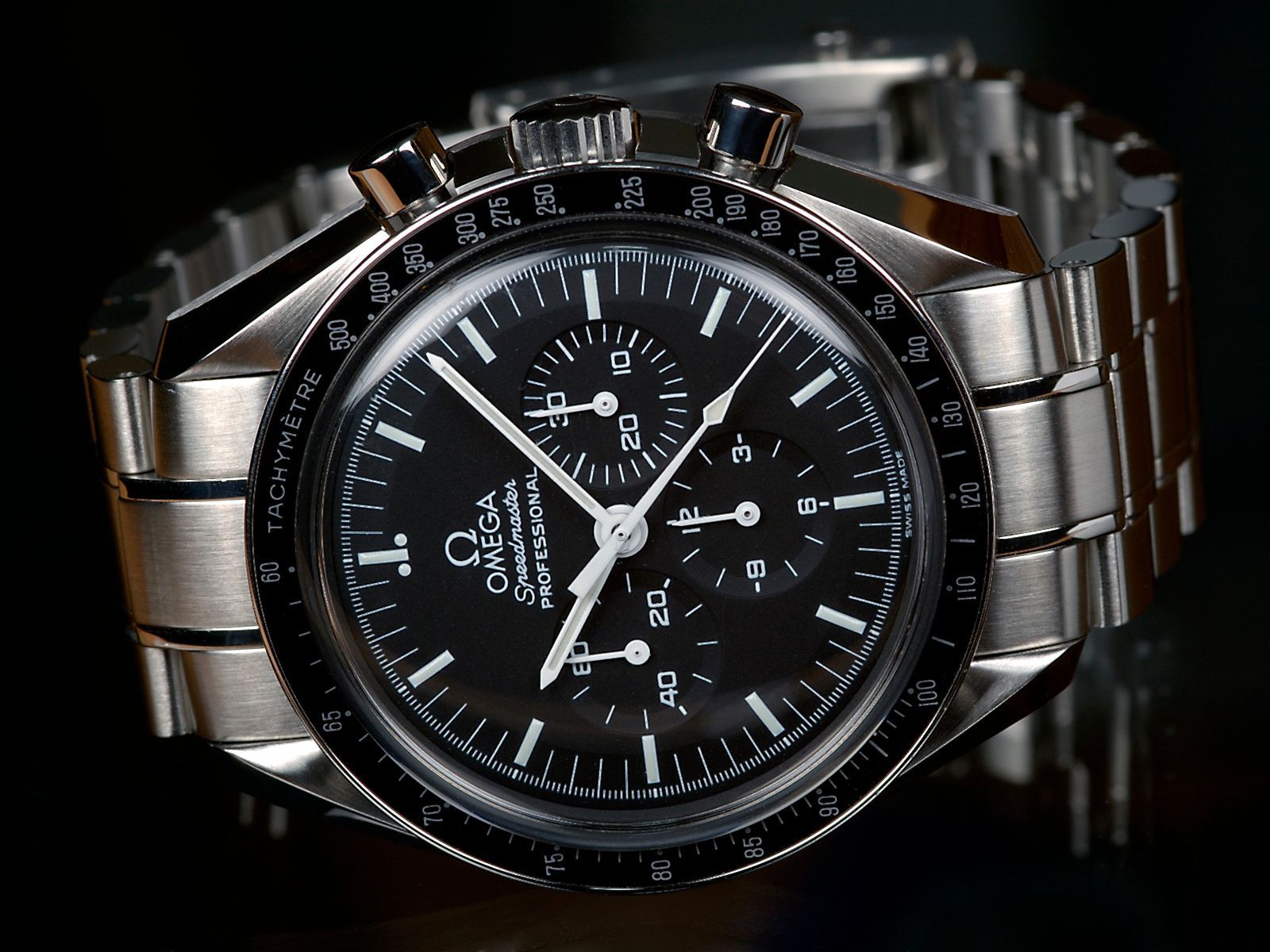
The Omega Speedmaster presents a more philosophically adjacent comparison. Like the Chronomat, the Speedmaster has deep operational heritage and a design that encodes that heritage visibly. The significant difference is scale and aesthetic register: the Speedmaster remains relatively compact by contemporary standards, its case profile understated, its bracelet conventional. The Chronomat is emphatically larger and more assertive. They are watches for different temperaments.
The honest assessment: the Chronomat offers relative accessibility compared to the Daytona — no waiting lists, no secondary market premium — combined with deeper operational heritage than many buyers realise.
Frequently Asked Questions
Is the Chronomat a good investment?
As a direct financial investment, the contemporary Chronomat has not historically appreciated at rates competitive with the Rolex Daytona. It trades at or near retail on the secondary market. However, it represents excellent value as a long-term keeper — well-made, genuinely heritage-backed, and pleasurable to wear daily. Vintage 81950 examples from 1984–1990 in original condition have shown more consistent appreciation than contemporary references.
What makes the 1984 relaunch historically significant?
Three reasons: it was a commercial rescue of a struggling brand; it established the rider tabs and Rouleaux bracelet as a visual language defining Breitling's identity for forty years; and it demonstrated that authentic operational heritage made legible in design could sustain a luxury sports watch against fashion cycles. The Frecce Tricolori requirement was not fictional — the watch was designed for real professional use, and that authenticity has sustained it.
What is the difference between the Chronomat B01 44 and the Super Chronomat?
The Super Chronomat (specifically the B01 44 Origins variants) differs in design references that invoke the 1984 original more explicitly — dial colour, bezel treatment, bracelet finishing. The movement is identical. For buyers who simply want the best current Chronomat, the standard B01 44 is mechanically identical and available in a wider range of configurations.
Is the Chronomat suitable for everyday wear?
At 44mm, wrist size matters — on wrists below approximately 17cm circumference it can read as oversized. On larger wrists it is an exceptionally capable everyday watch: comfortable bracelet, 200m water resistance, 70-hour power reserve. The Chronomat Automatic 38 offers the full design identity in a more universally wearable format.
What does a Breitling Chronomat cost?
The Chronomat B01 44 in steel with bracelet retails for approximately $7,000–$9,000. Coloured-dial configurations and special editions sit toward the top of that range; steel with rubber strap is typically lower. The Chronomat Automatic 36 and 38 are priced from approximately $4,500–$6,500. On the secondary market, contemporary references trade near retail; vintage 81950 references from 1984–1990 in original condition command meaningful premiums.