Jaeger-LeCoultre Master Ultra Thin: Calibre 920 and the Pursuit of Thinness
Jaeger-LeCoultre Master Ultra Thin: Calibre 849 and the Pursuit of Thinness
The pursuit of thinness in watchmaking is not merely aesthetic. A thin movement is technically more demanding to produce than a thick one: tolerances tighten as height is compressed, the regulating organ must be engineered for minimum height, and the gear train must be laid out in two dimensions rather than three. A thin watch also wears differently — it slides under a shirt cuff, sits flush against the wrist, and disappears in the way that a deep-lugged sports watch cannot.
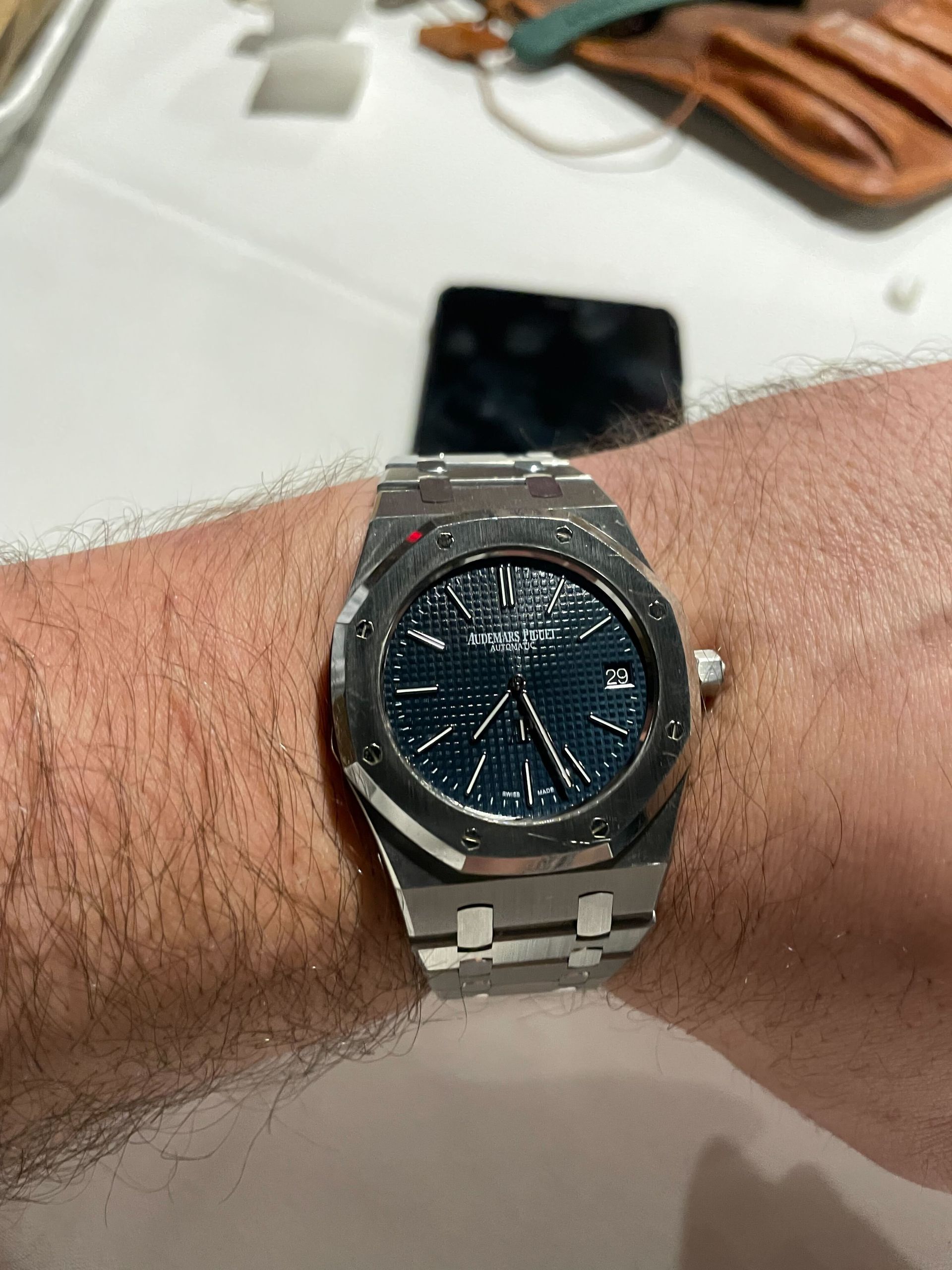
Jaeger-LeCoultre's ultra-thin credentials begin with the Calibre 920 of 1967 — 2.45mm thick, the world's thinnest automatic movement with a full-sized rotor at the time of its introduction. That calibre powered the original Nautilus and the Royal Oak. JLC's own ultra-thin line, built around the Calibre 849 , represents the manufacture's dress watch expression of the same technical priority.
Photo: Tiberido — CC BY-SA 4.0 — Wikimedia Commons
Foundation — Calibre 920 (1967)
Photo: Provo rossi — CC BY 4.0 — Wikimedia Commons
The Calibre 920 was designed at JLC but never used internally. At 2.45mm
base thickness, it was the world's thinnest automatic movement with a full-sized peripheral rotor at the time of its introduction. It was sold as an ébauche to three manufactures:
- Audemars Piguet
(Calibre 2121/2120/2800 — Royal Oak)
- Patek Philippe
(Calibre 28-255 — original Nautilus reference 3700/1A, 1976–1981)
- Vacheron Constantin
(Calibre 1120/1121/1122 — Patrimony, still produced today)
The Calibre 920 established JLC's technical authority in ultra-thin automatics, even if the watches it powered bore other names. The three manufactures that received it produced some of the most celebrated watches of the 1970s.
Calibre 849 — The Movement
Photo: LeCoultre & Co. — Public Domain — Wikimedia Commons
The Calibre 849 is the movement at the centre of JLC's own ultra-thin line.
Specifications:
- Thickness: 1.85mm
- Components: 123 parts
- Jewels: 20
- Frequency: 21,600 vph
(3 Hz)
- Power reserve: 36 hours
- Winding: Manual (hand-wound)
At 1.85mm, the Calibre 849 is one of the thinnest mechanical watch movements in current production. It descends from the Calibre 839 (1975), with revised bridges and one additional jewel. The movement's height is achieved through extreme tolerance control — the individual components must be machined to fractions of a millimetre in order to fit within the total 1.85mm height.
The Calibre 849 is used in the Master Ultra Thin in both solid-plate and skeletonized configurations.
Calibre 849SQ — Skeletonized Variant
The Calibre 849SQ
is the skeletonized version of the 849:
- Same thickness: 1.85mm
- Components: 119 parts
(4 fewer than the standard 849)
- The bridges and plates are cut away to leave only the structural members necessary for functional integrity
Skeletonizing a movement this thin requires removing material that conventional skeletonization could not touch — the structural margins are already minimal. The 849SQ achieves visual openness while maintaining the mechanical integrity of the non-skeletonized version at the same height.
Master Ultra Thin Jubilee (2014)
Photo: Clyde94 — CC BY-SA 4.0 — Wikimedia Commons
Introduced in 2014 for JLC's Jubilee anniversary programme, the Master Ultra Thin Jubilee achieved a total case thickness of 4.05mm — the thinnest mechanical wristwatch in the world at the time of its release.
- Case diameter: 39mm
- Movement: Calibre 849
- Case material: 18k pink gold or platinum
The 4.05mm figure refers to the complete cased watch, not the movement alone. The movement at 1.85mm expands to 4.05mm once the case components — crystal, case middle, caseback — are added. Achieving 4.05mm total required case engineering as precise as the movement itself.
Master Ultra Thin Squelette (2015)
Launched in July 2015 , the Master Ultra Thin Squelette achieved a total case thickness of 3.60mm — the thinnest mechanical watch in the world at time of release, surpassing the Piaget Altiplano 900P (3.65mm, 2014) by 0.05mm.
Specifications:
- Movement: Calibre 849SQ (skeletonized, 1.85mm)
- Total case thickness: 3.60mm
- Case diameter: 38mm
- Case material: 18k pink gold
The additional thinness over the Jubilee was achieved through a combination of skeletonization reducing the movement's mass profile and further refinement of the case architecture. The watch effectively creates the visual impression of wearing a movement on the wrist — the skeletonized bridges and plates are visible through the sapphire crystal on both the front and reverse.
Record note: Ultra-thin records are a moving target in Swiss watchmaking. As of the 2015 release the JLC Squelette held the record; subsequent introductions from Bulgari and Richard Mille have since produced thinner watches in different categories.
Master Ultra Thin Perpetual Calendar (from 2013)
The Calibre 868 extends the ultra-thin line into grand complication territory:
Calibre 868 specifications:
- Type: Automatic perpetual calendar
- Components: 336 parts
- Power reserve: 70 hours
- Introduction: 2013
Master Ultra Thin Perpetual case:
- Case diameter: 39mm
- Case thickness: 9.2mm
- Reference: Q1308470 (stainless steel), available in precious metals
The perpetual calendar is correct until 2100 once set (the Gregorian century exception means it will be one day ahead at 1 March 2100). Displays: day, date, month, year, and moonphase. The 9.2mm total case thickness for a perpetual calendar is a significant achievement relative to comparable complications from other manufactures.
Ultra-Thin Record Timeline
Photo: Provo rossi — CC BY-SA 4.0 — Wikimedia Commons
| Watch | Thickness | Year |
|---|---|---|
| JLC Calibre 920 (movement only) | 2.45mm | 1967 |
| Piaget Altiplano 900P (complete watch) | 3.65mm | 2014 |
| JLC Master Ultra Thin Jubilee (complete watch) | 4.05mm | 2014 |
| JLC Master Ultra Thin Squelette (complete watch) | 3.60mm | 2015 |
The Ultra-Thin Proposition
Photo: Daderot — CC0 1.0 Universal — Wikimedia Commons
Ultra-thin watches serve a specific purpose that thicker watches cannot: they disappear under a cuff, they do not catch on sleeve fabric, and they create no visible wrist profile through a shirt sleeve. For the buyer who wears a watch primarily in formal professional and social contexts, thinness is a functional specification rather than an aesthetic preference.
The Master Ultra Thin addresses this market with manufacture-level movement quality — the Calibre 849 is JLC's own, produced in Le Sentier, finished to manufacture standard. The alternative in the ultra-thin category is primarily Piaget, whose Altiplano line has traded directly with the JLC Squelette for the thinness record. Both manufactures produce legitimate integrated-manufacture thin movements; the preference between them is a matter of aesthetic rather than technical priority.
Frequently Asked Questions
What movement does the Master Ultra Thin use?
Calibre 849 — JLC's in-house manual-wind movement, 1.85mm thick, 123 parts, 21,600 vph, 36-hour power reserve. The skeletonized variant (Calibre 849SQ, 119 parts) is used in the Squelette.
How thin is the Master Ultra Thin Squelette?
3.60mm total case thickness — the thinnest mechanical watch in the world at its 2015 launch, surpassing the Piaget Altiplano 900P (3.65mm, 2014) by 0.05mm.
What is the Calibre 920?
A JLC-designed automatic movement from 1967 — 2.45mm thick, the thinnest full-rotor automatic at the time. Sold as an ébauche to Audemars Piguet (used in the Royal Oak), Patek Philippe (used in the original Nautilus), and Vacheron Constantin (still in production as Cal. 1120).
Does the Master Ultra Thin come in a perpetual calendar version?
Yes — the Master Ultra Thin Perpetual (from 2013) uses Calibre 868 (in-house automatic, 336 parts, 70-hour power reserve). Case: 39mm diameter, 9.2mm thick. Displays day, date, month, year, and moonphase.
What is the difference between the Calibre 849 and 849SQ?
The 849SQ is a skeletonized version of the 849 — same 1.85mm thickness, 119 components vs. 123 in the standard version. The bridges and plates are cut away to reveal the movement architecture while maintaining structural integrity.