Jaeger-LeCoultre Duomètre: The Dual-Wing Movement Architecture
Jaeger-LeCoultre Duomètre: The Dual-Wing Movement
The problem with conventional chronograph architecture is that the chronograph and the timekeeping function share the same power source. When the chronograph is engaged, energy is drawn from the single mainspring barrel that also drives the escapement. Under sufficient load — a large balance wheel, worn mainspring, extended chronograph use — this can degrade the oscillator's amplitude, introducing rate errors at precisely the moment when accuracy matters most: while timing something.
Jaeger-LeCoultre's Duomètre addresses this directly. Its Dual-Wing architecture separates the power sources: one mainspring barrel drives the timekeeping train and escapement, another drives all complications. They share a single oscillator but are otherwise energetically independent. The complication can draw as much power as it requires without affecting the amplitude — and the accuracy — of the timekeeping function.
Photo: Tiberido — CC BY-SA 4.0 — Wikimedia Commons
Historical Precedent — Calibre 19/20RMSMI (1881)
Photo: Provo rossi — CC BY 4.0 — Wikimedia Commons
The Dual-Wing concept was not invented for the Duomètre. JLC traces it to its own pocket watch Calibre 19/20RMSMI of 1881 , which also used two barrels — one for timekeeping, one for the complications. The 2007 Duomètre reapplied the architecture to a wristwatch format with contemporary engineering precision.
The historical precedent is significant because it positions the Duomètre as a continuation of a JLC technical tradition rather than a novel invention. The Calibre 380, the first Duomètre movement, is connected to a 126-year lineage of the same fundamental concept.
Dual-Wing Architecture — How It Works
Photo: LeCoultre & Co. — Public Domain — Wikimedia Commons
The Dual-Wing mechanism operates as follows:
First wing (timekeeping):
- Dedicated mainspring barrel
- Powers the gear train that drives the escapement and regulating organ
- Drives the hours and minutes display
Second wing (complication):
- Separate mainspring barrel
- Powers all complication functions — in the first Duomètre, the chronograph seconds, flyback mechanism, and all related displays
Shared element:
- A single oscillator (balance wheel and escapement) governs both wings
- Both gear trains are regulated by the same regulating organ
Winding system:
- A single crown winds both barrels sequentially
- A dynamometric decoupling system
prevents overwinding either barrel independently
- The crown rotates clockwise to wind the timekeeping barrel, anti-clockwise for the complication barrel — or JLC's mechanism sequences them automatically
Key consequence: The chronograph cannot impose a load on the oscillator because it does not draw power from the timekeeping barrel. The oscillator is fed at constant amplitude from the timekeeping barrel regardless of what the complication barrel is doing. A Duomètre chronograph is theoretically more accurate than a conventional single-barrel chronograph design under the same conditions.
Calibre 380 — The First Duomètre (2007)
Photo: Ghilt — CC BY-SA 3.0 — Wikimedia Commons
Introduced at SIHH Geneva 2007 , the Calibre 380 was the first Duomètre movement and the foundation of the collection.
Calibre 380 specifications:
- Two mainspring barrels (Dual-Wing)
- Column-wheel chronograph
- Flyback function
- Power reserve indicator (two separate indicators — one for each barrel)
- Frequency: 28,800 vph (4 Hz)
Case: approximately 45mm , 18k gold
The column-wheel chronograph in the Duomètre à Chronographe operates with the precision characteristic of column-wheel designs: the column wheel's positive mechanical engagement — each rotation advancing the mechanism one step — provides tactile clarity at the pushers and reliable chronograph function across repeated start/stop operations.
The two separate power reserve indicators are a functional consequence of the Dual-Wing architecture: because the two barrels are independent, their states of wind must be displayed independently. A single power reserve indicator would be inadequate.
Key Duomètre References
Photo: Clyde94 — CC BY-SA 4.0 — Wikimedia Commons
Duomètre à Chronographe (2007): Calibre 380, column-wheel chronograph with flyback, ~45mm case. The founding reference.
Duomètre à Quantième Lunaire (2008): Calibre 381 — Dual-Wing with moonphase and date rather than a chronograph. Extends the architecture into the calendar complication domain.
Duomètre à Sphérotourbillon: Calibre with a spherical tourbillon — the tourbillon cage rotates on two axes (one at 30-second intervals, one at 15-second intervals, set at a 30° tilt), providing a multi-plane correction of gravitational error. Limited editions in platinum (50 pieces) and pink gold.
Duomètre à Grande Sonnerie (2009): Calibre 182 — part of the Hybris Mechanica 55 trilogy. Over 1,300 components; 26 complications including grande sonnerie, petite sonnerie, Westminster carillon, minute repeater, flying tourbillon, and retrograde perpetual calendar.
Duomètre Chronograph Moon (2024): Calibre 391 — the latest Duomètre variant, combining chronograph and celestial display. Continues the architectural tradition into the current production era.
The Two Power Reserve Indicators
Photo: Daderot — CC0 1.0 Universal — Wikimedia Commons
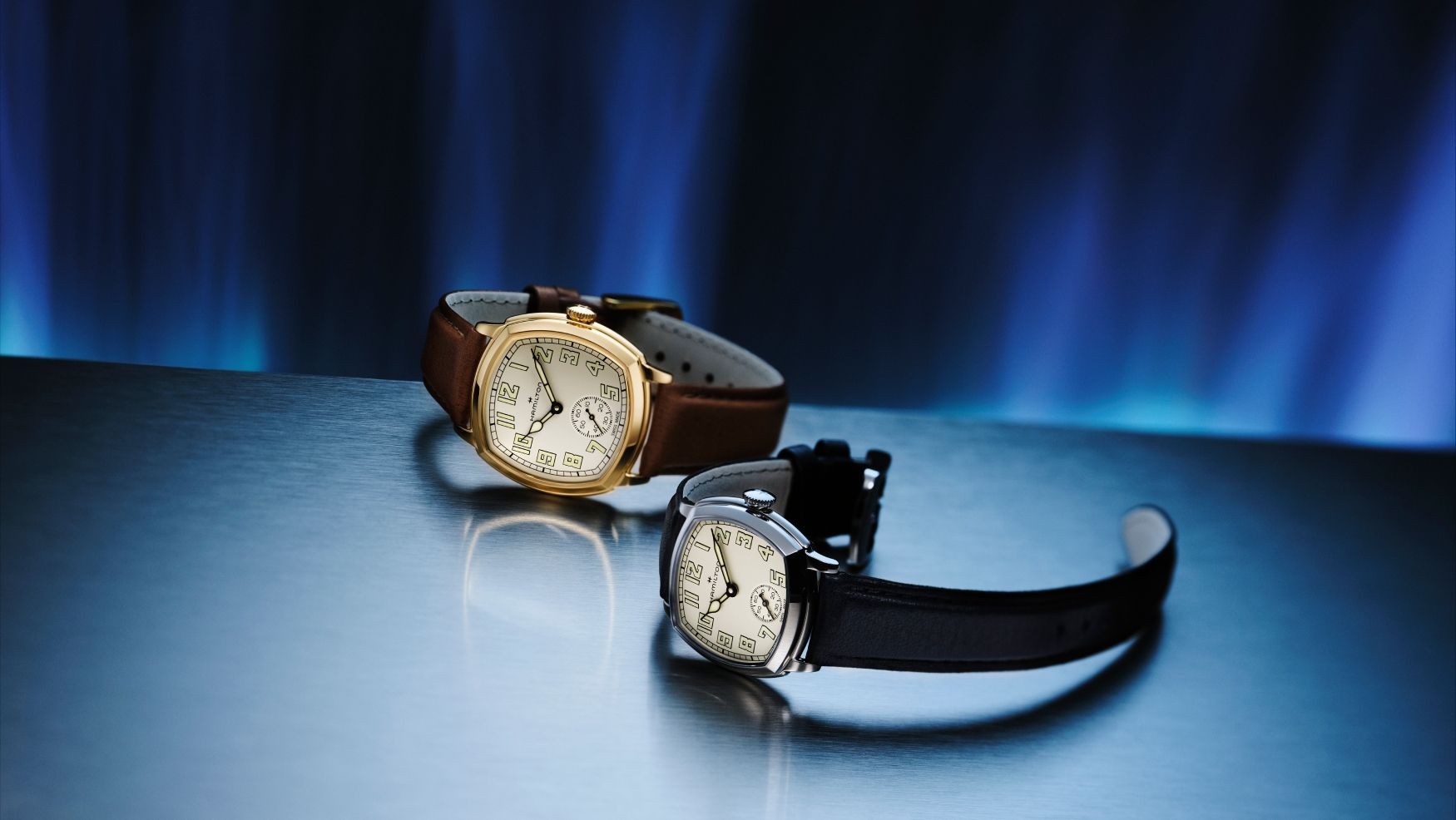
Every Duomètre that uses both barrels for separate functions displays two power reserve indicators — typically positioned symmetrically on the dial. This is not a styling choice; it is a functional requirement. The owner needs to know the state of each barrel independently: a depleted complication barrel will stop the chronograph but not the time display, while a depleted timekeeping barrel will stop the watch entirely. The two indicators communicate different practical information.
This functional explanation also explains the Duomètre's dial layout — the symmetrical reserve indicators on either side of the dial are immediately identifiable and place the Duomètre among the most legible grand complications in terms of communicating the movement's state.
Collector Position
The Duomètre à Chronographe is one of the most technically sophisticated manually wound chronograph-plus-complications watches available from a major manufacture. Its reference within JLC's hierarchy places it above the Master Control and Polaris lines and within the grand complications territory occupied by the Hybris Mechanica pieces.
Pre-owned Duomètre à Chronographe and Quantième Lunaire references trade at premiums above retail, driven by limited production and the complexity of the movement rather than allocation dynamics. The Sphérotourbillon variants, at original retail prices exceeding USD $250,000, represent the upper tier of the Duomètre market and are held by a small collector audience.
Frequently Asked Questions
What is the Duomètre Dual-Wing movement?
An architecture using two independent mainspring barrels sharing a single escapement. One barrel powers the timekeeping function; the other powers all complications. This ensures that the complication (typically a chronograph) cannot draw power from the timekeeping train or degrade the oscillator's amplitude — improving accuracy while the complication is in use.
When was the Duomètre introduced?
SIHH Geneva, 2007. The first reference was the Duomètre à Chronographe, powered by Calibre 380 — a column-wheel flyback chronograph using the Dual-Wing architecture.
Why does the Duomètre have two power reserve indicators?
Because it has two independent barrels. The timekeeping barrel and the complication barrel have separate states of wind that must be communicated independently — a single indicator would be inadequate and potentially misleading about the watch's functional state.
What complications have been made in Duomètre form?
Chronograph (Cal. 380), moonphase + date (Cal. 381), spherical tourbillon (Sphérotourbillon), grande sonnerie + minute repeater + flying tourbillon + perpetual calendar (Cal. 182 — part of Hybris Mechanica 55), and chronograph + celestial display (Cal. 391, 2024).
What is the historical precedent for the Dual-Wing?
JLC's own pocket watch Calibre 19/20RMSMI of 1881, which also used two barrels — one for timekeeping, one for complications. The Duomètre reapplied this 126-year-old concept to a wristwatch format with contemporary engineering precision.
Related Articles
- Jaeger-LeCoultre: The Great Watchmaker of the Vallée de Joux
- Jaeger-LeCoultre Grand Complications: Hybris Mechanica
- Jaeger-LeCoultre Reverso: The Swiveling Watch Since 1931
- Jaeger-LeCoultre Master Control: The 1000 Hours Standard
- Jaeger-LeCoultre Master Ultra Thin: Calibre 849 and the Pursuit of Thinness