Ulysse Nardin Freak X Second Generation: 25 Years of Radical Timekeeping, Now More Wearable Than Ever
In 2001, Ulysse Nardin introduced a watch so conceptually strange that the industry didn't know what to call it. The original Freak had no dial, no hands, and no crown. The movement itself displayed the time, revolving around a central arbor so that the two rotating bridges — one for hours, one for minutes — acted as the indicators. It ran on silicon escapement wheels at a moment when silicon was essentially unknown in fine watchmaking. The effect was disorienting and brilliant in equal measure, and twenty-five years later, Ulysse Nardin has completely rebuilt the watch's more accessible sibling to mark the occasion.
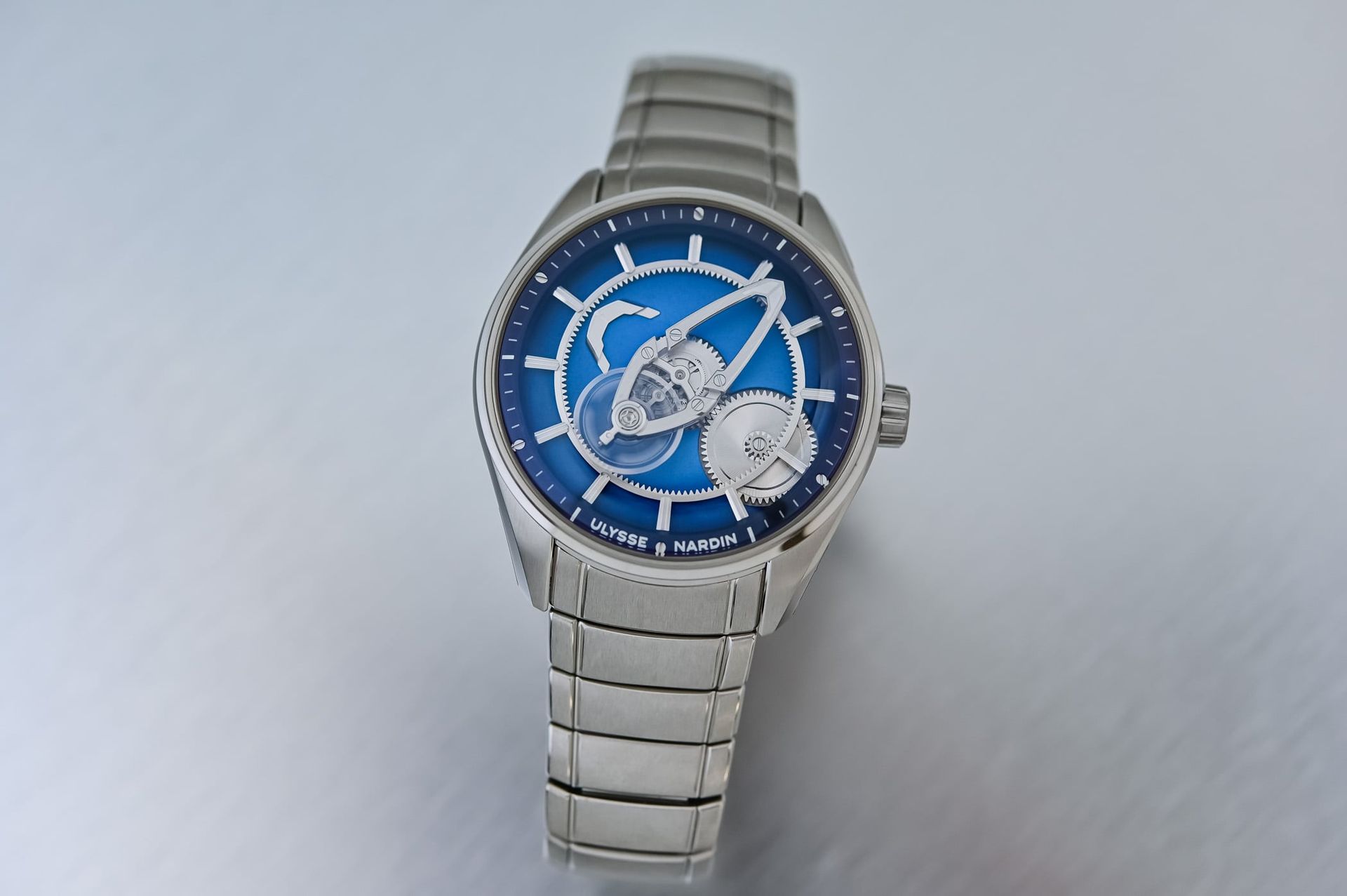
The Ulysse Nardin Freak X Second Generation (Calibre UN-232) is a ground-up redesign of the Freak X line introduced in 2019. Every significant dimension has changed, the movement architecture is new, and for the first time in the Freak's entire 25-year history, the watch winds itself automatically — via a rose gold micro-rotor integrated directly into the carousel mechanism.
What Ulysse Nardin Rebuilt — and Why It Matters
The first-generation Freak X (2019–2025) wore 43mm across the case and measured 49.6mm lug-to-lug. It was manual-winding and achieved 50 metres of water resistance. These numbers were defensible but they placed the watch firmly in the category of display pieces — something you'd wear to impress, not necessarily every day.
The second generation corrects each of these points systematically. The case shrinks to 41mm in diameter and 47.3mm lug-to-lug — meaningful reductions that allow the watch to sit convincingly on smaller wrists and slide under a shirt cuff. Thickness measures 10.35mm at the caseback rising to 13.6mm with the new glassbox sapphire crystal. The case is now monobloc rather than modular — one machined piece rather than the previous titanium sub-frame architecture — which allowed engineers to add a screw-down crown and double the water resistance to 100 metres .
The most significant change is inside. The new Calibre UN-232 incorporates a rose gold micro-rotor — the first automatic-winding mechanism in the 25-year history of the Freak line. Every Freak before this model, from the original 2001 piece through the entire Freak X generation, required the owner to wind manually. The micro-rotor is jewel-mounted and visible through the sapphire caseback, its warm gold tone contrasting with the steel architecture of the carousel. It runs at 21,600 vph , powers a 72-hour reserve , and drives 216 components across 27 jewels.
The escapement is new, too: a DIAMonSIL system in which both the escape wheel and pallet anchor are treated with a diamond-like carbon coating rated for more than 250 million annual impacts. The oversized silicon balance wheel and thermocompensated silicon hairspring are produced at SIGATEC, Ulysse Nardin's in-house silicon manufacturing facility. The result is an escapement that requires no lubrication, resists wear more aggressively than any previous Freak calibre, and improves long-term precision over years of service.
The 2001 Original: Why the Freak Still Matters
The second generation earns its price tag in part because the first generation deserved one. The 2001 Freak, conceived by Dr. Ludwig Oechslin and commissioned by Rolf Schnyder, introduced silicon escapement components to fine mechanical watchmaking before any other brand had attempted it commercially. The decision was made not for novelty but for precision: silicon is harder than steel, requires no lubrication, is non-magnetic, and can be photolithographically etched to tolerances impossible for traditional machined metals. Nearly every Swiss manufacture has since adopted silicon in some form, but Ulysse Nardin was first and did so across the entire escapement in one radical step.
The Freak was also the first watch to display time using the movement as the indicator — the two rotating bridges carrying their respective time information around the dial as the mainspring unwound. There was no separate dial ring, no printed chapter, nothing but the mechanics themselves. The crown, which exists on the new Freak X as a screw-down fitting, was absent entirely on the original: winding and setting were accomplished by rotating the caseback and then the bezel. It remains one of the most intellectually complete watch designs of the past half-century.
The Freak X Second Generation: Three Variants
The new Freak X launches in three configurations. Two use recycled steel (described as containing at least 80% recycled material) in 41mm cases; the third uses rose gold throughout.
| Variant | Reference | Material | Dial | Strap | Price (USD) |
|---|---|---|---|---|---|
| Grey | 2323-500-1A/0A | Recycled steel | Sandblasted grey hour disc | Light brown calfskin | $41,200 |
| Blue | 2323-500-3A/7A | Recycled steel | Blue gradient satin sunburst | Integrated steel bracelet | $42,400 |
| Gold | 2322-500-2A/1A | Rose gold | Sandblasted black hour disc | Black alligator, rose gold clasp | $64,000 |
All three feature the same quick-release interchangeable strap system requiring no tools, with nine total strap and bracelet combinations available at launch including leather, rubber, and steel options. The Blue variant's integrated bracelet includes on-the-fly micro-adjustment of 2mm per side at the clasp.
This is a permanent collection addition, not a limited anniversary edition. Ulysse Nardin has positioned the second-generation Freak X as the ongoing Freak X line going forward rather than a commemorative capsule — which means the 25th anniversary milestone marks a chapter, not a farewell.
Movement: UN-232 automatic, micro-rotor, DIAMonSIL escapement
Frequency: 21,600 vph | Power reserve: 72 hours | Components: 216 | Jewels: 27
Case: 41mm | 13.6mm thick (with crystal) | 47.3mm L2L | Monobloc steel or rose gold
Water resistance: 100m | Crown: Screw-down
Caseback: Sapphire display | Crystal: Glassbox sapphire with AR coating
What the Freak X Second Generation Gets Right
The wearability argument is now a serious one. At 41mm with a monobloc case and those lug dimensions, the Freak X Second Generation behaves as a daily watch in a way the first generation could not. The screw-down crown and 100-metre depth rating make it genuinely splash-proof for real life rather than controlled exposure. The automatic winding removes the one practical inconvenience that would have caused most owners to keep it as a watch-box piece.
At $41,200 for the steel entry point, the Freak X sits at the lower boundary of genuine haute horlogerie — the category of watches built primarily to demonstrate the limits of mechanical ingenuity rather than to tell time efficiently. Compared to six-figure alternatives from independent makers, the price-to-complication ratio is unusually favourable. What you are paying for is 25 years of silicon movement research, an in-house carousel mechanism assembled by a single watchmaker, and a concept that is still, in 2026, unlike anything else available at any price.
Frequently Asked Questions
What is the Ulysse Nardin Freak X?
The Freak X is Ulysse Nardin's more accessible line within the Freak family, introduced in 2019 as a 43mm watch. The second generation, launched in 2026 for the Freak's 25th anniversary, is a 41mm redesign featuring the first automatic (micro-rotor) winding in any Freak model and a new DIAMonSIL silicon-and-diamond escapement. It retains the carousel mechanism that displays time by rotating the movement around a central arbor — there are no traditional hands or dial in the conventional sense.
How does the Freak X display time?
Two rotating bridges travel around the case at different speeds: the upper bridge completes a rotation every 60 minutes, indicating minutes; the lower bridge (which also serves as the barrel cover) completes a rotation every 12 hours, indicating hours. The bridges are read against a fixed chapter ring at the case edge. The carousel movement is the indicator — not a set of hands attached to a central arbor in the conventional way.
Is the Freak X Second Generation a limited edition?
No. Ulysse Nardin has released the second-generation Freak X as a permanent collection model in three configurations (Grey steel, Blue steel, Gold rose gold). It is not numbered or production-limited.
What is the DIAMonSIL escapement?
DIAMonSIL is Ulysse Nardin's proprietary silicon escapement technology in which the escape wheel and pallet anchor are treated with a diamond-like carbon coating. The treatment dramatically increases surface hardness, reduces friction, eliminates the need for lubrication, and extends the operating life of the escapement. The system is rated for more than 250 million impacts annually — a figure relevant because the escapement fires thousands of times per hour over the life of the watch.
What is the price of the Ulysse Nardin Freak X Second Generation?
The steel Grey variant (reference 2323-500-1A/0A) with calfskin strap starts at $41,200 USD / CHF 33,500 / EUR 37,500 . The Blue steel variant on integrated bracelet (2323-500-3A/7A) is $42,400 / CHF 34,500 / EUR 38,600 . The Rose Gold variant (2322-500-2A/1A) with black alligator strap is $64,000 / CHF 52,000 / EUR 58,200 .
Sources: Ulysse Nardin (ulysse-nardin.com), Monochrome Watches, SJX Watches, Gear Patrol, WatchTime, Oracle of Time, Worn & Wound. Specifications and pricing as reported at launch, June 2026.