Grand Seiko Heritage Collection: The 44GS Design Language and Hi-Beat 9S85
Grand Seiko Heritage Collection: The 44GS Design Language
In 1962, Taro Tanaka — a Seiko industrial designer — began a study that changed the direction of Grand Seiko's visual identity. He spent time at WAKO, the most prestigious luxury department store in Ginza, observing how customers across different cultures responded to watch design. His conclusion: Grand Seiko lacked a clear identity and its cases lacked the optical brilliance of the finest Swiss watches.
The result, after five years of development, was the 44GS of 1967 — the first Grand Seiko watch designed from inception according to a set of codified visual principles. Those principles became known as the Grand Seiko Style or the Grammar of Design , and they remain the foundation of every Heritage Collection watch produced today.
Photo: Hiroaki Kikuchi (Torajiro) — CC BY-SA 3.0 — Wikimedia Commons
The 44GS — 1967
Photo: Roland Fischer (Dnalor 01) — CC BY-SA 3.0 AT — Wikimedia Commons
The 44GS was introduced in 1967 by Daini Seikosha (the Tokyo-based Seiko manufacturing arm). Its calibre — the Cal. 4420 — ran at 36,000 vph (Hi-Beat), and the case design applied Tanaka's design principles systematically for the first time.
The name "44GS" derives from the calibre number (44xx series). The 62GS , introduced by Suwa Seikosha in the same period, was the Nagano arm's corresponding design statement — a tonneau-shaped case applying the same principles from a different perspective.
Both the 44GS and 62GS are reproduced in limited Heritage Collection references today, with modern movements housed in period-correct case geometries.
The Nine Design Principles of Grand Seiko Style
Photo: STSPP — CC BY-SA 4.0 — Wikimedia Commons
Tanaka's design philosophy was codified into nine principles that define what is now called the Grand Seiko Style. Every Heritage Collection watch is built to comply with all nine.
- Flat, wide surfaces on the dial, case, and hands — maximised surface area for light reflection
- Distortion-free mirror surfaces — a polished flat surface must be geometrically true; any convexity destroys the clean reflection
- Flat dial — ensuring legibility from any angle without parallax distortion
- Flat, mirror-polished bezel — achieved exclusively by Zaratsu polishing on a rotating tin disc
- Inward-slanted case sides — the case walls angle slightly inward, making the watch appear thinner and creating expressive light sparkles at the transition
- Smoothly curved caseback edge — softening the geometry for wearing comfort without disrupting the optical character of the sides
- The 12 o'clock index is twice the width of other indices — establishing a strong vertical axis from 12 to 6 o'clock and creating immediate dial orientation
- Multi-faceted hands and indices — shaped and finished to maximise their interaction with light at multiple angles
- Three-dimensional curves avoided in case and bezel design — the geometry is composed of flat planes and their intersections, not curves that soften edges
The result of applying all nine simultaneously is the characteristic Grand Seiko case: immediately recognisable by its combination of hard-edged geometry, flat mirror planes, and the visual depth that comes from the contrast between polished and brushed surfaces meeting at knife-sharp ridges.
Calibre 9S85 — Hi-Beat Automatic
Photo: STSPP — CC BY-SA 4.0 — Wikimedia Commons
The Heritage Collection's mechanical flagship is Calibre 9S85 — the Hi-Beat automatic introduced in 2010 that preceded the 9SA5.
- Type: Self-winding (automatic) mechanical, Hi-Beat
- Jewels: 37
- Frequency: 36,000 vph (10 beats per second)
- Power reserve: 55 hours
- Accuracy: +5/−3 seconds per day
- Hairspring: Spron 610 (proprietary alloy, produced in-house)
- Mainspring: Spron 530 (proprietary high-torque alloy, required for Hi-Beat frequency)
- Shock protection: Diashock
- Introduction: 2010
The Spron 530 mainspring is a specific development for the Hi-Beat application. Running at 36,000 vph increases mainspring consumption relative to standard-beat movements; the Spron 530 alloy is formulated to provide the higher torque required without losing power reserve performance.
Key references using 9S85:
- SBGH201, SBGH267, SBGH269:
40mm stainless steel, Hi-Beat, various dial colours
- SBGJ series:
Some GMT configurations also use the 9S85 platform
The 62GS — Suwa Seikosha's Heritage Design
The 62GS represents the Suwa Seikosha (Nagano) answer to the 44GS — a tonneau-shaped case applying the Grand Seiko Style principles to a softer, more rounded outline. Where the 44GS is rectilinear, the 62GS is organic.
Both case types are reproduced in the Heritage Collection as period-reference limited editions. The modern interpretation typically houses a contemporary movement (9S65 standard automatic or 9S85 Hi-Beat) in a case that faithfully restores the original geometry, including case dimensions, lug profile, and crown position.
Heritage Collection and the Snowflake
Photo: STSPP — CC BY-SA 4.0 — Wikimedia Commons
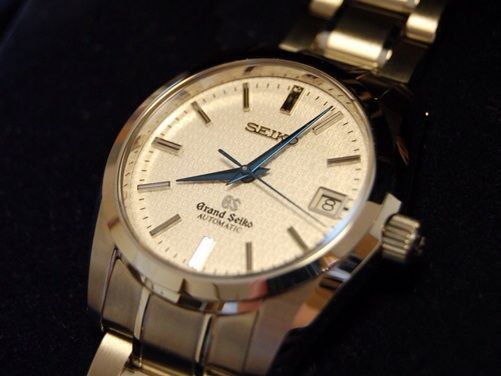
The SBGA211 "Snowflake" is technically classified within the Heritage Collection's Spring Drive tier — its case follows the 44GS design principles, its movement is the standard Spring Drive 9R65. This positions the Snowflake as an expression of the Heritage Collection's design vocabulary powered by a Spring Drive rather than a mechanical movement.
The Heritage Collection's Spring Drive references (SBGA series) differ from the mechanical Heritage references primarily in movement technology. The case finishing, dial standards, and design principles are consistent throughout.
44GS 55th Anniversary — 2022
Photo: Hiroaki Kikuchi (Torajiro) — CC BY-SA 3.0 — Wikimedia Commons
In 2022, Grand Seiko marked the 55th anniversary of the 44GS with the SBGP017 — a 40mm stainless steel watch in the 44GS case design powered by the 9F85 quartz movement.
- Movement: Calibre 9F85 quartz
- Accuracy: ±5 seconds per year
- Case: 40mm stainless steel, 44GS design
- Significance: The 9F quartz calibre achieves ±5 seconds/year — a precision that exceeds most mechanical movements, and a reminder that Grand Seiko's quartz programme is not a concession to the mass market but a serious technical programme in its own right
The SBGP017 makes the case that the 44GS case design is architecture rather than a container for a specific movement technology — it works equally well in mechanical, Spring Drive, and quartz configurations because the design principles are movement-independent.
Frequently Asked Questions
What is the 44GS?
The 1967 Grand Seiko model that first applied Taro Tanaka's nine design principles — flat wide surfaces, distortion-free mirror polish, inward-slanted case sides, the distinctive 12 o'clock index — in a codified, systematic way. The Heritage Collection's case design derives directly from the 44GS.
What are the nine design principles of Grand Seiko Style?
Flat wide surfaces, distortion-free mirror polish, flat dial, flat Zaratsu-polished bezel, inward-slanted case sides, curved caseback edge, double-width 12 o'clock index, multi-faceted hands and indices, and avoidance of three-dimensional curves in case geometry.
What movement is in the Heritage Collection Hi-Beat?
Calibre 9S85 — self-winding, 37 jewels, 36,000 vph, 55-hour power reserve, +5/−3 seconds/day accuracy. Hairspring in Spron 610 alloy, mainspring in Spron 530.
What is the 62GS?
The Suwa Seikosha (Nagano) design companion to the 44GS, featuring a tonneau-shaped case applying Grand Seiko Style principles to a softer outline. Both the 44GS and 62GS case designs are reproduced in Heritage Collection limited editions.
What is the difference between the Heritage Collection and the Elegance Collection?
Both use the 44GS design language. The Heritage Collection includes Hi-Beat variants (9S85) and the full range of Spring Drive references (SBGA series including Snowflake). The Elegance Collection is defined by emphasis on traditional Japanese dial artistry (Urushi, Kirazuri) with standard-beat mechanical calibres.