
Audemars Piguet Royal Oak Concept: History of AP’s R&D Showcase

Zach Charles • May 22, 2026

Share this article

Royal Oak Concept: AP's R&D Showcase

Every major Swiss manufacture needs a laboratory. A place where the constraints of production cost, wearability, and commercial viability can be suspended long enough to ask what is actually possible — what a movement can achieve when the engineers are not required to produce it at scale, and what materials can accomplish when weight and cost are secondary considerations to performance. For Audemars Piguet, that laboratory is the Royal Oak Concept.

Introduced in 2002 to mark the Royal Oak's 30th anniversary, the Concept began as a single limited edition of 150 pieces. It has evolved into a permanent sub-collection that serves a specific purpose within AP's catalogue: the watch where the brand shows what it can do when freed from the requirement to make financial sense. Skeletonized movements in forged carbon cases. Flying tourbillons in titanium. Combinations of complications that required years of development to achieve and that will be produced in dozens of pieces rather than thousands.

The Concept is where AP's future sometimes appears first.


Audemars Piguet Royal Oak Offshore Diver
An Audemars Piguet Royal Oak Offshore Diver — extending the Offshore’s dimensions and materials into the professional dive watch specification. The Royal Oak Offshore Diver retains the case architecture Genta introduced for the original Royal Oak while adding a rotating inner bezel, helium escape valve, and increased water resistance appropriate to professional diving use.
Photo: Clyde94 — CC BY-SA 4.0 — Wikimedia Commons

Origin — 30th Anniversary, 2002

Audemars Piguet ref. 25831 with date, power reserve and tourbillon, 1997
An Audemars Piguet reference 25831 from 1997, combining date, power reserve indicator, and tourbillon complication. AP’s 1986 tourbillon — the first self-winding tourbillon — established the manufacture’s position at the apex of Swiss horology. The automatic tourbillon, previously considered technically contradictory (the oscillating rotor mass working against the tourbillon’s vibration-isolation function), was AP’s most significant achievement of the decade.
Photo: EMore98 — CC BY-SA 4.0 — Wikimedia Commons

The Royal Oak Concept was created for the watch's 30th birthday in 2002. The brief was to demonstrate what the Royal Oak could be if the original's constraints — the ultra-thin brief, the steel commercial proposition — were replaced by an engineering-first mandate. What would the Royal Oak look like if AP's best watchmakers were asked to create the most technically ambitious version they could conceive?

The original 2002 Concept housed a flying tourbillon with a 72-hour power reserve, visible through a skeletonized dial that removed the tapisserie guilloché entirely in favour of open movement architecture. The case was titanium. The 150-piece production figure was intentional: rare enough to be significant, numerous enough to be distributed to the clients AP most wanted to recognise.

The reception confirmed that a market existed for the Concept's extreme positioning. AP formalised it as a permanent sub-collection.


What the Concept Is — and Is Not

Audemars Piguet Royal Oak Offshore Diver
An Audemars Piguet Royal Oak Offshore Diver — extending the Offshore’s dimensions and materials into the professional dive watch specification. The Royal Oak Offshore Diver retains the case architecture Genta introduced for the original Royal Oak while adding a rotating inner bezel, helium escape valve, and increased water resistance appropriate to professional diving use.
Photo: Clyde94 — CC BY-SA 4.0 — Wikimedia Commons

Understanding the Royal Oak Concept requires distinguishing it from the rest of the Royal Oak family:

It is not a larger or more complicated Royal Oak in the sense that the Offshore is a sportier Royal Oak. The Offshore shares the Royal Oak's design vocabulary in an enlarged, more aggressive form. The Concept departs from the Royal Oak's design language in several respects — particularly the open-worked dial that replaces the tapisserie with visible movement architecture.

It is a watch that carries the Royal Oak's octagonal bezel and integrated-bracelet DNA while using it as the vehicle for avant-garde technical exploration. The Concept's case retains the eight screws and the octagonal form; everything behind the bezel is different in intention and execution.

Materials used in Concept references include:
- Forged carbon (extremely light, non-reflective, carbon-fibre derived)
- Ceramic (scratch-resistant, non-reflective)
- Titanium (lightweight, hypoallergenic)
- Tantalum (dense, dark, extremely rare in watchmaking)
- Combinations of the above — titanium case with ceramic bezel, forged carbon with titanium

These materials are chosen for performance properties relevant to the watch's functional brief, not for luxury signalling in the traditional precious metal sense. A Concept reference in forged carbon is not cheaper than one in gold — it is different in character, and often more expensive.


The Flying Tourbillon — The Concept's Signature

Audemars Piguet ref. 25831 with date, power reserve and tourbillon, 1997
An Audemars Piguet reference 25831 from 1997, combining date, power reserve indicator, and tourbillon complication. AP’s 1986 tourbillon — the first self-winding tourbillon — established the manufacture’s position at the apex of Swiss horology. The automatic tourbillon, previously considered technically contradictory (the oscillating rotor mass working against the tourbillon’s vibration-isolation function), was AP’s most significant achievement of the decade.
Photo: EMore98 — CC BY-SA 4.0 — Wikimedia Commons

Most Concept references feature a flying tourbillon. Understanding why requires understanding the tourbillon and the "flying" distinction.

A tourbillon mounts the escapement and balance wheel in a rotating cage that completes one full rotation per minute. The rotation continuously averages out the positional errors that gravity creates in a vertical watch position — the escapement is never resting in one orientation long enough for that orientation's gravitational effect to accumulate meaningfully. Developed by Abraham-Louis Breguet in 1801 for pocket watches, the tourbillon was the most ambitious mechanism in eighteenth-century watchmaking.

A flying tourbillon eliminates the upper bridge that supports the tourbillon cage in a conventional design. The cage appears to float unsupported — it is actually cantilevered from below, held by a single bottom bearing. The flying design offers two advantages: the tourbillon becomes visually lighter and more dramatically legible, and the upper field of view through the dial is unobstructed by a bridge. It is a technically demanding alternative to the conventional tourbillon, requiring the single bearing to bear all loads that the upper bridge would otherwise share.

The flying tourbillon, visible through the Concept's open dial at full rotation per minute, is one of the most compelling things a watch can show its wearer. AP's production of the flying tourbillon in the Concept is among the brand's strongest statements of manufacture capability.


The RD# Research Series

Audemars Piguet Royal Oak Offshore Diver
An Audemars Piguet Royal Oak Offshore Diver — extending the Offshore’s dimensions and materials into the professional dive watch specification. The Royal Oak Offshore Diver retains the case architecture Genta introduced for the original Royal Oak while adding a rotating inner bezel, helium escape valve, and increased water resistance appropriate to professional diving use.
Photo: Clyde94 — CC BY-SA 4.0 — Wikimedia Commons

AP formalised a numbered research and development programme — the RD# series — to document specific technical breakthroughs and create watches that embody them. Each RD# project addresses a specific horological problem; the resulting watch demonstrates the solution.

RD#1 — Supersonnerie (2015):
The project that addressed acoustic engineering in minute-repeating watches. Conventional minute repeaters lose significant acoustic energy to the case structure — the vibrations are dampened by the metal. AP's research produced a striking mechanism with improved resonance properties, transmitted via a dedicated membrane rather than through the case walls. The auditory result was notably louder and clearer than conventional minute repeaters of comparable case size. The Supersonnerie technology has since migrated into production complications across the Royal Oak family.

RD#2 — Ultra-Thin Perpetual Calendar:
The project that pursued a semi-Gregorian perpetual calendar in ultra-thin format — approaching the Jumbo's case dimensions while incorporating the perpetual calendar mechanism. "Semi-Gregorian" acknowledges the 2100 correction requirement rather than mechanically computing century-exceptions. The RD#2 demonstrated that perpetual calendar function and ultra-thin architecture were not mutually exclusive, though the margin required extremely high precision engineering.

RD#3 — Flying Tourbillon in the Jumbo Case:
The project that placed a flying tourbillon into the Royal Oak Jumbo's ultra-thin case — combining the most demanding complication with the most demanding case constraint. The result demonstrated that a self-winding flying tourbillon could be integrated into a case approaching the Jumbo's 8mm profile.

RD#4 — Code 11.59 Universelle:
The ultra-complication that combined the technologies from RD#1, RD#2, and RD#3 into a single movement housed in the Code 11.59 case. The Universelle deploys the Supersonnerie striking mechanism, the ultra-thin perpetual calendar, and the self-winding flying tourbillon simultaneously. It is among the most technically ambitious wristwatches ever produced by any manufacturer.

RD#5 — Royal Oak Jumbo Extra-Thin Selfwinding Flying Tourbillon Chronograph:
The subsequent RD project after the Universelle, demonstrating flying tourbillon and chronograph function in the Jumbo's ultra-thin architecture.


Production, Pricing, and the Collector Position

Audemars Piguet ref. 25831 with date, power reserve and tourbillon, 1997
An Audemars Piguet reference 25831 from 1997, combining date, power reserve indicator, and tourbillon complication. AP’s 1986 tourbillon — the first self-winding tourbillon — established the manufacture’s position at the apex of Swiss horology. The automatic tourbillon, previously considered technically contradictory (the oscillating rotor mass working against the tourbillon’s vibration-isolation function), was AP’s most significant achievement of the decade.
Photo: EMore98 — CC BY-SA 4.0 — Wikimedia Commons

Royal Oak Concept references are produced in extremely limited numbers — typically dozens to low hundreds of pieces per reference. The limited production is not entirely marketing strategy; some Concept references genuinely cannot be produced at higher volume given the artisan time required per watch.

Retail prices range from approximately CHF 200,000 to over CHF 500,000, depending on the complication and materials. References with the Supersonnerie striking mechanism, tourbillon, and additional complications occupy the upper range. Flying tourbillon references without striking mechanisms start lower but are rarely below CHF 200,000.

Collector dynamics: The Concept occupies a market where the traditional demand-driven secondary market premium logic of the Royal Oak family applies but with different mechanics. Standard Royal Oaks trade at premiums primarily because of allocation scarcity. Concept references trade at premiums because of genuine rarity, technical uniqueness, and the collector recognition that AP's R&D achievements embedded in these watches will not be repeated in identical form.


Frequently Asked Questions

What is the Royal Oak Concept?
AP's permanent avant-garde sub-collection within the Royal Oak family. Introduced in 2002 for the Royal Oak's 30th anniversary (originally 150 pieces), it is now a permanent R&D showcase using avant-garde materials — forged carbon, ceramic, titanium — and ultra-high complications including flying tourbillons, split-seconds chronographs, and minute repeaters.

What is a flying tourbillon?
A tourbillon variant that eliminates the upper bridge supporting the tourbillon cage, making the rotating cage appear to float unsupported. The cage is cantilevered from below on a single bearing. Flying tourbillons are more visually dramatic than conventional tourbillons and technically more demanding to engineer.

What is the RD# series?
AP's numbered research and development programme, producing watches that demonstrate specific technical breakthroughs. RD#1 addressed acoustic engineering in minute repeaters (Supersonnerie). RD#2 achieved ultra-thin perpetual calendar function. RD#3 placed a flying tourbillon in the Jumbo case. RD#4 combined all three in the Code 11.59 Universelle.

How is the Concept different from the Royal Oak Offshore?
The Offshore is a larger, more sportive version of the Royal Oak in stainless steel or titanium, oriented toward a different wearer profile. The Concept is an engineering showcase in exotic materials with ultra-high complications, produced in very small numbers at exceptional prices. They share the Royal Oak's octagonal bezel but serve entirely different purposes.

What do Concept references cost?
Approximately CHF 200,000 to over CHF 500,000 at retail, depending on complication and materials. Some special editions exceed these figures. Secondary market prices for significant references frequently exceed retail.


Related Articles

Recent Posts

By Zach Charles • October 10, 2026
Hamilton's American Classic Cushion Mechanical revives its 1926 Art Deco cushion watches, seen in Oppenheimer, in 30mm and 34mm with the new hand-wound…
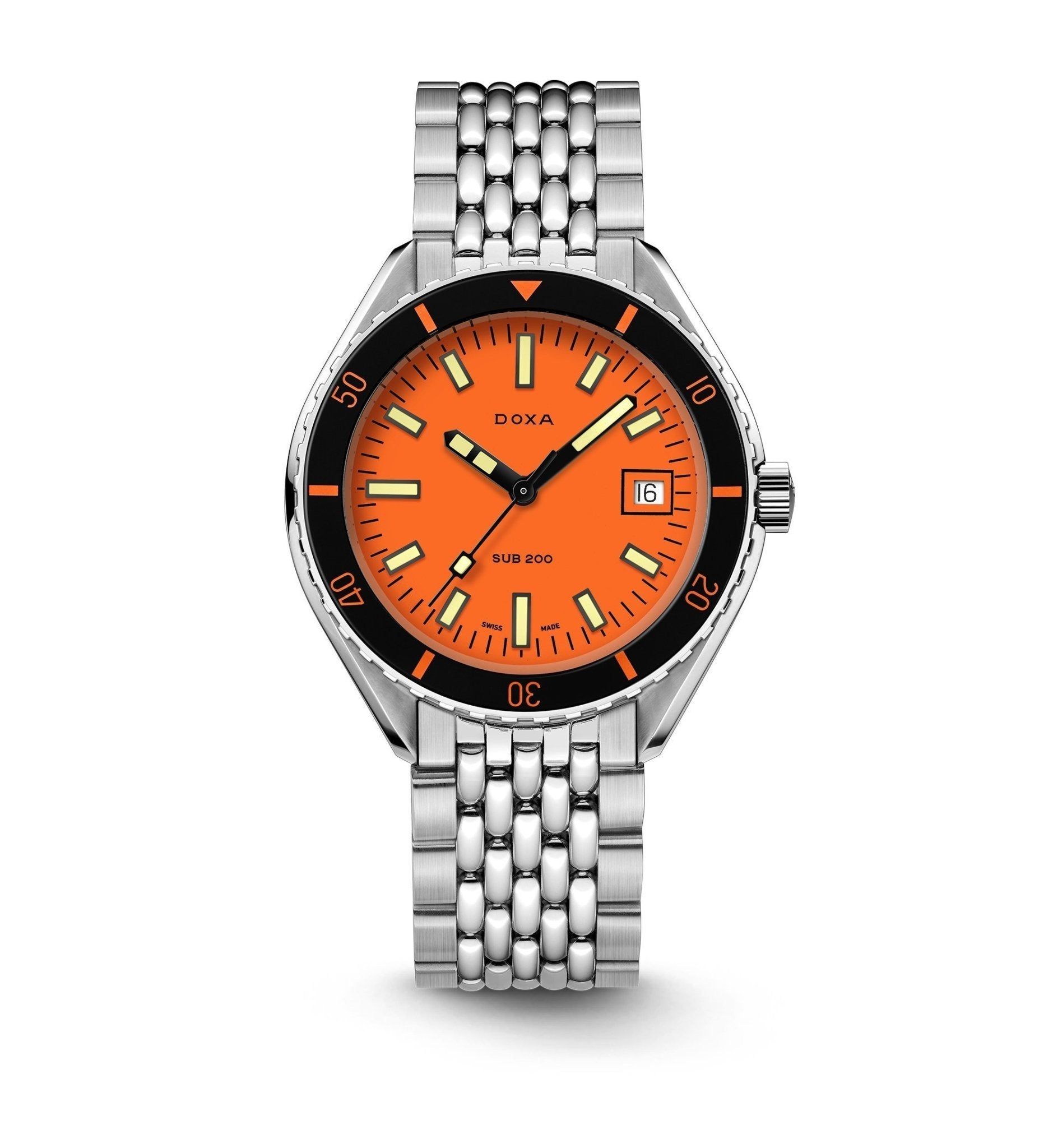
Doxa SUB 200: The Accessible Everyday Diver
By Zach Charles • October 10, 2026
Complete guide to the Doxa SUB 200 — 42mm, 200m, four colorways, Sellita SW200-1. The accessible entry to the Doxa SUB family with the full…

By Zach Charles • October 10, 2026
The Breitling Top Time B01 Aston Martin DB5 pairs a cushion-shaped 41mm case, a wooden inner ring and the in-house Caliber 01 across three limited…
By Zach Charles • October 10, 2026
TAG Heuer developed the Mikrograph (2011, 1/100th second), Mikrotimer Flying 1000 (2011, 1/1000th second), and Mikrogirder (2012, 1/2000th second).

Doxa SUB 1500T: The 1,500-Metre Depth-Rating Flagship
By Zach Charles • October 10, 2026
Complete guide to the Doxa SUB 1500T — 45mm, 1,500m depth rating, helium escape valve, ETA 2892-2 movement, USD 2,690.

Audemars Piguet Royal Oak 'Jumbo' ref. 15202 with blue tapisserie dial and integrated steel bracelet
By Zach Charles • October 10, 2026
The Audemars Piguet × Swatch Royal Pop is a $400 bioceramic pocket watch in 8 colourways, powered by a new hand-wound SISTEM51 with 90+ hour power…

Time on the Move logo
By Zach Charles • October 10, 2026
Zach Charles is the editor of Time on the Move, an independent watch reference covering brand and model histories, buying guides and release news…

Omega Speedmaster Professional 'Moonwatch' chronograph, front view on steel bracelet
By Zach Charles • October 9, 2026
Find the best watches at every price point from $500 to $15,000 — new and pre-owned. Covers every budget tier with specific reference picks, brand…
By Zach Charles • October 9, 2026
The latest watch news: new releases, Watches and Wonders coverage, discontinuations, industry analysis, and market trends. Currently 1 article.

Seiko's New Panda Chronograph Is Literally a Panda: The Power Design Project HHK001 and HHK002
By Zach Charles • October 8, 2026
Seiko's Power Design Project panda chronograph (HHK001, HHK002) turns the panda dial into an actual panda face, with ear pushers, a 'Sasameter' and a 3D…
Show More