
Audemars Piguet Royal Oak: History of the Luxury Sports Watch
Royal Oak: History of the Watch That Changed Luxury
The watch that changed luxury watchmaking was drawn in a single night. That fact is genuine, verified across multiple accounts, and still astonishing: the design that would become the most influential sports watch in Swiss watchmaking history began as an overnight commission with no time for deliberation, iteration, or second-guessing. Gérald Genta sat down in the evening with a brief and produced a complete sketch before morning. The watch that sketch became is the reason Audemars Piguet is still operating today, and the reason every luxury steel sports watch made since 1972 is evaluated against the same standard.
Understanding the Royal Oak requires understanding what it was arguing against — what "luxury" meant in 1971, what "sports watch" meant, and why combining those two words in the context of a steel case at a price above a gold Patek Philippe was not merely unusual but genuinely scandalous.
Photo: OpaleHorse — CC BY-SA 4.0 — Wikimedia Commons
The Overnight Commission — What Actually Happened
Photo: EMore98 — CC BY-SA 4.0 — Wikimedia Commons
The timeline here matters, because it is frequently misreported.
Georges Golay, Audemars Piguet's managing director, received word from the Italian market that AP needed to present "an unprecedented steel watch" at the upcoming Basel Watch Fair. He telephoned Gérald Genta — already the most respected watch designer in Switzerland, responsible for dozens of significant designs — on the afternoon before a key presentation, in late 1970 or very early 1971. The Basel fair where the watch publicly launched was April 1972 . The overnight design commission preceded that launch by over a year of development and production preparation.
The correct editorial formulation: Genta designed the Royal Oak overnight in late 1970 or early 1971. It launched at Basel in April 1972. Sources that state "Genta designed it overnight at Basel 1972" are conflating the design date with the launch date. The overnight story is real. The year is imprecise in most published accounts.
Genta's stated inspiration was the bronze helmet of a deep-sea scaphander — the hard-hat diving equipment used by industrial divers working the Rhône River dams near Geneva. The helmet was bolted at its rim by visible screws. Genta transferred the concept to a watch bezel: octagonal form, eight visible screws in hexagonal form, the bolted appearance of functional underwater equipment applied to a luxury wristwatch.
Before settling on "Royal Oak" — the name of the ship that sheltered King Charles II after the Battle of Worcester in 1651 — AP considered several alternatives: Safari, Colorado, Kilimanjaro, Grand Prix. The Royal Oak name was chosen by September 1971.
The Reference 5402ST — Why It Was Radical
Photo: OpaleHorse — CC BY-SA 4.0 — Wikimedia Commons

The Royal Oak launched at the 1972 Basel Watch Fair as reference 5402ST. It was stainless steel. It was priced at approximately CHF 3,300 — more expensive than comparable gold dress watches from Patek Philippe. It was 39mm in an era when dress watches typically measured 34–36mm. And it was, in the eyes of the Swiss watch trade, an act of commercial insanity.
The logic of luxury watchmaking in 1971 was inseparable from material hierarchy: gold communicated value, steel communicated practicality. A steel watch cost less, in all respects, than a gold one — in materials, in perception, and in price. Rolex had been building steel sports watches for decades, but the Submariner retailed at a fraction of gold dress watch prices. Nobody had suggested a steel watch should cost more than a gold watch.
The 5402ST made exactly that argument.
The key specifications:
- Case: 39mm diameter, 7.15mm thick, stainless steel monocoque (one-piece middle case — the movement was inserted from the front)
- Bezel: Octagonal, with eight
hexagonal white-gold screws whose slots must be perfectly aligned, a quality-control detail AP used as a visual mark of craftsmanship
- Dial: "Petite Tapisserie" guilloché — a fine-grain square grid produced on a rose engine, one dial at a time, by hand
- Bracelet: Integrated, designed by Gay Frères; 154 hand-finished components with alternating brushed and polished surfaces
- Movement: Calibre 2121, the ultra-thin automatic derived from the JLC Cal. 920 ebauche
- Price: Approximately CHF 3,300 (sources vary slightly — CHF 3,300 appears most frequently in authoritative references)
The reception was cold. Dealers found the watch difficult to sell. The market did not immediately understand what was being offered.
The Tapisserie — Why It Exists
Photo: EMore98 — CC BY-SA 4.0 — Wikimedia Commons

The tapisserie dial is not a decoration applied to make the Royal Oak distinctive. It is the visual solution to a specific problem.
A 39mm steel watch with a clean dial and no obvious complications risks looking like a tool watch. The tapisserie guilloché — produced on a traditional rose engine, one dial at a time, requiring the machine operator's continuous manual control — provides the visual density and craft evidence that signals the watch's price tier without complications that would compromise the ultra-thin case. You are looking, when you look at a tapisserie dial, at hours of hand work. The pattern proves it.
There are three distinct tapisserie patterns in the Royal Oak family:
- Petite Tapisserie:
The original fine-grain square grid, used on the Jumbo
references (5402, 14802, 15002, 15202, 16202). The most labour-intensive to produce.
- Grande Tapisserie:
Introduced later; squares are approximately 50% larger. Used on the 41mm date references (15300, 15400, 15500).
- Mega Tapisserie:
Found on Offshore
models. Produced by stamping rather than guilloché engraving — a different process.
Calibre 2121 — The Movement That Made It Possible
Photo: EMore98 — CC BY-SA 4.0 — Wikimedia Commons
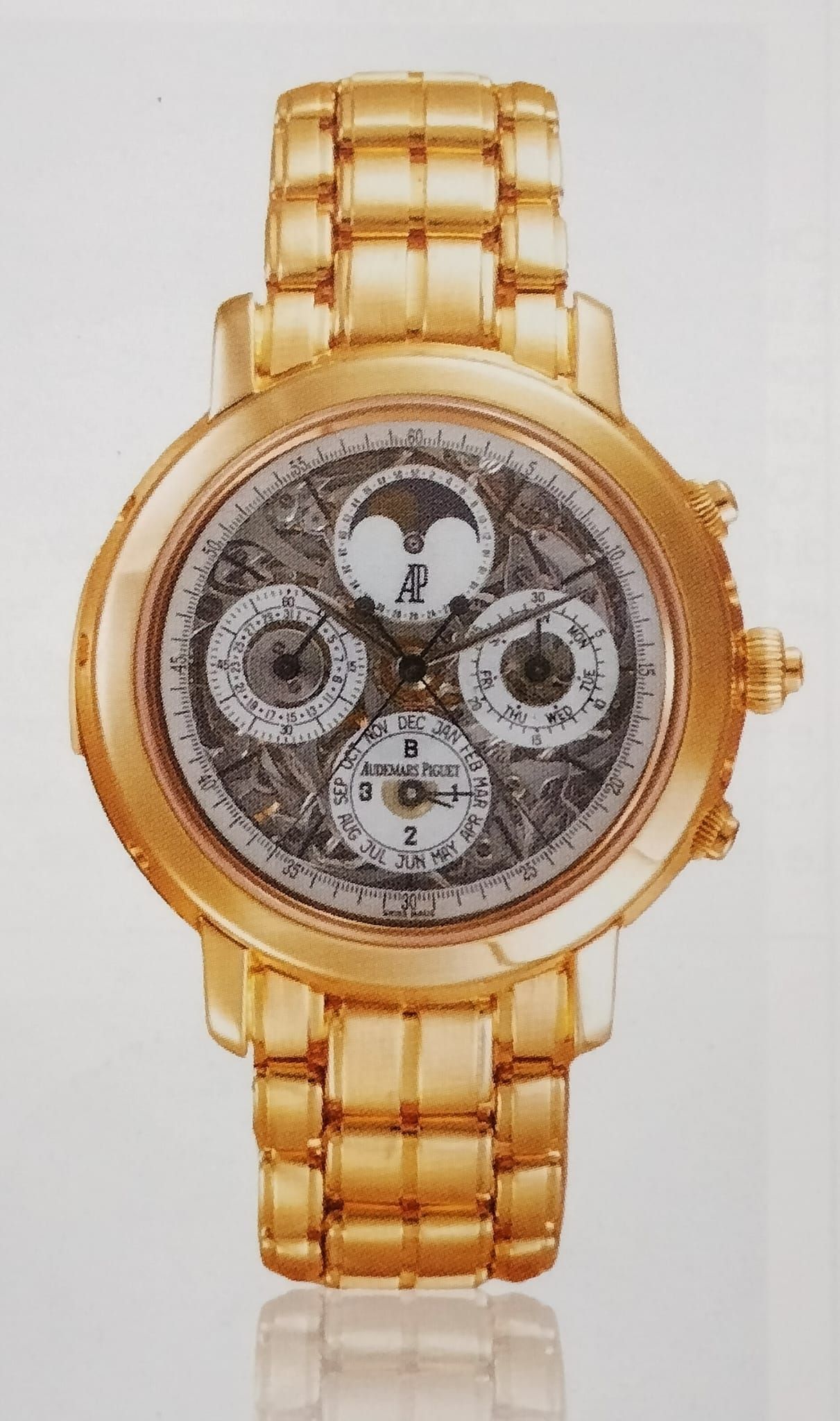
The Royal Oak's ultra-thin case — 7.15mm overall — required an ultra-thin movement. The Calibre 2121 (2.45mm including the rotor; 3.05mm with date mechanism) was at its introduction the thinnest automatic movement with a central rotor and date complication in production.
Its origins involve a three-way collaboration. JLC designed the base ebauche — designated Cal. 920 in JLC's own numbering — as a simultaneous commission for three clients: Audemars Piguet, Patek Philippe, and Vacheron Constantin, introduced in 1967. Each house applied its own decoration, finishing standards, and calibre designation:
- AP: Cal. 2120 (time-only) and Cal. 2121 (with date) — used in the Royal Oak
- Patek Philippe: Cal. 28-255 and variants
- Vacheron Constantin: Cal. 1120 and 1121
The AP version is finished to AP's standards. The 19,800 vph beat rate is slower than modern movements (typically 28,800 vph) — a collector talking point, because slower beat rates were traditionally associated with durability and the movement appears to tick more deliberately when viewed through the sapphire caseback.
No running seconds hand. The Calibre 2121 does not drive a centre seconds hand. The Royal Oak Jumbo has hours, minutes, and date — nothing more. This is a feature, not a limitation: a seconds hand crossing the tapisserie dial would optically disrupt its pattern. The absence communicates aesthetic discipline, not mechanical compromise.
The Royal Oak Family — A Map
Photo: Clyde94 — CC BY-SA 4.0 — Wikimedia Commons
The original 5402ST gave rise to a collection that now covers more than twenty distinct references across multiple case sizes, movements, and complications. Understanding the family requires knowing which watches are which:
The Jumbo line (39mm, ultra-thin): 5402 → 14802 → 15002 → 15202 → 16202. The direct lineage from the original. See the dedicated Jumbo article for the complete reference history.
The 41mm date references: 15300ST (Cal. 3120, approximately 2005–2012) → 15400ST (Cal. 3120, approximately 2012–2019) → 15500ST (Cal. 4302, 2019–present). Larger case, Grande Tapisserie dial, more contemporary movement specifications. Currently the highest-volume Royal Oak references in production.
The Royal Oak Offshore(42mm+, chronograph): A distinct sub-family launched in 1993. Crown guards, rubber pushers, Mega Tapisserie dials. Not a larger Royal Oak — a different brief and design.
The Royal Oak Perpetual Calendar: AP's perpetual calendar mechanism in the Royal Oak case. Among the most technically significant references in the collection.
The Royal Oak Concept: The R&D showcase. Skeletonized, avant-garde materials, ultra-high complications.
Secondary Market and Collector Dynamics
The Royal Oak secondary market is among the most discussed in watchmaking. Understanding it requires separating the different sub-families:
The Jumbo (15202ST/16202ST): The 15202ST was discontinued in 2022 with the introduction of the 16202ST. At discontinuation, secondary market prices for 15202ST reached approximately CHF 55,000–70,000+ against a retail price of approximately CHF 25,000. The 16202ST (current production) retails at approximately CHF 32,400 and trades at meaningful premiums due to allocation constraints.
The 15500ST (41mm): Current production, more widely available than the Jumbo. Secondary market prices of approximately CHF 30,000–38,000 against a retail around CHF 22,000–24,000.
Vintage 5402ST: Original references in collector-grade condition — particularly the earliest "A" series casebacks — trade at exceptional premiums reflecting rarity and historical significance.
Latest News
Frequently Asked Questions
When was the Royal Oak designed?
Gérald Genta designed the Royal Oak in a single overnight session in late 1970 or very early 1971. It launched at the Basel Watch Fair in April 1972. The design and the launch are not the same date — sources that say "designed overnight at Basel 1972" are conflating the two events.
How many screws does the Royal Oak bezel have?
Eight. The octagonal bezel has eight hexagonal white-gold screws whose slots must be aligned perfectly — horizontal for top and bottom, vertical for sides. The alignment is a quality-control detail that AP uses as a visual mark of craftsmanship.
Is there a no-date Royal Oak?
Not in the standard production lineup. All Jumbo references (5402, 14802, 15002, 15202, 16202) have a date at 3 o'clock. What distinguishes the Jumbo from the 41mm references is not the absence of a date — it is the 39mm case, ultra-thin Calibre 2121/7121, and Petite Tapisserie dial in the direct lineage of the original 5402.
What movement does the Royal Oak use?
The 39mm Jumbo references use Calibre 2121 (vintage and 15202ST) or Calibre 7121 (current 16202ST). The 41mm references use Calibre 3120 (15300, 15400) or Calibre 4302 (15500). These are distinct movements — the Calibre 2121/7121 is ultra-thin at 3.05mm; the Calibre 4302 is thicker but more modern in specification.
Why is the Royal Oak so sought-after on the secondary market?
Demand substantially exceeds production. AP deliberately limits output to maintain quality standards — each watch requires exceptional finishing time. The tapisserie dials are rose-engine produced one at a time. The integrated bracelet involves 154 hand-finished components. The combination of low production volume, high demand, and genuine manufacturing complexity creates the conditions for secondary market premiums.