
A. Lange & Söhne Richard Lange: Observatory Precision Watches

Zach Charles • May 24, 2026

Share this article

A. Lange & Söhne Richard Lange: Precision Timekeeping

Richard Lange (17 December 1845 — 1932) was the son of A. Lange & Söhne's founder Ferdinand Adolph Lange and one of the most significant precision watchmakers of his era. Born ten days after his father established the company in Glashütte, he joined the firm that bore his name, eventually filed 27 patents , and in 1931 — at the age of 85 — developed a beryllium alloy balance spring that was a direct precursor to Nivarox, the material used in virtually all modern balance springs.

The Richard Lange collection, introduced in 2006 , references the precision timekeeping tradition that Richard Lange embodied — observatory chronometry, the measurement of seconds to fractions, the watch as scientific instrument.


A. Lange & Söhne manufacture building, Glasütte
The A. Lange & Söhne manufacture in Glasütte, Saxony — the town that Ferdinand Adolph Lange chose in 1845 to re-establish German precision watchmaking, and where the Lange factory was re-founded on 7 December 1990 after the communist era.
Photo: Derbrauni — CC BY 4.0 — Wikimedia Commons

The Observatory Tradition

A. Lange & Söhne Grande Complication pocket watch No. 42.500
An A. Lange & Söhne Grande Complication pocket watch (No. 42.500) — one of the most complex timepieces from the Glasütte manufacture, demonstrating the movement-finishing traditions that define Lange’s horological identity.
Photo: Ventus55 — CC BY-SA 4.0 — Wikimedia Commons
Richard Lange's watchmaking focused on precision rather than complication in the decorative sense. Observatory trials — competitions among chronometers submitted to naval and scientific observatories for accuracy testing — were the relevant benchmark of the late 19th and early 20th century. A precision pocket chronometer needed consistent rate over temperature changes, positions, and extended running periods.

The Richard Lange collection carries this identity into the wristwatch: no unnecessary complications, a dial optimised for reading fractions of seconds (the time display is large, the hands are clearly legible, the subsidiary seconds at 6 is prominent), and movement finishing to the highest Lange standard.

The most distinctive technical feature of the base Richard Lange: it is the only Lange collection that displays the centre seconds directly via a dual-idler gear system — the running seconds hand sweeps at the centre of the dial, a layout associated with observatory chronometers, achieved through an additional gear train that does not alter the regulation of the base movement.

Calibre L041.2 (base Richard Lange):
- Parts: 199
- Jewels: 26
- Frequency: 21,600 vph


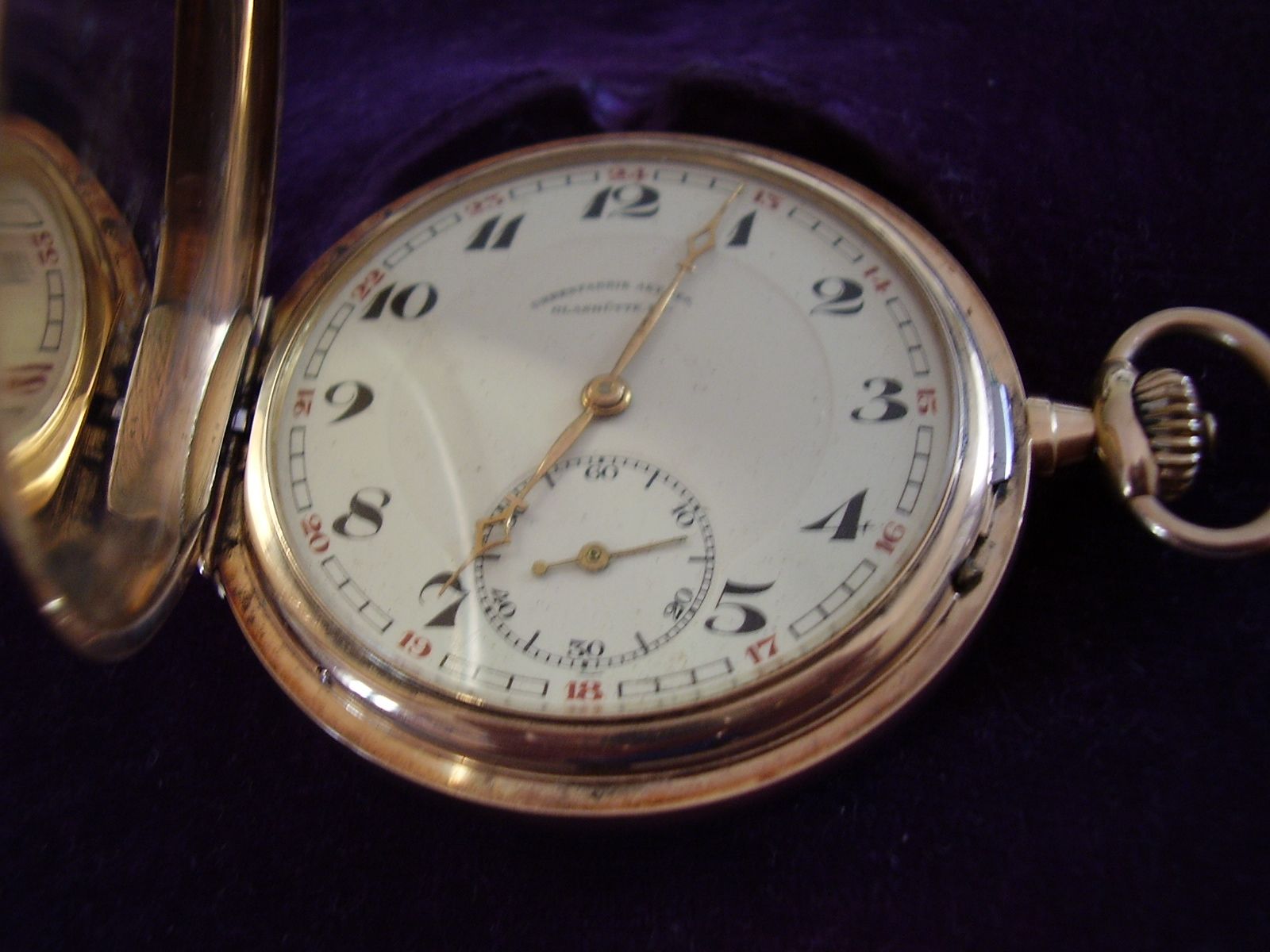
Golden pocket watch — Glasütte precision tradition
A golden Glasütte pocket watch from the Lange & Söhne tradition — evoking the observatory precision conventions that Richard Lange’s Glasütte observatory work brought to Lange’s calibre development in the late 19th century.
Photo: Werneuchen — Public Domain — Wikimedia Commons

Richard Lange Tourbillon Pour le Mérite — 2011

Golden pocket watch from Glasütte, A. Lange & Söhne
A golden Glasütte pocket watch from the Lange & Söhne tradition — exemplifying the three-quarter plate, Glasütte stripe finishing, and hand-engraved balance cock that have characterised Lange movements since the 1845 re-founding.
Photo: Werneuchen — Public Domain — Wikimedia Commons

The Richard Lange Tourbillon Pour le Mérite (introduced 2011 ) combines the observatory timekeeping identity of the Richard Lange with a fusée-and-chain transmission — the mechanism that gives A. Lange & Söhne's Pour le Mérite designation its meaning.

The fusée-and-chain equalises the torque delivered by the mainspring throughout its unwinding. As a mainspring unwinds, it delivers progressively less force; the conical fusée's geometry compensates, maintaining constant torque to the gear train. The result is consistent driving force from first wind to last.

Lange's fusée-and-chain is assembled from 636 individual parts , is 152 mm long and 0.5 mm wide , weighs 0.12 grams , and is strong enough to lift 2 kilograms. Each chain is assembled by hand.

Combined with the tourbillon — which corrects for gravitational error in the escapement by continuously rotating the entire escapement assembly — the Pour le Mérite produces what is, in principle, the most accurate possible mechanical timekeeping: constant-force delivery to a gravity-correcting escapement.


Richard Lange Perpetual Calendar "Terraluna" — Calibre L096.1

A. Lange & Söhne manufacture, Glasütte — exterior view
The A. Lange & Söhne manufacture exterior in Glasütte — the facility that produces approximately 5,000 watches per year across the Lange 1, Saxonia, 1815, and Zeitwerk collections, each assembled twice and then disassembled for final movement finishing.
Photo: Derbrauni — CC BY 4.0 — Wikimedia Commons
The Richard Lange Perpetual Calendar "Terraluna" , introduced 2014 , represents the apex of the Richard Lange collection and one of the most technically distinguished astronomical watch movements in current production.

Calibre L096.1:
- Diameter: 37.3 mm
- Thickness: 11.1 mm
- Parts: 787
- Jewels: 80
- Frequency: 21,600 vph
- Power reserve: 14 days (two mainspring barrels)
- Case diameter: 45.5 mm

The 14-day power reserve — via two mainspring barrels — is among the longest in current wristwatch production for a movement of this complexity. The 787 parts support three separate major complications: the perpetual calendar, the orbital moon display, and the base timekeeping.

The Terraluna's Orbital Moon Display

The "Terraluna" name references the centrepiece of the caseback display: an orbital moon — a three-disc astronomical mechanism that models the relationship between Earth, the Moon, and the stars.

The three discs:
1. Earth disc: Represents the rotating Earth, completing one rotation every 24 hours in the counterclockwise direction as viewed from the North Pole — the astronomically correct direction
2. Star disc: 2,160 individual stars, replicating the night sky; rotates at the sidereal rate (one rotation per 29 days, 12 hours, 44 minutes, 9.6 seconds — the lunar period)
3. 24-hour outer ring: A stationary reference ring for reading the Earth disc's position

The moon is displayed on a satellite revolving around the Earth disc, visible from the caseback — the complete geocentric model, animated. The display advances to show the moon's current position relative to Earth across the lunar cycle.

Accuracy: The Terraluna's moon display is accurate to 1 day in 1,058 years without requiring any manual correction to the astronomical display.

The front dial displays the perpetual calendar (day, date, month, leap year) and the phase of the moon as it appears from Earth — a conventional moonphase disc behind a circular aperture.


Richard Lange and the Glashütte Precision Tradition

Richard Lange the man represents a dimension of German watchmaking that receives less attention than the decorative aspects of the three-quarter plate or the hand-engraved balance cock: the contribution to precision timekeeping science.

His 27 patents span rate adjustment systems, balance spring alloys, and other technical improvements to the accuracy of mechanical timekeeping. His 1931 beryllium balance spring development — achieved when he was 85 years old, a year before his death — placed him at the origin of the material science that underpins modern mechanical watch precision.

The Richard Lange collection honours this specifically technical inheritance. It is the collection for buyers who understand that the highest expression of watchmaking is not the most complex display but the most accurate mechanism — and who recognise that Lange's history includes both decorative tradition and scientific rigour.


Frequently Asked Questions

Who was Richard Lange?
Ferdinand Adolph Lange's son, born 17 December 1845 (ten days after the company founding), died 1932. He filed 27 patents and in 1931 developed a beryllium alloy balance spring that was a precursor to Nivarox — the material used in virtually all modern balance springs.

What is the Richard Lange Terraluna?
A Richard Lange Perpetual Calendar with an orbital moon display on the caseback — Calibre L096.1, 787 parts, 80 jewels, 14-day power reserve, 45.5mm case. The orbital display uses three discs to model Earth's rotation and the Moon's orbital position; accurate to 1 day in 1,058 years.

What is the Pour le Mérite?
A. Lange & Söhne's designation for models incorporating a fusée-and-chain transmission — a mechanism equalising mainspring torque delivery throughout the unwinding. Lange's chain is 636 parts, 152mm long, 0.5mm wide, 0.12 grams, hand-assembled.

What is Calibre L041.2?
The base Richard Lange movement: 199 parts, 26 jewels, 21,600 vph. Notable for being the only Lange movement displaying centre seconds via a dual-idler gear system — the observatory chronometer configuration.

When was the Richard Lange collection introduced?
2006. The Tourbillon Pour le Mérite variant followed in 2011; the Perpetual Calendar "Terraluna" (Calibre L096.1) in 2014.


Related Articles

Recent Posts

By Zach Charles • October 10, 2026
Hamilton's American Classic Cushion Mechanical revives its 1926 Art Deco cushion watches, seen in Oppenheimer, in 30mm and 34mm with the new hand-wound…
Doxa SUB 200: The Accessible Everyday Diver
By Zach Charles • October 10, 2026
Complete guide to the Doxa SUB 200 — 42mm, 200m, four colorways, Sellita SW200-1. The accessible entry to the Doxa SUB family with the full…
By Zach Charles • October 10, 2026
The Breitling Top Time B01 Aston Martin DB5 pairs a cushion-shaped 41mm case, a wooden inner ring and the in-house Caliber 01 across three limited…
By Zach Charles • October 10, 2026
TAG Heuer developed the Mikrograph (2011, 1/100th second), Mikrotimer Flying 1000 (2011, 1/1000th second), and Mikrogirder (2012, 1/2000th second).
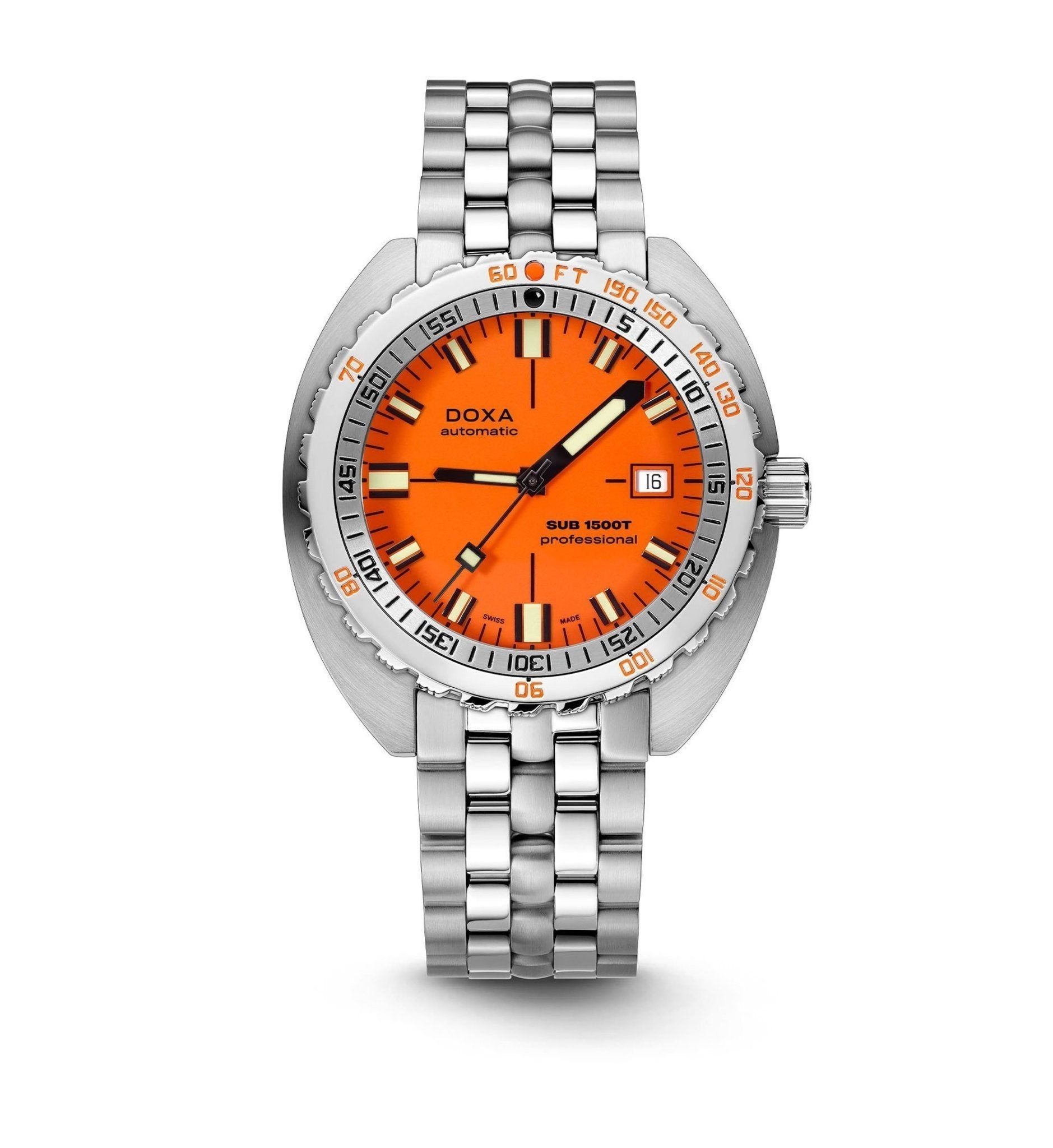
Doxa SUB 1500T: The 1,500-Metre Depth-Rating Flagship
By Zach Charles • October 10, 2026
Complete guide to the Doxa SUB 1500T — 45mm, 1,500m depth rating, helium escape valve, ETA 2892-2 movement, USD 2,690.
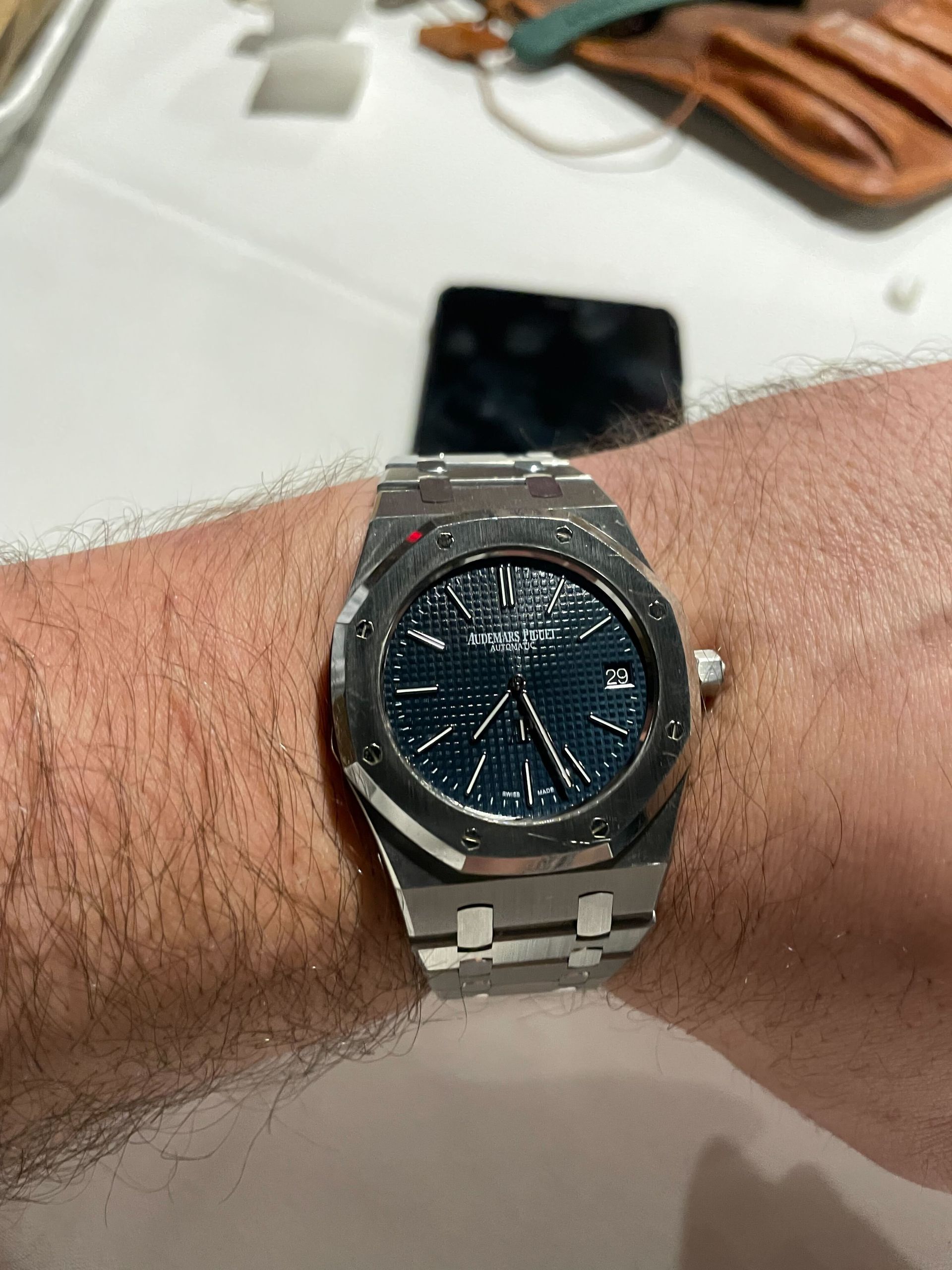
Audemars Piguet Royal Oak 'Jumbo' ref. 15202 with blue tapisserie dial and integrated steel bracelet
By Zach Charles • October 10, 2026
The Audemars Piguet × Swatch Royal Pop is a $400 bioceramic pocket watch in 8 colourways, powered by a new hand-wound SISTEM51 with 90+ hour power…

Time on the Move logo
By Zach Charles • October 10, 2026
Zach Charles is the editor of Time on the Move, an independent watch reference covering brand and model histories, buying guides and release news…
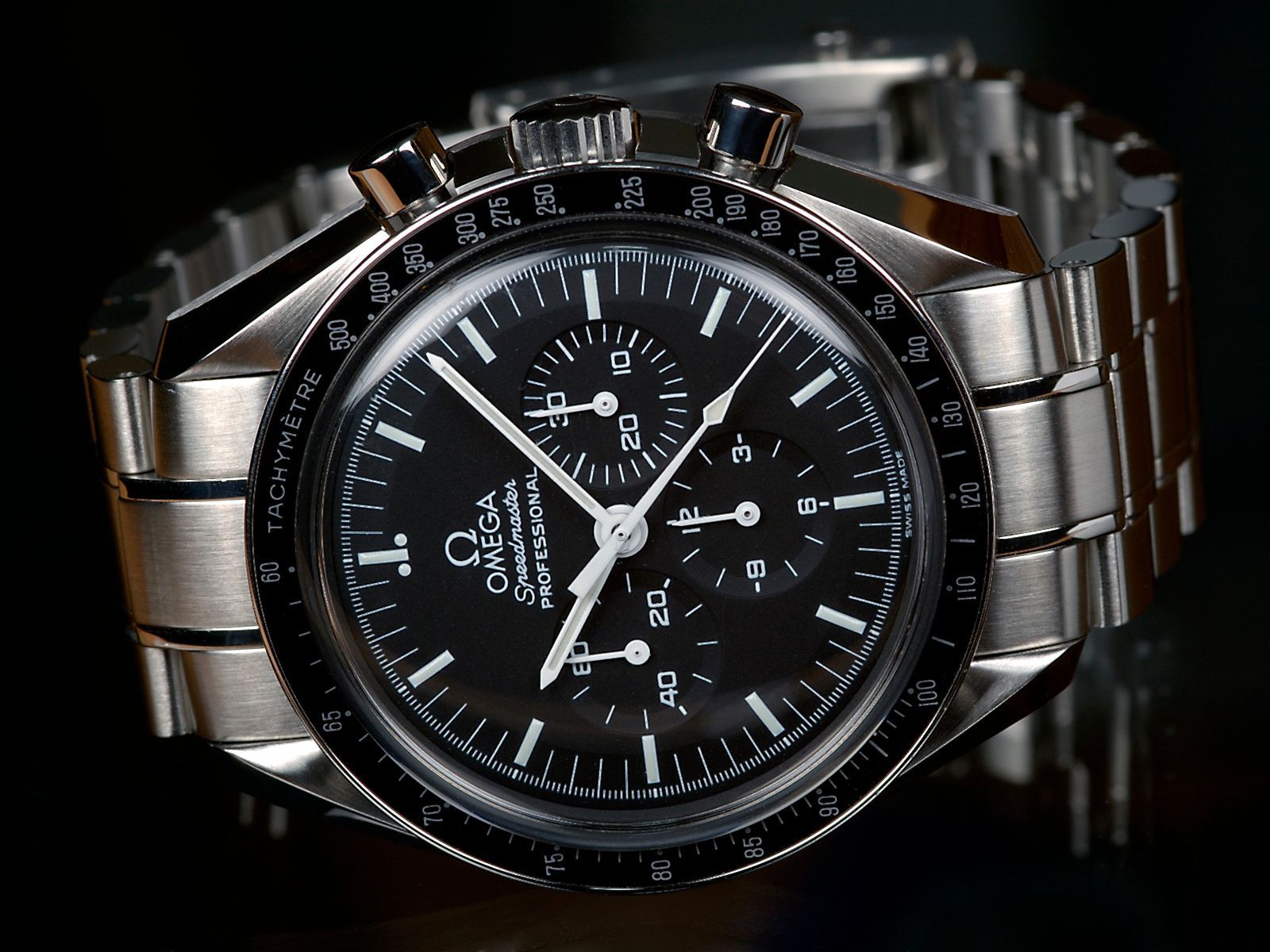
Omega Speedmaster Professional 'Moonwatch' chronograph, front view on steel bracelet
By Zach Charles • October 9, 2026
Find the best watches at every price point from $500 to $15,000 — new and pre-owned. Covers every budget tier with specific reference picks, brand…
By Zach Charles • October 9, 2026
The latest watch news: new releases, Watches and Wonders coverage, discontinuations, industry analysis, and market trends. Currently 1 article.
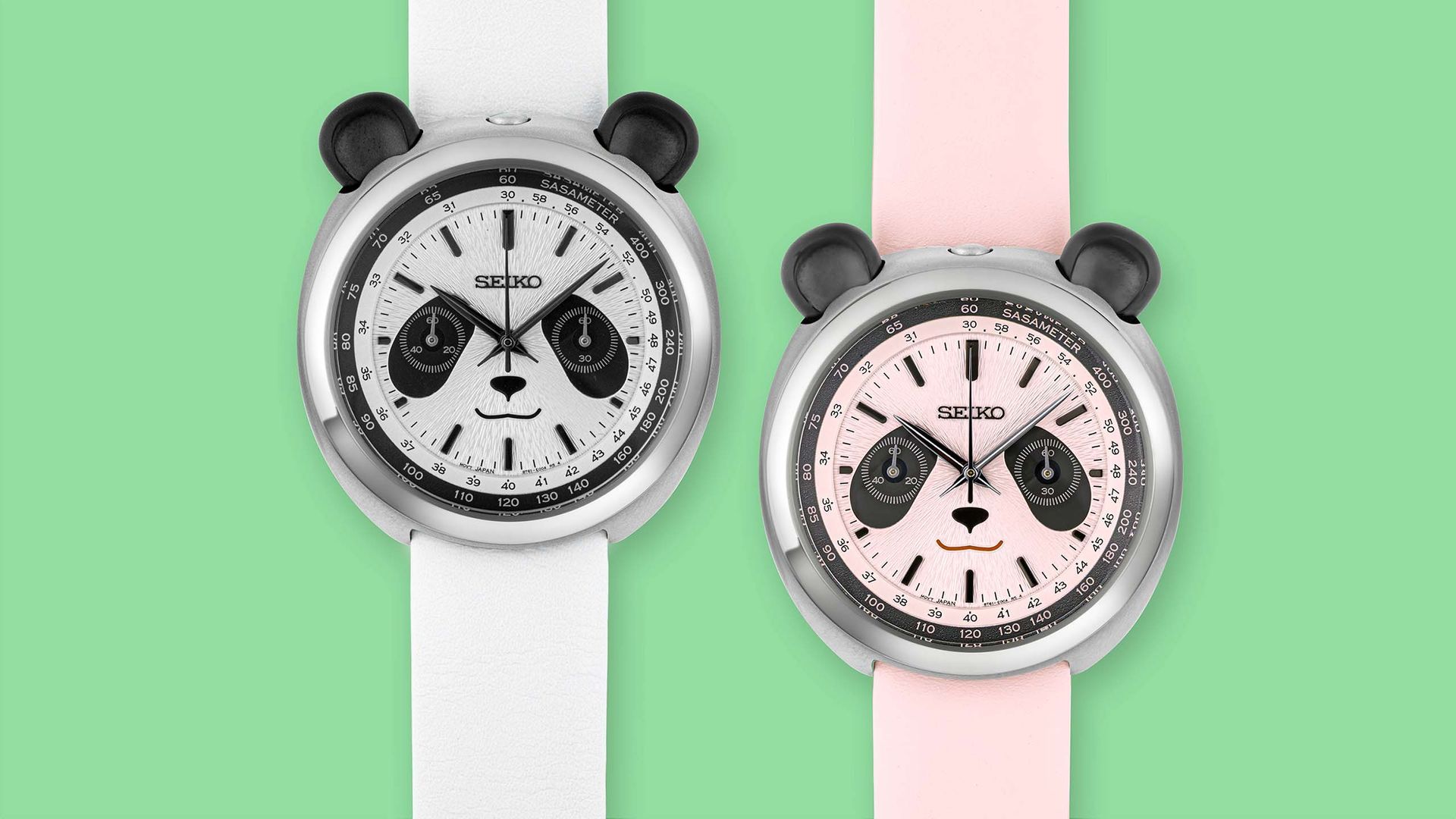
Seiko's New Panda Chronograph Is Literally a Panda: The Power Design Project HHK001 and HHK002
By Zach Charles • October 8, 2026
Seiko's Power Design Project panda chronograph (HHK001, HHK002) turns the panda dial into an actual panda face, with ear pushers, a 'Sasameter' and a 3D…
Show More