
Seiko Astron: The 1969 Quartz Revolution and GPS Solar

Zach Charles • August 1, 2026

Share this article

Seiko Astron: GPS Solar and the World's First Quartz Watch

The name Astron has been used twice in Seiko's history, and both uses represent milestones in the same ongoing project: building the most accurate wristwatch it is technically possible to build. In 1969, the Astron was the world's first commercial quartz wristwatch — accurate to within five seconds per month. In 2012, the Astron was the world's first GPS Solar watch — accurate to within a fraction of a second, indefinitely, as long as it can see the sky. The distance between these two milestones is 43 years of engineering, materials science, and miniaturisation. Both watches carry the same name because they represent the same ambition at different points in its realisation.


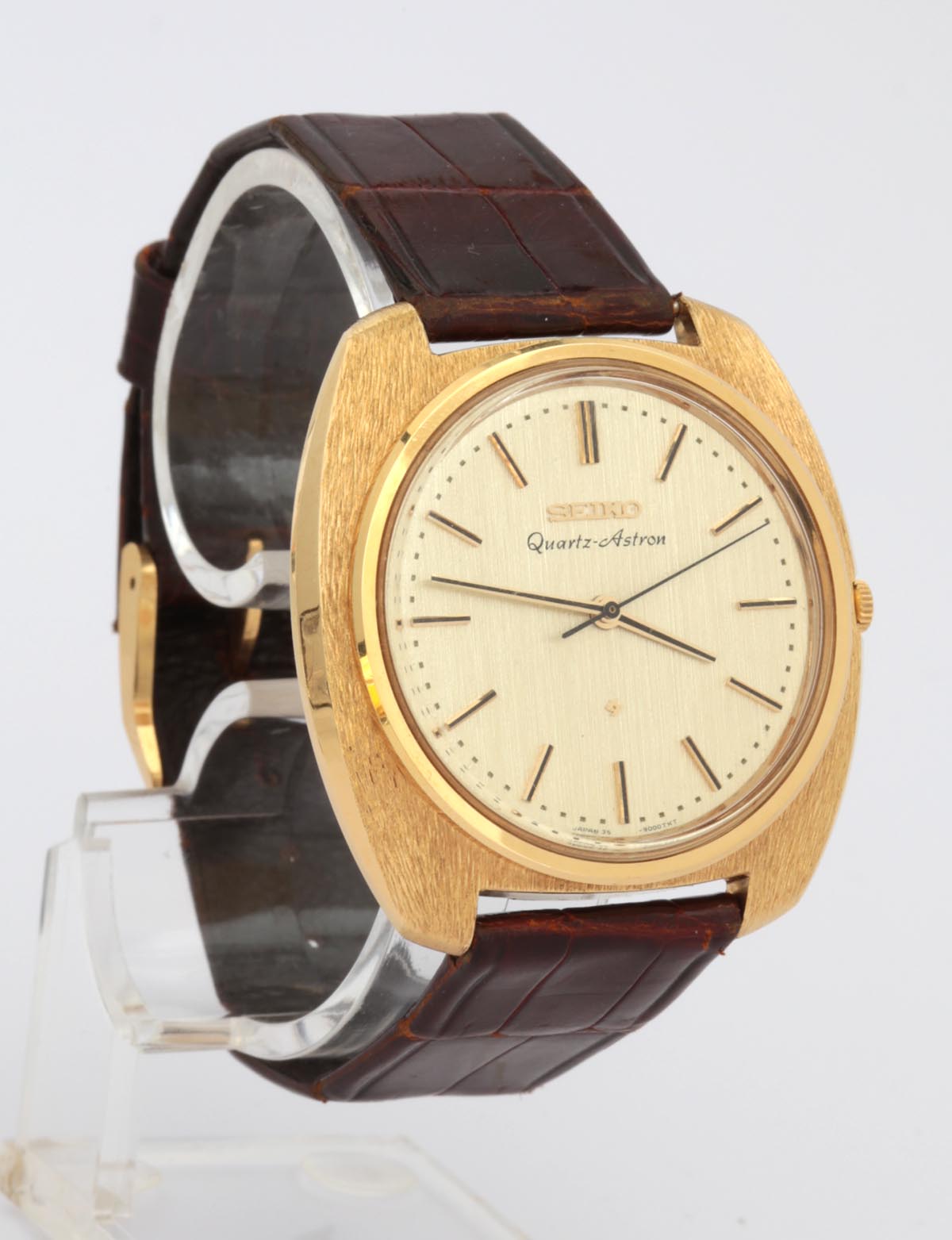
Seiko Astron 35SQ — world's first commercial quartz wristwatch, 1969
The Seiko Astron 35SQ — the world’s first commercial quartz wristwatch, sold on 25 December 1969 in Tokyo at 450,000 yen. Only 100 were made in the first production run.
Photo: Deutsches Uhrenmuseum — CC BY-SA 4.0 — Wikimedia Commons

The 1969 Astron — Quartz-Astron 35SQ

Seiko 6309 calibre — movement of the original Turtle diver
The Seiko 6309 calibre — the automatic movement that powered the original 6309-7040 ‘Turtle’ diver from 1976 and many classic Seiko sport references.
Photo: Les Zetlein — Public Domain — Wikimedia Commons

The Race to Commercial Quartz

By the mid-1960s, multiple organisations understood that a commercial quartz wristwatch was technically achievable. The fundamental physics were known: a quartz crystal's piezoelectric resonance is stable, temperature-compensable, and far more precise than the mechanical oscillation of a balance wheel. The engineering challenge was miniaturisation — reducing quartz oscillator circuits, power-regulating stages, and stepping motor drives to the dimensions and power consumption compatible with a wristwatch battery.

Seiko and the Swiss Centre Electronique Horloger (CEH) consortium were the principal competitors. Seiko's development team, led by Tsuneya Nakamura at Suwa Seikosha, completed the Astron prototype in 1967 — the same year CEH completed their Beta 1 prototype. The race to commercial production would take two more years.

On 25 December 1969 — Christmas Day — Seiko placed the Quartz-Astron 35SQ on sale in Japan. Only 100 watches had been produced for the initial release, of which a portion were sold before year's end. The Swiss Beta 21 appeared at the Basel Fair approximately four months later, in April 1970 .

Seiko had won.

35SQ Specifications

Specification Value
Reference 35SQ (Calibre designation)
Oscillator Quartz, 8,192 Hz
Accuracy ±5 seconds/month
Battery life Approximately 1 year
Case 18-karat solid gold
Price ¥450,000
USD equivalent ~$1,250 (~$10,974 in 2025 dollars)

Context — What ¥450,000 Meant in 1969

The price of ¥450,000 requires context to register properly. The Toyota Corolla E10 , launched in 1966, was priced at ¥432,000 — the Astron cost more than a medium-sized family car. For a mid-level salaryman in 1969 Japan, ¥450,000 represented approximately one year's salary. The watch was not a consumer product in any conventional sense. It was an assertion of technical achievement — a demonstration that the thing was possible — sold in an edition of limited practicality for the purpose of establishing priority.

The significance of the Astron was not the 100 watches sold in December 1969. It was the proof-of-concept that transformed every subsequent watch development decision made by every manufacturer in every country for the following three decades.

The Astron 35SQ is on permanent display at the Smithsonian Institution (National Museum of American History) in Washington D.C. It was designated a Mechanical Engineering Heritage in Japan in 2014.


Seiko 5 SNKA23 — mechanical tradition alongside quartz
The Seiko 5 SNKA23 — representing the mechanical automatic tradition that runs alongside Seiko’s landmark quartz and GPS innovations.
Photo: Ash Crow (Sylvain Boissel) — CC BY-SA 3.0 — Wikimedia Commons

The Modern Astron — GPS Solar (2012)

Seiko Spring Drive 5R86 calibre — disassembled components
The Seiko Spring Drive 5R86 calibre disassembled — the tri-synchro regulator combines mechanical energy with an electromagnetic governor to achieve ±0.5 seconds per day.
Photo: Ferengi — CC BY-SA 3.0 — Wikimedia Commons

Launch

On 27 September 2012 , Seiko released the modern Astron GPS Solar — the world's first GPS Solar watch. The naming choice — reclaiming the 1969 Astron name for a 2012 watch — was explicit: the same ambition, realised at a new level of precision.

How GPS Solar Works

The Astron GPS Solar system operates through a combination of three technologies:

  1. GPS reception : A miniaturised ring antenna embedded under the ceramic bezel receives signals from GPS satellites. GPS satellites transmit precise atomic clock data; the watch uses this signal to correct its timekeeping.

  2. Time zone database : The watch contains an onboard database mapping 1 million geographic squares to their correct time zones. When GPS reception identifies the watch's location, the database provides the correct UTC offset — allowing automatic time zone adjustment across all 39 globally recognised time zones.

  3. Solar power : The dial and bezel surface charge a secondary cell battery. The watch requires no manual charging or battery replacement. If no light is detected for 72 hours, the hands stop and the GPS system suspends — but timekeeping data is maintained for up to 2 years in sleep mode.

The result: a watch that is always on the correct local time, in any time zone, for as long as it receives periodic light exposure.

Calibre Evolution

Calibre Notes
7X series Original 2012 GPS Solar family
3X22 Later generation: world's smallest/thinnest GPS Solar module; 25% power consumption vs. 7X; 50% better GPS reception; ±15 sec/month without GPS sync
3X62 Further development in the current Astron lineup

The 3X22's 25% power reduction was a critical development for the solar charging system: lower power consumption means the watch can remain operational in lower-light environments for longer periods before entering sleep mode.

50th Anniversary — 2019

The Seiko Astron 50th anniversary of the original 1969 launch was marked with:

  • SBXD002 : Limited to 50 pieces , 40.9mm, 18-karat yellow gold, GPS Solar Calibre 3X22 — priced at ¥3.8 million (~$42,000)
  • SBXC023 : Stainless steel anniversary reference at a more accessible price point

The 50-piece limitation of the SBXD002 mirrors the approximate production of the original 1969 Astron — a deliberate reference to the original's rarity.


Seiko Spring Drive 5R86 — bridging mechanical and electronic
The Spring Drive 5R86 calibre — the technology that bridges Seiko’s mechanical watchmaking with the accuracy imperative the Astron first established.
Photo: Ferengi — CC BY-SA 3.0 — Wikimedia Commons

Accuracy Comparison

King Seiko 5246-6000 Hi-Beat Automatic —
King Seiko 5246-6000 Automatic Special Hi-Beat — “Chronometer Officially Certified” — from the era of direct competition between Daini Seikosha and Suwa Seikosha.
Photo: Roland Fischer (Dnalor 01) — CC BY-SA 3.0 AT — Wikimedia Commons
Technology Accuracy
Standard mechanical ±15–30 sec/day
COSC-certified mechanical -4/+6 sec/day
High-quality quartz ±15 sec/month
9F quartz (Seiko) ±10 sec/year
Astron GPS Solar (without GPS sync) ±15 sec/month
Astron GPS Solar (with GPS sync) GPS atomic accuracy — effectively zero drift

Frequently Asked Questions

What was the Seiko Quartz-Astron?
The world's first commercial quartz wristwatch, released 25 December 1969. Calibre 35SQ, oscillating at 8,192 Hz, accurate to ±5 seconds/month. Case: 18-karat solid gold. Price: ¥450,000 — approximately equivalent to the cost of a Toyota Corolla in 1969.

How does Seiko Astron GPS Solar work?
A ring antenna under the ceramic bezel receives GPS satellite signals, which provide precise atomic clock data. An onboard database of 1 million geographic squares maps the location to the correct time zone. Solar panels on the dial charge the battery. The watch automatically shows the correct local time in any of 39 time zones.

When was the modern Seiko Astron GPS Solar launched?
27 September 2012 — the world's first GPS Solar watch.

Does the Astron GPS Solar need a battery replacement?
No. Solar charging maintains the secondary cell battery. If no light is detected for 72 hours, the watch enters sleep mode (hands stop, GPS suspends) but retains timekeeping data for up to 2 years. Normal operation resumes when the watch is exposed to light.


Related Articles

Recent Posts

By Zach Charles • October 10, 2026
Hamilton's American Classic Cushion Mechanical revives its 1926 Art Deco cushion watches, seen in Oppenheimer, in 30mm and 34mm with the new hand-wound…
Doxa SUB 200: The Accessible Everyday Diver
By Zach Charles • October 10, 2026
Complete guide to the Doxa SUB 200 — 42mm, 200m, four colorways, Sellita SW200-1. The accessible entry to the Doxa SUB family with the full…
By Zach Charles • October 10, 2026
The Breitling Top Time B01 Aston Martin DB5 pairs a cushion-shaped 41mm case, a wooden inner ring and the in-house Caliber 01 across three limited…
By Zach Charles • October 10, 2026
TAG Heuer developed the Mikrograph (2011, 1/100th second), Mikrotimer Flying 1000 (2011, 1/1000th second), and Mikrogirder (2012, 1/2000th second).
Doxa SUB 1500T: The 1,500-Metre Depth-Rating Flagship
By Zach Charles • October 10, 2026
Complete guide to the Doxa SUB 1500T — 45mm, 1,500m depth rating, helium escape valve, ETA 2892-2 movement, USD 2,690.
Audemars Piguet Royal Oak 'Jumbo' ref. 15202 with blue tapisserie dial and integrated steel bracelet
By Zach Charles • October 10, 2026
The Audemars Piguet × Swatch Royal Pop is a $400 bioceramic pocket watch in 8 colourways, powered by a new hand-wound SISTEM51 with 90+ hour power…

Time on the Move logo
By Zach Charles • October 10, 2026
Zach Charles is the editor of Time on the Move, an independent watch reference covering brand and model histories, buying guides and release news…
Omega Speedmaster Professional 'Moonwatch' chronograph, front view on steel bracelet
By Zach Charles • October 9, 2026
Find the best watches at every price point from $500 to $15,000 — new and pre-owned. Covers every budget tier with specific reference picks, brand…
By Zach Charles • October 9, 2026
The latest watch news: new releases, Watches and Wonders coverage, discontinuations, industry analysis, and market trends. Currently 1 article.

Seiko's New Panda Chronograph Is Literally a Panda: The Power Design Project HHK001 and HHK002
By Zach Charles • October 8, 2026
Seiko's Power Design Project panda chronograph (HHK001, HHK002) turns the panda dial into an actual panda face, with ear pushers, a 'Sasameter' and a 3D…
Show More