News
Breitling
Chronomat
Watches & Wonders 2026
Integrated Bracelet
Breitling Chronomat 2026: The Integrated Bracelet Relaunch That Changes Everything
By Zach Charles, Editor, Time on the Move
By Time on the Move
April 8, 2026
• 10 min read
The Breitling Chronomat 2026
collection arrived at Watches & Wonders Geneva
(April 7–11, 2026) with a declaration that Breitling is no longer content to occupy its own lane. Twenty-two new references across three case sizes — 42mm, 40mm, and 36mm — share a single transformative design decision: a fully integrated bracelet
that erases four decades of truncated-lug architecture and puts the Swiss manufacture in direct conversation with some of the most coveted sport-luxury watches ever made.
For collectors and enthusiasts who have tracked Chronomat's history
since the aviator-oriented original debuted in 1984, this is the most architecturally significant update the model has ever received. The silhouette has not merely been refreshed — it has been reimagined from the point where case meets bracelet, in a move that signals Breitling's ambition to compete at the highest level of integrated sport-watch design.
The Design Revolution: Integrated Bracelet and Single-Piece Bezel
The defining characteristic of every Chronomat since its 1984 introduction has been a case architecture built around truncated lugs — short, squared-off protrusions that held the bracelet at a visible remove from the case flanks. That architecture served the watch well through the 1980s and 1990s boom years, giving the Chronomat a muscular, purposeful presence on the wrist. By the mid-2020s, with the market's appetite for seamless, flowing integrated designs reaching an all-time high, those truncated lugs had begun to read as a stylistic limitation rather than a design virtue.
Breitling's solution for the Breitling Chronomat 2026
is thoroughgoing. The new collection replaces the truncated lug structure with a fully integrated bracelet that flows directly from the case flanks — the case and the first bracelet link are designed as a single continuous form, with no visible gap or seam to interrupt the line from dial to wrist. The effect on the wearing experience is immediate: the watch sits lower on the wrist and distributes its weight more evenly.
Equally significant is the redesigned bezel. The previous Chronomat bezel was a complex assembly of 18 individual components. The 2026 collection introduces a single-piece bezel structure, machined from a single billet of steel and locked to the case with a refined click mechanism. The reduction in part count translates directly to a reduction in stack height, contributing meaningfully to the slimmer profiles achieved across all three case sizes.
The iconic Rouleaux bracelet — the rolling, cylindrical-link design that has been a Chronomat signature since the 1980s — is retained but upgraded with a new micro-adjustment concealed folding clasp. The clasp allows up to 5mm of on-the-fly sizing without tools, accommodating the wrist expansion that occurs between morning and evening or between air-conditioned interiors and outdoor heat. The clasp itself is hidden within the bracelet profile when closed, preserving the clean, uninterrupted line of the integrated design.
Breitling Chronomat 2026: The Three Case Sizes Explained
The 22 references in the 2026 Chronomat collection are distributed across three case sizes, each with its own movement and intended positioning.
Chronomat B01 42 — Specifications
| Case diameter |
42 mm |
| Case thickness |
13.77 mm (down from 15.1 mm) |
| Water resistance |
200 m |
| Movement |
Breitling Manufacture Caliber B01 |
| Certification |
COSC Chronometer |
| Power reserve |
~70 hours |
| Chronograph control |
Column wheel |
| Price (from) |
$9,450 |
The Chronomat B01 42
is the collection's flagship. The 42mm steel case is now 13.77mm thick — a reduction of 1.33mm from the outgoing 15.1mm profile, achieved through the combined effect of the new single-piece bezel and an optimised case architecture. The movement inside is the Breitling Manufacture Caliber B01, one of the brand's flagship in-house chronograph calibers. The B01 uses a column wheel to control the chronograph mechanism — a more precise and longer-lasting architecture than older cam-and-lever systems. COSC certification requires the movement to perform within −4/+6 seconds per day across a 16-day testing protocol at multiple temperatures and orientations.
B31 Automatic 40 — Specifications
| Case diameter |
40 mm |
| Case thickness |
10.99 mm |
| Lug width |
18.05 mm |
| Water resistance |
200 m |
| Movement |
Breitling Manufacture Caliber B31 |
| Price (from) |
$7,200 / £5,250 |
The B31 Automatic 40 is the everyday three-hand-with-date proposition in the 2026 lineup. At 40mm and 10.99mm thick, it achieves the lowest profile of the trio on any absolute measurement. The Breitling Manufacture Caliber B31 is an in-house automatic movement developed specifically for three-hand Chronomat applications. Unlike the B01 chronograph, the B31 does not carry COSC certification, but its manufacture status ensures quality control that externally sourced base movements cannot match.
Automatic 36 — Specifications
| Case diameter |
36 mm |
| Case thickness |
9.68 mm |
| Lug width |
16.05 mm |
| Water resistance |
100 m |
| Movement |
Breitling Caliber 10 |
| Certification |
COSC Chronometer |
| Power reserve |
42 hours |
| Price (from) |
$5,950 |
The Automatic 36 is the most accessible entry point at 9.68mm thick. The 100m water resistance — lower than the 200m rating of the two larger models — reflects the thinner case architecture rather than any compromise in build quality. Starting from $5,950, the Automatic 36 represents the most attainable way to own a COSC-certified Swiss manufacture watch with the 2026 Chronomat's integrated bracelet architecture.
Is the Breitling Chronomat 2026 a Genuine Royal Oak Rival?
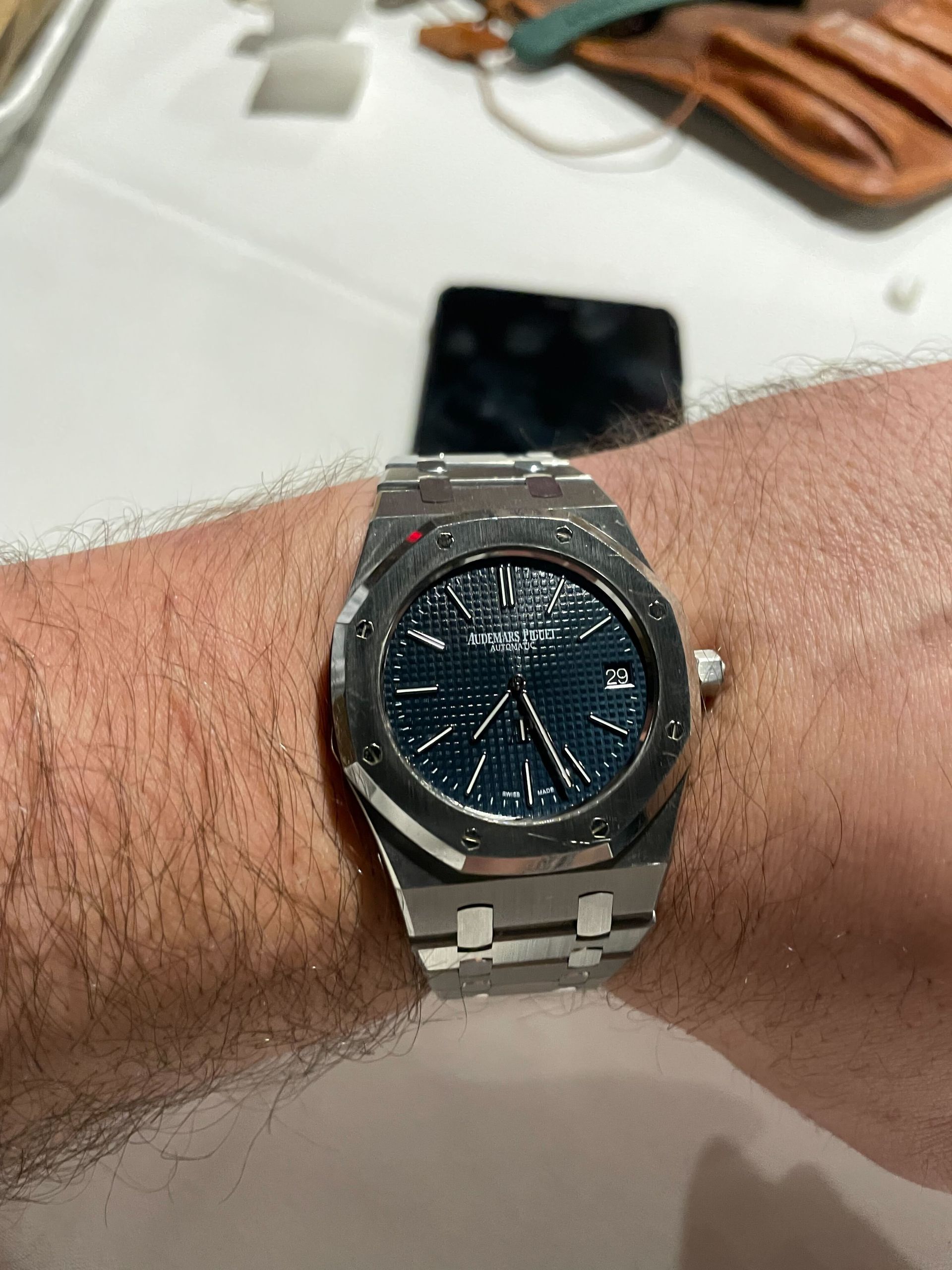
The question that hovered over every conversation on the Watches & Wonders Geneva show floor was unavoidable: does the 2026 Chronomat's new integrated bracelet language put Breitling in direct competition with the Audemars Piguet Royal Oak?
The Royal Oak, designed by Gérald Genta and introduced by Audemars Piguet in 1972, invented the integrated sport-luxury language. Its case and bracelet form a single, unbroken architectural statement — the watch that made steel sports watches cost more than gold dress watches. The 2026 Chronomat borrows this fundamental language — case flowing into bracelet — but arrives at it via a different route. Where the Royal Oak's architecture is geometric and defined by its eight exposed screws and chamfered bezel, the Chronomat's identity is rooted in aviation and functional sport. The Rouleaux bracelet links are circular in cross-section, giving the integrated design a more organic, tactile quality.
On the functional specification sheet, the Chronomat makes a credible case. The B01 42's COSC-certified chronograph with 200m water resistance at $9,450 compares favourably to entry-level Royal Oak pricing, which currently begins above $25,000 for the basic three-hand steel reference — without chronograph function. Breitling is not trying to replace the Royal Oak. It is broadening the competitive set in which the Chronomat is considered.
Context: Breitling's Horological Legacy and the Chronomat's Place in It
To understand why the 2026 relaunch carries the weight it does, it helps to understand the broader context of Breitling's horological history. The company was founded in 1884 by Léon Breitling in Saint-Imier and built its reputation through the twentieth century on professional instruments for pilots and divers — watches designed to be used under operational conditions. The Chronomat's history
begins with the 1984 reference, developed in collaboration with the Frecce Tricolori Italian Air Force aerobatic display team.
The 2026 relaunch also reflects Breitling's broader portfolio strategy. The Navitimer
remains the brand's core aviation identity with its circular slide rule bezel. The Superocean
anchors the dive-watch offering. By transforming the Chronomat into the brand's sport-luxury integrated design flagship, Breitling creates a clearer three-pillar structure: Navitimer for aviation heritage, Superocean for professional diving, Chronomat for contemporary integrated sport-luxury.
The 22 references launched at Watches and Wonders 2026
cover a wide range of dial configurations, metal combinations, and strap options — enough variety to suggest that Breitling intends the new Chronomat architecture to serve as the foundation for years of reference evolution. If collector reception matches the enthusiasm generated on the Geneva show floor, it may prove to be the most consequential product decision the manufacture has made since the 1984 original.
Frequently Asked Questions
What is the price of the Breitling Chronomat B01 42 in 2026?
The Chronomat B01 42
starts from $9,450
in stainless steel. This is the flagship 42mm chronograph powered by the COSC-certified Breitling Manufacture Caliber B01 with approximately 70 hours of power reserve.
What changed in the 2026 Breitling Chronomat design?
The most significant change is the move to a fully integrated bracelet
, replacing the truncated lug architecture that had defined the Chronomat since 1984. The bezel is now a single-piece structure (down from 18 pieces), all three case sizes are slimmer than their predecessors, and the Rouleaux bracelet features a new micro-adjustment concealed folding clasp.
Is the 2026 Breitling Chronomat B01 COSC certified?
Yes. The Chronomat B01 42
is powered by the Breitling Manufacture Caliber B01, which holds COSC chronometer certification
(−4/+6 seconds per day). The Automatic 36
is also COSC-certified via Breitling Caliber 10. The B31 Automatic 40 uses the in-house Caliber B31 but does not carry COSC certification.
How does the 2026 Chronomat compare to the Audemars Piguet Royal Oak?
Both watches now share the integrated bracelet design language pioneered by Gérald Genta's 1972 Royal Oak. The Chronomat retains a sport-aviation identity with COSC-certified chronograph and 200m water resistance, starting from $9,450 — well below the Royal Oak's entry price above $25,000 for the basic three-hand steel reference without chronograph function.